This Marine One Test Helicopter Was Brought Back From The Dead这架海军陆战队一号测试直升机死而复生
The old chopper started out life flying President Nixon and thanks to some creative maintainers at HX-21 it's back in the air once again.
Updated Sep 15, 2017 11:14 PM EDT
It’s always cool to see an old aircraft get a second chance at life, but one that gets a third chance, that’s rare. One unique helicopter with a special history was recently awarded just that.
NVH-3A bureau number 150614 first entered service 45 years ago, in 1972. During its youth it toted around Presidents Nixon and Ford as “Marine One.” It later served with Helicopter Combat Support Squadron HC-6 where it got flown heavily. In the early 1980s, after putting some 4,500 hours on its meter, the Sea King was sent to storage at Davis Monthan AFB’s sprawling boneyard.
In the late 1980s “614” was pulled from storage and regenerated to flying status so that it could act as a test aircraft at the Navy’s premier aircraft test center—NAS Patuxent River in Maryland. It lived its second life as a surrogate test aircraft for the fleet of “White Top” VH-3Ds flown by HMX-1. When the President is onboard these aircraft famously go by the callsign “Marine One.”
#614 started out life flying Presidents Ford and Nixon., President Ford Presidential Library
The Presidential airlift mission is extremely dynamic, demanding, and critical to national security. In addition to being flown all around the U.S. and the world to support the President’s travels, VH-3Ds and VH-60Ns based at Naval Support Facility Anacostia have to be ready without notice to grab the President from the White House and whisk him off to a safe location , hopefully before an enemy attack can arrive.
With these factors in mind, the nearly antique VH-3D fleet needs to be reliable and a special maintenance program has been devised and implemented to see that they are. These helicopters are literally “caged off” from their “green top” counterparts in a high security maintenance hangar at HMX-1’s base in Quantico, Virginia. There they get special care and more frequent inspections than pretty much any other helicopters flying today.
On top of that, even though the VH-3Ds are old, they have to be constantly refitted with upgrades to lessen the impact of their increasing age. They also have to be outfitted with the latest survivability capabilities, which include various infrared countermeasures systems. Their communication system also need to stay cutting edge so that the President can stay in contact with the National Command Authority and his cabinet at all times.
The VH-3D will soldier on into the next decade when it along with the VH-60N are slated to be replaced by the VH-92. , AP
All this systems integration work and development of updated operating procedures requires testing, and that’s exactly what NVH-3A “614” did for Air Test and Evaluation Squadron 21 (HX-21) up until 2013.
That year, 614 was assigned to be the test platform for the VH-3D Cockpit Upgrade Program (CUP), which would finally see the VIP Sea Kings receive a modern glass cockpit. In preparation for this work, the helicopter was totally stripped of its avionics, including its wiring harness. Then the program was abruptly cancelled.
By 2014, with 614 now a useless gutted hulk, HX-21’s creative maintainers began putting a plan together to return the four decades old helicopter back to service as the VH-3D fleet would be soldiering on for years to come. This was not a task that maintainers usually do. This type of work usually happens at dedicated depot facilities that concentrate on totally overhauling airframes, not by people who focus on keeping them flying from day to day.
Although some of the parts needed for the resurrection could be ordered from Sikorsky, with the Sea King being out of production for so long, many elements required for the restoration simply didn’t exist, so the HX-21 team built them from scratch. Over 200 parts were custom machined so that 614 would have a chance at flying again, and each one had to go through a stringent engineering approval process.
While the team from HX-21 was basically rewiring the entire airframe, they also updated many of the helicopter’s other major components. This would allow 614 to better represent the VH-3Ds flying operationally with HMX-1 than it ever did in the past.
Along with updated avionics, which were still made up largely of “steam gauges,” the helicopter’s rotors, drivetrain, turbine engines, landing gear, and fuel system were all replaced with the latest standard equipment. One element that didn’t get touched was the helicopter’s ’70s era VIP interior —a far cry from the internal cabin configuration of VH-3Ds that fly the President around today.
Dwight “Chic” James, the Presidential Helicopter fleet’s quality assurance officer (no stress in that job right?) stated the following to Naval Aviation News :
“We had to create a manufacturing quality assurance process, which is different than what we normally do in a maintenance environment… I don’t know if anybody on that crew has done this volume of work on a particular aircraft. Before, the aircraft had some VH-3D-like systems in racks. The avionics were in racks in the cabin and that’s how they had to use them… The right-hand side of the cockpit was the only VH-3D portion, and now the entire ship is essentially a VH-3D aircraft.”
“We had to create a manufacturing quality assurance process, which is different than what we normally do in a maintenance environment… I don’t know if anybody on that crew has done this volume of work on a particular aircraft.
Before, the aircraft had some VH-3D-like systems in racks. The avionics were in racks in the cabin and that’s how they had to use them… The right-hand side of the cockpit was the only VH-3D portion, and now the entire ship is essentially a VH-3D aircraft.”
On April 4th, 2017 614 took to the air in a hover once again, which evoked huge pride from everyone involved in the unique and highly challenging initiative. The helicopter is now actively involved with multiple upgrade programs for the VH-3D fleet, including lighting upgrades, flight program changes, and enhancements to the system that performs rotor track and balance for the high-profile helicopters.
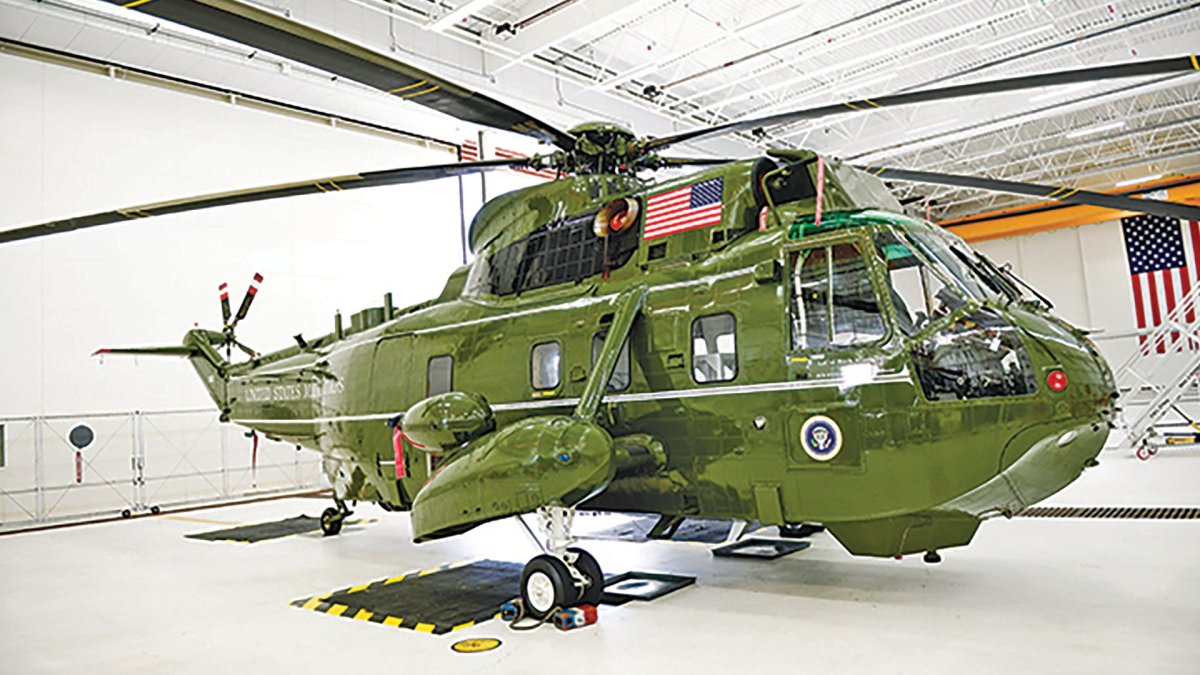
#614 sits fully restored in HX-21’s hangar at NAS Pax River., USN
With 614 flying again, HX-21 won’t have to borrow a fleet VH-3D for testing. This is a very good thing because the White Top VH-3D cadre is in extreme demand even as they enter the twilight of their service lives.
As of now, the first VH-92 replacement aircraft for the current White Top Presidential Airlift fleet won’t enter operational service until after the turn of the decade. The earliest possible declaration of initial operating capability is expected to be sometime in 2020, at which time the drawdown of the VH-3D fleet will finally begin. So even if things go perfectly, 614 has years of work left supporting the VH-3D fleet.
Regardless of when the VH-3D fleet meets its final demise, being left for nearly dead twice in its career, the 45 year old #614 is now more capable and up to date than it has ever been. That’s a testament not only to Sikorsky’s iconic Sea King design, but also to the talented problem solvers over at HX-21.
Contact the author: Tyler@thedrive.com
Comments couldn’t be loaded. Please refresh the page.
更新于美国东部时间2017年9月15日晚上11:14
看到一架老旧飞机获得第二次生命总是令人欣喜,但能获得第三次机会的飞机就非常罕见了。最近,一架有着特殊历史的独特直升机就获得了这样的机会。
NVH-3A 150614号机于45年前的1972年首次服役。服役初期,它曾作为“海军陆战队一号”搭载尼克松总统和福特总统出行。之后,它加入HC-6直升机战斗支援中队,执行了大量飞行任务。20世纪80年代初,在飞行时间达到约4500小时后,这架“海王”直升机被送往戴维斯-蒙森空军基地庞大的飞机坟场封存。
20世纪80年代末,“614”号飞机从封存状态中取出,修复后恢复飞行状态,作为海军顶级飞机测试中心——位于马里兰州帕图克森特河海军航空站的测试飞机。它开启了新的征程,成为HMX-1中队“白顶”VH-3D机队的替代测试飞机。当总统乘坐这些飞机时,它们会使用著名的呼号“海军陆战队一号”。
614 号飞机最初是为福特总统和尼克松总统服务的。福特总统图书馆
总统空运任务极其复杂多变,要求极高,对国家安全至关重要。除了执行飞往美国各地乃至世界各地的任务,为总统出行提供支持外,驻扎在阿纳科斯蒂亚海军支援基地的VH-3D和VH-60N直升机还必须随时待命,在接到通知后迅速将总统从白宫接走,并迅速送往安全地点,希望能在敌方攻击到来之前将其撤离。
考虑到这些因素,这支近乎老旧的VH-3D机队必须具备可靠性,为此,我们制定并实施了一项特殊的维护计划。这些直升机被严格隔离在位于弗吉尼亚州匡蒂科HMX-1基地的高安全级别维护机库中,与它们的“绿色”同型机完全分开。在那里,它们会得到特殊的照料,并且接受比当今几乎所有其他飞行直升机都更频繁的检查。
此外,尽管VH-3D直升机机龄已久,但仍需不断进行升级改造,以减轻其老化带来的影响。它们还必须配备最新的生存能力,包括各种红外对抗系统。其通信系统也必须保持领先水平,以便总统能够随时与国家指挥机构及其内阁保持联系。
VH-3D 将继续服役到下一个十年,届时它将与 VH-60N 一起被 VH-92 取代。(美联社)
所有这些系统集成工作和更新操作程序的开发都需要测试,而这正是 NVH-3A “614” 在 2013 年之前为第 21 空中测试与评估中队 (HX-21) 所做的工作。
那一年,614号直升机被指定为VH-3D座舱升级项目(CUP)的测试平台,该项目旨在为VIP海王直升机最终配备现代化的玻璃座舱。为了准备这项工作,这架直升机的所有航空电子设备,包括线束,都被彻底拆除。然而,该项目随后却突然被取消了。
到2014年,614号机已变成一堆毫无用处的残骸,HX-21中队的维护人员开始着手制定一项计划,让这架服役四十年的直升机重返蓝天,因为VH-3D机队还将继续服役多年。这并非维护人员的日常工作。这类工作通常由专门的维修基地负责,这些基地专注于对机身进行全面大修,而不是由那些负责日常飞行维护的人员来完成。
尽管可以从西科斯基公司订购一些修复所需的零件,但由于海王直升机停产时间过长,许多修复所需的部件根本无法找到,因此HX-21团队只能从零开始制造。为了让614号飞机有机会重返蓝天,他们定制加工了200多个零件,每个零件都必须经过严格的工程审批流程。
HX-21团队在对整架直升机进行重新布线的同时,也升级了许多其他主要部件。这使得614号机能够比以往任何时候都更好地模拟HMX-1中队实际执行作战任务的VH-3D直升机。
除了升级后的航空电子设备(尽管这些设备仍然主要由“老式仪表”组成)之外,直升机的旋翼、传动系统、涡轮发动机、起落架和燃油系统也全部更换为最新的标准设备。唯一没有改动的是直升机上世纪70年代的VIP内饰——这与如今总统乘坐的VH-3D直升机的内部客舱布局截然不同。
总统直升机机队质量保证官德怀特·“奇克”·詹姆斯(这份工作压力不大吧?)向《海军航空新闻》发表了以下声明:
“我们必须建立一套制造质量保证流程,这与我们通常在维护环境中所做的截然不同……我不知道机组人员中是否有人曾经对特定飞机进行过如此大规模的工作。以前,这架飞机上有一些类似VH-3D的系统安装在机架上。机舱内的航电设备也安装在机架上,他们只能那样使用……驾驶舱右侧是唯一使用VH-3D系统的部分,而现在整架飞机基本上都变成了VH-3D飞机。”
“我们必须建立一套制造质量保证流程,这与我们通常在维护环境中所做的有所不同……我不知道该团队中是否有人曾经对特定飞机进行过如此大量的工作。
以前,这架飞机上有一些类似VH-3D的系统,安装在机架上。航电设备都安装在机舱的机架上,他们也只能那样使用……驾驶舱右侧是唯一VH-3D的部分,而现在整架飞机基本上就是一架VH-3D飞机了。”
2017年4月4日,614号直升机再次成功悬停升空,这一独特且极具挑战性的飞行任务令所有参与者倍感自豪。目前,该直升机正积极参与VH-3D机队的多个升级项目,包括照明系统升级、飞行程序变更以及对高端直升机旋翼跟踪与平衡系统的改进。
614号飞机已完全修复,停放在美国海军帕图克森特河海军航空站HX-21中队的机库内。
随着614号机恢复飞行,HX-21中队无需再借用机队的VH-3D进行测试。这无疑是件好事,因为即使VH-3D飞行员已接近服役年限的尾声,他们仍然非常抢手。
截至目前,首架用于替换现役“白顶总统空运”机队的VH-92直升机要到本世纪末才能投入使用。最早的初始作战能力声明预计也要到2020年,届时VH-3D机队的退役工作也将正式启动。因此,即便一切顺利,第614中队仍需承担数年的VH-3D机队维护工作。
无论VH-3D机队最终何时退役(在其服役生涯中曾两次濒临报废),这架服役45年的614号机如今的性能和先进程度都达到了前所未有的水平。这不仅证明了西科斯基公司标志性的“海王”设计,也归功于HX-21中队那些才华横溢的问题解决者们。
联系作者:Tyler@thedrive.com
评论加载失败,请刷新页面。