The USS Ranger Sailed With A Unique “Grumman Air Wing” In The Mid 1980s20世纪80年代中期,游骑兵号航空母舰搭载了一支独特的“格鲁曼航空联队”。
The same year the Ranger became the star of Topgun, the carrier sailed with a air wing made up almost entirely of Grumman aircraft.
Updated Jul 5, 2020 7:14 PM EDT
We have talked about the highly diverse and numerous mix of aircraft that made up carrier air wings in decades past , and we have highlighted Battle Group Echo , the Battleship toting super flotilla that USS Ranger was a part of in 1987, but around that same time Ranger sported a unique air wing of its own.
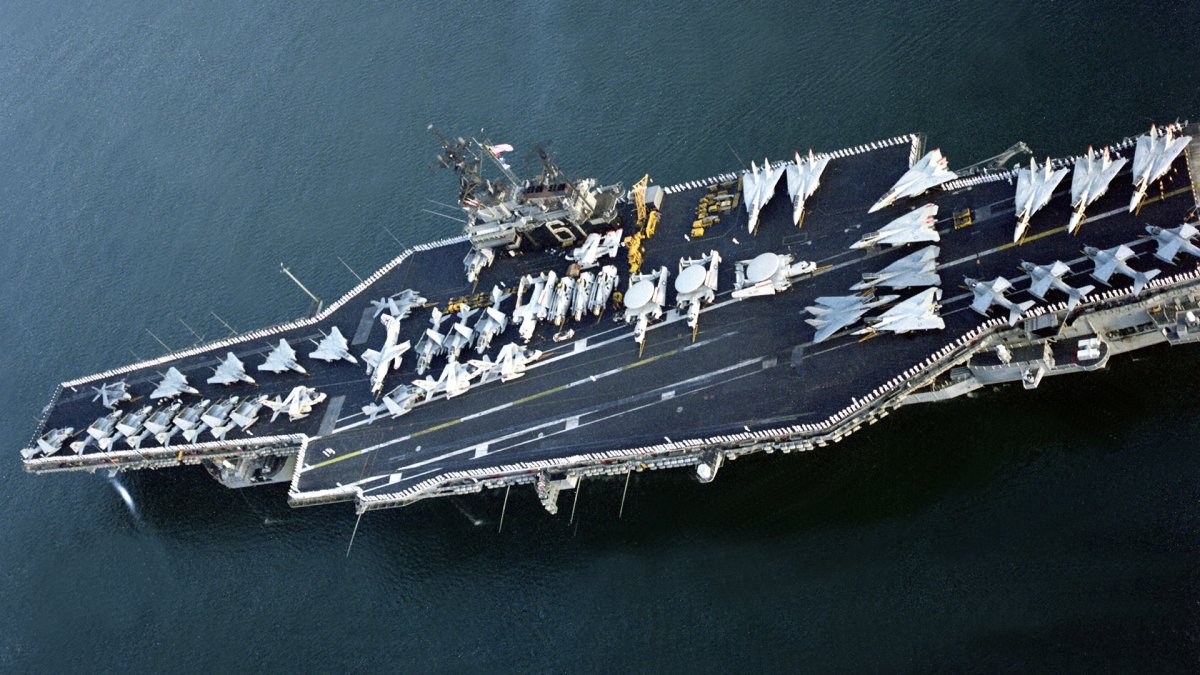
Dubbed unofficially the “Grumman Air Wing,” Carrier Air Wing Two (CVW-2) deployed aboard the Ranger in mid 1986 with mostly Grumman-built aircraft, and no light attack squadrons whatsoever.
An impressive view of Ranger brandishing its unique air wing. , USN
At the time, light attack and fighter attack squadrons were either made up of the LTV A-7 Corsair IIs or the still very young McDonnell Douglas F/A-18 Hornets. Instead, Ranger sported only two all weather attack squadrons made up of Grumman A-6 Intruders. One of these squadrons was augmented for the aerial refueling mission with KA-6D tankers. The carrier also embarked two fighter squadrons made up of Grumman F-14 Tomcats. The air wing’s electronic attack role was fulfilled by a squadron made up of another Grumman product, that being EA-6B Prowler. A E-2 Hawkeye airborne early warning and control squadron was part of the air wing as well and detachments of C-2 Greyhound carrier onboard delivery aircraft called on the ship regularly. Both the E-2 and C-2 are also Grumman aircraft. The rest of the air wing was comprised of non Grumman aircraft, but these consisted of only two types—the Lockheed S-3 Viking and the Sikorsky SH-3 Sea King.
Ranger with its “Grumman Air Wing” dotting its deck. , USN
Here is the exact squadron mix of CVW-2 in 1986:
VF-1 Wolfpack—F-14 Tomcat
VF-2 Bounty Hunters—F-14 Tomcat
VMA(AW)-121 Green Knights—A-6 Intruder
VA-145 Swordsman—A-6/KA-6
VAW-116 Sun Kings—E-2
VAQ-131 Lancers—EA-6B
VS-38 Red Griffins—S-3
*The air wing stayed largely unchanged until the Ranger’s retirement in 1993, aside from a swapping of VMA(AW)-121 Green Knights with VA-145 Silver Foxes in late 1990.
Tomcats of CVW-2 refuel from a KA-6D., USN
For comparison, USS Forrestal (CV-59), the same class of ship as Ranger , was deployed at the same time in 1987 but had a much more common air wing configuration. This included two F-14 Squadrons, two A-7 squadrons, one A-6/KA-6 squadron, one S-3 squadron, one EA-6B squadron, one E-2 squadron and a SH-3 squadron. Around this same time, Nimitz class supercarriers were sporting two F-14, two F/A-18, two A-6 and one EA-6B squadrons, as well as the same number of support squadrons as seen on the Forrestal class ships. Smaller Midway class carriers were deploying with three F/A-18 Squadrons, two A-6 squadrons—one of which had KA-6s—one E-2C squadron, one EA-6B squadron, and one SH-3 squadron.
The hangar bay of Ranger looked like the Grumman factory. , USN
It seems that the USS John F. Kennedy (CV-67) may have actually established the “Grumman Air Wing” concept before Ranger, but for just one year, between mid 1983 and 1984, with one major difference being there was a detachment of EA-3D Skywarriors that also flew from the boat. What made Ranger’s incarnation of the concept so interesting is that from mid 1986 on through Desert Storm and till its retirement in 1993, the ship kept with the Grumman Air Wing configuration, and CVW-2’s makeup largely stayed the same.
F-14 Tomcat launches off the waist catapult of the USS Ranger in the late 1980s., USN
It’s not entirely clear where the Grumman Air Wing concept came from, but it likely was a result of a number of factors. First being it was a simpler configuration to sustain as less aircraft types were embarked aboard the ship. In fact, the air wing’s inventory is somewhat similar to the current super carrier air wings of today, which have Hornets, Super Hornets, and Growlers that make up the fixed-wing tactical core of the air wing. The Super Hornets and Growlers share direct commonality, much like the A-6, KA-6 and EA-6B. The Super Hornet and the Hornet less so, but still there are synergies between the two fleets. Sadly and stupidly , the S-3 Viking has been removed from carrier decks for the better part of the decade, and the tiny handful that were serving in other roles were retired in early 2016.
Another shot of Ranger and her “Grumman Air Wing.”, USN
Aircraft availability at the time was likely also a factor as fleet management led to some unique air wing configurations. Each carrier’s capabilities, intended use and deployment area were also variables. Still, without a light attack or strike fighter squadron or two, Ranger’s air wing had some limitations. The A-6E TRAM upgrade packed a powerful and modern punch, and was able to drop precision guided munitions under certain conditions, but the omission of light attack squadrons and their crews that train more for close air support than their strike-focused Intruder crew counterparts would have limited the carrier’s ability to support ground operations, and a handful of other missions to some degree.
VF-2 Bounty Hunters F-14 flying by Ranger ., USN
Today “Grumman Iron” has largely vanished from the decks of America’s supercarriers, with only the E-2 Hawkeye and C-2 Greyhound being of Grumman heritage. The C-2 will slowly be retired in the coming decade, with a poor replacement in the CMV-22 Osprey taking its place. But Grumman’s proud naval aviation heritage may be on the verge of a resurgence of sorts.
The Navy is actively working to field its first operational advanced unmanned air vehicle from the decks of its carriers. The program is known as the Carrier Based Aerial Refueling System, or CBARS for short, and the type has now gained the designation MQ-25 Stingray . Although the Navy should have reached farther when it came to fielding a semi-autonomous carrier based drone, including deep strike and penetrating reconnaissance in its mission portfolio, the MQ-25 is still what is likely the beginning of a slow end for carrier-borne manned aircraft systems.
Northrop Grumman’s X-47B made history operating from a supercarrier. , USN
Northrop Grumman is uniquely well poised to win the MQ-25 contract and others that will follow for more advanced and capable drones. The company pioneered the technology with it s X-47B demonstrators and continues to be a leader in the unmanned space. There will still be very stiff competition from Lockheed, Boeing, General Atomics and possibly others, but who knows, maybe the Grumman’s Air Wing will return to carriers in the form of a hive of swarming advanced unmanned combat air vehicles in the decades to come.
X-47B during shipboard testing. , USN
Contact the author: Tyler@thedrive.com
Comments couldn’t be loaded. Please refresh the page.
更新于美国东部时间2020年7月5日晚上7:14
我们曾讨论过过去几十年航母舰载机联队中种类繁多、数量庞大的飞机组合,也重点介绍了“回声”战斗群,即1987年“游骑兵”号航母所属的由战列舰组成的超级舰队,但大约在同一时期,“游骑兵”号也拥有自己独特的舰载机联队。
第二舰载航空联队(CVW-2)于 1986 年年中部署在“游骑兵”号航母上,非正式地被称为“格鲁曼航空联队”,主要装备格鲁曼公司制造的飞机,没有任何轻型攻击机中队。
令人印象深刻的“游骑兵”号战列舰展示其独特的舰载机联队。(美国海军)
当时,轻型攻击机和战斗攻击机中队要么由LTV A-7“海盗II”攻击机组成,要么由当时还很新的麦克唐纳·道格拉斯F/A-18“大黄蜂”战斗机组成。而“游骑兵”号航母却只有两个全天候攻击机中队,装备的是格鲁曼A-6“入侵者”攻击机。其中一个中队还配备了KA-6D加油机,用于执行空中加油任务。该航母还搭载了两个战斗机中队,装备的是格鲁曼F-14“雄猫”战斗机。舰载机联队的电子战任务由一个中队承担,该中队装备的是另一款格鲁曼公司的产品——EA-6B“徘徊者”电子战飞机。此外,舰载机联队还配备了一个E-2“鹰眼”预警机中队,并且定期有C-2“灰狗”舰载运输机分遣队到舰执行任务。E-2和C-2也都是格鲁曼公司生产的飞机。其余的航空联队飞机并非格鲁曼公司生产的,但只有两种型号——洛克希德S-3维京和西科斯基SH-3海王。
“游骑兵”号航母甲板上点缀着“格鲁曼航空联队”的标志。
以下是1986年CVW-2中队的确切组成:
VF-1“狼群”中队——F-14“雄猫”战斗机
VF-2赏金猎人中队——F-14雄猫战斗机
VMA(AW)-121“绿骑士”中队——A-6“入侵者”攻击机
VA-145 剑客——A-6/KA-6
VAW-116 太阳王中队—E-2
VAQ-131“枪骑兵”中队——EA-6B
VS-38 红狮鹫中队—S-3
除了在 1990 年末将 VMA(AW)-121“绿骑士”中队与 VA-145“银狐”中队交换外,航空联队在 1993 年“游骑兵”退役之前基本保持不变。
美国海军第2舰载航空联队(CVW-2)的F-14“雄猫”战斗机正在从一架卡-6D“雄猫”战斗机上进行空中加油。
作为对比,与“游骑兵”号同属一级舰艇的“福莱斯特”号航空母舰(CV-59)也于1987年同期部署,但其舰载机联队配置更为常见。该舰配备了两个F-14中队、两个A-7中队、一个A-6/KA-6中队、一个S-3中队、一个EA-6B中队、一个E-2中队和一个SH-3中队。大约在同一时期,“尼米兹”级超级航母则配备了两个F-14中队、两个F/A-18中队、两个A-6中队和一个EA-6B中队,以及与“福莱斯特”级航母相同数量的支援中队。而较小的“中途岛”级航母则部署了三个F/A-18中队、两个A-6中队(其中一个配备了KA-6)、一个E-2C中队、一个EA-6B中队和一个SH-3中队。
“游骑兵”号的机库看起来就像格鲁曼公司的工厂。(美国海军)
看来“约翰·F·肯尼迪”号航空母舰(CV-67)可能比“游骑兵”号更早地采用了“格鲁曼航空联队”的概念,但仅持续了一年,从1983年中期到1984年,主要区别在于“游骑兵”号上还搭载了一个EA-3D“空中勇士”电子战飞机分遣队。“游骑兵”号对这一概念的诠释之所以如此引人注目,是因为从1986年中期到“沙漠风暴”行动结束,直至1993年退役,“游骑兵”号始终保持着格鲁曼航空联队的配置,CVW-2的组成也基本保持不变。
20世纪80年代末,F-14“雄猫”战斗机从“游骑兵”号航空母舰的腰部弹射器起飞。(美国海军)
格鲁曼航空联队的概念起源尚不完全清楚,但很可能是多种因素共同作用的结果。首先,由于舰载机型号较少,这种配置更易于维护。事实上,该航空联队的机队配置与当今超级航母的舰载机联队颇为相似,都以“大黄蜂”、“超级大黄蜂”和“咆哮者”等固定翼战术核心机型为主。“超级大黄蜂”和“咆哮者”拥有直接的通用性,就像A-6、KA-6和EA-6B一样。“超级大黄蜂”和“大黄蜂”之间的通用性稍弱,但两者之间仍然存在协同效应。令人遗憾的是,S-3“维京”反潜巡逻机在过去十年中大部分时间都未在航母甲板上服役,少数几架仍在其他岗位上服役的S-3也于2016年初退役。
另一张“游骑兵”号及其“格鲁曼航空联队”的照片,美国海军
当时的飞机可用性可能也是一个因素,因为舰队管理导致了某些独特的舰载机联队配置。每艘航母的性能、预期用途和部署区域也是不同的因素。尽管如此,由于缺少一两个轻型攻击机或打击战斗机中队,游骑兵号的舰载机联队仍然存在一些局限性。A-6E TRAM 升级版拥有强大的现代化火力,能够在特定条件下投掷精确制导武器,但由于缺少轻型攻击机中队及其机组人员(这些中队和机组人员的训练重点并非打击,而是近距离空中支援),游骑兵号航母支援地面作战的能力以及执行其他一些任务的能力在一定程度上受到了限制。
VF-2赏金猎人中队的F-14战斗机从游骑兵号航母上空飞过。
如今,“格鲁曼钢铁”已基本从美国超级航母的甲板上消失,仅剩E-2“鹰眼”预警机和C-2“灰狗”运输机仍保留着格鲁曼公司的血统。C-2将在未来十年内逐步退役,取而代之的是性能较差的CMV-22“鱼鹰”倾转旋翼机。但格鲁曼引以为傲的海军航空传统或许即将迎来某种程度的复兴。
美国海军正积极推进其首款可从航母甲板部署的先进无人机项目。该项目名为“舰载空中加油系统”(Carrier Based Aerial Refueling System,简称CBARS),该机型现已正式命名为MQ-25“黄貂鱼”(Stingray)。尽管海军在部署半自主舰载无人机方面本应走得更远,例如在其任务组合中纳入纵深打击和渗透侦察等功能,但MQ-25的出现很可能标志着舰载有人驾驶飞机系统走向衰落的开端。
诺斯罗普·格鲁曼公司的X-47B在超级航母上起降,创造了历史。
诺斯罗普·格鲁曼公司在赢得MQ-25合同以及后续更先进、更强大的无人机合同方面拥有得天独厚的优势。该公司凭借X-47B验证机开创了无人机技术,并持续引领着无人机领域的发展。尽管洛克希德·马丁公司、波音公司、通用原子公司以及其他一些公司仍将构成激烈的竞争,但谁又能预料未来几十年内,格鲁曼公司的航空联队或许会以蜂拥而至的先进无人作战飞行器群的形式重返航母呢?
X-47B 在舰载测试期间。,美国海军
联系作者:Tyler@thedrive.com
评论加载失败,请刷新页面。