I got used to hiding a part of my name. Then I learnt what I was leaving out我习惯了隐藏名字的一部分。后来我才知道我隐瞒的是什么。
A recurring problem during a flight booking sent Mr K B Ryan Joshua Mahindapala searching for the story behind a family name he had rarely acknowledged. Here's what he learnt along the way about identity and heritage.
A recurring problem during a flight booking sent Mr K B Ryan Joshua Mahindapala searching for the story behind a family name he had rarely acknowledged. Here's what he learnt along the way about identity and heritage.
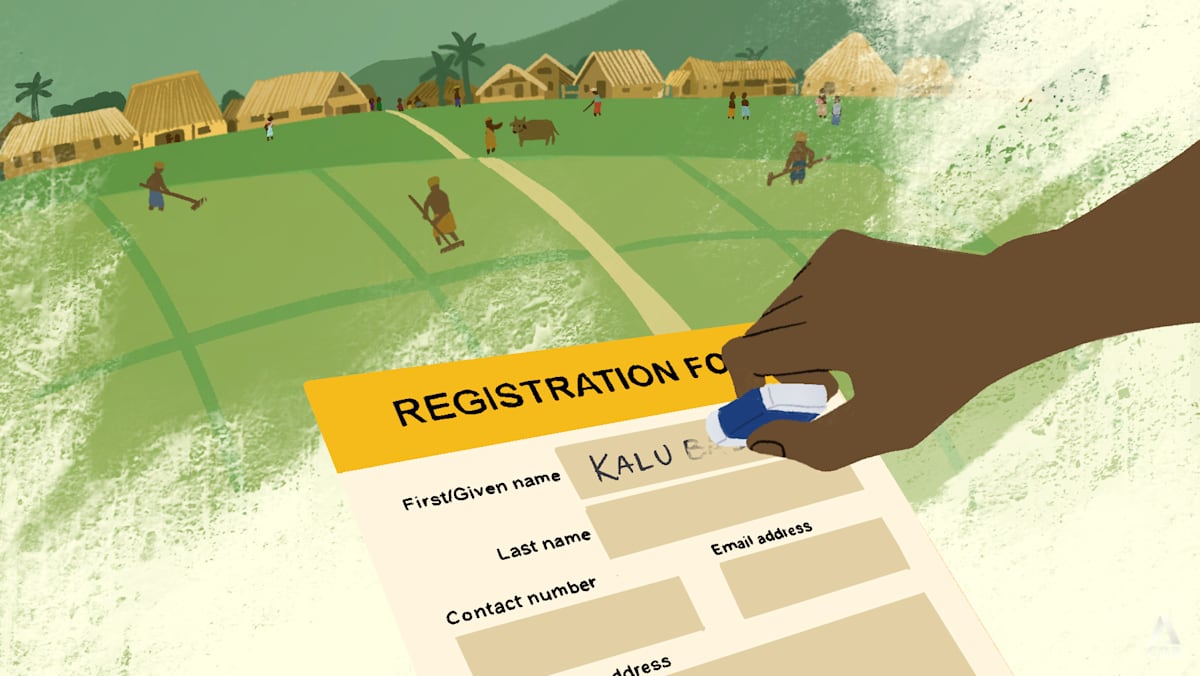
Names may not always fit neatly into administrative boxes, but they can carry stories of family and heritage stretching back generations. (Illustration: CNA/Li Lyn Tan)
This audio is generated by an AI tool.
Not long ago, I was booking flight tickets online. After choosing my seats, I arrived at the part I always dread: passenger details.
My name, as my identity card states it, is K B Ryan Joshua Mahindapala. It’s a mouthful that has never neatly fit into the blank boxes of airline websites demanding a first and last name, within character limits.
As always, I typed, deleted and rearranged, hoping the airline's virtual booking system and my passport could come to some sort of agreement about who I am.
CNA Games Guess Word Crack the word, one row at a time Buzzword Create words using the given letters Mini Sudoku Tiny puzzle, mighty brain teaser Mini Crossword Small grid, big challenge Word Search Spot as many words as you can Show More Show Less As always, I found myself thwarted over and over, wishing for simplicity. Why did I have to have this unwieldy, untidy name? MAKING MYSELF SMALLER In my daily life, I go simply by "Ryan". I rarely gave any thought or effort to acknowledging the two letters that precede it in my full, official name – nor did I ask anyone else to. The habit began nearly two decades ago, in secondary school. Back then, when classmates asked what the K B stood for, I told them: Kalu Badalge. I said it proudly, with no shame. Growing up, my family had told me the words meant "blacksmith", and I remember nodding, feeling like this was enough to explain who I am and where I come from. I thought my classmates would react the same way. Instead, what I got was giggling. I wondered what I had said that was so funny. But I don't think they meant any harm by it. In my experience as an educator, teenagers have a habit of reacting to the unfamiliar by attempting to find the funny in it rather than engaging it with sincere curiosity. But word soon got around, and for a while it became a lightning rod for teasing from my peers at school. I never mentioned it to my parents or relatives. I simply drew my own conclusion: it was not wise to hand my full name out to just anyone, or brandish it in public.
As always, I found myself thwarted over and over, wishing for simplicity. Why did I have to have this unwieldy, untidy name?
MAKING MYSELF SMALLER
In my daily life, I go simply by "Ryan". I rarely gave any thought or effort to acknowledging the two letters that precede it in my full, official name – nor did I ask anyone else to.
The habit began nearly two decades ago, in secondary school.
Back then, when classmates asked what the K B stood for, I told them: Kalu Badalge.
I said it proudly, with no shame. Growing up, my family had told me the words meant "blacksmith", and I remember nodding, feeling like this was enough to explain who I am and where I come from.
I thought my classmates would react the same way. Instead, what I got was giggling.
I wondered what I had said that was so funny. But I don't think they meant any harm by it.
In my experience as an educator, teenagers have a habit of reacting to the unfamiliar by attempting to find the funny in it rather than engaging it with sincere curiosity.
But word soon got around, and for a while it became a lightning rod for teasing from my peers at school.
I never mentioned it to my parents or relatives. I simply drew my own conclusion: it was not wise to hand my full name out to just anyone, or brandish it in public.
In job interviews, Mr K B Ryan Joshua Mahindapala would ask interviewers to simply call him “Ryan”, hoping to avoid any awkwardness over his full name. (Photo: iStock)
By the time I reached adulthood, the reflex was fully formed.
I stopped acknowledging my first two initials to casual acquaintances. In situations where it couldn't be helped, I introduced myself as "Ryan" before others could raise a brow at the full iteration of my name.
In formal situations such as job interviews, nerves led me to believe that leaving openings for an interviewer to stumble over my full name, printed on my resume, might cost me the job. In my head, my trusty opener "Please, call me Ryan" was my secret weapon to remove all awkwardness. It gave me an equal chance, even before the interview had properly begun.
Over time, I convinced myself that the safest version of me was the shortest one. Those two letters had never felt like they truly belonged to me anyway, nor I to them.
Did it really matter so much if I hid them from view – even if that view was my own?
WHAT PARTS OF ME HAVE I BEEN SELF-CENSORING?
For some reason, on this day, I found myself pausing over the flight booking page. I stared at the two letters I could never seem to make fit, that I had spent so many years trying to censor from my identity.
With them, what else had I been unwittingly censoring about myself?
Pulling up a new browser window, I tried searching "Kalu Badalge" on Google. The results weren't very helpful, only circling the name without ever landing on it.
With the pending flight demanding my attention, I set my search aside for the moment. But a few days later, I typed "Kalu Badalge" into an AI chatbot and asked what it meant.
The answer arrived in seconds.
"Kalu Badalge" follows a traditional Sinhalese naming pattern: a "ge-nama" or hereditary house name that comes before a person's given names. "Kalu" means "dark" while "badal" means "smith" or "artificer". Put those together with "ge", meaning "house of" and you get "Kalu Badalge" – "the house of the dark smith".
The name points to an ancestry based in metalwork, to forebears traditionally linked with the Navandanna, the artisan communities of old Sri Lanka.
I didn't take a machine's word for it. I asked for historical sources.
I was led to scholarly works more than a century old, out of copyright and free for anyone to read. Other sources were not as easily available, with some needing paid access, so I had to do my own separate searches based on inferences drawn by the chatbot.
What I found and pieced together was not a comprehensive genealogy of my own family, but the history and traditions behind the name I inherited.
Naming patterns like this, it turns out, reach back at least to the era of the Kandyan kingdom, which stood in Sri Lanka's highlands until 1815.
This was a world in which hereditary craft service bound smith households to royal court, temple or chief, with family trades sometimes becoming names handed down through generations, long before Dutch surveyors began recording them in the 1700s.
Such names are plausibly 400 to 500 years old – already centuries old when Sir Stamford Raffles first stepped ashore in Singapore in 1819.
When we scrub these inconveniences out of our names, what else are we scrubbing from the canvas of our heritage?
I asked my family whether they knew any of this.
They had always known, and had told me growing up, that Kalu Badalge meant "blacksmith". From what I told them of my search, they encouraged me to keep looking.
They had only pieces of the full picture – half-memories of stories passed down by grandparents and great-grandparents, stories that shifted a little depending on who was telling it.
This is simply what happens so often to information that is preserved through telling rather than writing. It can become a generational game of broken telephone, the message eventually getting lost in the passage of time – until somebody thinks to look for it again.
Names in Singapore are so often compressed archives of identity and heritage: the "bin" and "binte" that record a parent, the "s/o" and "d/o" ("son of" and "daughter of") on identity cards, surnames spelt three ways across one family depending on which clerk did the romanising.
Even the shortest, simplest surname can hearken back to a clan, a dialect or a village its bearer has never known.
Yet we tend to treat some names as mere admin problems. We apologise for complicated spellings or tricky pronunciations at counters. We trim them for convenience, ignore the rest. We apologise for "inconvenient" names – or even pick new names altogether. Names that are cleaner, neater.
But when we scrub these inconveniences out of our names, what else are we scrubbing from the canvas of our heritage?
Lately, I've stopped apologising for my name or trying to explain it away. I am who I am, and no paperwork can shrink or sand that down.
Those two letters that once made me self-conscious, no longer bother me at all. They point to a time and place inhabited by real people who lived – and a naming tradition associated with skilled tradesmen and houses named for their work.
In his search, Mr K B Ryan Joshua Mahindapala found that his name Kalu Badalge is associated with a Sinhalese naming tradition linked to blacksmiths and artisan communities in Sri Lanka. (Photo: iStock)
Living in Singapore in the 21st century, I'll confess that I know nothing of metal. And yet, I imagine a connection between the profession that gave rise to my name and the work I do today.
Theirs demanded heat, repetition and patience to create something new. For me, writing and teaching bring their own pressures and call for different forms of repetition and patience. Both entail working on something until it takes shape.
This revelation has made my family's history feel personal rather than academic.
Before this, I'd never had thoughts of visiting Sri Lanka. But now, I find myself curious to see for myself the land from which my family and my name came, where generations of craftsmen once worked and left a legacy that endures today.
If there is a part of your own name you cannot fully explain or understand, it has never been easier to ask. It costs nothing, but the gains could be more valuable than you think.
As for the flight that started all this, my booking went through that day. Every letter eventually found its place, as the airline's virtual system demanded.
Nothing changed in those blank boxes – but something in me certainly has.
K B Ryan Joshua Mahindapala is a Singaporean lawyer turned writer and educator. He frequently writes on topics related to heritage, culture and identity.
If you have an experience to share or know someone who wishes to contribute to this series, write to voices [at] mediacorp.com.sg ( voices[at]mediacorp[dot]com[dot]sg ) with your full name, address and phone number.
Get our pick of top stories and thought-provoking articles in your inbox
Stay updated with notifications for breaking news and our best stories
Join our channel for the top reads for the day on your preferred chat app
一次航班预订过程中反复出现的问题,促使KB Ryan Joshua Mahindapala先生开始探寻一个他鲜少提及的家族姓氏背后的故事。以下是他在此过程中对身份认同和家族传承的感悟。
名字或许并非总能被简单地归入行政分类,但它们却承载着世代相传的家族故事和传承。(插图:CNA/李琳谭)
这段音频由人工智能工具生成。
不久前,我在网上预订机票。选好座位后,就到了我最害怕的部分:填写乘客信息。
我的名字,正如我的身份证上所显示的,是KB Ryan Joshua Mahindapala。这名字太长了,航空公司网站上要求填写姓名(包括姓和名)的空白框总是限制字符数,我根本填不进去。
和往常一样,我输入、删除、重新排列信息,希望航空公司的虚拟预订系统和我的护照能够就我的身份达成某种共识。
CNA游戏 猜词游戏 逐行破解单词 流行词游戏 用给定的字母组成单词 迷你数独 小谜题,脑力挑战 迷你填字游戏 小方格,大挑战 单词搜索 尽可能多地找出单词 显示更多 显示更少 和往常一样,我一次又一次地受挫,渴望简单。为什么我的名字这么拗口难记? 简化自己 在日常生活中,我通常用“Ryan”这个名字。我很少会去想或费心去理解我正式全名前面那两个字母的含义——我也没要求别人这样做。这个习惯始于近二十年前的中学时代。那时,当同学问起KB是什么意思时,我会告诉他们:Kalu Badalge。我自豪地说出这句话,毫不羞愧。从小到大,我的家人告诉我这两个词的意思是“铁匠”,我记得当时我点点头,觉得这足以解释我是谁,我来自哪里。我以为同学们的反应会和我一样。结果,他们却咯咯地笑了起来。我纳闷自己到底说了什么这么好笑。不过,我想他们应该没有恶意。以我作为教育工作者的经验来看,青少年面对不熟悉的事物,往往会试图从中找出笑点,而不是真正地去好奇。但这件事很快就传开了,有一段时间,我成了同学们取笑的对象。我从未跟父母或亲戚提起过这件事。我只是自己得出结论:把我的全名告诉别人,或者在公共场合炫耀,都不是什么明智之举。
和往常一样,我一次又一次地碰壁,渴望简单一些。为什么我非得用这么个笨拙又杂乱的名字呢?
让自己变得更渺小
在日常生活中,我通常只用“瑞恩”这个名字。我很少会去想或费心去注意我全名前面那两个字母——我也没要求别人这样做。
这个习惯始于近二十年前的中学时期。
当时,当同学们问我 KB 代表什么时,我告诉他们:Kalu Badalge。
我自豪地说出了这句话,毫无羞耻之感。从小,家人就告诉我这句话的意思是“铁匠”,我记得当时我点点头,觉得这足以解释我是谁,我来自哪里。
我以为同学们也会有同样的反应。结果,他们却咯咯地笑了起来。
我很好奇自己说了什么这么好笑的话。但我认为他们并没有恶意。
根据我作为教育工作者的经验,青少年面对不熟悉的事物时,往往会试图从中寻找乐趣,而不是以真诚的好奇心去了解它。
但消息很快传开了,有一段时间,这件事成了我在学校里被同学们嘲笑的对象。
我从未跟父母或亲戚提起过这件事。我只是自己得出结论:把我的全名随便告诉别人,或者在公共场合炫耀,都不明智。
在求职面试中,KB Ryan Joshua Mahindapala 先生会要求面试官直接称呼他“Ryan”,以免因他的全名而感到尴尬。(图片:iStock)
等我成年的时候,这种反射已经完全形成了。
我不再向不太熟的人提及我的名字首字母。在不得不提及的情况下,我会在别人听到我全名之前,先介绍自己叫“瑞恩”。
在求职面试等正式场合,紧张让我总觉得,如果面试官听不清我简历上的全名,我可能就丢了工作。我心里一直想着,我那句万无一失的开场白“请叫我瑞恩”就是我的秘密武器,能帮我消除所有尴尬。它让我在面试正式开始前就拥有了平等的机会。
随着时间的推移,我逐渐说服自己,最安全的自我就是最简短的自我。反正那两封信对我来说,从来都不是真正属于我的,我也不属于它们。
即使我把它们藏起来不让别人看到——哪怕那只是我自己看到的——真的有那么重要吗?
我究竟在自我审查哪些方面?
不知为何,就在这一天,我突然停在了预订机票的页面上。我盯着那两个我始终无法正确拼写的字母,这两个字母,我曾花费多年时间试图从我的身份中抹去。
和他们在一起时,我还在不知不觉中隐瞒了自己哪些方面?
我打开一个新的浏览器窗口,尝试在谷歌上搜索“Kalu Badalge”。搜索结果没什么帮助,只是圈出了名字,却始终找不到对应的页面。
由于即将登机,我暂时搁置了搜索。但几天后,我在一个人工智能聊天机器人中输入了“Kalu Badalge”,询问它的意思。
答案几秒钟后就到了。
“Kalu Badalge”遵循僧伽罗人传统的命名模式:在个人名字之前,会有一个“ge-nama”(世袭的家族名称)。“Kalu”意为“黑暗的”,“badal”意为“铁匠”或“工匠”。将它们与“ge”(意为“……的房子”)组合在一起,就得到了“Kalu Badalge”——“黑暗铁匠的房子”。
这个名字表明其祖先从事金属加工,与古斯里兰卡的工匠社群纳万丹纳有着传统联系。
我没有轻信机器的说法,而是要求提供历史资料。
我找到了一些一百多年前的学术著作,这些著作已经过了版权保护期,任何人都可以免费阅读。其他一些资源则不太容易获取,有些甚至需要付费才能访问,所以我不得不根据聊天机器人的推断自行进行搜索。
我发现并拼凑起来的,并不是我自己家族的完整族谱,而是我所继承的姓氏背后的历史和传统。
事实证明,这种命名模式至少可以追溯到康提王国时期,该王国一直统治着斯里兰卡的高地,直到 1815 年。
这是一个世袭手工艺服务将铁匠家庭与皇室、寺庙或酋长联系起来的世界,家族的职业有时会成为代代相传的名字,这比荷兰测量员在 18 世纪开始记录它们要早得多。
这些名字很可能已有 400 至 500 年的历史——早在 1819 年斯坦福·莱佛士爵士首次踏上新加坡的土地时,它们就已经存在了几个世纪。
当我们从名字中抹去这些不便之处时,我们还在从我们的文化遗产中抹去什么呢?
我问过家人是否知道这些事。
他们一直都知道,而且从小就告诉我,“Kalu Badalge”的意思是“铁匠”。我跟他们讲述了我的寻找过程后,他们鼓励我继续寻找。
他们只掌握了部分完整的故事——祖父母和曾祖父母代代相传的故事的零碎记忆,而且这些故事还会根据讲述者的不同而略有变化。
这就是口口相传而非书面记录的信息经常会遇到的情况。它会变成代代相传的“传话游戏”,信息最终会在时间的流逝中遗失——直到有人再次想起去寻找它。
新加坡的姓名往往是身份和传承的浓缩档案:记录父母的“bin”和“binte”,身份证上的“s/o”和“d/o”(“……之子”和“……之女”),一个家庭的姓氏根据负责罗马化的职员的不同,拼写方式可能有三种。
即使最短、最简单的姓氏,也可能追溯到其持有者从未了解过的氏族、方言或村庄。
然而,我们往往把一些名字仅仅当作行政问题。在柜台,我们会为拼写复杂或发音拗口的名字道歉。为了方便起见,我们会删减一些,其余的则视而不见。我们会为“不方便”的名字道歉——甚至干脆换个更简洁、更清晰的名字。
但是,当我们从名字中抹去这些不便之处时,我们还从我们的文化遗产中抹去了什么呢?
最近,我不再为我的名字道歉,也不再试图解释它。我就是我,任何文件都无法改变这一点。
曾经让我感到不自在的那两个字母,现在完全不再困扰我了。它们指向一个真实存在过的时代和地点,那里住着真实的人——也指向一种与技艺精湛的工匠以及以其工作命名的房屋相关的命名传统。
KB Ryan Joshua Mahindapala 先生在查找资料时发现,他的名字 Kalu Badalge 与斯里兰卡僧伽罗族的命名传统有关,这种传统与铁匠和工匠群体相关。(图片:iStock)
生活在21世纪的新加坡,我坦白说我对金属乐一窍不通。然而,我却觉得我的名字源于音乐,而我今天所从事的工作与此有着某种联系。
他们的创作需要热情、反复和耐心才能创造出新的事物。对我而言,写作和教学各有其压力,也需要不同形式的反复和耐心。两者都意味着要不断打磨,直到最终成型。
这一发现让我意识到,家族史不再是学术研究,而是与我个人息息相关的历史。
在此之前,我从未想过要去斯里兰卡。但现在,我却很想亲眼看看这片土地,我的家族和我的名字都源于此,世世代代的工匠曾在这里辛勤劳作,留下了至今仍流传下来的宝贵遗产。
如果你对自己名字的某个部分无法完全解释或理解,现在问起来比以往任何时候都更容易。问这个问题完全免费,但收获可能比你想象的更有价值。
至于引发这一切的那趟航班,我的预订当天就完成了。正如航空公司虚拟系统所要求的那样,每个字母最终都找到了对应的位置。
那些空白的方框里什么也没变——但我的内心却发生了变化。
KB Ryan Joshua Mahindapala 是一位新加坡律师,后转型成为作家和教育家。他经常撰写有关遗产、文化和身份认同等主题的文章。
如果您有经验想要分享,或者认识有人想要为本系列文章投稿,请将您的全名、地址和电话号码写信至 voices [at] mediacorp.com.sg ( voices[at]mediacorp[dot]com[dot]sg )。
订阅我们的邮件,即可获取精选热点新闻和引人深思的文章。
订阅通知,第一时间获取突发新闻和精彩报道。
加入我们的频道,即可在您常用的聊天应用上获取当日热门文章。