China’s Huge WZ-X Stealth Drone’s Strange Wing Configuration Confirmed中国巨型WZ-X隐形无人机的奇特机翼布局已得到证实
New photos of the WZ-X airborne give us a clearer view of the aircraft's unique wing design. The latest views offer clues about the aircraft’s design, including an unusual wing that may reflect the demands of very-high-altitude, long-endurance flight.
By Thomas Newdick , Tyler Rogoway
Published Sep 4, 2026 6:42 PM EDT
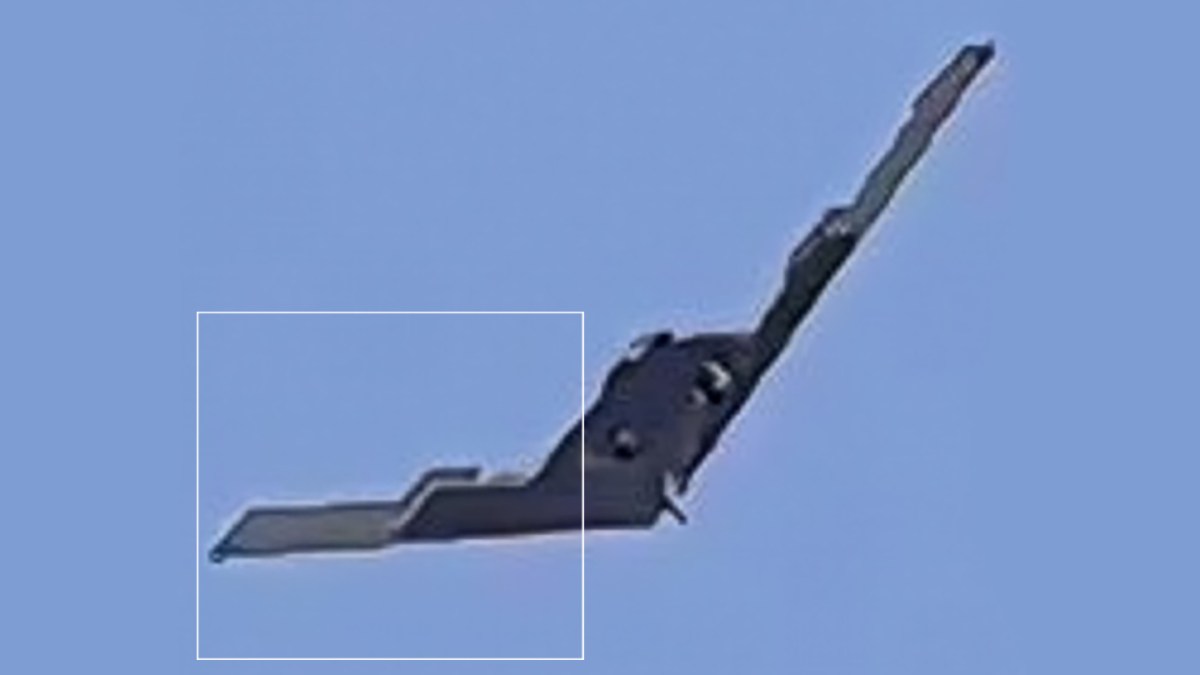
New imagery appearing out of China provides the best look yet at one of the country’s most enigmatic aircraft: the very large, low-observable, flying-wing drone widely referred to as the WZ-X . Seen previously primarily in satellite imagery, TWZ broke the story of the existence of this monster high-altitude, long-endurance drone. The new views that emerged today help clear up one of the most puzzling aspects of the aircraft’s appearance, namely the unusual shape of its enormous wings.
The aircraft was first identified in satellite imagery collected in May 2025 showing the People’s Liberation Army Air Force’s (PLAAF) sprawling test facility at Malan in Xinjiang. At the time, it was difficult to determine whether some of the apparent discontinuities in the wing planform were genuine features, visual countermeasures, or artifacts of the imagery.
The WZ-X seen for the first time at China’s secretive test base near Malan in Xinjiang province in a satellite image taken on May 14, 2025. PHOTO © 2025 PLANET LABS INC. ALL RIGHTS RESERVED. REPRINTED BY PERMISSION
The new photograph, seen at the top of the article and below, as well as a new satellite image, shows that the aircraft has a broader-chord inner wing section that transitions into a substantially narrower outer section. Rather than tapering continuously from the center section toward the tips, the wing effectively becomes much more slender over its outer portion in a ‘step down’-like fashion. The resulting planform gives the aircraft an exceptionally long, narrow outer wing. The wing arrangement differs from the B-2 and other stealthy flying wing designs because it has two outer wing sections, in addition to its diamond-like central fuselage, instead of just one.
Image showing the WZ-X’s chord change for its out wing and semi-sedated trailing edge. Chinese internet via Chinese internet
A satellite image taken last week of Malan shows the WZ-X undergoing testing and gives us a clear view of its shallowly ‘serrated’ trailing edge. PHOTO © 2026 PLANET LABS INC. ALL RIGHTS RESERVED. REPRINTED BY PERMISSION
We still can’t say for sure if this feature is just the way the aircraft’s wing was designed or if it also is due to some other exotic feature, such as wing folding or removable outboard sections. While a more novel explanation is possible, it is somewhat improbable at this point.
Seen from behind, the aircraft has a relatively shallow central fuselage section, with extremely long wings extending outward from it. The landing gear is extended, revealing large main undercarriage doors and substantial landing gear consistent with an aircraft of this size. Split rudders are visible toward the outer wing areas, broadly reminiscent of those used on the B-2 .
An earlier view of the WZ-X. via Chinese internet
As in previous imagery, the rear of the center section of the aircraft may also reveal slot-like exhaust openings, supporting the assessment that it is twin-engined.
For an aircraft intended to spend long periods operating at high altitude, a very long overall span combined with a relatively narrow outer wing could be advantageous. Such an arrangement would increase effective aspect ratio and reduce induced drag during efficient cruise, potentially improving endurance and high-altitude performance.
It may also allow the designers to concentrate structural mass and internal volume closer to the center of the aircraft while still achieving a very large span.
There is a potential low-observable tradeoff, however. A significant change in chord introduces additional planform geometry and potential edge-alignment discontinuities that must be reconciled with the requirements of a stealth aircraft. The transition will influence radar reflections depending on its precise shape, orientation, and relationship to the aircraft’s other edges and surfaces. This will also be highly dependent on the aspect the radar is viewing the aircraft from. Modern very low observable designs try to minimize these exact types of features, with large continuous structures being the most advantageous to radar signature. This philosophy can be seen in the design of the B-21’s planform, which was also how the B-2 was supposed to look originally. You can read all about this here.
Regardless, the WZ-X does indeed have a semi-sawtooth trailing edge due to this intriguing feature.
New images of the so-called WZ-X stealthy flying-wing drone. via Chinese internet
The overall scale of the aircraft is also becoming increasingly apparent. Our initial analysis of satellite imagery put its wingspan at approximately 170 feet, roughly comparable to the 172-foot span of the B-2. That would make it considerably larger than other Chinese flying-wing drones identified to date.
Andreas Rupprecht, an analyst specializing in Chinese military aviation and TWZ contributor, assesses that the WZ-X is likely a twin-engined design similar in configuration to the supposed U.S. RQ-180 , but considerably larger.
Rupprecht estimates a length of approximately 46 feet. He also assesses the aircraft as having a relatively spacious central fuselage and a dorsal satellite communications antenna. His estimates of a range exceeding 12,000 miles and a normal cruising altitude of somewhere between 59,000 and 66,000 feet remain unconfirmed.
The WZ-X is notably different from China’s smaller flying-wing designs. The CH-7 , for example, has a deeper and more curved center section and is substantially smaller. The WZ-X’s broad, relatively flattened center body and enormous span instead appear particularly compatible with high-altitude endurance.
CH-7 stealthy flying-wing drone. via Chinese internet
Its apparent configuration also makes a long-duration surveillance mission plausible. The central body and inner wing section would provide substantial space for fuel, sensors, and communications systems, while the outer wing, combined with its lifting central body, could support highly efficient flight at high altitude.
A low-observable platform of this size could potentially conduct many types of wide-area surveillance and networking assistance while operating in or very near contested airspace where conventional high-altitude UAVs would face greater risks. A strike capability cannot be ruled out, particularly given China’s broader development of combat-capable flying-wing UCAVs, but the aircraft’s proportions appear especially well suited to persistence and reconnaissance.
While the location of the latest imagery is unconfirmed, Malan has developed into a massive center for Chinese drone testing, with satellite imagery showing extensive expansion of its infrastructure in recent years. The facility has been associated with multiple flying-wing designs, including the WZ-X and the similarly mysterious and also very large GJ-X . This substantially different flying-wing aircraft with a cranked-kite planform is also undergoing flight testing. That aircraft is estimated to have a wingspan of around 137 feet, underscoring the breadth of China’s experimentation with large low-observable uncrewed aircraft.
GJ-X seen at the new secure test facility in Malan. PHOTO © 2025 PLANET LABS INC. ALL RIGHTS RESERVED. REPRINTED BY PERMISSION
Dubbed GJ-X, this massive cranked-kite planform flying-wing was first spotted on the runway at the drone test base near Malan. via Chinese internet
China is pursuing tailless/flying-wing designs across an increasingly wide range of sizes and missions, alongside larger crewed aircraft programs including the J-36 and J-XDS and, eventually, the H-20 stealth bomber.
The WZ-X appears to be part of a much broader effort to develop highly integrated, low-observable aircraft optimized for different combinations of range, endurance, payload, and survivability.
For now, its official designation, manufacturer, propulsion system, performance, and intended mission remain unknown.
However, its configuration appears well suited to the requirements of a very large high-altitude endurance aircraft, although the trade-off between its performance and its stealth characteristics remains equally mysterious.
Contact the author: thomas@thewarzone.com
Comments couldn’t be loaded. Please refresh the page.
作者:托马斯·纽迪克、泰勒·罗戈威
发布于美国东部时间2026年9月4日下午6:42
来自中国的最新图像让我们得以一窥该国最神秘的飞行器之一:体型庞大、难以探测的飞翼无人机,俗称WZ-X。此前,人们主要通过卫星图像了解WZ-X的存在,TWZ率先报道了这款巨型高空长航时无人机的出现。今天曝光的新图像有助于解开该飞行器外观上最令人费解的谜团之一,即其巨大机翼的奇特形状。
这架飞机最早于2025年5月在卫星图像中被发现,图像显示的是位于新疆马兰的中国人民解放军空军庞大的试验基地。当时,很难确定机翼平面形状中一些明显的断点是真实特征、视觉对抗措施,还是图像伪影。
2025年5月14日拍摄的卫星图像显示,WZ-X导弹首次出现在中国新疆马兰附近秘密试验基地。照片© 2025 PLANET LABS INC. 保留所有权利。经许可转载。
文章顶部和下方所示的新照片以及一张新的卫星图像显示,该飞机的内翼段弦长较宽,并逐渐过渡到明显更窄的外翼段。与从中心翼段到翼尖连续变细的传统机翼不同,该机翼的外翼段呈阶梯状逐渐变细。由此产生的翼型使该飞机拥有异常细长的外翼。与B-2和其他隐形飞翼设计不同的是,该机除了菱形中央机身外,还拥有两个外翼段,而不是只有一个。
图片显示了WZ-X飞机外翼的弦长变化和半钝化后缘。图片来自中国互联网。
上周拍摄的马兰卫星图像显示,WZ-X火箭正在进行测试,并清晰地展示了其浅锯齿状的后缘。照片© 2026 PLANET LABS INC. 保留所有权利。经许可转载。
我们目前还无法确定这一特征仅仅是飞机机翼的设计特性,还是由于其他一些特殊设计,例如机翼折叠或可拆卸的外侧翼段。虽然可能存在更新颖的解释,但就目前而言,这种可能性不大。
从后方看,这架飞机的机身中部相对较浅,两侧延伸出极长的机翼。起落架已展开,露出宽大的主起落架舱门和与其尺寸相符的坚固起落架。外侧机翼区域可以看到分离式方向舵,与B-2轰炸机使用的方向舵颇为相似。
这是WZ-X的早期照片。(图片来自中国互联网)
与之前的图像一样,飞机中央部分的后部也可能显示出狭缝状的排气口,这支持了它是双引擎飞机的判断。
对于需要在高空长时间飞行的飞机而言,较长的翼展结合相对较窄的外翼可能是有利的。这种设计可以提高有效展弦比,降低巡航时的诱导阻力,从而有可能提高续航能力和高空性能。
它还可以让设计师将结构质量和内部空间集中在飞机的中心附近,同时还能实现非常大的翼展。
然而,低可探测性设计可能存在权衡取舍。弦长的显著变化会引入额外的平面几何形状和潜在的边缘对齐不连续性,这些都必须与隐形飞机的要求相协调。这种过渡会影响雷达反射,具体影响取决于其精确的形状、方向以及与飞机其他边缘和表面的关系。此外,雷达对飞机的观测角度也会对雷达反射产生显著影响。现代超低可探测性设计力求最大限度地减少此类特征,其中大型连续结构对降低雷达信号特征最为有利。B-21 的平面形状设计就体现了这种理念,而 B-2 最初的设计也正是如此。您可以在这里阅读更多相关内容。
无论如何,由于这一有趣的特性,WZ-X 的确具有半锯齿状的后缘。
所谓WZ-X隐形飞翼无人机的最新图片。(图片来自中国互联网)
这架飞机的整体尺寸也越来越清晰。我们初步分析卫星图像后发现,它的翼展约为170英尺,与B-2轰炸机的172英尺翼展大致相当。这将使其比迄今为止发现的其他中国飞翼无人机大得多。
专门研究中国军事航空的分析师兼 TWZ 撰稿人 Andreas Rupprecht 评估认为,WZ-X 很可能是一款双引擎设计,其配置与所谓的美国 RQ-180 类似,但尺寸要大得多。
鲁普雷希特估计该飞机长度约为46英尺。他还认为该飞机拥有相对宽敞的中央机身和背部卫星通信天线。他估计该飞机航程超过12000英里,正常巡航高度在59000至66000英尺之间,但这些估计尚未得到证实。
WZ-X与中国其他小型飞翼设计明显不同。例如,CH-7的中心翼段更深、弧度更大,而且尺寸也小得多。相比之下,WZ-X宽阔、相对扁平的中心翼段和巨大的翼展似乎更适合高空续航。
CH-7隐形飞翼无人机。图片来自中国互联网
其外形设计也使其能够执行长时间的监视任务。中央机身和内翼部分将为燃料、传感器和通信系统提供充足的空间,而外翼与升力型中央机身相结合,可以支持其在高空高效飞行。
这种尺寸的低可探测性平台有可能在敌对空域或附近空域执行多种类型的广域监视和网络支援任务,而传统的高空无人机在这些空域将面临更大的风险。考虑到中国正在大力发展具备作战能力的飞翼式无人作战飞机,也不能排除其具备打击能力的可能性,但该飞机的机身比例似乎特别适合执行持久侦察任务。
虽然最新图像的拍摄地点尚未得到证实,但马兰已发展成为中国无人机试验的大型中心,卫星图像显示,近年来其基础设施得到了大规模扩建。该设施与多种飞翼设计有关,包括WZ-X和同样神秘且体型巨大的GJ-X。这款采用曲翼式翼型、结构截然不同的飞翼飞机也正在进行飞行测试。据估计,该飞机的翼展约为137英尺(约42米),这凸显了中国在大型低可探测性无人机试验方面的广泛性。
在马兰新建的安全测试设施中拍摄到的GJ-X。照片© 2025 PLANET LABS INC. 保留所有权利。经许可转载。
这款名为GJ-X的巨型曲柄风筝形飞翼无人机,最早在马兰附近的无人机试验基地跑道上被发现。(图片来自中国互联网)
中国正在推进无尾/飞翼设计,其尺寸和任务范围越来越广,同时还在推进包括歼-36和歼-XDS在内的大型有人驾驶飞机项目,最终目标是研制轰-20隐形轰炸机。
WZ-X 似乎是更广泛的研发计划的一部分,该计划旨在开发高度集成、低可探测性的飞机,以优化航程、续航时间、有效载荷和生存能力的不同组合。
目前,该舰的正式名称、制造商、推进系统、性能和预期任务仍然未知。
然而,它的配置似乎非常适合大型高空持久飞行飞机的要求,尽管其性能和隐身特性之间的权衡仍然同样神秘。
联系作者:thomas@thewarzone.com
评论加载失败,请刷新页面。