China’s Own “Catfish” Flying Avionics Testbed For The J-20 Fighter Emerges中国自主研发的歼-20战斗机航电测试平台“鲶鱼”现身
Lifting a play from western 5th generation fighter development methodology, China is facing its own challenges with 5th-gen fighter sensor fusion in the air.
Updated Jul 5, 2020 6:56 PM EDT
China’s heavy stealth fighter-interceptor, the J-20 , has rapidly matured over the last half decade , with some reports stating the jet may have reached limited initial operating capability. That term can mean very different things in the Russian and Chinese aerospace and defense communities than it does to their western counterparts. Fielding hardware early on, with minimal capabilities, and developing it in a spiral manner over time by using the operational community as a kind of testing ground, invites higher risk and less than fully vetted capabilities to front-line units. Yet it also offers more immediate results and can be strategically important not just in terms of fielded new capabilities, but also in terms of “optics” both for internal and external consumption.
Regardless of its operational state, the J-20 concept represents a potential threat as it was designed—along with other emerging Chinese aerial weaponry —to exploit weaknesses in American forces’ order of battle and combat doctrine. But the jet also represents a massive leap in Chinese aerospace and manufacturing capabilities and still holds many mysteries—maybe the most pressing among them is the maturity and intended abilities of its integrated avionics suite.
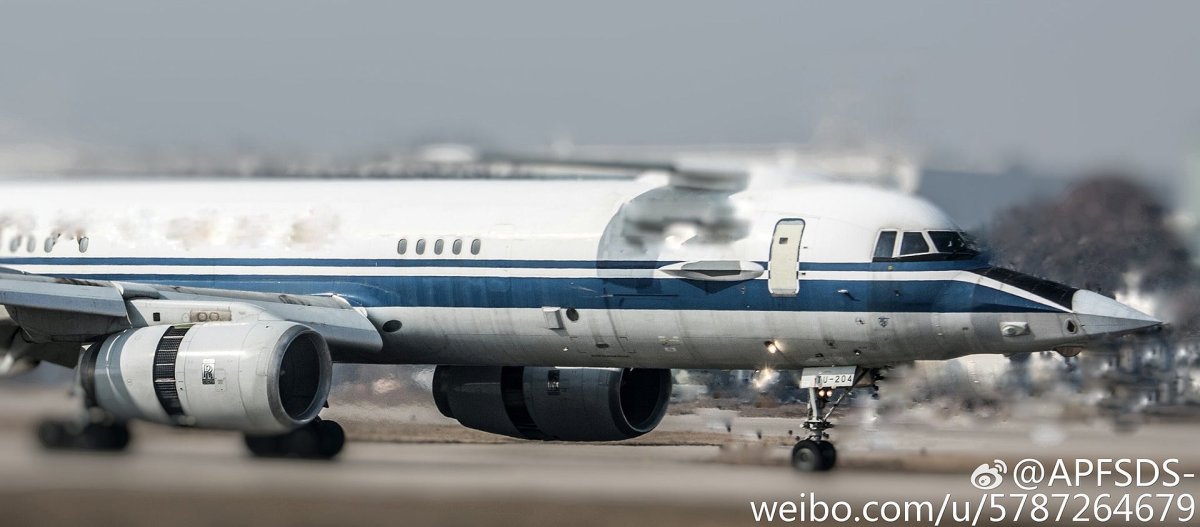
Now an image has emerged that shows how the Chinese are grabbing yet another play right out of modern western fighter development—using a surrogate airliner to act as a flying integrated avionics testbed for their new 5th generation fighter.
China’s J-20 avionics testbed seen at the Yanglian flight test center :
The highly modified Russian-built Tupolev Tu-204C looks like a clone to Boeing’s 757-200 prototype turned F-22 integrated avionics testbed—better known as “The Catfish” due to its unique and highly modified nose profile. The Catfish has worked for nearly two decades to test and perfect the F-22’s ever evolving avionics suite .
Boeing’s Catfish sits on the ramp at its home at Boeing Field in Washington (Clemens Vasters/Wikicommons):
Built primarily around the Raptor’s APG-77 AESA radar and its equally important ALR-94 electronic support measures suite—but also including its low-probability of intercept data-link, AAR-56 IR/UV missile approach warning system and secure communications systems, among other tactical subsystems—the F-22’s sensor suite and its powerful mission computers were unprecedented in their complexity and capability for their time.
Today the system is rivaled only by the one on the F-35. Much of the development that allowed for all these systems to work together reliably in an automated fashion was done aboard the Catfish. The aircraft features not only the iconic nose profile of the Raptor, but also the aircraft’s swept wing leading-edges, in which conformal antennas are buried. Inside the aircraft, computer workstations, server racks and even a recreation of the F-22 cockpit allow for testing in real flying conditions, including recreating tactical and environmental scenarios F-22 pilots may see in real life.
Catfish was by no means the first avionics testbed. Quite the contrary actually. Surrogate aircraft were used to test avionics, and especially radars, all the way back to World War II. But where the F-22 differed was in its level of “sensor fusion,” that was brought about by deep integration of its various sensors, computers, and communications systems. Before it, fighter avionics were largely “federated,” or systems of their own within a large package of individual systems. As such, Catfish represented a new level of surrogate testbed that was necessary to tackle the huge job of making all the F-22’s systems work together, as if by magic, in an actual airborne environment.
Here is Boeing’s press release from Catfish’s first flight in 1999:
“SEATTLE, March 11—Boeing today began testing the F-22 Raptor’s integrated avionics on board its 757 Flying Test Bed. The 757 took off from Boeing Field and tested navigation and sensor emitter management functions.
Testing the Raptor’s advanced avionics aboard the company’s test bed will help reduce risk, as well as cut back on future F-22 flight test hours by enabling extensive in-flight testing, evaluation and troubleshooting before full avionics suites are installed on F-22 fighters.
The first avionics package, Block 1, which includes the radar and mission software, will be tested on the 757 between March and August 1999. Raptor 4004 will be the first aircraft to fly with its integrated avionics installed, and is scheduled to make its first flight in 2000.
Bob Barnes, Boeing vice president and F-22 program manager, said the
initial test flight went extremely well, adding that testing aboard the
757 will allow early delivery of a better developed avionics package.
“Avionics testing on other fighters has taken 4,000 to 6,000 hours,” Barnes added. “We should be able to cut the hours on the F-22 by about 50 percent using our test bed.”
The test avionics are operated from a simulated F-22 cockpit, which has been installed in the test-bed cabin. The cockpit has primary and secondary F-22 displays, as well as a throttle and stick. There is room on the aircraft for up to 30 software engineers and technicians to evaluate the avionics during testing.
Additional modifications to the test bed include installation of an F-22 forward fuselage section to the nose of the plane, and installation of a sensor wing on the plane’s crown. The sensor wing was designed and built to simulate the same wing sweep and orientation as an F-22 wing. Additionally, communication, navigation and identification sensors will be mounted directly on the wing to simulate sensor positioning on the F-22’s wings.
Boeing is teamed with Lockheed Martin, Pratt & Whitney and the U.S. Air Force to develop the F-22. Boeing supplies the F-22’s aft fuselage, wings, radar, 70 percent of the mission software, avionics integration and testing, training and life support systems.”
Since the F-22 became operational over a decade ago, Catfish has continued to play a vital role in supporting upgrades to the jet’s hardware and software, as well as in tactics development to some degree. From time-to-time it will migrate down to Edwards AFB or Nellis AFB for development work, and will even fly alongside other integrated testbeds, like the F-35’s Cooperative Avionics Testbed —nicknamed the CATbird—or those used by Northrop Grumman, Raytheon and other for cross-platform integration.
Knowing all this, it’s easy to see why Chinese aerospace firms involved with the J-20’s development have chosen to take an almost identical, and highly proven, route for developing the J-20’s integrated avionics suite. I mean, it’s not like China has any problems with lifting proven designs and aerospace concepts from the US . And just because this testbed aircraft is just now emerging, it doesn’t mean it hasn’t existed for some time. In fact, most indications point toward the aircraft being fitted with J-20’s radar for at least a year—if not two. Nor does it give any indication as to how far along the J-20’s avionics suite, and particularly its radar, is developmentally.
Contact the author: Tyler@thedrive.com
Comments couldn’t be loaded. Please refresh the page.
更新于美国东部时间2020年7月5日下午6:56
中国的重型隐形战斗拦截机歼-20在过去五年中发展迅速,一些报道称该机可能已经具备有限的初始作战能力。然而,在俄罗斯和中国的航空航天及国防领域,“有限初始作战能力”的含义与西方同行截然不同。早期部署能力有限的装备,然后以螺旋式发展的方式,利用作战部队作为试验场,虽然会给一线部队带来更高的风险和未经充分验证的能力,但也能带来更直接的成果,其战略意义不仅在于部署新的作战能力,还在于对内对外形象的塑造。
无论歼-20的作战状态如何,它都代表着一种潜在威胁,因为它与其他新兴的中国空中武器一样,旨在利用美军作战序列和作战理论中的弱点。但这款战机也代表着中国航空航天和制造能力的巨大飞跃,并且仍然存在许多未解之谜——其中最紧迫的问题或许是其集成航电系统的成熟度和预期性能。
现在出现了一张图片,显示中国正在从现代西方战斗机发展中借鉴另一个策略——使用替代客机作为其新型第五代战斗机的飞行综合航空电子设备测试平台。
在杨联飞行试验中心,中国歼-20航电试验台亮相:
经过高度改装的俄罗斯制造的图波列夫Tu-204C,外形酷似波音757-200原型机,后者被改装成F-22综合航电测试平台——因其独特且经过高度改装的机头轮廓而被昵称为“鲶鱼”。“鲶鱼”已服役近二十年,用于测试和完善F-22不断演进的航电系统。
波音公司的“鲶鱼”飞机停放在位于华盛顿波音机场的停机坪上(Clemens Vasters/Wikicommons):
F-22 的传感器套件及其强大的任务计算机主要围绕猛禽的 APG-77 AESA 雷达和同样重要的 ALR-94 电子支援措施套件构建,但也包括其低截获概率数据链、AAR-56 红外/紫外导弹逼近告警系统和安全通信系统以及其他战术子系统。在当时,F-22 的传感器套件及其强大的任务计算机的复杂性和功能是前所未有的。
如今,只有F-35上的系统能与之匹敌。所有这些系统能够可靠地自动协同工作的诸多研发工作,都是在“鲶鱼”试验机上完成的。这架飞机不仅拥有猛禽战斗机标志性的机头轮廓,还采用了后掠翼前缘设计,其中隐藏着共形天线。机舱内配备了计算机工作站、服务器机架,甚至还复原了F-22的驾驶舱,以便在真实的飞行条件下进行测试,包括模拟F-22飞行员在现实中可能遇到的战术和环境场景。
“鲶鱼”绝非首个航空电子设备测试平台。恰恰相反,早在二战时期,人们就利用替代飞机来测试航空电子设备,尤其是雷达。但F-22的独特之处在于其“传感器融合”水平,这得益于其各种传感器、计算机和通信系统的深度集成。在此之前,战斗机的航空电子设备大多是“联邦式”的,或者说是包含在一个庞大的独立系统包中的独立系统。因此,“鲶鱼”代表了一种新型的替代测试平台,它对于解决F-22所有系统在实际空中环境中协同工作的艰巨任务至关重要,就像变魔术一样。
以下是波音公司1999年“鲶鱼”号首飞时发布的新闻稿:
西雅图,3月11日——波音公司今天开始在其757飞行测试平台上测试F-22猛禽战斗机的集成航空电子设备。这架757飞机从波音机场起飞,测试了导航和传感器发射器管理功能。
在公司测试平台上测试猛禽战机的先进航空电子设备将有助于降低风险,并通过在F-22战斗机上安装完整的航空电子设备套件之前进行广泛的飞行测试、评估和故障排除,来减少未来的F-22飞行测试时间。
第一个航空电子设备组件 Block 1(包括雷达和任务软件)将于 1999 年 3 月至 8 月在 757 飞机上进行测试。猛禽 4004 将是第一架安装集成航空电子设备的飞机,计划于 2000 年进行首飞。
波音公司副总裁兼F-22项目经理鲍勃·巴恩斯表示:
首次试飞非常成功,并补充说,机载测试也进展顺利。
757 将允许更早地交付更完善的航空电子设备。
巴恩斯补充说:“其他战斗机的航电测试耗时4000到6000小时。利用我们的测试平台,我们应该能够将F-22的测试时间缩短约50%。”
测试航电系统由安装在测试平台机舱内的模拟F-22座舱操作。该座舱配备F-22主副显示器,以及油门杆和操纵杆。飞机上可容纳多达30名软件工程师和技术人员,以便在测试期间评估航电系统。
对试验台的其他改进包括在机头安装F-22的前机身段,以及在机头顶部安装传感器翼。该传感器翼的设计和制造旨在模拟F-22机翼的后掠角和姿态。此外,通信、导航和识别传感器将直接安装在机翼上,以模拟F-22机翼上的传感器位置。
波音公司与洛克希德·马丁公司、普惠公司和美国空军合作开发F-22战斗机。波音公司为F-22提供后机身、机翼、雷达、70%的任务软件、航空电子设备集成和测试、培训以及生命保障系统。
自F-22战机十多年前投入使用以来,“鲶鱼”(Catfish)测试机在支持该战机硬件和软件升级以及一定程度的战术发展方面一直发挥着至关重要的作用。它会不时地前往爱德华兹空军基地或内利斯空军基地进行研发工作,甚至会与其他综合测试平台并肩飞行,例如F-35的合作航电测试平台(绰号“猫鸟”),以及诺斯罗普·格鲁曼公司、雷神公司和其他公司用于跨平台集成的测试平台。
了解了这些,就不难理解为什么参与歼-20研发的中国航空航天企业会选择一条几乎相同且久经考验的路线来开发歼-20的综合航电系统。毕竟,中国借鉴美国成熟的设计和航空航天理念并非难事。而且,这架试验机虽然是最近才出现的,但这并不意味着它之前从未存在过。事实上,种种迹象表明,这架飞机至少在一年甚至两年前就已经装配了歼-20的雷达。但这也丝毫没有说明歼-20的航电系统,尤其是雷达,究竟研发到了什么程度。
联系作者:Tyler@thedrive.com
评论加载失败,请刷新页面。