Australia aims to boost local arms production. So far it’s leaning foreign.澳大利亚的目标是提升本土武器生产能力。但就目前而言,它仍然倾向于进口武器。
Are the government’s efforts to sovereignly produce guided weapons misguided?
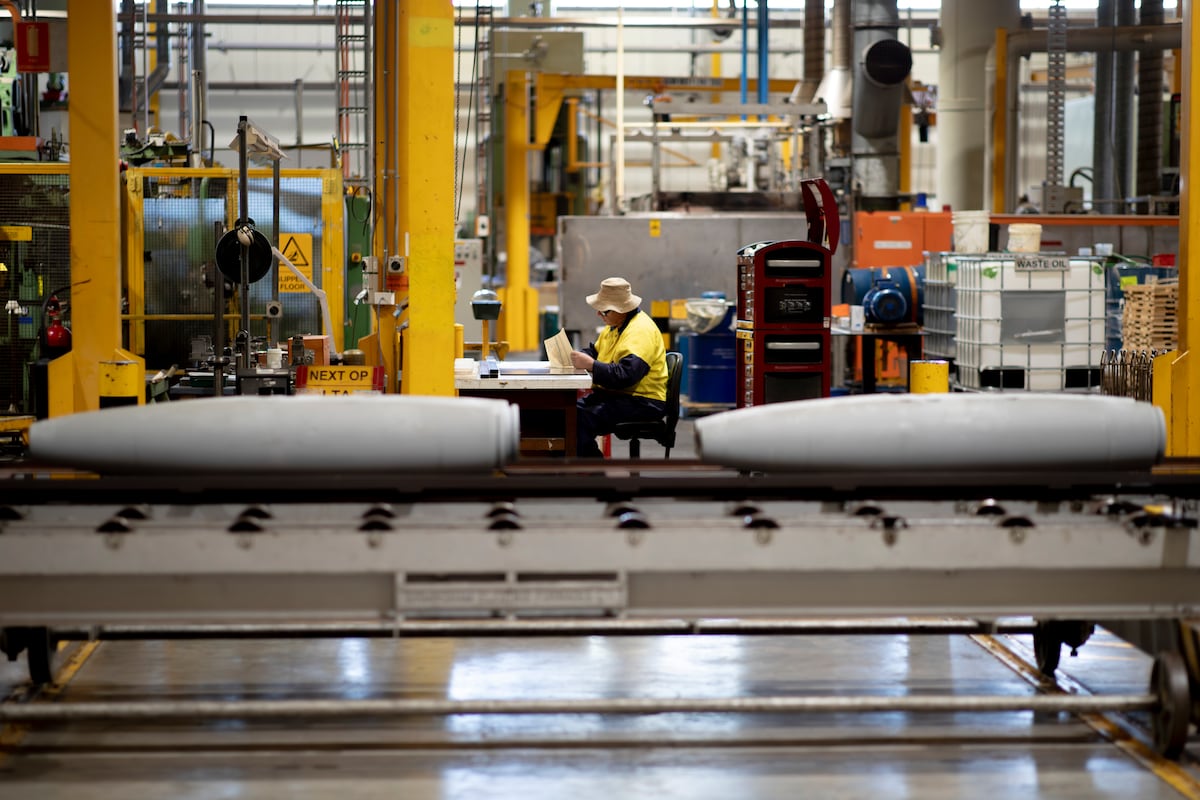
CHRISTCHURCH, New Zealand — Travis Reddy wants to buy a Brazilian weapons manufacturer .
As the CEO of DefendTex, an Australian firm specializing in precision-guided weapons, rockets and loitering munitions, he’s encouraged by a government-run program aimed at growing the domestic industry’s capability to build long-range weaponry. The problem, though, is he can’t get the financial backing expected from the Australian government’s Guided Weapons and Explosive Ordnance Enterprise program.
Instead, large defense contractors, especially those hailing from overseas, are receiving preferential treatment, according to a local analyst.
“There’s a tendency by government to default to the primes. Everything must go through Lockheed Martin, Boeing, Thales or whatever. Let’s see what SMEs [small and medium enterprises] can do in terms of things like long-range missiles,” said Malcolm Davis, an expert in capability development and military technology at the Australian Strategic Policy Institute. “Give them a chance to actually demonstrate their capabilities.”
For months, DefendTex has been asking Export Finance Australia — the government’s export credit agency — for a yearlong AU$70 million (U.S. $46 million) loan to acquire cash-strapped Avibras in Brazil. Reddy said he’s depending on the government to assist, noting that domestic banks have refused to provide him a loan as a weapons manufacturer.
DefendTex’s exclusive negotiation period with Avibras has reportedly expired, as the timetable was to last until the end of June. Already the Chinese defense industry giant NORINCO is taking steps to buy the business. To sweeten the deal, NORINCO has expressed a willingness to manufacture Chinese weapons in Brazil.
But Reddy said Australia could benefit from Avibras’ extensive experience with guided weapons, gain intellectual property and quickly replicate manufacturing facilities on Australian soil. “We know that within 24 months we’d achieve full-rate production in Australia: the full IP suite, the seeker, propulsion system, the whole box and dice.”
A DefendTex-made D40 underslung grenade launcher-deployed drone flies through the air during an exercise in England on Oct. 13, 2020. (Leon Neal/Getty Images)
Referring to mounting geopolitical tensions in the Asia-Pacific region, Davis highlighted the government’s slow response time with endeavors like the Guided Weapons and Explosive Ordnance (GWEO) Enterprise.
“At the moment it seems to be moving very much at a snail’s pace on a small scale, a very hesitant approach on the part of government, which I don’t understand given the very adverse strategic outlook we’re facing,” he said.
The GWEO Enterprise program is the government’s official vehicle to develop a sovereign capability for producing long-range strike weapons . It currently boasts about 900 personnel and was formally created in May 2023 when Air Marshal Leon Phillips was appointed its inaugural chief.
“The GWEO group was established to accelerate the development of a guided weapons and explosive ordnance manufacturing industry in Australia,” Phillips told Defense News.
He outlined the enterprise’s two main functions: to establish a manufacturing industry, and to manage the acquisition, sustainment and support of weapons. According to the Defence Department’s website, the government is spending $4.1 billion to increasingly buy long-range strike systems and locally manufacture longer-range munitions.
However, Reddy said the program’s lean toward American defense companies is hindering plans like his.
Indeed, the government has appointed the Australian arms of the American firms RTX and Lockheed Martin as GWEO’s strategic partners.
“The strategic partners and their U.S. parent companies are working with [the Department of] Defence to explore opportunities for greater partnerships and, to this end, are developing detailed, costed plans for manufacturing guided weapons and their components in Australia,” Phillips said.
The department has said it will consider those “costed plans” in the second quarter of 2024.
“Support and assistance from the U.S. is critical to the success of the GWEO Enterprise. At the Australia-U.S. Ministerial Consultations in July 2023, the principals agreed to deepen cooperation on Australia’s GWEO Enterprise by collaborating on a flexible guided-weapons production capability in Australia. This cooperation is underway, and an initial batch of GMLRS [Guided Multiple Launch Rocket System] missiles will be manufactured in Australia by 2025,” Phillips added, referring to a AU$37.4 million contract for Lockheed Martin Australia, announced in January 2024.
U.S. Marines fire GMLRS rockets from a High Mobility Artillery Rocket System during the exercise Talisman Sabre in Queensland, Australia, on July 19, 2021. (Lance Cpl. Ujian Gosun/U.S. Marine Corps)
James Heading, the director of programs at the Strategic Capabilities Office within Lockheed Martin Australia’s missiles and fire control division, said further developing industry is critical and that GMLRS is a good starting point for the country. International demand for GMLRS is growing, especially in Ukraine amid its war with Russia.
“That doesn’t necessarily mean everything’s manufactured in Australia,” Heading added. For example, he noted, it might be five to 10 years before Australian industry can unilaterally build missile seekers for the GMLRS.
Tenders for GMLRS production-related requirements in Australia close around the June-July time frame this year, which will lead to the assembly of GMLRS kits starting next year at the munitions storage base Defence Establishment Orchard Hills in Sydney. What will follow is the gradual introduction of domestically assembled components, before ramping up quantities, Heading said.
To be clear, Reddy said, he doesn’t take issue with the Lockheed deal, but does think the government needs a backup plan.
“I’m not saying don’t do GMLRS, don’t do HIMARS [High Mobility Artillery Rocket System]. Do all of that and preserve 5% of your budget [for] a plan B,” he said, referring to government funding to support domestic industry acquisitions. “That would be the pragmatic approach to ensuring we get the best of both worlds. So if the world goes to hell in a handbasket tomorrow, we’ve got something we can respond with.”
He argued that the purchase of Avibras would be a “very cheap” insurance policy that does not detract from any long-term plans dependent on American firms.
Davis agreed that there isn’t a clear path from the Lockheed deal that would lead to more locally made, sophisticated capabilities. “I think it’s taken an inordinately long time to actually make any progress, and we’re only talking about assembling GMLRS components here in Australia in 2025.”
People fill shells at a government explosives factory in Australia in the 1940s. (Hulton Archive/Getty Images)
He said the government should encourage industry to pursue the local production of longer-range weapons like the Long Range Anti-Ship Missile, the extended-range variant of the Joint Air-to-Surface Standoff Missile, and the Tomahawk cruise missile — all of which are made by American businesses.
But the GWEO Enterprise isn’t just about American-made weapons. For example, the Spike missile by Israel’s Rafael Advanced Defense Systems and the Naval Strike Missile by Norway’s Kongsberg are both candidates for domestic production.
“GWEO is really about giving industry the opportunity to participate,” Heading said, noting gaps in Australia’s defense industry are due to capacity rather than ability.
To overcome these issues, Davis suggested the government further prioritize the GWEO program as well as incorporate lessons from the Russia-Ukraine war.
“We should actually be looking at how can we, ourselves, develop the long-range strike capabilities that can support the needs of the ADF [Australian Defence Force], the needs of our allies and partners, and offer us an export capability as well,” he urged. “Once again, there seems to be this lack of boldness and vision on the part of the government just to even think beyond the most minimalist application of GWEO in the near term.
“I don’t understand why their perception of GWEO is so constrained and so limited.”
Part of the problem is Australia’s peacetime mindset, Davis said.
“We assume that nothing bad will happen in this decade, and that we’ve got 10 years to wait. Ironically, we’ve said in past defense whitepapers that we no longer have 10 years of strategic warning, but that mindset of 10-year strategic warning time is still pervasive in the defense organization and within government,” he explained.
“There needs to be recognition that we might have two, maybe three years to prepare for a major war,” he added. “So what can we do in the next two to three years in terms of mass production of capabilities? That’s going to take some risks, it’s going to take a bit of vision.
“My concern is that those decisions won’t be made and we’ll end up going into a next war in 2027 or 2028 with what we’ve got — and not much to show for GWEO.”
An Australian-manufactured BLU-111 detonates at the Port Wakefield testing area in South Australia. (Australian Defence Department)
To be sure, the program hasn’t been idle, Philips said, noting several major achievements to date, including upgrades to infrastructure and technology at the government-owned Mulwala and Benalla munitions factories operated by Thales Australia; remediation of the Port Wilson wharf to enable large-scale imports and exports of weapons; commissioned construction of additional storage and distribution infrastructure; and domestic production of 500-pound BLU-111 bombs.
In addition to the GMLRS contract, Phillips also pointed to accelerated acquisitions of Tomahawks, JASSM-ERs, Naval Strike Missiles and sea mines from overseas.
But these foreign purchases by the government don’t help with situations like Reddy’s.
“They’re not taking any steps to develop a domestic, sovereign alternative to the kind of weapons they need,” he said. “In the event of high-intensity conflict, will Australia as a nation have the ability to manufacture the ordnance that it needs to keep the Australian Defence Force capable of conducting its mission? The overwhelming answer is no.”
Gordon Arthur is an Asia correspondent for Defense News. After a 20-year stint working in Hong Kong, he now resides in New Zealand. He has attended military exercises and defense exhibitions in about 20 countries around the Asia-Pacific region.
新西兰基督城——特拉维斯·雷迪想要收购一家巴西武器制造商。
作为澳大利亚一家专门生产精确制导武器、火箭和巡飞弹的公司DefendTex的首席执行官,他受到一项旨在提升国内产业远程武器制造能力的政府项目的鼓舞。然而,问题在于他无法从澳大利亚政府的“制导武器和爆炸物企业计划”中获得预期的资金支持。
一位当地分析人士表示,相反,大型国防承包商,尤其是来自海外的承包商,正在享受优惠待遇。
“政府往往倾向于依赖大型企业。所有项目都必须通过洛克希德·马丁、波音、泰雷兹或其他类似的公司。让我们看看中小企业在远程导弹等领域能做些什么,”澳大利亚战略政策研究所能力发展和军事技术专家马尔科姆·戴维斯说道。“给他们一个机会,让他们真正展现自己的能力。”
几个月来,DefendTex公司一直向澳大利亚出口信贷局(政府的出口信贷机构)申请一笔为期一年的7000万澳元(约合4600万美元)贷款,用于收购资金短缺的巴西Avibras公司。雷迪表示,他指望政府的帮助,并指出国内银行拒绝向他这家武器制造商提供贷款。
据报道,DefendTex与Avibras的独家谈判期已结束,原定谈判期限至6月底。中国国防工业巨头北方工业公司(NORINCO)已开始着手收购Avibras。为了促成交易,北方工业公司表示愿意在巴西生产中国制造的武器。
但雷迪表示,澳大利亚可以借鉴Avibras在制导武器方面的丰富经验,获得知识产权,并迅速在澳大利亚本土复制生产设施。“我们知道,24个月内我们就能在澳大利亚实现全速生产:包括全部知识产权、导引头、推进系统,以及所有相关部件。”
2020年10月13日,在英国的一次演习中,一架由DefendTex公司制造的D40型下挂式榴弹发射器无人机在空中飞行。(Leon Neal/Getty Images)
戴维斯在谈到亚太地区日益紧张的地缘政治局势时,强调了政府在制导武器和爆炸物(GWEO)企业等项目上反应迟缓。
他说:“目前看来,这项工作进展非常缓慢,规模也很小,政府方面的态度非常犹豫,考虑到我们面临的非常不利的战略前景,我无法理解这一点。”
全球远程作战工程企业计划是政府发展自主生产远程打击武器能力的官方途径。该计划目前拥有约900名员工,并于2023年5月正式成立,当时空军元帅莱昂·菲利普斯被任命为首任负责人。
菲利普斯告诉《防务新闻》:“GWEO集团的成立是为了加速澳大利亚制导武器和爆炸物制造产业的发展。”
他概述了该企业的两大主要职能:建立制造业,以及管理武器的采购、维护和保障。据国防部网站显示,政府正斥资41亿美元,用于不断采购远程打击系统,并在本地生产远程弹药。
然而,雷迪表示,该计划对美国国防公司的偏袒阻碍了像他这样的计划。
事实上,政府已指定美国公司RTX和洛克希德·马丁的澳大利亚分公司为GWEO的战略合作伙伴。
菲利普斯说:“战略合作伙伴及其美国母公司正在与国防部合作,探索扩大合作的机会,为此,他们正在制定详细的、有成本的计划,以便在澳大利亚制造制导武器及其部件。”
该部门表示,将在 2024 年第二季度考虑这些“成本核算计划”。
“美国的支持和援助对全球地球同步轨道飞行器(GWEO)项目的成功至关重要。在2023年7月举行的澳美部长级磋商中,双方同意通过在澳大利亚合作建立灵活的制导武器生产能力,深化澳大利亚GWEO项目的合作。这项合作正在进行中,首批多管火箭炮系统(GMLRS)导弹将于2025年在澳大利亚生产,”菲利普斯补充道。他指的是2024年1月宣布的与洛克希德·马丁澳大利亚公司签订的价值3740万澳元的合同。
2021年7月19日,在澳大利亚昆士兰州举行的“护身军刀”演习中,美国海军陆战队员使用高机动性火箭炮系统发射GMLRS火箭。(美国海军陆战队下士乌吉安·戈松摄)
洛克希德·马丁澳大利亚公司导弹与火控部门战略能力办公室项目主管詹姆斯·海丁表示,进一步发展相关产业至关重要,而GMLRS(通用多管火箭炮系统)是澳大利亚的良好起点。国际市场对GMLRS的需求正在增长,尤其是在乌克兰与俄罗斯交战期间。
海丁补充道:“但这并不一定意味着所有东西都是在澳大利亚制造的。”例如,他指出,澳大利亚工业界可能需要五到十年的时间才能独立为GMLRS系统制造导弹导引头。
澳大利亚GMLRS(通用多管火箭炮系统)生产相关需求的招标将于今年6月至7月左右截止,届时GMLRS组件将于明年在悉尼的奥查德山国防基地开始组装。海丁表示,接下来将逐步引入国产组装的零部件,然后再逐步提高产量。
雷迪明确表示,他并不反对洛克希德公司的交易,但他认为政府需要一个备用方案。
“我不是说不要研发GMLRS(通用多管火箭炮系统),也不要研发HIMARS(高机动性火箭炮系统)。而是说,把这些都研发出来,然后留出5%的预算作为备选方案,”他指的是政府拨款支持国内工业采购。“这才是务实的做法,确保我们能两全其美。这样,即使明天世界陷入混乱,我们也有应对之策。”
他认为,收购 Avibras 将是一份“非常便宜”的保险,不会损害任何依赖美国公司的长期计划。
戴维斯也认为,从洛克希德的交易来看,并没有明确的途径能够带来更多本地制造的先进能力。“我认为,取得任何进展都花费了异常长的时间,而我们现在讨论的仅仅是在2025年之前在澳大利亚组装GMLRS的部件。”
20世纪40年代,澳大利亚一家政府炸药厂的工人们正在装填炮弹。(Hulton Archive/Getty Images)
他表示,政府应该鼓励工业界追求远程武器的本地化生产,例如远程反舰导弹、联合空对地防区外导弹的增程型以及战斧巡航导弹——所有这些武器都是由美国企业制造的。
但全球武器出口组织(GWEO)的战略目标并非仅限于美国制造的武器。例如,以色列拉斐尔先进防御系统公司的“长钉”导弹和挪威康斯伯格公司的“海军打击”导弹都是美国本土生产的候选武器。
“GWEO 的真正意义在于让业界有机会参与,”海丁说,并指出澳大利亚国防工业的差距是由于产能不足而不是能力不足造成的。
为了克服这些问题,戴维斯建议政府进一步优先考虑全球变暖与环境组织(GWEO)计划,并吸取俄乌战争的教训。
他敦促道:“我们实际上应该考虑如何自主发展远程打击能力,以满足澳大利亚国防军、盟友和伙伴的需求,并为我们自身提供出口能力。” “政府似乎再次缺乏魄力和远见,甚至连在短期内对全球空间战(GWEO)进行最基本的应用都不愿考虑。”
“我不明白为什么他们对全球变暖观测组织的认知如此局限和狭隘。”
戴维斯说,部分原因是澳大利亚的和平时期思维模式。
“我们假设这十年内不会发生任何坏事,我们有十年的时间可以等待。具有讽刺意味的是,我们过去在国防白皮书中说过,我们不再有十年的战略预警时间,但这种十年战略预警时间的思维模式在国防机构和政府内部仍然普遍存在,”他解释道。
他补充说:“我们必须认识到,我们可能只有两到三年的时间来准备一场大战。那么,在接下来的两到三年里,我们在大规模生产作战能力方面可以做些什么呢?这需要承担一些风险,也需要一些远见卓识。”
“我担心的是,这些决定不会做出,最终我们会带着现有的资源在 2027 年或 2028 年卷入下一场战争——而全球变暖与外星秩序计划(GWEO)并没有给我们留下多少成果。”
一枚澳大利亚制造的BLU-111炸弹在南澳大利亚州韦克菲尔德港试验场引爆。(澳大利亚国防部)
菲利普斯表示,该计划当然没有停滞不前,并指出迄今为止取得了几项重大成就,包括对泰雷兹澳大利亚公司运营的政府所有的穆尔瓦拉和贝纳拉弹药厂的基础设施和技术进行升级;修复威尔逊港码头,以便大规模进出口武器;委托建造额外的存储和配送基础设施;以及在国内生产500磅重的BLU-111炸弹。
除了 GMLRS 合同外,菲利普斯还指出,美国正在加速从海外采购战斧导弹、JASSM-ER 导弹、海军打击导弹和水雷。
但政府的这些海外采购对像雷迪这样的情况并无帮助。
他说:“他们没有采取任何措施来研发他们所需的国产、自主的武器替代方案。一旦爆发高强度冲突,澳大利亚作为一个国家是否有能力制造出维持澳大利亚国防军执行任务所需的军火?答案显然是否定的。”
戈登·阿瑟是《防务新闻》的亚洲特派记者。在香港工作20年后,他现居新西兰。他曾到访亚太地区约20个国家,参加过军事演习和防务展览。