First batch of Marine amphibious combat vehicles arrive in Okinawa首批海军陆战队两栖作战车辆抵达冲绳
The vehicle had its overseas operational debut in May.
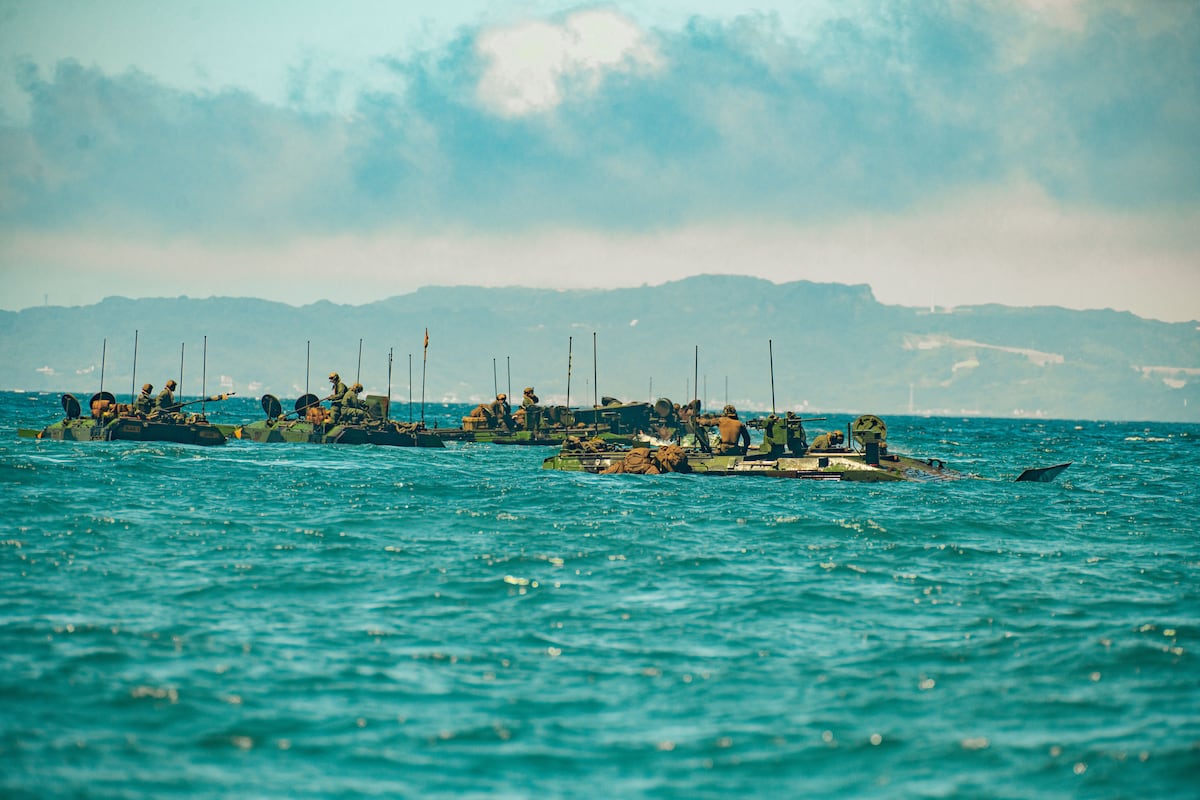
Marines on Okinawa, Japan, have received their first batch of amphibious combat vehicles ― the Corps’ upgrade for the assault amphibious vehicle that has been in service since the Vietnam-era.
III Marine Expeditionary Force received the shipment of amphibious combat vehicles at Naha Military Port on Saturday, according to a Marine press release .
“Upgrading our fleet with amphibious combat vehicles capable of supporting sea denial and maritime operations will further bolster our ability to support deterrence efforts and respond to contingencies in the Indo-Pacific,” Lt. Gen. Roger Turner, III MEF commanding general, said in the press release.
Those vehicles will head to Camp Schwab on the north end of the island.
The first overseas employment of the amphibious combat vehicle took place in early May , when the 15th Marine Expeditionary Unit conducted a live-fire, waterborne gunnery range exercise in Oyster Bay, Philippines, during the annual Balikatan exercise with that partner nation.
Section leaders within the amphibious combat vehicle platoon, Alpha Company, Battalion Landing Team 1/5, used the coordinated simultaneous fires of all their section’s weapons while afloat against targets ashore.
Teams fired 40 mm training rounds that marked targets with orange chalk on impact instead of high explosive rounds due to the location.
The amphibious combat vehicle is a next-generation, eight-wheeled vehicle designed to move Marines from ship to shore, according to the Marine Corps. It will be the primary tactical mobility for the Marine infantry battalion at sea and ashore, replacing the assault amphibious vehicle.
The assault amphibious vehicle uses tracks instead of wheels is smaller and has a flatter hull.
The new vehicle can carry three crew members with 13 Marines and two days of combat load, according to a report issued in May by the Congressional Research Service .
Col. Tim Hough first announced in early May that a dozen amphibious combat vehicles would arrive at 4th Marine Regiment in Okinawa, Japan, this summer. Hough serves as the Corps’ program manager for advanced amphibious assault.
Marines with Amphibious Vehicle Test Branch, Marine Corps Tactical Systems Support Activity, drive amphibious combat vehicles low-light surf transit testing on Camp Pendleton, California, Dec. 18, 2019. (Lance Cpl. Andrew Cortez/Marine Corps)
“That’s important because now we’ll be in distinct geographical locations,” Hough said.
The move comes as the service prepared in recent years to handle challenges of having the amphibious combat vehicles spread out globally for the first time.
BAE Systems, the vehicle manufacturer, has fielded 184 vehicles to the Corps since fielding began in late 2020.
But those have been housed at the Assault Amphibian School and 3rd Assault Amphibian Battalion at Camp Pendleton, California.
Following multiple rollovers in 2022 the Corps temporarily pulled the vehicles from operations in the surf zone. The rollovers did not result in any reported injuries and the service later determined they were a result of insufficient training on differences between the new vehicle and its predecessor.
Initial requirements for the amphibious combat vehicle were conceived in 2014. The service selected BAE Systems to produce the vehicle in mid-2018. Fielding began in late 2020.
The Marine Corps reduced its initial request of funding to procure 108 vehicles for fiscal year 2025 due to spending caps down to 80 vehicles, according to the Congressional Research Service report.
The command-and-control-focused variant reached initial operating capability this summer. The Corps expects the variant with a 30-mm cannon will reach initial operational capability in 2026, officials said.
Todd South has written about crime, courts, government and the military for multiple publications since 2004 and was named a 2014 Pulitzer finalist for a co-written project on witness intimidation. Todd is a Marine veteran of the Iraq War.
驻扎在日本冲绳的美国海军陆战队员收到了他们的第一批两栖作战车辆——这是海军陆战队对越战时期服役的两栖突击车的升级。
据海军陆战队新闻稿称,第三海军陆战远征军于周六在那霸军事港接收了这批两栖作战车辆。
“通过装备能够支持海上拒止和海上作战的两栖作战车辆来升级我们的舰队,将进一步增强我们支持威慑行动和应对印太地区突发事件的能力,”第三海军陆战队远征军司令罗杰·特纳中将在新闻稿中表示。
这些车辆将前往岛屿北端的施瓦布营地。
该两栖作战车辆首次海外部署是在 5 月初,当时第 15 海军陆战队远征部队在菲律宾牡蛎湾与该伙伴国家举行年度“肩并肩”联合军演期间,进行了一次实弹水上炮击靶场演习。
两栖战斗车辆排、第 1/5 营登陆队 Alpha 连的班长们利用本班所有武器在水上对岸目标进行协调一致的火力打击。
由于比赛地点的原因,各队发射的是 40 毫米训练弹,这种训练弹会在撞击目标时用橙色粉笔标记目标,而不是高爆弹。
据海军陆战队称,这款两栖作战车辆是一款新一代八轮车辆,旨在将海军陆战队员从舰艇运送到岸上。它将成为海军陆战队步兵营在海上和岸上的主要战术机动工具,取代突击两栖车。
这种两栖突击车采用履带而非轮子,车身更小,车体更扁平。
根据国会研究服务处 5 月份发布的一份报告,这种新型车辆可以搭载 3 名乘员、13 名海军陆战队员以及两天的作战物资。
蒂姆·霍夫上校于五月初首次宣布,今年夏天将有十二辆两栖作战车辆抵达驻扎在日本冲绳的美国海军陆战队第四团。霍夫是海军陆战队先进两栖突击项目的项目经理。
2019年12月18日,在加利福尼亚州彭德尔顿营地,隶属于海军陆战队战术系统支援活动两栖车辆测试分队的海军陆战队员驾驶两栖作战车辆进行低光照冲浪通行测试。(海军陆战队下士安德鲁·科尔特斯/海军陆战队)
“这很重要,因为现在我们将身处不同的地理位置,”霍夫说。
此举是近年来该军种为应对两栖作战车辆首次在全球范围内部署所带来的挑战而做的准备。
自 2020 年底开始交付以来,车辆制造商 BAE Systems 已向美国陆军工程兵团交付了 184 辆车辆。
但这些装备一直存放在加利福尼亚州彭德尔顿营的两栖突击学校和第3两栖突击营。
2022年发生多起翻车事故后,海军陆战队暂时停止了这些车辆在冲浪区的作业。这些翻车事故未造成人员伤亡,事后调查认定事故原因是新旧车辆之间的差异缺乏足够的培训。
两栖作战车辆的最初需求是在 2014 年提出的。2018 年年中,军方选择 BAE 系统公司生产该车辆。2020 年底开始列装。
据国会研究服务处报告,由于支出上限降至 80 辆车,海军陆战队将 2025 财年采购 108 辆车的最初资金申请减少了 80 辆车。
以指挥控制为重点的改进型已于今年夏季达到初始作战能力。官员表示,海军陆战队预计配备30毫米机炮的改进型将于2026年达到初始作战能力。
自2004年以来,托德·索斯为多家出版物撰写有关犯罪、法院、政府和军事方面的文章,并因与人合著的关于恐吓证人的文章入围2014年普利策奖决赛。托德是参加过伊拉克战争的海军陆战队老兵。