Taiwan-US ‘firepower’ center to hone asymmetric warfare tactics台美“火力中心”将磨练非对称作战战术
Taiwan, for its part, would contribute “elite troops,” and Washington might assign personnel in Guam or elsewhere in the Indo-Pacific region to help.
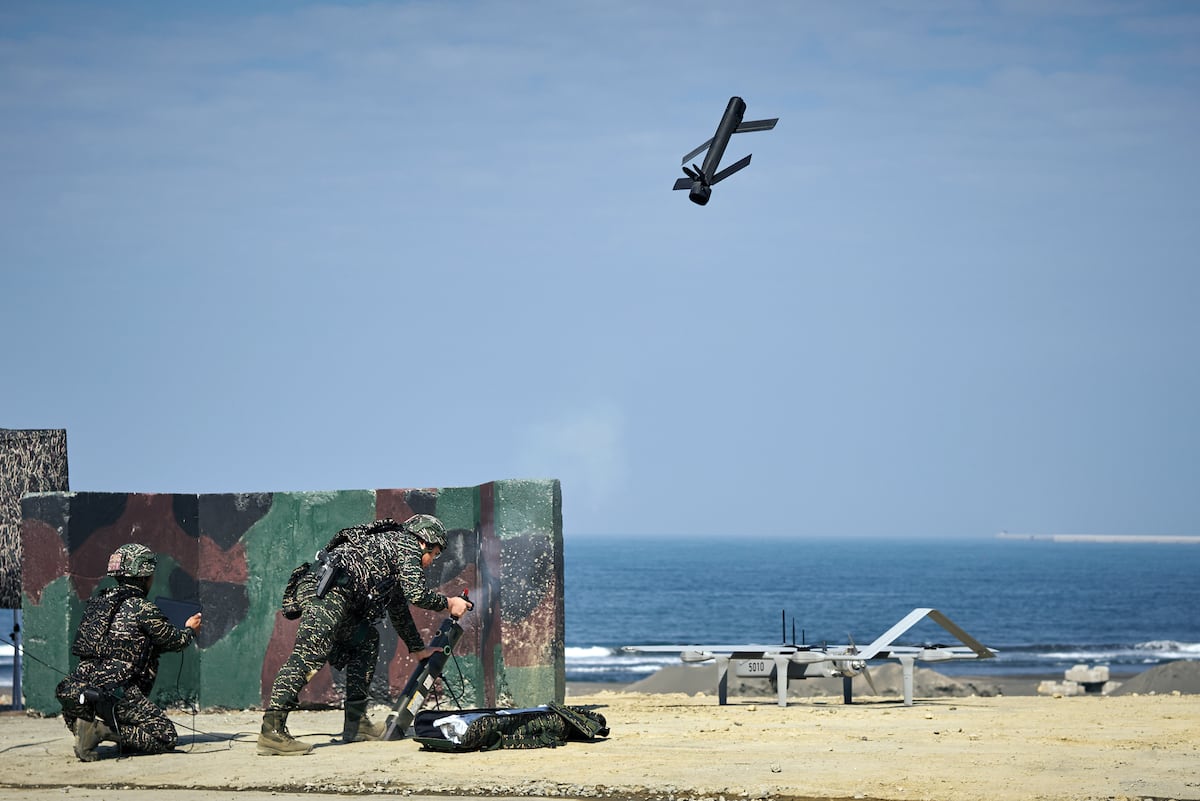
HONG KONG — The United States and Taiwan are expected to roll out their latest hardware and use elite Taiwanese troops under a joint project to prepare for asymmetric warfare in case the island government’s long-time political rival China attacks, according to military experts.
That effort, the Joint Firepower Cooperation Center, as first reported by Taiwan’s United Daily News late last month, would help coordinate a Taiwanese defense against the People’s Liberation Army forces ahead of 2027, when some American think tanks believe China will have sufficient attack capability.
The United States would likely offer military equipment made by some of its major contractors to the Joint Firepower Cooperation Center, the latest preparedness measure as Beijing steps up military pressure, according to Taiwanese media reports and analysts in Taipei.
Northrop Grumman, for example, has already installed a medium-caliber ammunition test range in Taiwan, letting the island’s defense ministry run tests on “global industry standards” and allowing transfers of technology to support home-grown hardware, the de facto U.S. embassy, the American Institute in Taiwan, wrote on its website on Jan. 22.
Fellow American contractor Anduril has also set up an “initiative” to find local suppliers for key components for its Ghost-X autonomous air vehicle, the website says.
Deliveries from previously agreed U.S. arms sales from Taiwan could be added to the cooperation effort as those deals lead to deliveries, said Huang Chung-ting, assistant research fellow with the Institute for National Defense and Security Research in Taipei.
Taiwan, for its part, would contribute “elite troops,” and Washington might assign personnel in Guam or elsewhere in the Indo-Pacific region to help as “they understand Taiwan’s military status,” Huang said.
The big idea is to help Taiwan practice asymmetric air and sea warfare, the strategy where a numerically weaker force fights off a stronger one through unconventional means, analysts say. China’s military is significantly larger than Taiwan’s.
“In the event of a kinetic conflict with China, Taiwan has no chance of succeeding at a traditional strategy of air superiority,” said Bethany Allen, head of China investigations with the Australian Strategic Policy Institute.
“But as we’ve seen in Ukraine, a militarily weaker actor can successfully defend against an invasion through air denial,” Allen said. “In Taiwan’s case, a strategy of air denial could be especially effective, since Taiwan is an island and no invasion by land route can occur. To that end, surface to air missiles, drone swarms, and other anti-aircraft weapons could be very effective.”
Taiwan, though it has missiles and batteries, lacks certain military intelligence, surveillance and reconnaissance “capacity,” said Alexander Huang, strategic studies professor at Taiwan’s Tamkang University. The military could particularly use improvements in interceptions and early warnings, he added.
“I think a joint collaboration would provide Taiwan with better targeting and better signaling,” the professor said.
China, about 100 miles away from Taiwan at its closest point, sees the self-ruled island as part of its territory and has not ruled out military force if other unification efforts fail. Since August 2022 it has flown military aircraft near the island almost daily and carried out seven large-scale drills at sea.
“We’d need to avoid letting the PLA’s units challenge Taiwanese airspace, it would be that kind of goal,” Huang Chung-ting said. If the firepower cooperation effort worked out, he said, “coordination between weapons and personnel would be all the better”.
Neither side’s military has elaborated.
The U.S. Indo-Pacific Command in Hawaii declined to comment in late January but pointed to online news reports indicating that the United States would not deploy troops to the joint firepower center.
A media liaison with Taiwan’s Ministry of National Defense said last week it was “inconvenient to disclose details” about the cooperation center but that it had already “systemized” and “deepened” cooperation with the U.S. military to strengthen its capabilities.
Since 1950, the United States has sold Taiwan nearly $50 billion in defense “equipment and services”, the Council on Foreign Relations think tank says in a 2024 study. The U.S. government had troops in Taiwan until 1979, the year it switched diplomatic recognition to Beijing, but Washington still considers the island a quiet security partner in view of China’s growing strength.
Beijing has indicated that it’s unfazed.
Taiwanese weapons, even if “coordinated” under the firepower cooperation center, “are not that advanced” and “no match for the Chinese People’s Liberation Army”, the Beijing-based Global Times said Jan. 26, quoting a Chinese military expert.
香港——据军事专家称,美国和台湾预计将推出最新装备,并根据一项联合计划使用台湾精锐部队,以应对可能发生的非对称战争,以防台湾长期政治对手中国发动攻击。
据台湾《联合日报》上月底报道,这项名为“联合火力合作中心”的计划旨在协调台湾在2027年之前抵御中国人民解放军的进攻,一些美国智库认为,届时中国将拥有足够的攻击能力。
据台湾媒体报道和台北分析人士称,随着北京加大军事压力,美国可能会向联合火力合作中心提供一些主要承包商生产的军事装备,这是最新的备战措施。
例如,诺斯罗普·格鲁曼公司已经在台湾建立了一个中口径弹药试验场,让台湾国防部按照“全球行业标准”进行测试,并允许技术转让以支持本土硬件。事实上的美国大使馆——美国在台协会——于 1 月 22 日在其网站上写道。
该网站称,另一家美国承包商 Anduril 也发起了一项“倡议”,为其 Ghost-X 无人飞行器寻找关键部件的本地供应商。
台北国防安全研究院助理研究员黄仲廷表示,此前美国对台军售达成的协议,随着相关交易的推进,可以把这些军火纳入合作范围。
黄说,台湾方面将提供“精锐部队”,而华盛顿可能会在关岛或印太地区的其他地方派遣人员提供帮助,因为“他们了解台湾的军事地位”。
分析人士称,此举旨在帮助台湾演练非对称海空作战,即以少胜多,运用非常规手段对抗兵力较弱的一方。中国的军事规模远大于台湾。
澳大利亚战略政策研究所中国调查负责人贝瑟尼·艾伦表示:“如果与中国发生实际冲突,台湾没有机会通过传统的空中优势战略取得成功。”
“但正如我们在乌克兰所看到的,军事实力较弱的国家可以通过空中封锁成功抵御入侵,”艾伦说。“就台湾而言,空中封锁战略可能尤其有效,因为台湾是一个岛屿,无法通过陆路入侵。为此,地对空导弹、无人机群和其他防空武器可能非常有效。”
台湾淡江大学战略研究教授黄国强表示,台湾虽然拥有导弹和导弹系统,但在军事情报、监视和侦察方面却存在不足。他补充说,台湾军方尤其需要在拦截和预警方面有所提升。
“我认为联合合作将为台湾提供更好的目标定位和更好的信号传递,”这位教授说。
中国与台湾最近距离约100英里,视台湾为中国领土的一部分,并表示如果其他统一努力失败,中国不排除动用武力。自2022年8月以来,中国几乎每天都派遣军机飞越台湾附近海域,并在海上进行了七次大规模演习。
黄仲廷表示:“我们需要避免解放军部队挑战台湾空域,这才是我们的目标。” 他说,如果火力合作取得成功,“武器和人员之间的协调性将会更好”。
双方军方均未作详细说明。
1月下旬,位于夏威夷的美国印太司令部拒绝置评,但指出网络新闻报道称,美国不会向联合火力中心部署军队。
台湾国防部媒体联络员上周表示,关于合作中心的“细节不便透露”,但已与美国军方“系统化”和“深化”合作,以增强自身能力。
据美国外交关系委员会智库2024年的一份研究报告显示,自1950年以来,美国已向台湾出售了近500亿美元的国防“装备和服务”。美国政府在台湾驻军直至1979年,那一年美国转而承认北京为外交关系。但鉴于中国日益增长的实力,华盛顿仍然将台湾视为一个低调的安全伙伴。
北京方面已表示并不担心。
据北京《环球时报》1月26日报道,一位中国军事专家表示,台湾的武器即使在火力合作中心的“协调”下,“也并不先进”,而且“无法与中国人民解放军匹敌”。