Unusual High-Altitude Spy Plane Appears at Special Operations Exercise一架不同寻常的高空侦察机出现在特种作战演习中
German company Grob only ever made five G 520s and one showed up for drills in Indiana.
新闻视频
By Joseph Trevithick
Updated Jul 5, 2020 7:16 PM EDT
The U.S. military, including the U.S. Coast Guard, has a long history of operating high-flying surveillance aircraft based on or otherwise derived from powered gliders. Recent pictures show U.S. special operators are at least training with one particularly rare type, the Grob G 520.
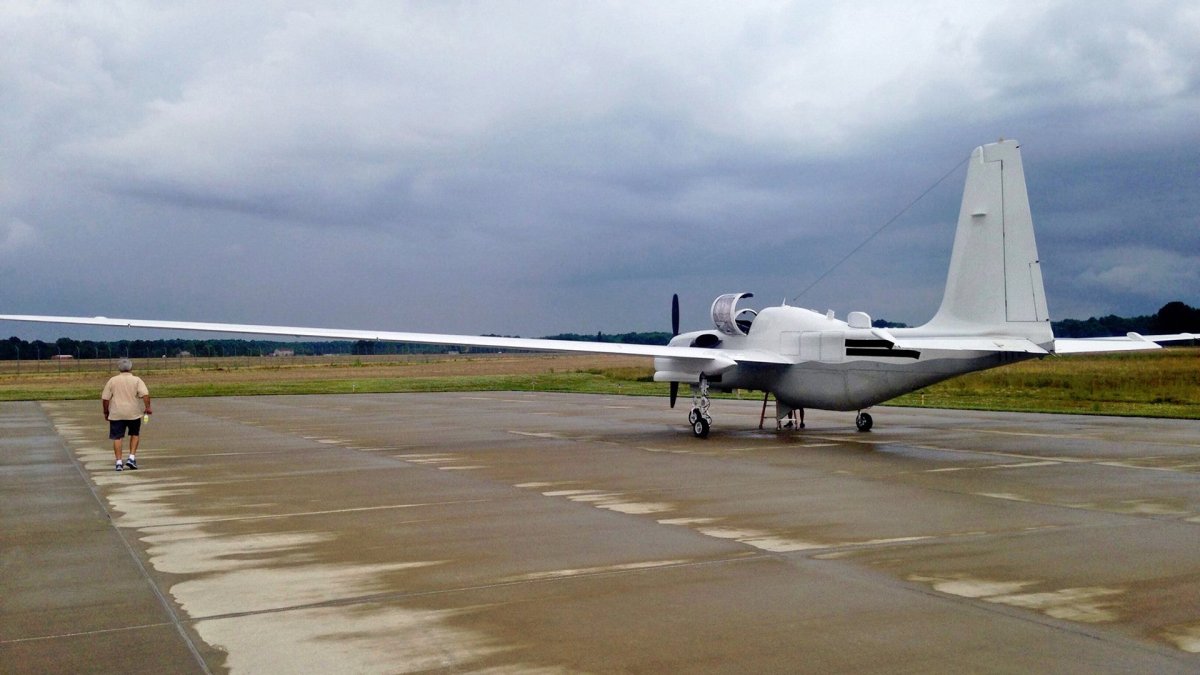
On July 12, 2017, Indiana’s North Vernon Municipal Airport posted a series of pictures on its official Facebook page of U.S. Air Force and Army special operations aircraft on their way to an exercise. The photographs showed what appeared to be C-130H Hercules and an MH-47G Chinook , as well as what looked like stock photos of a CV-22B Osprey , an AH-6M Little Bird, and multiple MH-60M Black Hawks. There was also a picture of an odd looking white-and-gray aircraft and someone had blacked out its only apparent marking.
We have been unable to confirm the exact model or owner conclusively. However, this plane is most likely the Grob G 520 EGRETT II, which Bear Defense currently owns. The defense contractor, based in Tampa, Florida , home of U.S. Special Operations Command (SOCOM), refers to the plane as the “NYX ISR” on their website. At the time of writing, the company had not responded to a request to confirm they had participated in any recent U.S. military exercise in Indiana or provide additional information about their aircraft, which carries the registration N520DM and has subdued shark mouth art on the nose. SOCOM had similarly not returned a request for more information on the drill, which was called Total Force Exercise (TFX) 17-3.
From the image on their website, Bear Defense’s NYX ISR has a large sensor turret, which almost certainly contains a full-motion video and a forward-looking infrared system. For some reason, this appears to be missing on the aircraft at North Vernon Municipal Airport. It could be that the crew planned to install it once they arrived or had otherwise removed it for servicing. It is also possible that the U.S. military opted for another particular sensor package for the exercise that would be fitted once the aircraft arrived or that is mounted internally, such as a radar system.
The aircraft spotted at North Vernon Municipal Airport in July 2017., North Vernon Municipal Airport
Bear Defense aircraft appears to have a satellite communications antenna on the dorsal spine, which would allow for sharing video footage or other data in near real time with troops on the ground. In 2015, Bear Defense reportedly installed the SCOTTY Communication Platform-Air on the aircraft, allowing for fast, encrypted streaming of the video feed to internet-enabled terminals . The rear portion of the aircraft’s ventral gondola would be perfect for a side-looking airborne radar with synthetic aperture and/or ground moving target indicator modes, or some combination of those capabilities.
The history of the slim-winged aircraft is somewhat nebulous itself. The design reportedly originated from a late Cold War joint U.S.-German requirement for a relatively low-cost, high-altitude surveillance plane. In response, in the 1980s, Germany’s Grob Aircraft , which still builds powered and unpowered gliders, as well as other aircraft, teamed up with E-Systems and Garrett AiResearch, both in the United States. The name EGRETT comes from a combination of the three companies’ names.
Bear Defense’s NYX ISR aircraft, a Grob G 520 EGRETT II., Bear Defense
According to the publicly available accounts , the official purpose of the program, which the U.S. Air Force reportedly nicknamed Senior Guardian, was to provide a cheaper alternative to the U-2 Dragon Lady spy plane for both treaty verification and environmental monitoring purposes. In the 1980s, the United States and the Soviet Union were negotiating the terms of what would become the Intermediate-Range Nuclear Forces Treaty (INF) and the Treaty on Conventional Armed Forces in Europe (CFE). INF entered force in 1988, while CFE did not go into effect until 1990. Both required robust verification methods.
However, “although the mission of the Senior Guardian project is publicly portrayed as focused environmental monitoring and treaty verification, a similar cover story was used during the early years of the U-2 program,” defense information website GlobalSecurity.org ’s entry on the aircraft notes. Early on in the Dragon Lady’s development, the Air Force and the Central Intelligence Agency claimed the aircraft was focused on “weather reconnaissance,” referring to the aircraft WU-2s to try and hide their true function.
The involvement of E-Systems could only have fueled conspiracy theories and the belief that the EGRETT’s official job description was a cover for something else. The Greenville, Texas-based electronics company had previously worked on a number of secretive Air Force programs in the 1960s and 1970s, including the NC/AC-123K Black Spot “gunship.” In addition, the word “ Senior ” is reserved for Headquarters, Air Force projects and is widely associated with spy planes and associated equipment, such as the “ Senior Year ” U-2 and the “ Senior Crown ” SR-71 Blackbird.
Grob and the rest of the team ultimately built total of five aircraft in various versions, starting with the prototype D 450 EGRETT, followed two more D 500 EGRETT II aircraft. The contractors then modified the D 500s into the final G 520 configuration before building a third of these pre-production planes. Finally, Grob produced a two-seat G 520T trainer version.
Whatever, the original impetus, the aircraft with its composite airframe did boast impressive performance characteristics. It was able to carry more than 2,000 pounds of sensors and equipment in any of 12 separate, modular bays, five of which lined the bottom of the fuselage. There was enough room there for turreted day- and night-vision cameras, as well as synthetic aperture radars and other gear, similar to what we see on the aircraft at North Vernon Municipal Airport and on Bear Defense’s stock picture of their NYX ISR.
A schematic of the payload bays on the latest G 520NG, similar to those in the original G 520., Grob Aircraft
The G 520 could fly this equipment to an altitude of 50,000 feet. This can’t match the service ceiling of the Dragon Lady, but begins to approach that of the RQ-4 Global Hawk drone . The aircraft has a very narrow cord wing with a span of just more than 108 feet – close in overall length to that of a 737 airliner – another feature it shares with the Global Hawk. Depending on the exact load out and flight profile, the plane reportedly could have a range of more than 1,500 miles or loiter over a particular area for up to eight hours.
While it has single turboprop engine and a slender fuselage, it is not clear if the G 520’s design included any features to make it particularly physically stealthy or acoustically quiet, unlike the Vietnam-era Lockheed YO-3A Quiet Star or the late Cold War Schweizer RG-8A Condor . On its website, Grob does say that its latest version, which it calls the G 520NG, has a “reduced footprint, very low probability of intercept.” The composite structure would help reduce the aircraft’s radar cross section and all of the known versions of the aircraft have large exhaust mufflers that could reduce both infrared and acoustic signatures.
Though the INF and CFE treaties remain in force, the end of the Cold War seems to have killed the official requirement for the Senior Guardian aircraft. Neither the United States nor the Germans officially adopted the aircraft in any capacity. Germany formally cancelled its portion, known as the Luftgestutztes Abstandsfahiges Primar Aufklarungssystem (LAPAS), translating to airborne, long distance primary reconnaissance system, in 1993. At that time, the German government’s expected nine aircraft order had an estimated price tag of $800 million.
The Grob G 520 EGRETT II N520DM while still flying with Raytheon in 2010., Mark Harkin via Wikimedia
The Air Force may have briefly reconsidered the concept in the 1990s. David Kier, the deputy director of the National Reconnaissance Office from May 1997 to August 2001, described a “minimalist design” he referred to as the “TR-3,” which “he derisively called ‘a Cessna 172 compared to a 747,’” according to official historical monograph Air Force UAVs: The Secret History . The nomenclature TR-3 is itself the subject of wide speculation.
“A likely candidate for a program fitting Kier’s description was a moderately stealthy (all-composite) high altitude German airframe called Egrett that was built in cooperation with a major American electronics firm,” the history’s author Dr. Thomas Ehrhard wrote in a separate footnote. Interestingly, Ehrhard says the aircraft was “optionally piloted,” a detail not found in other accounts .
In the end, the existing prototypes filtered out onto the open market through the original partners. In 1995, Raytheon bought E-Systems, ultimately renaming it as their Intelligence, Information and Services division. The company’s flight test outfit continued flying at least one EGRETT II for some time afterward, providing support to NASA’s Airborne Science Program . According to the Federal Aviation Administration , this aircraft, N520DM, apparently passed to Bear Defense circa 2012.
The D 450 EGRETT aircraft is also still in the U.S. civil registry, listed as N520EG , and property of a company called Gentran Corporation. This Omaha, Nebraska-based “ trucking company ” has one employee, according to publicly available records. Spotters caught this all-white aircraft in California in 2012 and it does not appear to match the one flying in Indiana earlier in July 2017.
The two-seat Grob G 520T., Grob Aircraft
Grob continues to offer the updated single and two-seat G 520NG variants , though these aircraft do not appear to be in active production. The company brought the demonstrator to the 2014 Farnborough Airshow in the United Kingdom, claiming it could start series production of the type by 2016. The G 520T appeared at the 2015 iteration of the event, but there is still no word about potential sales.
We do not know if the U.S. military is actively considering adopting the plane again. During TFX 17-3, it could have simply provided a cheap surrogate for a high-altitude system such as the U-2, RQ-4, or even a much more rare aircraft such as the RQ-170 Sentinel , as well as more common aircraft such as the unmanned MQ-9 Reaper or MQ-1C Gray Eagle .
Grob claims its G 520NG has the “lowest operational cost in class.” Regardless, the G 520 series would be able to offer roughly comparable capabilities for training purposes, but be significantly simpler and cheaper to operate and maintain than either the Dragon Lady or Global Hawk. On top of that, those aircraft are already in high demand for actual missions around the world.
In addition, the modular nature of the Grob 520 would make it particularly well suited for cost effective, rapid testing of new sensors or equipment. At the National Defense Industry Association’s annual Special Operations Forces Industry Conference in Tampa, Florida in May 2017, U.S. Air Force Colonel Eric Forsyth, head of SOCOM’s Program Executive Office-Fixed Wing, said his organization was actively working on color night vision video cameras, as well as looking into the possibility of color three-dimensional imaging technology, improved radars, and other systems.
No matter the reason why, its still impressive to see this essentially experimental plane still in active use after all these years. You can be sure we’ll be keeping a look out for more information on this particular exercise and we’ll be sure to follow-up if the Grob G 520 makes any more notable appearances.
Contact the author: joe@thedrive.com
Comments couldn’t be loaded. Please refresh the page.
作者:约瑟夫·特雷维西克
更新于美国东部时间2020年7月5日晚上7:16
包括美国海岸警卫队在内的美国军方,长期以来一直使用基于动力滑翔机或其衍生机型的高空侦察机。最近的照片显示,美国特种作战人员至少正在使用一种极其罕见的机型——格罗布G 520进行训练。
2017年7月12日,印第安纳州北弗农市政机场在其官方Facebook页面上发布了一系列美国空军和陆军特种作战飞机前往演习途中的照片。照片中出现了疑似C-130H“大力神”运输机和MH-47G“支奴干”直升机,以及一些看起来像是CV-22B“鱼鹰”倾转旋翼机、AH-6M“小鸟”武装直升机和多架MH-60M“黑鹰”直升机的库存照片。此外,还有一架外观奇特的白灰色飞机,其唯一明显的标志被涂黑了。
我们目前尚无法最终确认该飞机的具体型号或所有者。然而,这架飞机极有可能是格罗布G 520 EGRETT II型飞机,目前由熊防公司(Bear Defense)所有。这家国防承包商位于佛罗里达州坦帕市,美国特种作战司令部(SOCOM)所在地。该公司在其网站上将该飞机称为“NYX ISR”。截至发稿时,该公司尚未回复我们关于其是否参与了近期在印第安纳州举行的任何美军演习或提供有关其飞机的更多信息的请求。该飞机注册号为N520DM,机头涂有低调的鲨鱼嘴图案。同样,美国特种作战司令部也未回复我们关于此次名为“全军演习(TFX)17-3”的演习的更多信息请求。
从熊防公司网站上的图片来看,其NYX ISR飞机配备了一个大型传感器转塔,几乎可以肯定其中包含全动态视频系统和前视红外系统。但不知何故,北弗农市政机场的这架飞机上似乎缺少这个装置。可能是机组人员计划抵达后再安装,或者为了维护而将其拆卸下来。也有可能美军为此次演习选择了其他特定的传感器组件,例如雷达系统,这些组件将在飞机抵达后安装,或者安装在机身内部。
2017年7月,有人在北弗农市立机场发现了这架飞机。
Bear Defense公司的飞机似乎在背脊上装有卫星通信天线,这使其能够与地面部队近乎实时地共享视频或其他数据。据报道,Bear Defense公司于2015年在该飞机上安装了SCOTTY空中通信平台,从而能够将视频流快速加密地传输到联网终端。飞机腹部吊舱的后部非常适合安装侧视机载雷达,该雷达可具备合成孔径雷达和/或地面移动目标指示器模式,或两者的某种组合功能。
这种细翼飞机的历史本身就有些模糊不清。据报道,其设计源于冷战后期美德两国对一种相对低成本的高空侦察机的联合需求。为了响应这一需求,在20世纪80年代,德国格罗布飞机公司(Grob Aircraft,该公司至今仍在生产动力滑翔机、无动力滑翔机以及其他类型的飞机)与美国的E-Systems公司和Garrett AiResearch公司合作。EGRETT这个名字正是由这三家公司的名称组合而成。
Bear Defense公司的NYX ISR飞机,一架Grob G 520 EGRETT II。
根据公开资料,该项目(据称美国空军将其昵称为“高级卫士”)的官方目的是为条约核查和环境监测提供一种比U-2“龙夫人”侦察机更经济的替代方案。20世纪80年代,美国和苏联正在就后来成为《中导条约》(INF)和《欧洲常规武装力量条约》(CFE)的条款进行谈判。《中导条约》于1988年生效,而《欧洲常规武装力量条约》则于1990年生效。两项条约都要求建立强有力的核查机制。
然而,国防信息网站GlobalSecurity.org在其关于该飞机的条目中指出,“尽管‘高级卫士’项目公开宣称其任务是重点进行环境监测和条约核查,但U-2项目早期也曾使用过类似的掩护说法。”在“龙夫人”(U-2的昵称)研发初期,美国空军和中央情报局声称该飞机专注于“气象侦察”,并以WU-2飞机来指代该机型,试图掩盖其真实用途。
E-Systems公司的参与只会加剧阴谋论,并让人更加相信EGRETT的官方任务描述另有隐情。这家总部位于德克萨斯州格林维尔的电子公司曾在上世纪六七十年代参与过多个空军秘密项目,包括NC/AC-123K“黑点”炮艇机。此外,“高级”(Senior)一词专指空军总部项目,并且广泛用于间谍飞机及其相关设备,例如“高级年”(Senior Year)U-2和“高级皇冠”(Senior Crown)SR-71“黑鸟”。
格罗布和他的团队最终共制造了五架不同型号的飞机,首先是D 450 EGRETT原型机,随后又制造了两架D 500 EGRETT II。之后,承包商将D 500改装成最终的G 520配置,并制造了三分之一的预生产型飞机。最后,格罗布还生产了一架双座G 520T教练机。
无论最初的研发动机是什么,这款采用复合材料机身的飞机确实拥有令人印象深刻的性能。它能够在12个独立的模块化舱室中携带超过2000磅的传感器和设备,其中5个舱室位于机身底部。这些舱室空间充足,足以容纳炮塔式昼夜视摄像机、合成孔径雷达和其他设备,类似于我们在北弗农市政机场看到的飞机以及Bear Defense公司发布的NYX ISR飞机图片中所见的装备。
最新款G 520NG的有效载荷舱示意图,与初代G 520类似。(格罗布飞机公司)
G 520 可以将这批设备飞行到 50,000 英尺的高度。虽然这不及“龙夫人”的实用升限,但已接近 RQ-4“全球鹰”无人机的升限。该机采用极窄翼弦设计,翼展略超过 108 英尺——总长度接近 737 客机——这也是它与“全球鹰”无人机的共同特征。据报道,根据具体的载荷和飞行剖面,该机航程可超过 1,500 英里,或在特定区域上空盘旋长达八小时。
虽然G 520采用单涡轮螺旋桨发动机和纤细的机身,但目前尚不清楚其设计是否包含任何使其具有特殊物理隐身或声学静音特性的功能,这与越战时期的洛克希德YO-3A“静星”或冷战后期的施韦策RG-8A“秃鹰”不同。格罗布公司在其网站上表示,其最新版本G 520NG“尺寸更小,被拦截的概率极低”。复合材料结构有助于降低飞机的雷达反射截面积,所有已知型号的飞机都配备了大型排气消音器,可以降低红外和声学特征。
尽管《中导条约》和《欧洲常规武装力量条约》仍然有效,但冷战的结束似乎已经终结了对“高级卫士”侦察机的官方需求。美国和德国都没有正式采用该型飞机。德国于1993年正式取消了其在“高级卫士”侦察机项目中的份额,该项目名为“空中远程侦察系统”(Luftgestutztes Abstandsfahiges Primar Aufklarungssystem,简称LAPAS)。当时,德国政府预计订购的9架该型飞机总价值约为8亿美元。
2010年,格罗布G 520 EGRETT II N520DM仍在雷神公司服役时的照片,图片来自Mark Harkin via Wikimedia
空军可能在上世纪90年代曾短暂地重新考虑过这个概念。据官方历史专著《空军无人机:秘史》记载,1997年5月至2001年8月担任国家侦察局副局长的戴维·基尔描述了一种他称之为“TR-3”的“极简设计”,并“嘲讽地称之为‘塞斯纳172与波音747的差距’”。TR-3这个名称本身也引发了广泛的猜测。
“基尔描述的那个项目很可能是一款名为‘白鹭’(Egrett)的德国高空隐形(全复合材料)飞机,它是德国与一家美国大型电子公司合作建造的,”该历史著作的作者托马斯·埃尔哈德博士在另一条脚注中写道。有趣的是,埃尔哈德说这架飞机“可以选择有人驾驶”,这一细节在其他记载中并未出现。
最终,现有的原型机通过最初的合作伙伴流入市场。1995年,雷神公司收购了E-Systems公司,并将其更名为其情报、信息和服务部门。此后一段时间,该公司的飞行测试部门继续使用至少一架EGRETT II飞机进行飞行测试,为NASA的机载科学计划提供支持。据美国联邦航空管理局称,这架注册号为N520DM的飞机大约在2012年转让给了Bear Defense公司。
这架D 450 EGRETT飞机目前仍在美国民用航空器登记册上,注册号为N520EG,属于一家名为Gentran Corporation的公司所有。根据公开记录,这家位于内布拉斯加州奥马哈的“货运公司”只有一名员工。飞机观察员于2012年在加利福尼亚州发现了这架全白色的飞机,但它似乎与2017年7月初在印第安纳州飞行的那架飞机并不相同。
双座格罗布G 520T,格罗布飞机公司
格罗布公司继续提供升级后的单座和双座G 520NG机型,但这些飞机似乎并未投入生产。该公司曾携演示机参加2014年英国范堡罗航展,并声称有望在2016年开始批量生产该机型。G 520T则亮相于2015年的航展,但目前仍未有关于其潜在销售情况的消息。
我们不知道美军是否正在积极考虑再次采用这款飞机。在TFX 17-3演习期间,它可能只是高空侦察系统(例如U-2、RQ-4,甚至是RQ-170“哨兵”这样更为罕见的飞机)以及更常见的无人机(例如MQ-9“死神”或MQ-1C“灰鹰”)的廉价替代品。
格罗布公司声称其G 520NG拥有“同级别产品中最低的运营成本”。无论如何,G 520系列在训练方面能够提供大致相当的能力,但其操作和维护成本却远低于“龙夫人”或“全球鹰”。此外,这些飞机在世界各地的实际任务中已经非常抢手。
此外,Grob 520的模块化设计使其特别适合对新型传感器或设备进行经济高效的快速测试。在2017年5月于佛罗里达州坦帕举行的美国国防工业协会年度特种作战部队工业大会上,美国空军上校、特种作战司令部固定翼项目执行办公室主任埃里克·福赛斯表示,他的部门正在积极研发彩色夜视摄像机,并研究彩色三维成像技术、改进型雷达和其他系统的可能性。
无论出于何种原因,看到这架本质上仍处于实验阶段的飞机在多年后仍在服役,仍然令人印象深刻。我们一定会密切关注此次演习的更多信息,如果格罗布G 520有任何其他引人注目的亮相,我们也会及时跟进报道。
联系作者:joe@thedrive.com
评论加载失败,请刷新页面。