These Secret Helicopters Were Flown By A Shadowy Unit During The Battle of Mogadishu在摩加迪沙战役期间,这些秘密直升机由一支神秘部队操控。
Few photographs exist of these unique helicopters, but all evidence points to them belonging to the Army's highly secretive Flight Concepts Division.
新闻视频
By Joseph Trevithick
Updated Dec 1, 2019 6:50 AM EST
In August 1993, a joint U.S. special operations force, known as Task Force Ranger, with personnel from elite units across the services, deployed to Somalia. Its principal objective was to hunt down and capture warlord Mohammed Farah Aidid and other senior militants responsible for orchestrating attacks on U.S. and U.N. personnel in the country. It is well known that this task force included special operations helicopters from the U.S. Army’s elite 160th Special Operations Aviation Regiment , which infamously lost two MH-60 Black Hawks in the aftermath of one raid. This event is now known commonly as the Battle of Mogadishu or the Black Hawk Down incident. But there is also significant evidence that it also received support from two Little Birds from one of the U.S. military’s most top-secret aviation units, the Flight Concepts Division .
There are limited pictures and video from Task Force Ranger’s deployment to Somalia, also known as Operation Gothic Serpent, in general. The operation began with the departure of an advance party on Aug. 22, 1993, and lasted until mid-October 1993. The 160th Special Operations Aviation Regiment (SOAR) provided the bulk of the organic aviation support for the force with a mix of MH-60 Black Hawks and AH-6 and MH-6 Little Birds.
Task Force Ranger also included a squadron from the Army’s secretive Delta Force and a company from that service’s elite 75th Ranger Regiment . There were also additional personnel from the U.S. Navy’s Special Warfare Development Group (DEVGRU), better known as SEAL Team Six , and the U.S. Air Force’s 24th Special Tactics Squadron . The U.S. Special Operations Command’s Joint Special Operations Command (JSOC) oversaw the task force, with U.S. Army Major General William Garrison, JSOC’s commander at the time, going to Somalia himself to lead the operation.
But at least two undated images from the operation show another pair of mysterious Little Birds with some small, but distinct differences from those assigned to the 160th Special Operations Aviation Regiment (SOAR). Unlike their light attack and light assault cousins, these aircraft appear to have been highly specialized intelligence, reconnaissance, and surveillance platforms with then state-of-the-art equipment.
Covert intelligence gathering platforms
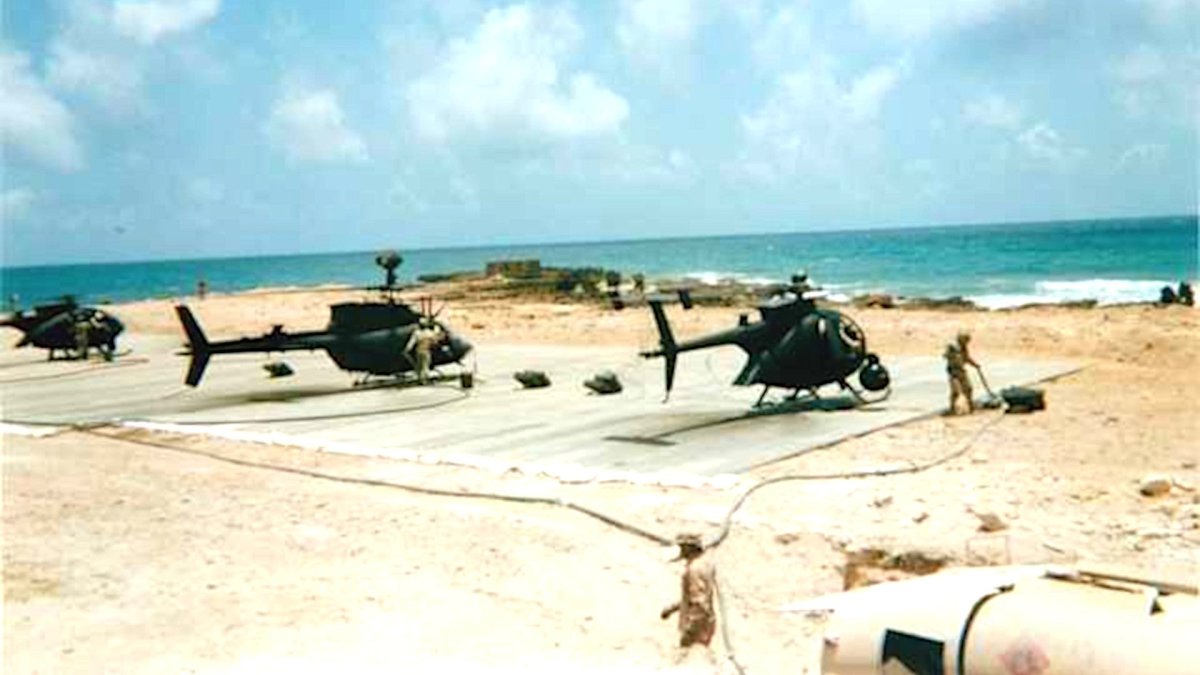
The first of the available images, seen at the top of this story and below, shows the two Little Birds at a seaside Forward Arming and Refueling Point (FARP), along with an OH-58D Kiowa Warrior . The Kiowa Warrior is another important piece of this story, but more on that later.
The two Little Birds at a FARP in Somalia, along with an OH-58D Kiowa Warrior in the middle., via ARC Forums
The two helicopters both feature a large “ batwing ” satellite communications antenna on top of their tail boom, as well as downward facing “sugar scoop” exhausts. This latter feature helped to reduce the helicopter’s infrared signature, making it less vulnerable to heat-seeking surface-to-air missiles.
One of the helicopters has a sensor turret under the nose, similar to the 160ths AH-6s and MH-6s. This could be a Hughes AN/AAQ-16 forward-looking infrared (FLIR) turret, which Raytheon Systems Company continued producing into the 1990s. This system provides infrared full motion day or night video in almost any weather conditions. For years, it was a standard feature on the Army’s special operations AH/MH-6s, MH-60s, and MH-47s , as well as the U.S. Air Force’s HH-60G Pave Hawk rescue helicopters, among other aircraft.
The other helicopter, however, has a much larger turret on a mount on the right side of the fuselage. This is a WESCAM system , which Canadian firm Isolation Stabilization Technologies, or Istec, produced at the time.
The Military Division of Westinghouse Canada originally developed this system for the Canadian military. WESCAM stands for Westinghouse Steered Stabilized Camera Mount. The WESCAM is also a FLIR sensor, but it had greater range and stability compared to the AN/AAQ-16 thanks to a telescopic lens and a more robust gyro-stabilized gimbal. The complete system also featured a data link that could transmit the feed straight back to command centers on the ground.
A Bell Model 206L Jet Ranger helicopter equipped with a WESCAM “ball” takes off from Bankstown Airport in Sydney, Australia circa 1998., YSSYguy via Wikimedia
The WESCAM “ball” would have allowed this helicopter to orbit much further away from its target, while still providing important persistent surveillance capabilities. This would have been an essential capability for Task Force Ranger’s mission locate and capture specific individuals.
Since the 1990s, the technology necessary to provide this kind of persistent surveillance has steadily become smaller even while providing much higher fidelity and greater wide-area surveillance functionality . In 2002, L3 Technologies bought WESCAM, which became L3 WESCAM , and the company continues to produce a particularly popular MX line of sensor turrets for aircraft and other platforms.
The helicopter with the ball notably has an additional blade antenna on the right side of the fuselage, as well as one under the forward fuselage. These are often associated with high-frequency radios and other communications systems.
Converted commercial Little Birds
Beyond their specialized equipment, it is also clear that these helicopters are MD Helicopters Model 500s or 530Fs , types that the 160th does not appear to have ever flown. Based on its features and other available information , the far aircraft in the FARP photo appears to be a 530F in that it features a pointed nose. The Army’s special operations AH/MH-6 variants, which Boeing now produces, have rounded noses.
All of these helicopters are derivatives of the Hughes Model 369, which the Army first began flying as the OH-6A Cayuse scout helicopter in 1966. In parallel, Hughes developed the commercial 500 series, which steadily evolved to incorporate more powerful engines and other improvements, including a main rotor with five blades instead of four and a redesigned T-shaped tail.
In 1982, what had become Hughes Helicopters first introduced the pointed nose on the Model 500E . In 1984, McDonnell Douglas bought Hughes Helicopters, renaming it MD Helicopters, and that company introduced the 530F variant that same year. The 530F was a version of the 500E optimized for hot-and-high conditions with a new 650-shaft horsepower Allison 250-C30HU engine.
An Afghan Air Force MD Helicopters 530F., USAF
The WESCAM-equipped Little Bird in Somalia may have a rounded nose found the AH/MH-6 Little Birds, as well as on earlier 500-series helicopters , but it has another set of features that identify it as a commercial helicopter. To this day, 500-series helicopters, as seen in the picture of an Afghan Air Force 530F above, feature trapezoidal fins on either side of the T-shaped tail.
The 160th’s AH-6s and MH-6s have arrow-shaped fins. A second picture of the two mysterious helicopters, which appears to have been taken at Mogadishu International Airport, where Task Force Ranger operated from, shows little of the helicopters beyond their distinctly 500-series fins.
The trapezoidal fins are clearly visible in this picture., via ARC Forums
A pair of AH-6J Little Birds from the 160th Special Operations Aviation Regiment take off in Iraq in 2003. The arrow-shaped fins are clearly visible., USAF
Further adding to the evidence that these helicopters were commercial 500-series helicopters is a curious entry in the operations log from the Battle of Mogadishu on Oct. 3-4, 1993. It reads “Recce launch (2 x H-530 & 1 x OH-58D),” according to Leigh Neville’s Day of the Rangers .
U.S. Army Colonel Lawrence Casper’s memoir also mentions this tasking, with the added note that this was to replace a U.S. Navy P-3 Reef Point intelligence, surveillance, and reconnaissance aircraft that had previously been on station over the city, another type of aircraft we will circle back to later. At the time Casper was head of the 10th Combat Aviation Brigade, 10th Mountain Division . He was in Somalia as the commander of a 3,600-man quick reaction force, known as Falcon Brigade, which was separate from Task Force Ranger and attached to the U.N. force in the country.
There is no indication that the available picture showing the pair of 530Fs with an OH-58D is actually from the Battle of Mogadishu, but it does indicate that this was a common combination for reconnaissance and surveillance operations in support of Task Force Ranger. The OH-58Ds were officially part of Falcon Brigade, but had been “chopped” to the special operations force after its arrival in the country. The Kiowa Warrior in the picture has its own batwing satcom antenna, a feature that was not found on standard Army versions of this helicopter, indicating that this was added during the deployment to link it to the task force’s communications and data networks.
“Shortly after TF Ranger’s arrival, TF Raven chopped the Fort Hood-based OH-58Ds to TF Ranger,” Casper told U.S. Army Major Marshall Ecklund and U.S. Air Force Major Michael A. McNerney during the course of their work on a 2004 joint master’s thesis at the Naval War College. “The OH-58D’s unique mast-mounted optics and FLIR could be ‘down-linked’ directly to TF Ranger’s JOC [Joint Operations Center].”
A US Army OH-58D Kiowa Warrior., US Army
Helicopters from a top-secret unit
All this evidence strongly points to the two 500-series helicopters belonging to a top-secret U.S. Army unit known at the time as the Flight Concepts Division . The service established this entity, in cooperation with the Central Intelligence Agency (CIA), around 1981, at which time it was called Seaspray .
Seaspray’s job was to provide fixed-wing aircraft and helicopters to support “black” covert and clandestine operations, often working together with the Army’s secretive Delta Force and Intelligence Support Activity (ISA), as well as CIA paramilitary elements . MD 500 and 530 helicopters, along with Beechcraft King Airs, some of which were converted to intelligence gathering platforms, initially formed the core of this secret air component, which conducted operations in Latin America, the Middle East, and elsewhere.
In 1987, one of the unit’s Little Birds appeared at Frankfurt Airport in what was then West Germany, which you can read about more here . The helicopter was almost certainly supporting then-U.S. President Ronald Reagan’s visit that year, which included his famous “ Tear down this wall! ” speech.
A Seaspray Little Bird sits at Frankfurt Airport in 1987. FAA records show that this helicopter began life as a military Model 369D, also sometimes referred to as the OH-6D, and it features the arrow-shaped fins typically associated with military little birds., Manfred Faber
Scandals and leaks to the media about Seaspray and the ISA, the history of which are very much intertwined, prompted the Army to officially shut down those entities in 1989 . They never truly went away, though, continuing to operate in the black world under new names and behind new top-secret special access program codewords. To this day, they remain closely tied to the Joint Special Operations Command (JSOC) and the CIA.
By the early 1990s, what the Army had called the ISA had morphed into the blandly-titled Office of Military Support, also known by the codename Centra Spike, and Seaspray had turned into the Flight Concepts Division, which had its own codename, Quasar Talent. You can read more about the Flight Concepts Division in this past War Zone feature on it and other top-secret U.S. military aviation units.
In Somalia, well before Task Force Ranger even touched down, the CIA at least had been in the country performing a variety of missions, including gathering signals intelligence and setting up local human intelligence networks. Day of the Rangers notes that, by the time the special operations force went into action, there were an array of intelligence assets in place and available to support Operation Gothic Serpent that also included elements from the Flight Concepts Division and the Office of Military Support.
In terms of aerial intelligence, surveillance, and reconnaissance platforms, Task Force Ranger could call upon the 500-series helicopters and the OH-58Ds. There were also Beechcraft King Airs with civilian-style paint schemes equipped for intelligence gathering missions, which also could have been from the Flight Concepts Division or the CIA. There was also at least one RG-8A Condor in Somalia, an ultra-quiet, high-flying powered glider that you can read about in more detail here , which may have belonged to the Agency, according to Day of the Rangers .
An RG-8A Condor in US Coast Guard service., RuthAS via Wikimedia
At this time, long-endurance drones such as the MQ-1 Predator , had not yet become a ubiquitous feature of American military operations, meaning that fleets of manned aircraft with state-of-the-art sensors remained the primary means of providing the kind of persistent surveillance necessary to locate and monitor specific locales and individuals, such as Aidid. The 530Fs, especially the one with the WESCAM ball, would have been an important tool for observing the so-called “ patterns of life ” of individual targets so that Task Force Ranger could determine the best time and place to launch a mission to capture them. The ability to pipe that feed straight into the task force’s Joint Operations Center would have also allowed for more dynamic planning in near-real time.
It’s important to remember that Colonel Casper stated that the pair of 500-series helicopters, along with the OH-58D, were specifically meant to take over for a Navy Reef Point aircraft. Subsequently known by the codename Iron Clad, these “ special projects ” P-3s are not to be confused with the Navy’s EP-3E Aries electronic intelligence aircraft.
Their exact configuration is classified, and has changed multiple times over the years, but the aircraft flying over Mogadishu on Oct. 3-4, 1993 had a powerful electro-optical and infrared camera suite that could provide full-motion video, according to Day of the Rangers . The Reef Point/Iron Clad aircraft also carry signals intelligence systems and have an array of communications systems and data links to be able to send video and other information to ground control stations.
A P-3 assigned to Patrol Squadron Special Projects Unit One (VPU-1) at the time of that unit’s disestablishment in 2012., USN
So, it is possible that second 530F may have carried signals intelligence gear to help in initially locating targets for the camera-equipped Little Bird to focus its attention on. There is limited information available about a small number of “EH-6” Little Birds, which may have been assigned to the 160th or Seaspray in the 1980s. Some reports suggest these aircraft were simply communications relay nodes , rather than electronic intelligence platforms.
There remain virtually no details about the exact scope of the Flight Concepts Division’s involvement in Somalia in support of Task Force Ranger, or that of other covert aviation elements, and the full extent of those activities may never emerge. We don’t know what happened to the two 530Fs after their tour in Somalia, either.
Little Birds have remained closely associated with the Flight Concepts Division since then, though the exact composition of its aircraft fleet remains shrouded in secrecy. Around 2016, it appears that it changed its official name again, too, becoming the Aviation Technology Office. It is still based in a highly secure hangar facility at Felker Army Airfield, which is situated within Fort Eustis in Virginia. The unit is now slated to get a large new hangar and a host of other facilities in the coming years.
An annotated satellite image of the Aviation Technology Office’s future home at Felker Army Airfield in Virginia., US Army
What is well known is that the raid in Mogadishu on Oct 3, 1993, touched off a running battle through the city that stretched into the next day. Somali militiamen allied with Aidid killed 18 American personnel, shot down two Black Hawks, and captured U.S. Army Chief Warrant Officer Michael Durant , a pilot from the 160th.
Nearly two weeks later, Aidid’s men released Durant, along with a Nigerian soldier from the U.N. force in the country who they had captured earlier, to the International Committee of the Red Cross. Operation Gothic Serpent ended days later and Task Force Ranger returned to the United States.
Other American forces remained in Somalia under the U.N. flag until March 1994 and the international mission came to a close completely the following year. Aidid declared himself president in 1995, but received no international recognition. He died the following year in a shootout with militiamen allied with Osman Ali Atto , a former political ally. Task Force Ranger had actually captured Atto in September 1993, but he was out of custody the next year as part of an abortive peace process. He died of natural causes in Mogadishu in 2013.
The Black Hawk Down incident effectively turned Somalia into a no-go zone for the U.S. military for more than a decade. But since 2007, American involvement of the country has been steadily growing.
In 2017, the Trump Administration further expanded the scope and scale of U.S. military operations in the country, ostensibly to combat terrorist groups including the Al Qaeda-linked Al Shabaab and a regional faction aligned with ISIS. There has been a dramatic uptick in recent years in American air strikes in the country, including targeted strikes, along with reports of more operations in the ground in concert with local partner forces .
Maybe, years from now, we’ll learn that elements of the Flight Concepts Division also returned to the region to reprise their intelligence, surveillance, and reconnaissance role or provide other support for this new era of still highly classified operations in Somalia.
Contact the author: jtrevithickpr@gmail.com
Comments couldn’t be loaded. Please refresh the page.
作者:约瑟夫·特雷维西克
更新于美国东部时间2019年12月1日上午6:50
1993年8月,一支由美军各军种精锐部队人员组成的联合特种作战部队——游骑兵特遣队——部署到索马里。其主要目标是追捕并抓获军阀穆罕默德·法拉赫·艾迪德以及其他策划袭击驻索马里美军和联合国人员的高级武装分子。众所周知,这支特遣队配备了来自美国陆军精锐部队第160特种作战航空团的特种作战直升机,该团在一次突袭行动中损失了两架MH-60黑鹰直升机,这一事件如今通常被称为摩加迪沙之战或黑鹰坠落事件。但也有确凿证据表明,此次行动还得到了美国军方最高机密航空单位之一——飞行概念部——的两架“小鸟”直升机的支援。
关于特遣部队“游骑兵”在索马里部署(又称“哥特蛇行动”)的图片和视频资料总体上非常有限。该行动始于1993年8月22日先遣队的出发,一直持续到1993年10月中旬。第160特种作战航空团(SOAR)为该部队提供了大部分的航空支援,使用的机型包括MH-60“黑鹰”、AH-6和MH-6“小鸟”等。
“游骑兵”特遣队还包括陆军神秘的三角洲特种部队的一个中队和该部队精锐的第75游骑兵团的一个连。此外,还有来自美国海军特种作战发展大队(DEVGRU,即更为人熟知的海豹突击队第六分队)和美国空军第24特种战术中队的人员。美国特种作战司令部下属的联合特种作战司令部(JSOC)负责指挥该特遣队,时任JSOC司令的美国陆军少将威廉·加里森亲自前往索马里指挥此次行动。
但至少有两张未注明日期的照片显示,行动中还出现了另外两架神秘的“小鸟”飞机,它们与分配给第160特种作战航空团(SOAR)的飞机有一些细微但明显的不同。与它们的轻型攻击和轻型突击同类飞机不同,这些飞机似乎是高度专业化的情报、侦察和监视平台,配备了当时最先进的设备。
秘密情报收集平台
本文顶部和下方展示的第一张图片显示,两架“小鸟”直升机停放在海边的前沿武器补给点(FARP),旁边还有一架OH-58D“基奥瓦勇士”直升机。“基奥瓦勇士”直升机是本文的另一个重要组成部分,稍后会详细介绍。
两架“小鸟”直升机停在索马里的一处前沿部署点,中间是一架OH-58D“基奥瓦勇士”直升机。(图片来自ARC论坛)
这两架直升机的尾梁顶部都装有大型“蝙蝠翼”卫星通信天线,以及向下倾斜的“糖勺”式排气管。后一种设计有助于降低直升机的红外特征,使其不易受到热寻地对空导弹的攻击。
其中一架直升机的机头下方装有传感器转塔,类似于第160团的AH-6和MH-6直升机。这可能是休斯公司生产的AN/AAQ-16前视红外(FLIR)转塔,雷神系统公司一直生产到20世纪90年代。该系统几乎可以在任何天气条件下提供昼夜全动态红外视频。多年来,它一直是陆军特种作战部队AH/MH-6、MH-60和MH-47直升机以及美国空军HH-60G“铺路鹰”救援直升机等多种机型的标准配置。
然而,另一架直升机在机身右侧安装了一个更大的炮塔。这是一套WESCAM系统,由当时的加拿大公司Isolation Stabilization Technologies(简称Istec)生产。
西屋加拿大公司的军用部门最初为加拿大军方开发了这套系统。WESCAM 是 Westinghouse Steered Stabilized Camera Mount(西屋转向稳定相机支架)的缩写。WESCAM 也采用了 FLIR 热成像传感器,但由于配备了伸缩镜头和更坚固的陀螺稳定云台,其探测距离和稳定性均优于 AN/AAQ-16。整套系统还包含一个数据链路,可以将实时图像直接传输回地面指挥中心。
一架配备 WESCAM“球形”摄像头的贝尔 206L 型喷气游侠直升机于 1998 年左右从澳大利亚悉尼的班克斯敦机场起飞。(图片来自 Wikimedia,YSSYguy 提供)
WESCAM“球形”装置可以让这架直升机在距离目标更远的轨道上运行,同时仍能提供重要的持续监视能力。这对于“游骑兵特遣队”定位和抓捕特定目标的任务至关重要。
自20世纪90年代以来,实现这种持续监视所需的技术在提供更高保真度和更广域监视功能的同时,体积却不断缩小。2002年,L3 Technologies收购了WESCAM,后者更名为L3 WESCAM,该公司继续生产广受欢迎的MX系列传感器转塔,用于飞机和其他平台。
值得注意的是,带有球形装饰的直升机机身右侧有一个额外的螺旋桨天线,机身前部下方也有一个。这些天线通常与高频无线电和其他通信系统有关。
改装的商业小鸟
除了其专用设备外,这些直升机显然是MD直升机公司的500型或530F型,而第160直升机联队似乎从未驾驶过这些型号的直升机。根据其特征和其他已知信息,FARP照片中远处的那架飞机似乎是530F型,因为它具有尖头。而目前由波音公司生产的陆军特种作战AH/MH-6系列直升机则采用圆头设计。
所有这些直升机都是休斯369型直升机的衍生机型,陆军于1966年开始将其作为OH-6A“卡尤斯”侦察直升机投入使用。与此同时,休斯公司开发了商用500系列直升机,该系列直升机不断发展,采用了更强大的发动机和其他改进,包括将主旋翼从四片叶片改为五片叶片,以及重新设计了T形尾翼。
1982年,休斯直升机公司(Hughes Helicopters)首次在其500E型直升机上采用了尖头设计。1984年,麦克唐纳·道格拉斯公司(McDonnell Douglas)收购了休斯直升机公司,并将其更名为MD直升机公司。同年,MD直升机公司推出了530F型直升机。530F型是500E型的改进版本,针对高温高海拔环境进行了优化,配备了新型的650轴马力艾里逊250-C30HU发动机。
一架阿富汗空军的MD 530F型直升机,美国空军
索马里装备WESCAM系统的“小鸟”直升机可能拥有与AH/MH-6“小鸟”以及早期500系列直升机类似的圆形机头,但它还有其他一些特征表明它是一架商用直升机。时至今日,500系列直升机(如上图所示的阿富汗空军530F型)仍然在T形尾翼两侧保留着梯形垂直尾翼。
第160航空团的AH-6和MH-6直升机都配备了箭头形尾翼。另一张拍摄于摩加迪沙国际机场(特遣部队“游骑兵”的行动基地)的神秘直升机照片,除了其独特的500系列尾翼外,几乎看不出其他细节。
图片中可以清晰地看到梯形鳍片。(图片来自ARC论坛)
2003年,两架隶属于美国空军第160特种作战航空团的AH-6J“小鸟”直升机在伊拉克起飞。图中清晰可见其箭形尾翼。
进一步佐证这些直升机是商用 500 系列直升机的证据是 1993 年 10 月 3 日至 4 日摩加迪沙战役的作战日志中的一条奇怪记录。根据 Leigh Neville 的《游骑兵之日》记载,该记录写道:“侦察起飞(2 架 H-530 和 1 架 OH-58D)”。
美国陆军上校劳伦斯·卡斯珀的回忆录也提到了这项任务,并补充说明,此举是为了替换此前驻扎在该市上空的美国海军P-3“礁点”侦察机(我们稍后会再提到另一种机型)。当时,卡斯珀是第10山地师第10战斗航空旅的指挥官。他当时在索马里,担任一支3600人的快速反应部队——“猎鹰旅”的指挥官。这支部队独立于“游骑兵”特遣队,隶属于驻索马里的联合国部队。
目前尚无证据表明这张显示两架530F直升机和一架OH-58D直升机的照片确实拍摄于摩加迪沙战役,但它确实表明,这种组合在支援游骑兵特遣部队执行侦察和监视任务时十分常见。OH-58D直升机名义上隶属于猎鹰旅,但在抵达该国后被“调配”至特种作战部队。照片中的基奥瓦勇士直升机配备了独立的翼状卫星通信天线,这是该型直升机标准陆军版本所没有的,表明该天线是在部署期间加装的,用于将其连接到特遣部队的通信和数据网络。
“游骑兵特遣队抵达后不久,渡鸦特遣队就将驻扎在胡德堡的OH-58D直升机调配给了游骑兵特遣队,”卡斯珀在2004年与美国陆军少校马歇尔·埃克伦德和美国空军少校迈克尔·A·麦克纳尼在海军战争学院共同撰写硕士论文期间说道。“OH-58D独特的桅杆式光学设备和前视红外成像仪可以直接‘下行’传输到游骑兵特遣队的联合行动中心。”
美国陆军OH-58D“基奥瓦勇士”直升机。
来自绝密部队的直升机
所有这些证据都强烈指向这两架500系列直升机,它们属于当时美国陆军一个名为“飞行概念部”的绝密单位。该单位由美国陆军与中央情报局(CIA)合作,于1981年左右成立,当时名为“海浪行动”(Seaspray)。
Seaspray公司的任务是提供固定翼飞机和直升机,以支持“黑色”的秘密行动,经常与陆军的秘密三角洲部队和情报支援活动(ISA)以及中央情报局的准军事部队合作。MD 500和530直升机,以及比奇空中国王飞机(其中一些被改装成情报收集平台),最初构成了这支秘密空中力量的核心,其行动遍及拉丁美洲、中东和其他地区。
1987年,该部队的一架“小鸟”直升机出现在当时的西德法兰克福机场,详情请点击此处。这架直升机几乎可以肯定是在为时任美国总统罗纳德·里根当年的访问提供支持,其中包括他著名的“推倒这堵墙!”演讲。
1987年,一架Seaspray Little Bird直升机停在法兰克福机场。美国联邦航空管理局(FAA)的记录显示,这架直升机最初是一架军用369D型直升机,有时也被称为OH-6D,它具有军用小型直升机常见的箭形尾翼。——曼弗雷德·法伯
关于Seaspray和ISA(两者的历史紧密交织)的丑闻和泄密事件促使陆军于1989年正式关闭了这些机构。然而,它们从未真正消失,而是以新的名称和新的绝密特殊访问项目代号继续在秘密世界运作。时至今日,它们仍然与联合特种作战司令部(JSOC)和中央情报局(CIA)保持着密切联系。
到了20世纪90年代初,陆军之前称之为ISA的机构已经演变成名称平淡无奇的军事支援办公室(Office of Military Support),代号为“中央尖峰”(Centra Spike);而“海浪”(Seaspray)则变成了飞行概念部(Flight Concepts Division),其代号为“类星体人才”(Quasar Talent)。您可以在《战区》(War Zone)杂志之前关于飞行概念部和其他美国绝密军事航空单位的专题报道中了解更多信息。
在索马里,早在游骑兵特遣队抵达之前,中央情报局就已经在该国执行各种任务,包括收集信号情报和建立当地的人力情报网络。《游骑兵之日》一书指出,当这支特种作战部队投入行动时,一系列情报资源已经到位,可以支持“哥特蛇行动”,其中包括来自飞行概念处和军事支援办公室的资源。
在空中情报、监视和侦察平台方面,“游骑兵特遣队”可以调用500系列直升机和OH-58D直升机。此外,还有一些涂装成民用风格的Beechcraft King Air飞机,这些飞机也配备了用于情报收集任务的设备,它们可能来自飞行概念部门或中央情报局。根据《游骑兵之日》一书的描述,在索马里至少还有一架RG-8A“秃鹰”滑翔机,这是一种超静音、高空飞行的动力滑翔机,您可以在这里阅读更多相关信息,它可能也属于中央情报局。
美国海岸警卫队服役的一架RG-8A“秃鹰”直升机。(图片来自Wikimedia,RuthAS摄)
当时,像MQ-1“捕食者”这样的长航时无人机尚未成为美军行动的普遍装备,这意味着配备尖端传感器的有人驾驶飞机机队仍然是提供持续监视的主要手段,而这种监视对于定位和监控特定地点和人员(例如艾迪德)至关重要。530F型无人机,尤其是配备WESCAM球形摄像头的型号,本可以成为观察目标“生活模式”的重要工具,以便“游骑兵”特遣部队能够确定抓捕目标的最佳时间和地点。此外,将这些数据直接传输到特遣部队联合行动中心的能力,还能实现近乎实时的动态规划。
值得注意的是,卡斯珀上校曾表示,这两架500系列直升机以及OH-58D直升机是专门用来接替海军礁点基地飞机的。这些后来被称为“铁甲舰”(Iron Clad)的“特种项目”P-3反潜巡逻机,切勿与海军的EP-3E“白羊座”(Aries)电子情报飞机混淆。
它们的具体配置属于机密,并且多年来多次变更,但据《游骑兵之日》一书所述,1993年10月3日至4日飞越摩加迪沙的飞机配备了一套强大的光电和红外摄像系统,能够提供全动态视频。礁点/铁甲舰飞机还搭载了信号情报系统,并拥有一系列通信系统和数据链路,能够将视频和其他信息发送到地面控制站。
一架P-3反潜巡逻机,隶属于2012年解散的第一巡逻中队特种项目部队(VPU-1)。(美国海军)
因此,第二架530F可能携带了信号情报设备,以帮助配备摄像头的“小鸟”无人机初步定位目标,以便其集中注意力。关于少量“EH-6”型“小鸟”无人机的信息有限,这些无人机可能在20世纪80年代被分配给了第160中队或“海浪”中队。一些报告表明,这些飞机仅仅是通信中继节点,而非电子情报平台。
关于飞行概念部门在索马里支援游骑兵特遣队的具体参与程度,以及其他秘密航空部队的参与情况,目前几乎没有任何细节,而且这些活动的全部范围可能永远不会曝光。我们也不知道那两架530F飞机在索马里任务结束后发生了什么。
此后,“小鸟”部队一直与飞行概念部门保持着密切联系,但其机队的具体组成仍然保密。大约在2016年,该部队似乎再次更改了正式名称,成为航空技术办公室。它仍然位于弗吉尼亚州尤斯蒂斯堡费尔克陆军机场内一个高度安全的机库设施中。该部队计划在未来几年内获得一个大型新机库和一系列其他设施。
一张带有注释的卫星图像,展示了美国陆军航空技术办公室未来位于弗吉尼亚州费尔克陆军机场的办公地点。
众所周知,1993年10月3日发生在摩加迪沙的突袭引发了一场持续到第二天的激烈战斗。与艾迪德结盟的索马里民兵打死了18名美军人员,击落了两架黑鹰直升机,并俘虏了美国陆军第160飞行大队的飞行员、准尉迈克尔·杜兰特。
近两周后,艾迪德的手下将杜兰特以及此前俘虏的一名驻伊联合国部队尼日利亚士兵移交给红十字国际委员会。“哥特蛇行动”数日后结束,“游骑兵特遣队”返回美国。
其他美军部队在联合国旗帜下继续驻扎在索马里,直至1994年3月。次年,国际维和行动彻底结束。艾迪德于1995年宣布自己为总统,但未获得国际社会承认。次年,他在与奥斯曼·阿里·阿托(其前政治盟友)的民兵交火中身亡。事实上,游骑兵特遣队早在1993年9月就已抓获阿托,但由于一项失败的和平进程,阿托于次年获释。2013年,阿托在摩加迪沙因自然原因去世。
“黑鹰坠落”事件实际上使索马里在十多年间成为美军的禁区。但自2007年以来,美国对索马里的介入一直在稳步增加。
2017年,特朗普政府进一步扩大了美国在该国的军事行动范围和规模,表面上是为了打击包括与基地组织有关联的青年党和与“伊斯兰国”结盟的地区派系在内的恐怖组织。近年来,美国在该国的空袭次数显著增加,包括定点打击,同时还有报道称,美军与当地伙伴部队开展了更多地面行动。
也许多年以后,我们会得知飞行概念部门的部分人员也已返回该地区,重新承担情报、监视和侦察任务,或为索马里这个仍然高度机密的新时代行动提供其他支持。
联系作者:jtrevithickpr@gmail.com
评论加载失败,请刷新页面。