The Mach-3 XF-108 Rapier Would Have Packed Its Big Missiles On A Revolver-Like Launcher马赫数3的XF-108“长剑”导弹本应将其大型导弹装载在类似转轮手枪的发射器上。
The Rapier carried its trio of long-range missiles in a rotary pack that would be used for downing marauding Soviet bombers.
新闻视频
Published Jul 14, 2021 7:22 PM EDT
Of all the aircraft projects of the 1950s that never saw the light of day, without doubt, one of the most potentially impressive was the North American XF-108 Rapier . This was a planned all-weather interceptor that would have been propelled to a speed of over Mach 3 by a pair of General Electric J93 afterburning turbojets. Those were the same engines that powered the remarkable XB-70 Valkyrie strategic bomber, another Mach-3 North American product. The XF-108 shared some visual similarities and certain components with its larger cousin, but perhaps the most novel feature was its unique, internal rotary missile launcher.
A rotary launcher for weapons is today a standard fixture in the bomb bays on U.S. strategic bombers , but no operational American fighter has ever had a similar feature. While there have been some ingenious solutions to packing weapons into internal bays on fighters , and new technologies are still being developed in this field today, rotary launchers are much more associated with air-to-ground weapons, rather than air-to-air ones.
Concept artwork of the XF-108 in its definitive configuration., U.S. Air Force
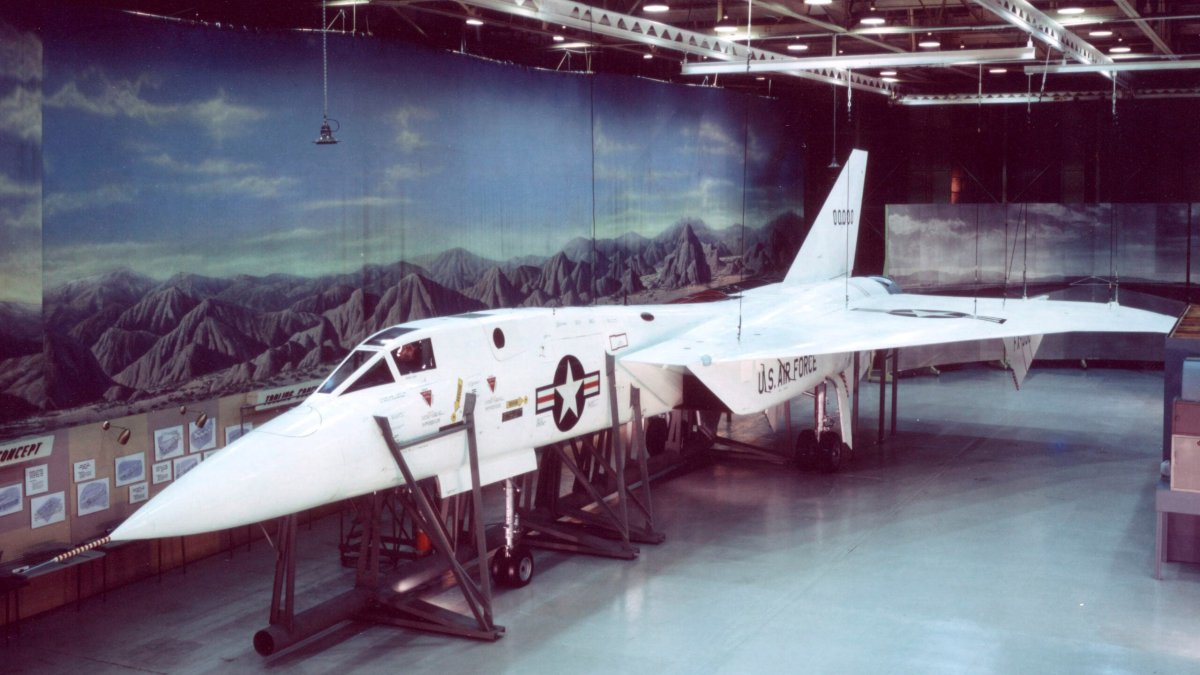
After Air Defense Command released its General Operating Requirement (GOR) 114 in late 1955, work on the XF-108 began, leading to a full-scale mockup that was presented to the Air Force in January 1959. A photo of the XF-108’s rotary launcher installation, apparently from this same mockup, was brought to our attention by Twitter user @clemente3000 and shows just how neat the jet’s weapons solution was expected to be. As it was, the Rapier would be canceled before the end of that same year.
A mockup of the XF-108’s rotary missile bay, loaded with GAR-9s., NATIONAL ARCHIVES
The weapons launcher, which would have carried three of the long-range GAR-9 missiles on a T-shaped assembly, was designed to fit the relatively slim stores bay in the lower fuselage between the XF-108’s huge engines and intakes. As the weapons bay door opened, it rotated to expose the missiles, meaning there were no doors that extended into the airstream.
For a while, at least, the McDonnell F-101B Voodoo used a somewhat similar arrangement for its armament, with a rotary pallet that carried three Falcon air-to-air missiles on the outside, and three more on the inside, but when opened, all the missiles were exposed. On the XF-108, in contrast, a single missile was exposed in turn.
With a primary mission of swatting down nuclear-armed Soviet bombers before they got too close to American territory, the Rapier would have been expected to cruise at Mach 3 and 70,000 feet and hit an altitude of 100,000 feet in a zoom climb. Burning exotic “zip” fuel, which produced much more energy on combustion than normal jet fuel, each of its engines would put out around 30,000 pounds of thrust, a little more than the F100-PW-229 that powers today’s F-15EX , albeit optimized for high-speed, high-altitude flight. These performance expectations meant that internal weapons carriage was a prerequisite, not only to ensure low drag but because kinetic heating would likely render any external ordnance useless.
As for the missiles the XF-108 was intended to carry, the GAR-9 was a member of the Hughes Falcon family, but was considerably larger than its cousins, with a length of over 12 feet. By comparison, the GAR-1D and GAR-3A Falcons then in service at the time were around 6 and 7 feet long, respectively.
The GAR-9 had been specifically developed for the Long-Range Interceptor Experimental (LRI-X) program, for which the XF-108 was selected in 1957 as the winning design, being chosen ahead of the rival Republic XF-103 .
Illustrations from a 1958 Air Force document showing the proposed F-108’s layout, including the weapons bay. , U.S. AIR FORCE
Originally intended to carry a conventional or nuclear warhead, the GAR-9 would have had a range of 100 miles or more, flying to its target using semi-active radar homing, with the engagement process being managed by the AN/ASG-18 fire-control system on the Rapier. Design changes to the GAR-9 increased its weight and diameter, leading to modifications to the XF-108’s weapons bay, although it’s unclear if the rotary mechanism was changed in the process.
North American concept art of the F-108 in Air Force service., U.S. Air Force
Ultimately, however, despite good progress in the development effort, XF-108 was canceled in 1959, with the Air Force failing to find the funds needed to keep the program alive, despite its promised performance. Moreover, the concern about Soviet bombers was beginning to diminish, now that intercontinental ballistic missiles (ICBMs) appeared to pose a much graver threat. It would be left, instead, to Convair F-106 Delta Darts to defend North American skies against bombers, a job that they did well into the 1980s.
A similar fate befell the XB-70, too, this being canceled in 1961 — before any examples had been flown. The reasons included developments in Soviet surface-to-air missiles, which were expected to put it at risk, as well as the appearance of cheaper, nuclear-armed ICBMs.
Despite the demise of the XF-108 program, work continued on the GAR-9, which was redesignated as the AIM-47 in 1963. It was now intended to arm the Lockheed YF-12A , the interceptor version of the A-12 spy plane , which performed several successful test launches of the AIM-47 before it, too, was canceled.
An AIM-47 missile before loading into one of the Lockheed YF-12A’s weapons bays. , U.S. Air Force
Thereafter, the AIM-47 and ASG-18 helped inform the design of the AIM-54 Phoenix and AN/AWG-9 radar that, as part of the F-14 Tomcat , ensured air defense of the U.S. Navy carrier battle groups for much of the Cold War.
While the developmental DNA of the XF-108 was destined to endure, the U.S. Air Force was destined never to field a Mach-3 fighter, let alone one armed with a revolving missile launcher.
Contact the author: thomas@thedrive.com
Comments couldn’t be loaded. Please refresh the page.
发布于美国东部时间2021年7月14日晚上7:22
在20世纪50年代所有未能面世的飞机项目中,北美XF-108“长剑”无疑是最具潜力的机型之一。这是一款计划中的全天候截击机,原本计划由两台通用电气J93加力涡轮喷气发动机驱动,速度可达3马赫以上。这些发动机也曾用于性能卓越的XB-70“女武神”战略轰炸机,后者同样是北美公司研发的3马赫超音速飞机。XF-108与它的“表亲”在外观和某些部件上有一些相似之处,但其最独特的设计或许是其内置的旋转导弹发射器。
如今,旋转式武器发射器已成为美国战略轰炸机弹舱的标准配置,但美国现役战斗机却从未配备过类似装置。尽管战斗机内部弹舱的武器装载方式多种多样,且该领域的新技术仍在不断涌现,但旋转式发射器更多地与空对地武器而非空对空武器联系在一起。
XF-108最终构型的概念图,美国空军
1955年末,美国防空司令部发布了第114号通用作战需求(GOR 114)后,XF-108的研发工作随即展开,并于1959年1月向空军提交了全尺寸模型。推特用户@clemente3000分享了一张XF-108旋转发射器安装的照片,照片显然也来自同一模型,展现了当时人们对这款战机武器系统的设想有多么精妙。然而,就在同年年底,“长剑”(Rapier)导弹项目就被取消了。
XF-108旋转导弹舱的模型,装载着GAR-9导弹。(美国国家档案馆)
这种武器发射器采用T形结构,可携带三枚远程GAR-9导弹,其设计旨在安装在XF-108巨型发动机和进气口之间机身下部相对狭窄的武器舱内。武器舱门打开时,会旋转以露出导弹,这意味着没有舱门会延伸到气流中。
至少在一段时间内,麦克唐纳F-101B“巫毒”战斗机的武器配置也采用了类似的方案:一个旋转式弹匣外侧挂载三枚“猎鹰”空空导弹,内侧挂载三枚,打开后所有导弹都暴露在外。相比之下,XF-108战斗机每次只露出一枚导弹。
“长剑”战斗机的主要任务是在苏联携带核弹头的轰炸机逼近美国领空之前将其击落。根据设计,该机巡航速度应达到3马赫,巡航高度为7万英尺,并能以10万英尺的高度进行爬升。它使用一种特殊的“高能”燃料,这种燃料燃烧时产生的能量远高于普通喷气燃料。每台发动机可产生约3万磅的推力,略高于如今F-15EX战斗机所使用的F100-PW-229发动机,尽管“长剑”的推力是针对高速高空飞行优化的。如此高的性能要求意味着必须采用内置武器挂载,这不仅是为了降低阻力,也是因为动能加热很可能会使任何外挂武器失效。
至于XF-108计划携带的导弹,GAR-9是休斯猎鹰系列导弹的一员,但比它的同系列产品大得多,长度超过12英尺。相比之下,当时服役的GAR-1D和GAR-3A猎鹰导弹的长度分别约为6英尺和7英尺。
GAR-9 是专门为远程拦截机实验 (LRI-X) 计划开发的,该计划于 1957 年选出 XF-108 作为获胜设计,击败了竞争对手共和 XF-103。
1958年美国空军文件中的插图,展示了拟议的F-108战斗机的布局,包括武器舱。
GAR-9导弹最初设计用于携带常规或核弹头,射程可达100英里或更远,采用半主动雷达制导,由“长剑”战斗机上的AN/ASG-18火控系统进行交战控制。GAR-9的设计变更增加了其重量和直径,导致XF-108战斗机的武器舱也进行了相应改造,但目前尚不清楚旋转机构是否也随之进行了更改。
美国空军F-108战斗机的北美概念图。
然而,尽管研发工作进展顺利,XF-108最终还是在1959年被取消。空军未能筹集到维持该项目所需的资金,尽管其性能已达到预期。此外,随着洲际弹道导弹(ICBM)的威胁日益凸显,人们对苏联轰炸机的担忧也开始减弱。因此,保卫北美领空免受轰炸机袭击的重任,便落到了康维尔F-106“三角镖”战斗机身上,它们一直服役到20世纪80年代。
XB-70也遭遇了类似的命运,该项目于1961年被取消——甚至在任何样机试飞之前。原因包括苏联地对空导弹的发展,预计这将对XB-70构成威胁,以及更便宜的核弹头洲际弹道导弹的出现。
尽管 XF-108 计划失败了,但 GAR-9 的研发工作仍在继续,该导弹于 1963 年被重新命名为 AIM-47。它原本计划装备洛克希德 YF-12A,即 A-12 侦察机的拦截机版本,该机曾多次成功试射 AIM-47,但最终也被取消了。
一枚AIM-47导弹在装入洛克希德YF-12A战斗机的武器舱之前。(美国空军)
此后,AIM-47 和 ASG-18 为 AIM-54 不死鸟导弹和 AN/AWG-9 雷达的设计提供了参考,作为 F-14 雄猫战斗机的一部分,它们在冷战的大部分时间里保障了美国海军航母战斗群的防空能力。
虽然 XF-108 的研发基因注定会延续下去,但美国空军注定永远不会部署马赫数为 3 的战斗机,更不用说装备旋转导弹发射器的战斗机了。
联系作者:thomas@thedrive.com
评论加载失败,请刷新页面。