Northrop’s battle command system for Poland primes production pump诺斯罗普公司为波兰设计的作战指挥系统启动生产泵
Northrop Grumman is sending Integrated Battle Command System relays to its first customer, while preparing for full-rate production for the U.S. Army.
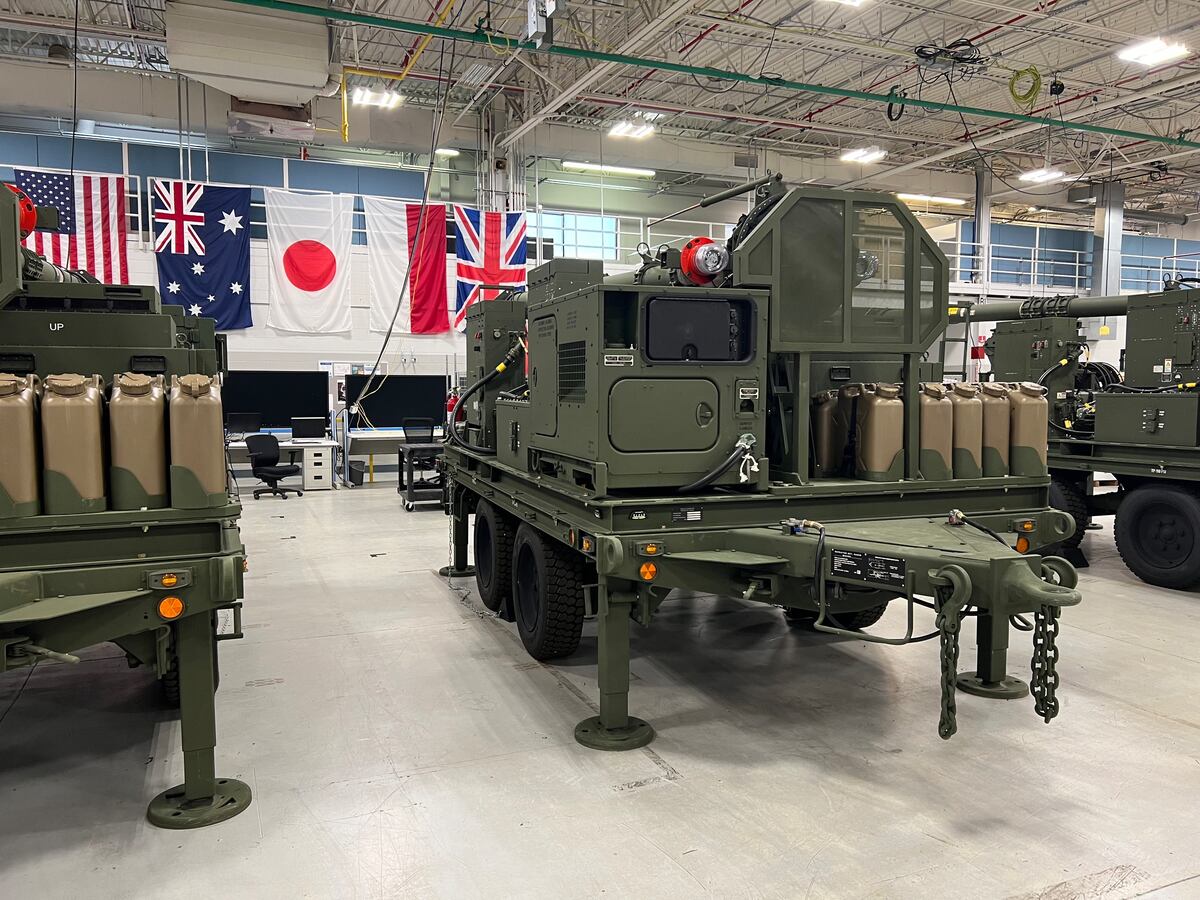
HUNTSVILLE, Ala. — At an Alabama-based Northrop Grumman facility , now primed to build a U.S. Army battle command system , three fire-control relays painted green sit side by side.
But these relays that connect the Integrated Battle Command System to sensors and shooters in the field aren’t for the American service . Instead, they are going from Madison to nearby Redstone Arsenal for a final review before shipment to the Polish military.
The three relays seen March 27 marked the last of the equipment that makes up the IBCS technology Poland will receive as part of its first order of Patriot air defense systems it bought years ago.
“That hardware will ship in-country next month. Actually, the Poles will complete their training, and we’ll reach base operational capability, essentially being online at the end of the summer,” Northrop Grumman’s director of network solutions, Ian Reynolds, told reporters at the production line on Monday.
With Russia carrying out an invasion of neighboring Ukraine, Poland is clambering to buy high-end defense capabilities. It reached an agreement with the U.S. in 2018 to buy Raytheon Technologies-made Patriot systems bolstered by an advanced battle command system that the U.S. Army was still developing.
Poland received a waiver to acquire IBCS because it wanted the capability before it would be fielded to U.S. soldiers. Typically, American-made weapon systems are fielded to U.S. forces before they’re sold internationally.
Poland’s request was risky because the IBCS program, at the time, was struggling in tests, and the program’s schedule had slipped by roughly four years .
The command system was originally developed as the brains of a future air and missile defense system for the Army. It was to tie together with a new 360-degree radar and potentially new launchers, replacing the aging Patriot weapon.
But the Army expanded the role for IBCS, deciding the system would also connect other sensors and shooters on the battlefield like the still-in-development Indirect Fire Protection Capability designed to defend against rockets, artillery, mortars, cruise missiles and drones. The mission expansion further delayed IBCS fielding plans.
Poland will become the first operational user of IBCS, not the U.S. Army. But the U.S. will benefit from the Eastern European country using the system, Reynolds said.
“As we were proposing [low-rate initial production] in a competition, we were able to show that: ‘Hey, we, Northrop Grumman, have a live, hot production line. We have a team already supporting the software development, the hardware development.’ " he said. “So that really benefited the U.S. Army — just stepping into that already established line.”
American and Polish service members walk to the site of a Patriot missile system for a verbal demonstration of its operation and capabilities near Drawsko Pomorskie, Poland, in 2018. (Spc. Aaron Good/Michigan Army National Guard)
The company also took lessons learned from building systems for Poland’s Wisla program — the effort to procure a Patriot capability — and applied it to the U.S. Army’s low-rate production program, according to Michael Hahn, Northrop’s IBCS program director.
The U.S. Army awarded Northrop a $1.4 billion contract for both low-rate initial production and full-rate production of its future battle command system in December 2022.
Poland’s first order, which includes two Patriot Configuration 3+ batteries, came with a $4.75 billion price tag.
As part of the deal, Northrop delivered two firing batteries of IBCS, which consists of six engagement operations centers, six integrated collaborative environment tents and associated equipment, and 12 integrated fire control network relays.
Polish Defence Minister Mariusz Błaszczak announced in May 2022 that the country would launch the second phase of its midrange air defense program by requesting the U.S. government sell it six more Patriot batteries with related gear, including IBCS.
Proliferating prospects
The U.S. Army passed through the initial operational test and evaluation last fall, and a full-rate production decision is expected April 10, as well as the delivery of the first two batteries of IBCS to Poland. Other European-based NATO allies are watching Poland and the U.S. program of record evolve, Reynolds said.
Northrop also submitted IBCS for an Australian competition for a joint air battle management system, Reynolds said, and both Japan and the U.K. are seeking international solutions for an air defense battle command capability. He expects Australia will choose a winner this summer.
And Hahn anticipates Japan will soon issue a letter of request for the capability, while the U.K. has already posted a draft request for proposal to industry.
Poland also wants IBCS for its Narew short-range air defense program, and the country is working on issuing a letter of offer and acceptance with the U.S. government before the end of the year as well as a letter for the second phase of the Wisla program. Poland is buying MBDA’s Common Anti-air Modular Missile for the Narew program.
“With current world events, a lot of our allies and partners are increasing their defense spending investment,” Reynolds said. “While air and missile defense has always been important, it hasn’t always risen above the budget cut line, but we are seeing that it is now that they are backing up their intentions around integrated air and missile defense.”
Northrop is touting the IBCS system as an open, modular system beneficial to foreign customers. “There’s real recognition that in a fight, they’re going to want truly integrated operations with the U.S. Army,” Reynolds explained.
The company is busy preparing its IBCS production line for new and existing customers within the 60,000-square-foot manufacturing space, and it has 500 employees across the program. It takes roughly 18 months to build an IBCS, according to Hahn.
While the system struggled earlier in the program, the company says the technology has had 15 out of 15 successful flight tests , meaning they resulted in target intercepts.
IBCS was also chosen as the command-and-control capability for a new air and missile defense architecture in Guam , where it will connect to a variety of sensors and shooters. Northrop is working with the Missile Defense Agency to tie IBCS into other homeland defense capabilities.
Jen Judson is an award-winning journalist covering land warfare for Defense News. She has also worked for Politico and Inside Defense. She holds a Master of Science degree in journalism from Boston University and a Bachelor of Arts degree from Kenyon College.
阿拉巴马州亨茨维尔——在位于阿拉巴马州的诺斯罗普·格鲁曼公司工厂里,三个涂成绿色的火控继电器并排摆放着,该工厂现在已准备好建造美国陆军的作战指挥系统。
但这些连接综合作战指挥系统与战场传感器和射击设备的继电器并非供美军使用。相反,它们将从麦迪逊运往附近的雷德斯通兵工厂进行最终检查,之后再交付给波兰军队。
3 月 27 日看到的三个中继器标志着构成 IBCS 技术的所有设备的最后交付,这些设备是波兰多年前购买的第一批“爱国者”防空系统的一部分。
“这批硬件将于下个月运抵波兰。实际上,波兰人将完成培训,我们将在夏季末达到基本作战能力,基本上实现上线运行,”诺斯罗普·格鲁曼公司网络解决方案总监伊恩·雷诺兹周一在生产线上告诉记者。
俄罗斯入侵邻国乌克兰之际,波兰正急于购买高端防御能力。2018年,波兰与美国达成协议,购买雷神技术公司制造的“爱国者”导弹系统,并辅以美国陆军当时仍在研发的先进作战指挥系统。
波兰获得了采购IBCS系统的豁免权,因为它希望在美军部署该系统之前就掌握这项能力。通常情况下,美国制造的武器系统会先装备美军,然后再向国际市场出售。
波兰的请求是冒险的,因为当时的 IBCS 项目在考试中遇到了困难,而且该项目的进度已经落后了大约四年。
该指挥系统最初是作为陆军未来防空反导系统的核心而开发的。它将与新型360度雷达以及可能的新型发射器配合使用,以取代老旧的“爱国者”导弹系统。
但陆军扩大了IBCS的功能,决定让该系统连接战场上的其他传感器和火力点,例如仍在研发中的间接火力防护能力(Indirect Fire Protection Capability),该能力旨在防御火箭弹、火炮、迫击炮、巡航导弹和无人机。任务扩展进一步推迟了IBCS的部署计划。
雷诺兹表示,波兰将成为IBCS的首个作战用户,而非美国陆军。但美国将从这个东欧国家使用该系统中受益。
“当我们在竞标中提出[小批量初始生产]方案时,我们能够证明:‘嘿,我们诺斯罗普·格鲁曼公司拥有一条正在运行的生产线。我们已经有团队支持软件开发和硬件开发。’”他说道。“所以这确实让美国陆军受益匪浅——他们只需接入这条已经建立的生产线即可。”
2018年,在波兰德拉夫斯科-波莫尔斯基附近,美国和波兰军人前往“爱国者”导弹系统部署地点,听取该系统操作和性能的口头演示。(陆军下士亚伦·古德/密歇根州陆军国民警卫队)
据诺斯罗普公司 IBCS 项目主管迈克尔·哈恩称,该公司还从为波兰维斯瓦河项目(旨在采购爱国者导弹系统)构建系统的过程中吸取了经验教训,并将其应用于美国陆军的低速生产项目。
2022 年 12 月,美国陆军授予诺斯罗普公司一份价值 14 亿美元的合同,用于其未来作战指挥系统的低速初始生产和全速生产。
波兰的首批订单包括两套“爱国者”3+型导弹防御系统,总价值达47.5亿美元。
作为交易的一部分,诺斯罗普公司交付了两套 IBCS 火力支援系统,该系统包括六个交战作战中心、六个集成协作环境帐篷及相关设备,以及 12 个集成火控网络中继器。
波兰国防部长马里乌什·布瓦什恰克于 2022 年 5 月宣布,该国将启动其中程防空计划的第二阶段,请求美国政府向其出售六个爱国者导弹系统及相关设备,包括 IBCS。
蓬勃发展的前景
美国陆军已于去年秋季完成了初步作战测试和评估,预计将于4月10日做出全面量产决定,并向波兰交付首批两套IBCS系统。雷诺兹表示,其他欧洲北约盟国正在密切关注波兰和美国该项目的进展。
雷诺兹表示,诺斯罗普公司也提交了IBCS系统参与澳大利亚联合空中作战管理系统竞标,日本和英国也在寻求国际解决方案以提升防空作战指挥能力。他预计澳大利亚将在今年夏天选出最终中标者。
哈恩预计日本很快就会发出能力请求函,而英国已经向业界发布了征求建议书草案。
波兰也希望为其“纳雷夫”(Narew)短程防空系统采购IBCS导弹系统,并正努力在年底前向美国政府发出正式的报价函和接受函,以及“维斯瓦”(Wisla)项目第二阶段的报价函。波兰正在为“纳雷夫”项目采购MBDA公司的通用防空模块化导弹。
雷诺兹说:“鉴于当前的世界形势,我们的许多盟友和伙伴都在增加国防开支。虽然防空和导弹防御一直都很重要,但它并非总能免于预算削减,不过我们现在看到,他们正在用实际行动来支持其在综合防空和导弹防御方面的决心。”
诺斯罗普公司大力宣传其IBCS系统,称其为一款开放式模块化系统,对外国客户大有裨益。“人们普遍认识到,在战争中,他们需要与美国陆军真正实现一体化作战,”雷诺兹解释道。
该公司正忙于在其占地 6 万平方英尺的生产车间内为新老客户准备 IBCS 生产线,该项目共有 500 名员工。据 Hahn 介绍,建造一台 IBCS 大约需要 18 个月的时间。
虽然该系统在项目早期遇到了一些困难,但该公司表示,该技术已成功完成了 15 次飞行测试,这意味着它们都成功拦截了目标。
IBCS也被选为关岛新型防空反导体系的指挥控制系统,它将与多种传感器和发射装置连接。诺斯罗普公司正与导弹防御局合作,将IBCS与其他国土防御能力整合起来。
珍·贾德森是一位屡获殊荣的记者,为《防务新闻》报道陆地战争。她也曾为《政治报》和《内幕防务》工作。她拥有波士顿大学新闻学硕士学位和凯尼恩学院文学学士学位。