The Soviet Union’s Burya Cruise Missile Was A Little-Known Cold War Monster苏联的“布里亚”巡航导弹:鲜为人知的冷战怪兽
The ramjet-powered, thermonuclear-tipped beast of a cruise missile competed with early ICBMs during the Cold War.
新闻视频
Updated Dec 15, 2020 7:14 PM EST
It’s often fascinating when a seemingly forgotten film showing Soviet-era military technology is uncovered, not least because the weapons systems involved are frequently of a seriously impressive scale , or otherwise represent a remarkable approach to the various challenges of the era. Fitting both those descriptions is a 1959-vintage film about the Burya strategic cruise missile.
The movie, which Dmitry Stefanovich, who tweets as @KomissarWhipla , brought to our attention, has been uploaded to YouTube in two parts. It was filmed in color and stretches to an impressive 74 minutes’ running time. While the quality of the footage may leave something to be desired, it provides an incredible opportunity to witness a strategic weapon program that was, for most of the Cold War, almost entirely unknown in the Western world.
The twin booster rockets ignite moments before the launch of a Burya test missile., YOUTUBE SCREENCAP
As a peculiar Cold War-era developmental dead-end, the Lavochkin Burya is, moreover, worth examining in a little more detail.
You can see both parts of the film — which includes successful launches as well as some disastrous misfires — below:
The Burya — the name means Storm in Russian — began life at a time when the Soviet Union was almost entirely focused on the ballistic missile as a means of delivering a nuclear warhead against its potential enemies. By mid-1956, the Soviet military had introduced into service the R-5M, known to NATO as the SS-3 Shyster, the country’s first nuclear-capable missile. However, even by forward-deploying this weapon in satellite states, the R-5M, with its 750-mile range, was unable to hit many high-value targets, including U.S. Air Force bomber bases in the United Kingdom or in the Pacific.
In the meantime, Soviet industry was tasked to develop a follow-on to the R-5M that would offer much greater performance, bringing intercontinental-range targets within reach. As of the early 1950s, this was a serious challenge, hampered above all by the lack of powerful and reliable engines, as well as the difficulty in creating multi-stage ballistic missiles.
A column of R-5 series ballistic missiles rolls through Moscow during a 1964 parade., Thomas Taylor Hammond/Wikimedia Commons
At this point, the Soviets turned their attention to what was going on in the United States. Here, it was clear that the Americans didn’t fully trust this early ballistic missile technology and instead hedged their bets with the parallel development of manned bombers and strategic cruise missiles. Of the latter, the most potent appeared to be the North American SM-64 Navaho , a ramjet-powered, nuclear-capable, Mach-3 missile that promised to be able to strike Soviet targets after launching from bases in the Continental United States.
A big advantage of a cruise missile like the Navaho was that it could fly like a plane and was propelled for most of its flight by an air-breathing ramjet, removing the need for it to carry supplemental oxidizer, and considerably reducing its overall weight. In turn, this meant it needed just a relatively small rocket to launch it initially.
The last Navaho missile to be launched lifts off from its pad in November 1958., USAF/Public Domain
The Navaho approach was attractive and the Soviet Korolev design bureau had already begun design work on a similar missile as a back-up to its own ballistic missile projects. In 1953, Korolev was ordered to focus on ballistic missiles, and its ramjet cruise missile design was handed over to two competing aviation design bureaus, Lavochkin and Myasishchev.
That decision put Sergei Korolev himself in direct competition not only with developments in the United States, but with two rival approaches to strategic missile development in his own country. He redoubled his own efforts on an intercontinental ballistic missile (ICBM), accordingly.
A Soviet stamp commemorating the life of Sergei Korolev , the country’s pre-eminent designer of rockets and spacecraft., Wikimedia Commons
At Lavochkin and Myasishchev, meanwhile, their respective strategic cruise missile projects were running into their own problems – it seems the concept, despite its early promise, was difficult to achieve in practice. In particular, the ramjet propulsion was hard to master, while it was a challenge to produce components that would resist the heat they would be subjected to through friction while flying at high speed. Considerable use was made of titanium in the construction of these weapons.
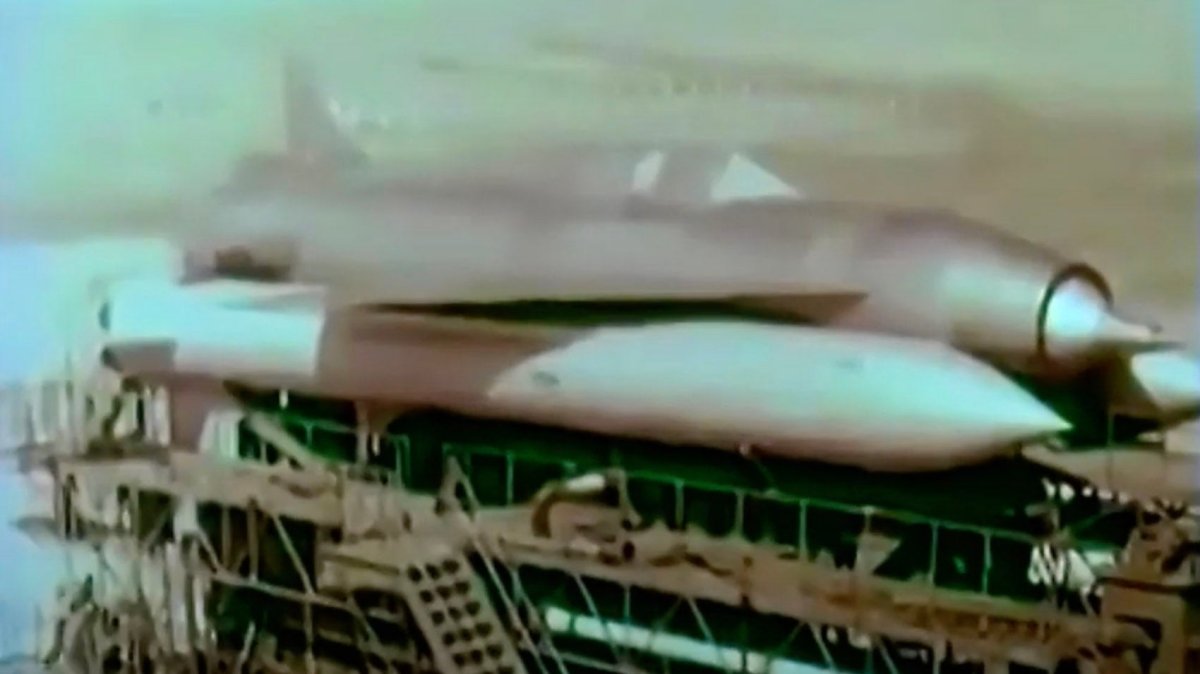
A Burya on the launch pad at a Soviet test facility., YOUTUBE SCREENCAP
In fact, the Myasishchev missile, the RSS-40 Buran (no relation to the subsequent Soviet space shuttle ), was canceled without a single missile completed. Over in the United States, the Navaho, too, was abandoned in July 1957, though work involving the missile, an air-launched derivative of which eventually entered service as the AGM-28 Hound Dog , continued into the following year.
Over at Lavochkin, work continued on the Burya, which received the in-house designation V-350. Work on this 60-foot-long missile had progressed further than on the Myasishchev rival, and by August 1, 1957, there were several examples completed, one of which conducted a first flight test on this date. It was an ignominious failure, the missile failing soon after takeoff.
The Burya’s flight profile began with it being raised to a vertical position, before blasting off its static launch pad under the power of a pair of liquid-fueled booster rockets, before the ramjet engine took over, propelling the vehicle to a maximum speed of around Mach 3.5.
Towed by a train, this still provides an idea of the impressive scale of the Burya missile., YOUTUBE SCREENCAP
Soon things picked up, though, and between 1957 and 1960 there was a total of 19 test launches, 14 of which successful. One test, in March 1960, saw the Burya test missile cover a distance of 4,000 miles before hitting a target with an accuracy of within six miles, thanks to its astronavigation guidance system. This was an acceptable level of accuracy considering the production missile would have been armed with a thermonuclear warhead.
After being fueled, a Burya is raised to the vertical position for launch., YOUTUBE SCREENCAP
By 1960, however, Soviet ICBMs had become a realistic proposition and the mighty ramjet-powered Burya was beginning to look like an anachronism. For all its technological prowess, it was potentially vulnerable to American air defenses due to its relatively slow terminal velocity.
Around this time, the Burya was shelved in favor of an ICBM. Fittingly, it was a Korolev design, the R-7, or SS-6 Sapwood , that was selected. In modified form, this missile was used to launch Sputnik 1 , the world’s first artificial satellite, into orbit, and was used for an entire family of Soviet, and later Russian, space launch vehicles.
Remarkably, it seems that Western intelligence entirely failed to identify the Burya missile, a point raised by Steven J. Zaloga in his book
The Kremlin’s Nuclear Sword . Whether that’s true, or whether it was known about, but not fully understood, it apparently never received a Western reporting name or designation.
Clouds of smoke accompany a Burya test launch., YOUTUBE SCREENCAP
In some ways, of course, the story of the ground-launched strategic cruise missile has now come full circle in modern-day Russia, with the development of the notorious 9M730 Burevestnik , although this trades supersonic performance for, reportedly, almost unlimited range, on account of its nuclear propulsion. You can read more about recent developments in this project in this previous War Zone article .
The mystery that surrounded the Burya makes the appearance of this 1959-vintage film all the more interesting. It is to be hoped that the Russian archives will continue to reveal such insights into more of the Cold War’s hidden military history.
Contact the author: thomas@thedrive.com
Comments couldn’t be loaded. Please refresh the page.
更新于美国东部时间2020年12月15日晚上7:14。
每当一部看似已被遗忘的、展现苏联时代军事技术的影片重见天日,总会令人着迷,尤其因为其中涉及的武器系统往往规模宏大,或者代表了当时应对各种挑战的卓越方法。一部拍摄于1959年的关于“布里亚”战略巡航导弹的影片,就符合上述两个特点。
这部影片由推特用户@KomissarWhipla(真名Dmitry Stefanovich)推荐给我们,已分两部分上传至YouTube。影片采用彩色拍摄,时长达74分钟,令人印象深刻。虽然画面质量可能略有不足,但它提供了一个绝佳的机会,让我们得以一窥冷战时期西方世界几乎完全不为人知的战略武器计划。
双助推火箭在布里亚试验导弹发射前瞬间点火。(YouTube截图)
此外,作为冷战时期一个特殊的研发死胡同,“拉沃奇金·布里亚”值得我们更详细地研究一番。
您可以在下方观看影片的两部分——包括成功的发射以及一些灾难性的失败:
“暴风雨”(Burya)导弹——俄语意为“风暴”——诞生于苏联几乎完全专注于弹道导弹作为向潜在敌人投送核弹头的武器时期。到1956年中期,苏联军方已将R-5M导弹(北约代号SS-3“骗子”)投入使用,这是苏联第一款具备核打击能力的导弹。然而,即使将这种武器前沿部署在卫星国,射程仅为750英里的R-5M导弹也无法打击许多高价值目标,包括位于英国或太平洋地区的美国空军轰炸机基地。
与此同时,苏联工业界的任务是研发R-5M的后续型号,使其性能大幅提升,能够打击洲际目标。到了20世纪50年代初期,这无疑是一项严峻的挑战,主要障碍在于缺乏强大可靠的发动机,以及制造多级弹道导弹的难度。
1964年阅兵式期间,一列R-5系列弹道导弹列队驶过莫斯科。(图片来源:Thomas Taylor Hammond/Wikimedia Commons)
此时,苏联将注意力转向了美国。显然,美国人对早期的弹道导弹技术并不完全信任,而是同时发展载人轰炸机和战略巡航导弹,以求稳妥。在战略巡航导弹中,北美公司的SM-64“纳瓦霍”导弹似乎最具威力。这是一款冲压式发动机驱动、可携带核弹头、速度可达3马赫的导弹,据称能够从美国本土基地发射后打击苏联目标。
像纳瓦霍这样的巡航导弹的一大优势在于它能像飞机一样飞行,并且大部分飞行时间都由吸气式冲压发动机推进,无需携带额外的氧化剂,从而大大减轻了整体重量。反过来,这意味着它只需要一枚相对较小的火箭即可发射。
1958年11月,最后一枚纳瓦霍导弹从发射台升空。(美国空军/公共领域)
纳瓦霍导弹的设计方案颇具吸引力,苏联科罗廖夫设计局当时已经开始研发类似的导弹,作为其弹道导弹项目的备用方案。1953年,科罗廖夫设计局奉命集中精力研发弹道导弹,其冲压式巡航导弹的设计工作被移交给两家竞争的航空设计局——拉沃奇金设计局和米亚西舍夫设计局。
这一决定使谢尔盖·科罗廖夫不仅直接与美国的发展展开竞争,而且在本国战略导弹发展方面也面临两种相互竞争的方案。因此,他加倍努力研发洲际弹道导弹(ICBM)。
一枚苏联邮票,纪念谢尔盖·科罗廖夫的一生,他是苏联最杰出的火箭和航天器设计师。(图片来自维基共享资源)
与此同时,拉沃奇金和米亚西舍夫各自的战略巡航导弹项目也遇到了各自的难题——尽管早期前景光明,但该概念在实践中却难以实现。特别是,冲压式喷气发动机的推进技术难以掌握,同时,制造能够承受高速飞行时摩擦产生的高温的部件也是一项挑战。这些武器的制造过程中大量使用了钛合金。
一架布里亚火箭炮在苏联试验场的发射台上。(YouTube截图)
事实上,米亚西舍夫导弹(RSS-40“暴风雪”,与后来的苏联航天飞机无关)在未完成任何一枚导弹的情况下就被取消了。在美国,纳瓦霍导弹项目也在1957年7月被放弃,尽管其空射衍生型号(最终以AGM-28“猎犬”导弹服役)的相关工作一直持续到次年。
在拉沃奇金设计局,布里亚导弹的研发工作仍在继续,其内部代号为V-350。这款长60英尺的导弹的研发进度比米亚西舍夫的同类导弹更为迅速。到1957年8月1日,已经完成了几枚样机,其中一枚于当日进行了首次飞行测试。然而,这次测试以惨败告终,导弹在起飞后不久便失效。
布里亚的飞行剖面图首先是将其升至垂直位置,然后在两枚液态燃料助推火箭的动力下从其静态发射台上发射升空,之后冲压喷气发动机接管动力,将飞行器推进到约 3.5 马赫的最大速度。
由火车牵引,这仍然能让人感受到布里亚导弹惊人的规模。(YouTube 截图)
不过,事情很快有了进展。1957年至1960年间,共进行了19次试射,其中14次成功。1960年3月的一次试射中,“暴风雨”试验导弹飞行了4000英里后,凭借其天文导航制导系统,以6英里以内的精度击中目标。考虑到量产型导弹将携带热核弹头,这样的精度是可以接受的。
加注燃料后,布里亚火箭被竖起至垂直位置准备发射。(YouTube截图)
然而到了1960年,苏联的洲际弹道导弹已经成为现实,而威力强大的冲压式发动机“暴风”导弹则显得有些过时。尽管它拥有卓越的技术实力,但由于其末端速度相对较慢,因此很容易受到美国防空系统的攻击。
大约在同一时期,“布里亚”导弹项目被搁置,转而研发洲际弹道导弹。最终选定的导弹正是科罗廖夫设计的R-7型,又称SS-6“树皮”导弹。经过改进后,该导弹被用于将世界上第一颗人造卫星“斯普特尼克1号”送入轨道,并被用于苏联乃至后来的俄罗斯一系列航天运载火箭。
令人惊讶的是,西方情报机构似乎完全未能识别出布里亚导弹,史蒂文·J·扎洛加在他的书中也提出了这一点。
克里姆林宫的核剑。无论这是否属实,或者它是否为人所知但未被完全理解,它显然从未获得西方媒体的正式名称或称谓。
布里亚火箭试射时,伴随着滚滚浓烟。(YouTube截图)
当然,从某种意义上说,陆基战略巡航导弹的故事在现代俄罗斯已经画上了一个完整的句号,臭名昭著的9M730“海燕”巡航导弹的研制就是一个例证。尽管它牺牲了超音速性能,但据称凭借核动力推进,拥有了近乎无限的射程。您可以在之前的“战区”文章中阅读更多关于该项目最新进展的信息。
围绕布里亚号的种种谜团,使得这部1959年拍摄的影片的出现更加引人入胜。希望俄罗斯档案馆能够继续揭示更多冷战时期不为人知的军事历史。
联系作者:thomas@thedrive.com
评论加载失败,请刷新页面。