Veteran S-3 Viking Crewman Breaks Down Everything Happening In This E-2 Hawkeye Carrier Launch Video资深S-3“维京”机组人员详细解读E-2“鹰眼”舰载机发射视频中的所有细节
Expert play-by-play and deep insight into exactly what we are seeing and hearing in this viral cockpit video of an E-2C carrier launch.
新闻视频
Published Aug 11, 2021 2:03 PM EDT
It really is a dance. Mostly described as a ballet. But I think we think only of the movements of the flight deck crews and aircraft. No. The dance is also in the cockpit and back-seat aircrew positions. It is in the head of the pilot sitting upfront having to pirouette through years of training and checklists and procedures. It is in the cognitively processed verbalizations spoken through a routine connection from one brain to others—from one who sees to the others who cannot.
This video is a tale told many times every day somewhere on the oceans of the world. A short, simple story of the movement of a machine and the men and women trying to safely make their way through well-orchestrated chaos while maintaining control of their aircraft and of themselves. While a video, it is mostly about spoken words—primarily the pilot’s monologue—over the ICS (Inter Communications System). The words are simple. But they are words designed to keep the crewmembers, who are a captive audience sitting in the back of the aircraft, aware of each movement and choreographed event that occurs, from the removal of chocks and chains to the separation of aircraft from the aircraft carrier.
I have never flown in a Grumman E-2C Hawkeye . I have, however, flown many hours in the S-3 Viking . One day, on the way out to my own aircraft, I followed the crew of a Hawkeye who were also launching from the deck of the USS Theodore Roosevelt (CVN-71). With their permission, I took a moment to peek inside of this incredible airborne early warning (AEW) stalwart of Naval Aviation that has been flying since October of 1960. I am certainly not qualified to tell the story of this video from their perspective. I am, however, still able to remember the complexity, the intensity, the adrenalin, and the variety of emotions this crew is experiencing after having done so myself over 200 times.
While viewing this short 10-minute and 46-second video, listen carefully to the words spoken. As you listen to those words, focus on the tones, the sounds, the attitudes, and the motive-power of what occurs when a naval aircraft makes its way from one point to the other across the flight deck of a bustling US Navy aircraft carrier. You are about to get a glimpse into a most incredible relationship that has been built on a 100-year-long foundation of ideas, of mishaps, of the loss of great men, and of late, women. A relationship also built of blood, sweat, and untold oceans of tears, resolve, trust—deep, deep trust—love of the profession, attention to detail, and devotion to the safety and care of fellow shipmates.
Now for the video, let the dance begin:
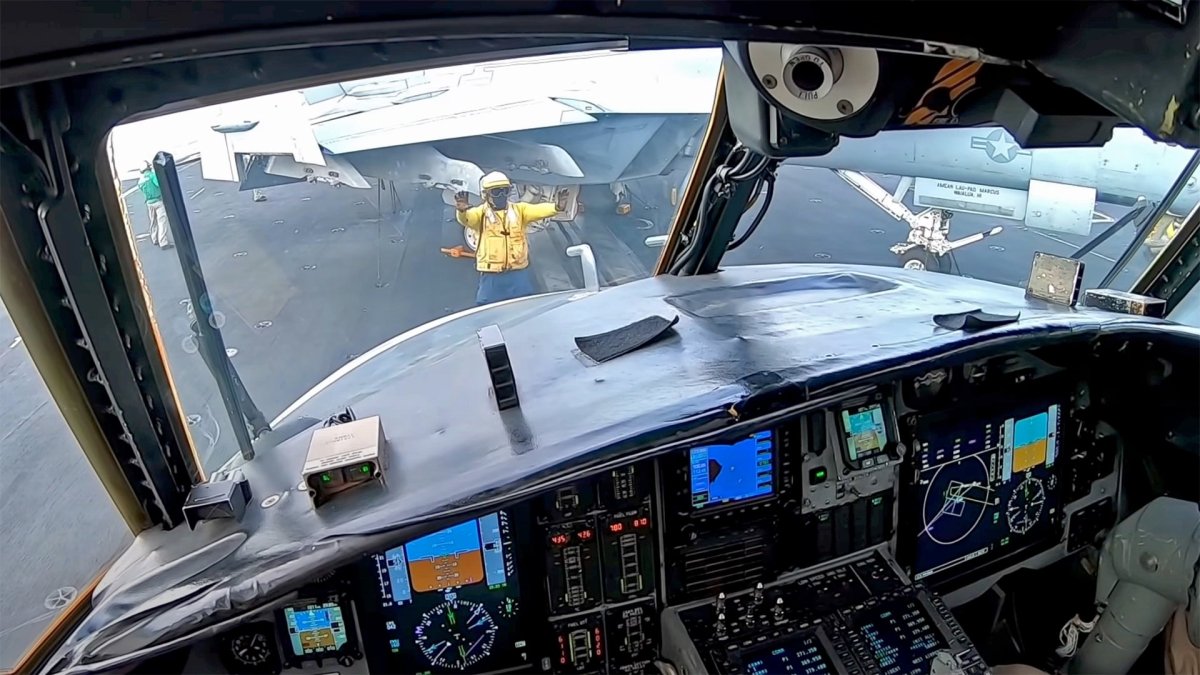
Okay, so the first thing you see is how the video is being shot from a GoPro camera attached to the helmet of the E-2C’s pilot sitting on the left side of the cockpit. Immediately obvious and a little disconcerting is the windscreen full of Super Hornet. Between the stubby nose of the Hawkeye and the sharp leading edges of the F/A-18E’s right-wing and stores’ pylons, a brilliantly colored “yellow shirt” flight deck plane director stands ready to initiate the dance.
The first thing the pilot tells his captive, unseeing audience in the back of the Hawkeye is that the carrier’s yellow shirt has taken over from the squadron’s brown-shirted plane captain and has sent the brown shirt and possibly a squadron green-shirt (maintenance personnel) under the aircraft to “break down” the chains and pull the wheel chocks holding the E-2 to the flight deck.
Once removed, and if the carrier deck is moving a lot due to the state of the sea, the backseaters’ stomachs might feel like that moment you first step out onto the ice with a pair of ice skates you haven’t worn since that winter a hundred years ago.
Note the flow of the yellow shirt’s arms. This may or may not be the first launch of the day. But the Hawkeye is almost always first to get airborne. Back in my day, the S-3 tended to join her on one of the four catapults. The E-2, once at altitude, would paint an aerial picture for the carrier battle group while the Viking would paint a surface picture . Today, in the absence of the S-3 , the Hawkeye is the only aircraft in the carrier air wing with a powerful airborne radar capable of surveilling huge geographical swathes, which the Carrier Strike Group (CSG) now relies on to paint both the much-needed air and sea pictures.
The cabin of the E-2 Hawkeye., USN
I hope you catch the sometimes-jovial, sometimes-salty comments of the crew throughout the video. These guys and gals have clearly been doing this same type of flight for a long time (as you’ll hear). They are fighting boredom. They are fighting fatigue that comes with repetition and boredom—regardless of how many hours they may have slept. They are fighting a mental malaise of sorts that can kill all of them, and potentially many more on the flight deck, in an “aircraft carrier second.”
The simplest thing can go wrong and might have gone wrong seven times before without sparking an emotion. But now, on its eighth occurrence, it will set one of the crew off on a brief ICS-tirade. The humor and anger are personality-driven. As with life all over our planet, we have and encounter all kinds of personalities. But there are those uncanny individuals who navigate the US Navy’s version of Bill Murray’s Groundhog Day with a strong sense of humor, dragging a reluctant smile out of even the sourest of sailors. It is these individuals who are the genuine heroes of the global war against boredom. Our pilot in this video is one such great soul.
Then it happens. The pilot is instructed to release the brakes and the yellow shirt does the unthinkable—something that made my heart run up into my throat the first time I saw this video: he directs the Hawkeye forward !
Holy shit! They’re already parked danger-close to the Hornet. IT’S DIRECTLY IN FRONT OF THEM! After my heart rate slowed to a reasonable rate and migrated back into my chest, I had to take into account that neither of the front-seaters made any protest, but simply complied with the yellow shirt’s directional commands.
THIS is an aircraft carrier flight deck!
As the E-2 creeps forward, the yellow shirt’s hands don’t demand the pilot put on the brakes to prevent the crunching of the two very expensive aircraft. Instead, he circles his hands then starts pushing the air back at the Hawkeye. What the…?
Here is the second ‘holy shit!’ moment: as nonchalantly as if the pilot just ordered a double Frappuccino at Starbucks, he describes for the backseaters how he is being told to back the aircraft up. I had no earthly idea—even after four years on sea duty on three aircraft carriers—that an E-2 could go backward on its own! And I’m not the only one who is surprised. Narratively, the pilot points out that some of the flight deck crew were as dumbfounded as I. But everything is planned for on a carrier’s flight deck. Obviously, even with that cute side mirror, the pilots can’t see a damn thing when backing up. The yellow shirt, too, has limited vision and is relying on others to assist, providing a watchful eye from key locations around the aircraft, ready to signal an immediate stop. It is kinda funny, however, as they continue to be directed backward, how the crew comments on how long and far the aircraft is being sent in that awkward direction.
Now, let me highlight something the pilot says here, perhaps the most critical of the vocalizations offered throughout his monologue: he tells the crew that they “ are backing off of Cat 2; looking like we’re going to Cat 1. ” The backseaters may have been made aware of where their aircraft was parked during the briefing in the Ready Room. This awareness would be reinforced when they came up onto the flight deck and walked to the aircraft. However, once they’ve climbed inside the cocoon-like fuselage of the Hawkeye and begin to conduct their individual preflights, equipment power-up, and operational checks, their very limited view and very limited perspective of a rapidly changing outside world only contribute to the depletion of their positional and situational awareness.
Once, with our very whiny auxiliary power unit yelling insults into the night air, I was so engrossed in my internal avionics-tunnel preflight, which consisted primarily of watching our maintenance guys swapping out broken “black” boxes, I completely missed the fact that my aircraft had been towed from the bow to just behind the waist catapult jet-blast deflectors (JBD) on the angle-deck.
An E-2C taxis on the USS Harry S. Truman. , USN
So the pilot reminds them where they are and where they are probably going. This is so important in the event of an emergency. If you’ve seen any of the videos of aircraft crashes on aircraft carrier flight decks, routes of escape can quickly be marginalized and an unaware backseater needs to know precisely what is going on around them and exactly where they are in order to effect a successful egress and escape.
For example, if I’m told we’re passing the carrier’s island to our right on the way to the bow catapults and an aircraft on Cat 3 explodes, engulfing my airplane in, initially, superficial flames, I know a ground egress through the S-3’s crew hatch (on the right front of the aircraft) will have me running in the direction of the island. Once at the island, I can then get behind it to protect myself from the conflagration, finish wetting my pants, and then, possibly, participate in fighting the fires as all good sailors should do.
Another thing I want you to notice is that life doesn’t stop for the rest of the crew while the aircraft is taxiing to a catapult. Notice how a backseater asks the front seaters for some sort of input information, probably the GPS/Inertial Navigation System. Then notice, in the midst of the aircraft not only backing up, but backing to the left, which is swinging the nose of the aircraft to the right, how easily the right seat pilot complies with the request. Tons and tons of things are all going on at once, on the flight deck as well as in the minds of these crewmembers, yet their training, mental acuity, and professionalism allow them to perform layers of tasks in what is the genuine definition of “multi-tasking.”
“Coming forward now. Heading straight toward the catapult one JBD… right turn, slightly more right turn heading toward an elevator. I’ve got a jet off to the right turning, so we’re going to get some exhaust…”
This pilot is brilliant. He is describing even the smallest adjustments to the direction of the aircraft.
“Getting a left turn setting us up for catapult one… we, upfront, are now crossing the JBD.”
Now, there are two reasons why the pilot has made this important statement about crossing the “JBD” or Jet Blast Deflector—the large plate-like structure that rises behind an aircraft during launch to deflect the blast from its engines or propellers away from everything behind it. Think of it as a threshold point. Not quite a point-of-no-return, but an important escalation of flight crew awareness.
The JBD is a huge slab of steel that flips up from being flush with the deck so as to block an aircraft’s dangerous exhaust during launch., USN
First, crossing the JBD is a signal for the mindset to change, particularly the mindset of the crew in the back. It is a warning to finish up what you are doing, store those items that may become FOD in the cockpit (Foreign Object Debris—or what, essentially, could become a missile when your aircraft goes from zero to 120 knots in two to three seconds), and adjust your thinking to the potentially life-threatening catapult launch. I’m not sure what happens in the back of the E-2, so let me tell you what I would be doing at this point in the S-3:
-INCOS tray (essentially a computer keyboard): stowed up and locked.
-Body position: adjust to ensure I’m in the proper body position (although I should already be there) should we have to eject.
-Shoulder straps/leg straps: pull, ensuring they are as tight as I can stand (ejection seat-slap can break a femur).
-Helmet visor: down.
-Flight gloves: on, if they aren’t already. The Nomex flight suit and gloves will protect an aircrew member from flash fire or the rocket motor of a simultaneously firing ejection seat.
-ICS control: switch from hot mic to push-to-talk so when the aircraft goes to full throttle, the engine noise won’t bleed into my boom mic and over the ICS creating unnecessary confusion and noise in the cockpit at one of the most critical moments in aircraft carrier aviation.
-Mouth: shut. They don’t need any unnecessary talking in their helmets.
-Ears: wide open to listen (listening, intently, to the front seaters talk through checklists, weight boards, wing unfolding).
The second reason why it is so important for the pilot to announce that the aircraft is crossing the JBD is that it might accidentally be raised as the aircraft is passing over it. JBDs are very quick, powerful, hydraulically actuated hunks of steel that will easily slice the fragile aluminum skin of an aircraft in half, rupturing fuel tanks as well as human flesh. Sadly, I have heard several stories of JBDs being lowered on unaware flight deck crew.
E-2 moving into launch position aboard the USS Dwight D. Eisenhower. , USN
“Here is our weight board person… weight board person should be showing us a five, four, zero, zero… zero. I see it; I like it.”
The flight deck catapult weight board. It can kill you. It has killed. As a SENSO (Sensor Operator) in the S-3, I didn’t care about calculating the weight of my aircraft prior to launch. That’s that pilot shit that pilots do. Besides, I’m shitty at math. But I am deeply invested in knowing what our weight is and hearing my front seaters acknowledge that they see those exact numbers on the weight board.
Notice I said front seaters—plural. Both of them need to agree that the aircraft carrier’s catapult crewmember has dialed in the correct weight (as the E-2’s right-seat pilot did). If the weight is too high, the power of the steam catapult may rip the nose gear off. If it’s too low, then the odds are very good that as the aircraft reaches the end-of-the-bow or angle deck, it is going swimming.
A green shirt showing the weight board for an aircraft about to launch., USN
As a result of this “cold cat” situation, the crewmembers of a Viking, for example, would be taking a rocket ride up and then parachute ride down to a swim of their own. In the case of the Hawkeye, the aircrew must wait for their bird to stop flying and begin swimming so all five can get the hell out through the top of the aircraft—there are no ejection seats.
Even then , if every one of the flight crew is in agreement that the weight board is correct there is still no guarantee that the other flight deck catapult crewmember who enters the aircraft weight from the weight board into the power-setting of the catapult will do so correctly.
Remember my point above about “trust— deep trust”?
Our friend Ward Carroll with a bit more on Cold Cats if you are interested:
As they’re taxiing up to Cat 1, note the almost mesmerizing hum of the Hawkeye’s engines. The Viking’s TF34s were very noisy, even through our protective helmet-headphones. One thing I noticed, as the E-2 is sitting there waiting for the launch process to happen, is how the pilots have their hands on the instrument panel glare shield and sometimes make gestures with them above it. It brought back to memory how my pilots repeatedly talked about how critical it was not to make any hand movements above the glare shield. These hand gestures might be interpreted by the flight deck catapult crew as a salute, inadvertently launching your aircraft when you are, in fact, not ready. Of course, this was a rule that came into play when the aircraft was at full power in catapult tension.
Note, at this point of the video, how the yellow shirt straddling the catapult finishes her directions and then walks off to the left with her arms and hands tucked against her float coat. This is a sign of a great yellow shirt who knows any movement of her arms could be misinterpreted by the cockpit crew as a signal.
“Alright, we’re lined up on Cat 1.”
At this point you have heard the backseaters dealing with some problems related to their jobs as Air Traffic Control (ATC) and Airborne Early Warning (AEW) directors. In the S-3, we had two ICS channels (if memory serves). While the aircraft is on the flight deck we were all up on the primary ICS channel. So, I find it interesting that the backseaters are already flying the upcoming mission and it is “bleeding” into the pilot’s conversation up front.
Now, there is a critical tone change.
This change of tone is a rapid recitation of more items on the checklist to ensure that the aircraft is ready to fly. The tone change is equivalent to a Catholic school nun’s tapping of her ruler on the desk to get her student’s undivided attention. For the kids, divided attention means an aching welt on the upper surface of the hand. For the aircrew, divided attention could result in the loss of their lives. The pilot’s recitation is so rapid that, for me—three decades since, I can’t understand much of what he is saying. Back then, I would be hanging on every word, even though I’d heard it so many times before.
“We should be getting a wingspread maybe…”
“Yep… I’m clear on the left to spread.”
Wing fold. That awe-inspiring, exciting and terrifying phenomenon of Naval Aviation. I never recall hearing my pilots call the area “clear” for the folding or unfolding of the S-3’s wings which were already high above the deck when fully spread. On the other hand, a Hawkeye’s wing fold/unfold configuration makes sense. Leroy Grumman’s fantastical wing folding system, which he purportedly designed while sitting at a table with a chalkboard eraser and paperclip in hand, is a sight to behold. Because of its range of motion, it makes sense that you hear the pilots check to make sure the area visible to them is clear. Notice how the pilot waits for the white shirts (final-checkers who sometimes have a black checkerboard painted on their white shirts) to give him a thumbs-up signal that the wings are locked.
Apparently, the E-2 has an indicator on the leading edge of the wing fold point to indicate a locked wing, whereas the S-3 had two holes underneath each wing that the final-checkers could peer through to confirm that each wing was properly locked. Those holes were not originally there.
As the tragic story goes, my squadron, the “Scouts” of VS-24, had a wing-fold-in-flight mishap shortly after a January 26, 1983, launch from the USS Nimitz (CVN-68) while in the Mediterranean Sea. Only one crewmember, Lieutenant Tim Dumbauld, the Tactical Coordinator (TACCO), successfully ejected and survived. It was fate: the left wing folded, causing the aircraft to rapidly roll off to the left and then tumble out of control. During the four-man ejection sequence, the backseaters go first, followed by the front a fraction of a second later. Because he was in the right-rear seat, he was on the top of the roll which kept his ejection seat in the envelope long enough for him to survive. The pilot, Lieutenant Commander Randy Dixon, the Co-Tactical Coordinator, Lieutenant Pete Moller, and the SENSO, AW2 Richard Lanzendorf, were all out of the ejection envelope and were killed. Because he survived, Lieutenant Dumbauld saved the lives of an unknown number of S-3 Viking crewmembers. He was able to tell investigators what had happened and after testing the mechanism, the holes were drilled in the aluminum skin to allow viewing of the locking mechanism.
Remember my point above about “…mishaps; the loss of great men; of blood…”?
E-2C unfolding its wings while moving into position on Cat 1. , USN
I might have missed it, but I found the pilot’s “wipeout” peculiar. A wipeout is a checking of all of the Hawkeye’s control surfaces by moving the yoke in all directions. The E-2 pilot did it just after the wings were spread. My pilot normally did this when in catapult tension and at full power to ensure he felt that all the controls were working. Very odd.
The final takeoff checklist items are recited. And then you hear a noticeable “Whhooooosssshhh!” try to overtake the pilot’s communication. Somebody’s hot mic starts bleeding over the ICS. Uhhhggg! That thing I hate. Notice how quickly they identify the problem and the guilty backseater assures the pilot: “Yeah, I’m trying to fix it.”
“Looks like Mom has stabled out… two five zero-ish.”
“Mom.” That’s what we call our aircraft carriers, with all the implied and intended affection. And that is what she is.
Now the pilot is transitioning to mission mode. He is still fully invested in a successful launch, but now he is informing the backseaters that the carrier, which all along has been gently turning into the wind, has possibly settled onto a final bearing for the launch and recovery of her chicks. By informing them of the “250ish” heading, he is also providing tactical situational awareness for the crew as they fly off into their mission. The all-important “ish” is the pilot’s way of confirming that the boat might still be in search of that final bearing, however.
The directing yellow shirt signals that the E-2 on Cat 1 is going into tension and passes off responsibility for the aircraft to the Shooter.
“We’re going into tension…”
The pilot pushes the throttle forward to full power. More checklist items are completed as they scan the instruments to ensure the engines are working and the aircraft is ready.
“We like it in the rear.”
Thumbs-up all around just moments before a Hawkeye gets catapulted off the deck., USN
That final acknowledgment is absolutely critical. The backseaters are part of the team. They must “like it” as well if the aircraft is going to go flying. With the onset of full power, they may see, smell or hear things the pilots, at that moment, cannot. Smoke, fuel leaking, electrical sparking, or an odd sound of the engines or aircraft are all things they are in a unique position to experience and communicate to the front seaters.
In the S-3, the “We like it…” wasn’t something we verbalized. Because of our proximity to the front of the aircraft, the CoTAC (or co-pilot) simply had to turn his head and see me and the TACCO holding a thumbs up to know we were ready and the back of the aircraft was good.
“Giving him a salute. He [the Shooter] is looking around. He’s looking aft… He’s looking back at us. He’s touched the deck.”
Damn! I love this guy! Complete, detailed information for the three blind mice in the back. Communication just doesn’t get any better!
The salute is key. It tells the Shooter that your multi-million dollar, many-thousand-pound aircraft is ready to go flying. This is why I made that point, above, about keeping your hands below the instrument glare shield. At night, since no one can see much of anything, in lieu of a salute, the pilot will turn on the aircraft’s navigation and anti-collision lights to inform the Shooter that the aircraft is ready. I won’t take the time, here, to discuss what it’s like taking off and landing on an aircraft carrier at night, under EMCON (electromagnetic emissions control similar to radio silence) conditions… with NO LIGHTS allowed. I only did it once during flight ops in the North Atlantic under simulated wartime conditions. I will tell you, however, that it scared the shit out of me.
Then, the joy ride—the one they pay you to take—begins.
An E-2 mid-cat shot., USN
When you live and fly with the same, relatively small group of people over and over, you get used to their voices and the moods those voices can convey. 54,000 pounds of E-2 going down the relatively short distance of the bow of an aircraft carrier instills its own set of emotions. But, as a backseater, you’re scanning that tone of voice to detect the slightest hesitation, fear, concern… or joy because of another great catapult shot.
I was used to hearing my pilots say: “Good shot!” Of course, after your first few shots, the feel becomes muscle memory and despite not being able to see much from the backseat, you do know it is good.
“Oh yeah!” is a good sound to hear.
Note, almost as soon as the aircraft is off the pointy end of the carrier, the pilot enters a “clearing turn.” After he is sure the aircraft is actually going to fly, he enters into either a right (when launching off the bow) or left turn (launching off the waist or angle) to ensure there are no mid-air collisions between aircraft that are launching simultaneously. If you don’t, the Air Boss will be reminding you, as only an angry father can, that you forgot to perform the critical turn.
An E-2C gets airborne., USN
Just a few other notes. Notice that the Hawkeye stayed relatively low until reaching the point of the escorting cruiser. I can’t speak to this mission, specifically, but we might have done so under EMCON conditions to keep an enemy radar from detecting a number of aircraft popping up on their screens from one specific locale which would give away the carrier’s position. Also, notice how quickly radar/IFF (Identification Friend or Foe) information started coming from the backseaters.
Now, once airborne, it was our turn to help the pilots maintain situational awareness of the very busy and crowded skies they were flying us off into. And you’ve got to love the backseater’s comments about eating her boom mic due to the power of the cat shot and bitching about her equipment.
Finally, as they are passing to the left of the cruiser, the two front seaters start discussing the identity of the ship. As one who had studied surface ship and submarine recognition for years, it made tears of laughter fall from my eyes to hear the fantastic pilot say:
“I don’t know anything about boats… I just know what the carrier looks like.”
Ahhh, the simple things in life!
U.S. Navy carrier aviation, ladies and gentlemen!
Contact the editor: Tyler@thedrive.com
Comments couldn’t be loaded. Please refresh the page.
发布于美国东部时间2021年8月11日下午2:03
这的确是一场舞蹈,通常被比作芭蕾。但我认为我们往往只想到驾驶舱机组人员和飞机的动作。不,这场舞蹈也存在于驾驶舱和后座机组人员的位置中。它存在于坐在驾驶舱的飞行员的脑海中,他必须将多年的训练、检查清单和操作流程像芭蕾舞一样翩翩起舞。它存在于认知处理后的语言表达中,这些表达通过大脑之间的常规连接传递——从能够看到的人传递到那些看不到的人。
这段视频讲述的故事,在世界各大洋上每天都在上演。这是一个简短而简单的故事,讲述了一架机器的运行,以及机组人员如何在精心安排的混乱中安全穿梭,同时还要保持对飞机和自身的控制。虽然是视频,但它主要由语音组成——主要是飞行员通过机内通信系统(ICS)进行的独白。这些话语虽然简单,但却是为了让坐在飞机后部的机组人员(他们就像被困在观众席上一样)清楚地了解每一个动作和精心安排的事件,从移除轮挡和链条到飞机与航母分离。
我从未乘坐过格鲁曼E-2C“鹰眼”预警机,但我驾驶S-3“维京”反潜巡逻机飞行过许多小时。有一天,在前往我自己的飞机途中,我跟随一架“鹰眼”预警机的机组人员,他们也正从“西奥多·罗斯福”号航空母舰(CVN-71)的甲板上起飞。征得他们的同意后,我得以窥见这架自1960年10月以来就服役至今的海军航空兵空中预警(AEW)主力机型的内部构造。我当然没有资格从他们的角度讲述这段视频的故事。然而,由于我自己也曾驾驶过200多次,我仍然能够清晰地记得机组人员所经历的复杂、紧张、肾上腺素飙升以及各种各样的情绪。
观看这段时长10分46秒的短片时,请仔细聆听对话。聆听时,请留意语气、声音、态度以及海军飞机在繁忙的美国海军航母飞行甲板上从一处飞向另一处时所展现出的动力。您即将一窥一段非凡的关系,这段关系建立在百年来的理念、事故、伟大人物的牺牲,以及近年来女性的牺牲之上。这段关系也凝聚着鲜血、汗水、无数泪水、决心、信任——深厚的信任——对职业的热爱、对细节的关注以及对战友安全和福祉的奉献。
现在开始播放视频,让我们开始跳舞吧:
好的,首先映入眼帘的是,这段视频是由安装在E-2C飞行员头盔上的GoPro相机拍摄的,飞行员坐在驾驶舱左侧。最引人注目也略显突兀的是挡风玻璃上密密麻麻地显示着F/A-18E超级大黄蜂的图案。在“鹰眼”短粗的机头和F/A-18E右翼锋利的翼尖以及挂架之间,一位身穿醒目黄色制服的飞行甲板指挥员正严阵以待,准备开始这场“舞蹈”。
飞行员告诉鹰眼飞机后座上那些被俘虏的、看不见的听众的第一件事是,航母上的黄衬衫飞行员已经接替了中队穿棕色衬衫的飞机机长,并派棕色衬衫飞行员和可能还有一名中队绿衬衫飞行员(维修人员)到飞机下面去“挣脱”链条,并拉动将 E-2 固定在飞行甲板上的轮挡。
一旦被移除,如果由于海况导致航母甲板剧烈晃动,后座乘客的胃可能会感觉像你第一次穿上自一百年前的那个冬天以来就没穿过的冰鞋踏上冰面的那一刻。
注意黄色衬衫手臂的摆动。这或许是当天的首次起飞,也或许不是。但“鹰眼”几乎总是第一个升空。想当年,S-3通常会和它一起从四台弹射器中的一台起飞。E-2一旦升空,就会为航母战斗群绘制空中态势图,而“维京”则负责绘制水面态势图。如今,由于S-3的缺席,“鹰眼”是航母舰载机联队中唯一拥有强大机载雷达的飞机,能够监视大片地理区域,航母打击群(CSG)现在依靠它来绘制至关重要的空中和海上态势图。
美国海军E-2“鹰眼”预警机的座舱。
我希望你能注意到视频中机组人员时而轻松愉快、时而略带讽刺的评论。正如你将听到的,这些男男女女显然已经执行这种类型的飞行任务很长时间了。他们正在与无聊作斗争。他们正在与重复和无聊带来的疲劳作斗争——无论他们睡了多少个小时。他们正在与一种精神上的不适作斗争,这种不适可能会在“航母瞬间”夺走他们所有人的生命,甚至可能危及甲板上更多人的生命。
一件最简单的事都可能出错,而且可能之前已经出错七次都没引起什么反应。但现在,第八次出错时,却会让某个船员突然爆发,在ICS系统里大发雷霆。这种幽默和愤怒都源于性格使然。就像地球上的其他生命一样,我们遇到各种各样的人。但总有一些人,他们能以强烈的幽默感应对美国海军版的“土拨鼠日”,甚至能让最愁眉苦脸的水兵勉强露出一丝笑容。这些人才是这场全球抗击无聊战争的真正英雄。视频中的飞行员就是这样一位伟大的灵魂。
然后,意想不到的事情发生了。飞行员接到指令松开刹车,而身穿黄衬衫的飞行员做出了令人难以置信的举动——我第一次看到这段视频时,心都提到了嗓子眼:他竟然指挥鹰眼向前飞去!
我的天!他们居然把车停得离大黄蜂战斗机太近了!它就在他们正前方!等我的心跳恢复正常,重新回到胸腔里之后,我才意识到,前排的两个乘客竟然没有提出任何异议,只是乖乖地听从了黄衫司机的指挥。
这是航空母舰的飞行甲板!
随着E-2缓缓向前移动,身穿黄衬衫的飞行员并没有命令飞行员踩刹车以避免两架昂贵的飞机相撞。相反,他转动双手,开始向鹰眼飞机推气。这……?
第二个“卧槽!”时刻来了:飞行员语气轻松得仿佛刚在星巴克点了一杯双份星冰乐,向后座乘客描述着他如何被指示倒车。我做梦都没想到——即便我在三艘航母上服役四年——E-2预警机居然能自己倒车!而且惊讶的还不止我一个。飞行员在叙述中指出,一些甲板上的船员也和我一样目瞪口呆。但航母甲板上的一切都在计划之中。显然,即使有那个可爱的侧视镜,飞行员倒车时也什么都看不见。那位穿黄衬衫的飞行员视野也有限,只能依靠其他人的协助,在飞机周围的关键位置密切观察,随时准备发出紧急停车信号。不过,当他们继续被指示倒车时,船员们评论飞机被引导了多远多长,这倒也挺滑稽的。
现在,我想重点指出飞行员在这里说的一句话,这或许是他整段独白中最关键的一句话:他告诉机组人员,“我们正在从二级危险区域撤退;看起来我们要降到一级危险区域了。”后座乘客可能在准备室的简报会上已经知道飞机停放的位置。当他们登上驾驶舱走向飞机时,这种认知会得到进一步强化。然而,一旦他们进入“鹰眼”战斗机茧状的机身内,开始进行各自的飞行前检查、设备启动和运行检查,他们极其有限的视野和对瞬息万变的外部世界的感知,只会进一步削弱他们的位置感和态势感知。
有一次,我们那台发出刺耳噪音的辅助动力装置在夜空中发出恼人的叫喊声,我却全神贯注于机舱内的飞行前检查,主要内容是看着维修人员更换损坏的“黑匣子”,完全没有注意到我的飞机已经被从机头拖到了斜甲板上腰部弹射器喷气偏转器(JBD)的后面。
一架E-2C预警机在“哈里·S·杜鲁门”号航空母舰上滑行。(美国海军)
所以飞行员会提醒他们当前的位置以及可能的飞行方向。这在紧急情况下至关重要。如果你看过航母甲板上飞机坠毁的视频,就会发现逃生路线很快就会变得狭窄,而意识不清的后座乘客需要清楚地了解周围环境和自身位置,才能成功撤离。
例如,如果我被告知我们正飞越右侧的航母舰岛前往舰艏弹射器,而3号弹射器上的飞机突然爆炸,我的飞机最初只是被表面火焰吞噬,那么我知道可以通过S-3的机组舱门(位于飞机右前方)逃生,朝着舰岛的方向跑去。到达舰岛后,我可以躲到舰岛后面,保护自己免受火焰的侵袭,然后继续尿裤子,之后,或许还可以像所有优秀的水兵一样参与灭火。
还有一点需要注意的是,飞机滑行到弹射器时,机组其他成员的工作并没有停止。请注意,后座飞行员会向前座飞行员询问一些输入信息,很可能是GPS/惯性导航系统的信息。然后请注意,在飞机不仅向左后退,而且还向左后退,导致机头向右摆动的情况下,右座飞行员是如何轻松地执行了这一操作。驾驶舱内以及机组人员的脑海中同时发生着无数的事情,但他们的训练、敏锐的思维和专业精神使他们能够同时处理多项任务,这才是真正意义上的“多任务处理”。
“现在向前飞去。径直朝着一号JBD弹射器飞去……右转,再稍微右转,朝着升降机飞去。右边有一架喷气式飞机正在转弯,所以我们会听到一些尾气……”
这位飞行员真是太棒了。他甚至能描述出飞机航向的最小调整。
“左转后,我们就可以像弹射器一样冲向终点……我们现在正走在最前面,穿越JBD。”
现在,飞行员之所以就穿越“喷气尾流偏转器”(JBD,即喷气尾流偏转器)发表这番重要声明,有两个原因。喷气尾流偏转器是飞机起飞时后方升起的大型板状结构,用于偏转发动机或螺旋桨产生的尾流,使其远离后方的一切。可以将其视为一个临界点。虽然并非不归路,但标志着机组人员的警觉性显著提升。
JBD是一块巨大的钢板,它从与甲板齐平的位置向上翻转,以阻挡飞机起飞时危险的尾气排放。(美国海军)
首先,越过联合弹射障碍(JBD)意味着机组人员的心态需要转变,尤其是后座机组人员的心态。这是一个警告,提醒他们完成手头的工作,将那些可能成为外来物碎片(FOD,即飞机在两到三秒内从零加速到120节时可能变成导弹的物体)的物品妥善存放,并调整思路,应对可能危及生命的弹射起飞。我不确定E-2预警机后座的情况,所以让我告诉你,如果我驾驶的是S-3反潜巡逻机,此时我会做什么:
-INCOS 托盘(本质上是一个电脑键盘):收起并锁定。
-身体姿势:调整身体姿势,确保我处于正确的身体姿势(尽管我应该已经处于正确姿势),以防万一我们需要弹射。
-肩带/腿带:拉紧,确保它们尽可能紧(弹射座椅的拍打可能会造成股骨骨折)。
-头盔面罩:放下。
飞行手套:如果还没戴,请戴上。Nomex飞行服和手套可以保护机组人员免受闪燃或弹射座椅同时发射时火箭发动机的伤害。
-ICS 控制:从热麦克风切换到按键通话,这样当飞机全速前进时,发动机噪音就不会传入我的吊杆麦克风并通过 ICS 系统,在航空母舰航空最关键的时刻之一造成驾驶舱内不必要的混乱和噪音。
嘴:闭嘴。他们戴着头盔,不需要任何不必要的谈话。
-耳朵:睁大眼睛倾听(全神贯注地听前排乘客讲解检查清单、配重板、机翼展开等)。
飞行员必须通报飞机正在飞越联合爆破装置(JBD)的第二个重要原因是,飞机飞越时,JBD可能会被意外升起。JBD是一种速度极快、威力巨大的液压驱动钢制装置,能够轻易地将飞机脆弱的铝制蒙皮切成两半,不仅会撕裂油箱,还会伤及机组人员。令人痛心的是,我听说过好几起JBD在毫无防备的驾驶舱内被降下的事故。
E-2预警机正在“德怀特·D·艾森豪威尔”号航空母舰上进入发射位置。
“这是我们的举重员……举重员应该向我们展示5、4、0、0……0。我看到了;我喜欢。”
飞行甲板上的弹射器重量指示牌。它会要你的命。它已经害死过人了。作为S-3的传感器操作员,我并不关心弹射前计算飞机的重量。那是飞行员才干的事。再说,我的数学很差。但我非常在意我们飞机的重量,也希望听到前座的飞行员确认他们看到了重量指示牌上的准确数字。
请注意我说的是前座飞行员——复数。他们两人都需要确认航母弹射器操作员已将配重设置正确(就像E-2预警机的右座飞行员那样)。如果配重过高,蒸汽弹射器的动力可能会扯掉前起落架。如果配重过低,那么飞机到达舰艏或斜角甲板末端时,很可能就会坠入水中。
一件绿色衬衫,上面印着即将起飞的飞机的配重板。(美国海军)
由于这种“冷猫”效应,例如,维京战机的机组人员会先乘坐火箭升空,然后借助降落伞下降到水里自救。而鹰眼战机的机组人员则必须等待飞机停止飞行并开始下沉,这样五名机组人员才能从机舱顶部逃生——因为没有弹射座椅。
即使如此,如果所有机组人员都一致认为重量板是正确的,也不能保证另一位负责将飞机重量从重量板输入到弹射器功率设置中的飞行甲板弹射器机组人员能够正确地输入重量板。
还记得我上面提到的“信任——深层次的信任”吗?
如果您有兴趣,我们的朋友沃德·卡罗尔还有更多关于“冷猫”乐队的信息:
当飞机滑行至1号弹射平台时,请注意“鹰眼”预警机发动机那几乎令人着迷的嗡嗡声。“维京”预警机的TF34发动机噪音很大,即使戴着头盔耳机也能听得一清二楚。我注意到,当E-2预警机停在那里等待弹射程序启动时,飞行员们的手放在仪表板的遮光罩上,有时还会用手在遮光罩上方做手势。这让我想起我的飞行员们反复强调,绝对不能在遮光罩上方做任何手部动作。这些手势可能会被弹射器操作人员误认为是敬礼,从而在飞机尚未准备就绪的情况下意外弹射。当然,这条规则只适用于飞机处于弹射器全速待命状态的情况。
请注意视频的这一部分,身穿黄色衬衫、跨坐在弹射器上的女飞行员完成指令后,双手和手臂都贴在了救生衣上,向左侧走去。这表明她是一位经验丰富的飞行员,深知任何手臂动作都可能被驾驶舱机组人员误解为信号。
“好的,我们已经排好1号线了。”
到目前为止,你们已经听到后座人员正在处理一些与他们作为空中交通管制(ATC)和空中预警(AEW)指挥官的工作相关的问题。在S-3飞机上,我们有两个ICS频道(如果我没记错的话)。当飞机在驾驶舱内时,我们都在使用主ICS频道。所以,我觉得很有意思的是,后座人员已经开始执行即将到来的任务,而且他们的谈话内容“干扰”到了前座飞行员的对话中。
现在,语气发生了重大变化。
这种语气的变化意味着快速地复述检查清单上的更多项目,以确保飞机做好飞行准备。这种语气的变化就好比天主教学校的修女用尺子敲击桌面,以引起学生的全神贯注。对孩子们来说,注意力分散意味着手背上会留下一个疼痛的肿块。对机组人员来说,注意力分散则可能导致生命损失。飞行员的复述速度如此之快,以至于三十年后的我,现在几乎听不懂他在说什么。而当时,即使我已经听过无数遍,我也会全神贯注地聆听每一个字。
“我们或许应该展开双翼……”
“是的……我明确表示要向左翼传播。”
机翼折叠。这是海军航空兵令人敬畏、激动人心又令人胆战心惊的现象。我从未听过我的飞行员在S-3飞机折叠或展开机翼时喊“安全区域”,因为S-3的机翼完全展开时已经高高地悬在甲板之上。另一方面,鹰眼战斗机的机翼折叠/展开方式就合情合理了。据说,勒罗伊·格鲁曼设计这套神奇的机翼折叠系统时,手里拿着黑板擦和回形针,这套系统本身就是一道奇观。由于其活动范围很大,所以你会听到飞行员检查周围区域是否安全也就不足为奇了。注意飞行员是如何等待身穿白衬衫的最终检查员(他们的白衬衫上有时会画着黑色方格图案)竖起大拇指,表示机翼已锁定的。
显然,E-2型飞机在机翼折叠点的前缘设有指示器,用于指示机翼是否锁定;而S-3型飞机则在每侧机翼下方有两个孔,最终检查人员可以通过这些孔来确认每侧机翼是否已正确锁定。这些孔最初并不存在。
悲惨的故事是这样的:1983年1月26日,我的中队VS-24“侦察兵”在地中海从“尼米兹”号航空母舰(CVN-68)起飞后不久,就发生了一起机翼折叠事故。只有一名机组成员,战术协调员(TACCO)蒂姆·邓博尔德中尉成功弹射并幸存下来。这完全是命运的安排:左翼折叠,导致飞机迅速向左侧翻滚,然后失控翻滚。在四人弹射程序中,后座飞行员先弹射,前座飞行员紧随其后。由于邓博尔德中尉坐在右后座,他正好处于翻滚的顶端,这使得他的弹射座椅在弹射包线内停留了足够长的时间,使他得以幸存。飞行员兰迪·迪克森中校、战术协调员皮特·莫勒中尉以及SENSO(空中导航支援官)理查德·兰岑多夫二级空军准尉均已超出弹射范围,不幸遇难。邓博尔德中尉幸存下来,拯救了数量不详的S-3“维京”反潜巡逻机机组人员的生命。他向调查人员讲述了事故经过,在测试了相关机制后,调查人员在铝制蒙皮上钻孔,以便观察锁定机构。
还记得我上面提到的“……事故;伟人的牺牲;流血……”吗?
E-2C 正在展开机翼,同时向第一类目标移动。(美国海军)
我可能错过了,但我发现飞行员的“扫射”动作很奇怪。扫射是指通过向各个方向移动操纵杆来检查“鹰眼”预警机的所有控制面。E-2 的飞行员是在机翼展开后立即进行的。我的飞行员通常会在弹射器拉紧、全油门状态下进行扫射,以确保他感觉所有控制面都工作正常。真是奇怪。
起飞前的最后检查清单项目被逐一念出。这时,你听到一声明显的“呼——”试图盖过飞行员的通讯。有人麦克风没关,声音开始通过仪表飞行系统(ICS)传到飞行员的通讯里。啊!我最讨厌这玩意儿了。注意他们是如何迅速找到问题的,那个“罪魁祸首”——后座乘客——向飞行员保证:“是啊,我正在努力解决。”
“看来妈妈的情况已经稳定下来了……大概在250左右。”
“妈妈。”我们这样称呼我们的航空母舰,其中蕴含着浓浓的爱意。而她,也的确是我们的妈妈。
现在飞行员正切换到任务模式。他仍然全神贯注于发射成功,但现在他正在告知后座机组人员,这艘一直在轻微迎风转向的运输机可能已经确定了最终的发射和回收航向。通过告知他们“大约250度”的航向,他也在为机组人员提供战术态势感知,以便他们执行任务。然而,至关重要的“大约”一词是飞行员确认运输机可能仍在寻找最终航向的方式。
身穿黄色制服的指挥员表示,1 类 E-2 飞机即将进入紧张状态,并将飞机的控制权移交给射手。
“我们正进入紧张状态……”
飞行员将油门推至全功率。他们一边检查仪表,确保发动机运转正常、飞机准备就绪,一边完成更多检查清单项目。
“我们喜欢坐在后面。”
就在“鹰眼”战机被弹射离甲板的前一刻,所有人都竖起了大拇指。(美国海军)
最后这一点至关重要。后座乘客也是团队的一份子。如果飞机要起飞,他们也必须“喜欢”这种感觉。当飞机全速运转时,他们可能会看到、闻到或听到飞行员此时无法察觉的事物。烟雾、燃油泄漏、电火花,或是发动机或飞机发出的异常声响,这些都是他们能够独特地体验并传达给前座乘客的信息。
在S-3飞机上,“我们很满意……”这句话并不是我们说出口的。由于我们离飞机前部很近,副驾驶(CoTAC)只需要转过头,看到我和TACCO竖起大拇指,就知道我们已经准备就绪,飞机后部一切正常。
“向他敬礼。他(射手)正在环顾四周。他向后看……他回头看着我们。他摸了摸甲板。”
真棒!我太喜欢这家伙了!他给后面三个瞎老鼠提供了完整详细的信息。沟通简直不能更好了!
敬礼至关重要。它告诉对方飞行员,你那架价值数百万美元、重达数千磅的飞机已经准备就绪,可以起飞了。这就是为什么我之前强调过,要把手放在仪表遮光罩下方。在夜间,由于几乎什么都看不见,飞行员会打开飞机的导航灯和防撞灯,而不是敬礼,以此告知对方飞机已准备就绪。我在这里就不赘述在夜间,在电磁管制(类似于无线电静默)条件下,在禁止开启任何灯光的情况下,在航空母舰上起降是什么感觉了。我只在北大西洋的模拟战时飞行训练中体验过一次。不过我可以告诉你,那真是把我吓得魂飞魄散。
然后,他们付钱让你体验的“兜风之旅”就开始了。
美国海军E-2中型机射击照片。
当你反复与同一群相对较小的人一起生活和飞行时,你会逐渐习惯他们的声音以及这些声音所传递的情绪。一架重达54000磅的E-2飞机沿着航母舰艏相对较短的距离滑翔而下,这本身就令人百感交集。但作为后座乘客,你会仔细聆听他们的语气,试图捕捉到哪怕最细微的犹豫、恐惧、担忧……或是因又一次精彩的弹射而产生的喜悦。
我以前经常听到飞行员说:“好枪法!” 当然,拍了几枪之后,感觉就变成了肌肉记忆,虽然从后座看不到什么,但你确实知道这枪打得不错。
“哦耶!”这真是个令人高兴的声音。
注意,飞机几乎一离开航母的尖端,飞行员就会立即进行“清场转弯”。在确认飞机能够顺利起飞后,他会向右转弯(从舰艏起飞时)或向左转弯(从舰腰或斜角起飞时),以确保同时起飞的飞机之间不会发生空中碰撞。否则,空中指挥官会像一位愤怒的父亲那样提醒你,你忘记进行这个关键的转弯。
一架E-2C预警机升空。(美国海军)
还有几点需要注意。鹰眼雷达在接近护航巡洋舰之前一直保持相对较低的飞行高度。我无法具体说明这次任务的情况,但我们当时可能处于电磁管制(EMCON)状态,以避免敌方雷达探测到来自同一区域的多架飞机同时出现在屏幕上,从而暴露航母的位置。另外,请注意后座飞行员很快就开始接收到雷达/敌我识别(IFF)信息。
现在,飞机升空后,就轮到我们帮助飞行员保持对繁忙拥挤的空域的态势感知了。你肯定会喜欢后座乘客抱怨说,由于猫咪镜头的威力太大,她把麦克风杆都咬坏了,还不停地抱怨她的设备。
最后,当他们从巡洋舰左侧经过时,前排的两名飞行员开始讨论这艘船的身份。作为一个研究水面舰艇和潜艇识别多年的人,听到那位出色的飞行员说:
“我对船一窍不通……我只知道航母长什么样。”
啊,生活中的小确幸!
各位女士先生,美国海军航母航空兵!
联系编辑:Tyler@thedrive.com
评论加载失败,请刷新页面。