Behold Arguably The Most Spectacular Photo Of NASA’s Shuttle Carrier Aircraft Ever请欣赏这堪称NASA航天飞机运输机最壮观的照片!
The Shuttle Program wouldn't have been possible without these magnificent flying beasts of burden.
新闻视频
Updated Dec 1, 2019 6:42 AM EST
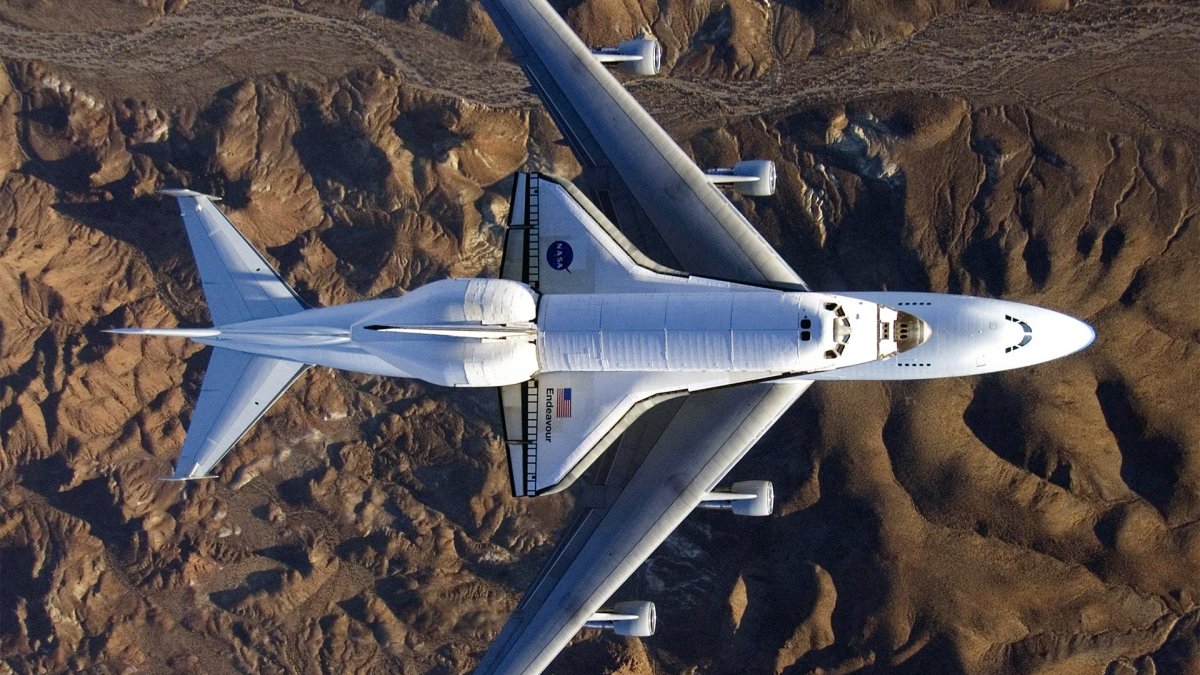
When I was last down at Edwards AFB, I also spent some time at what is now known as Armstrong Flight Research Center. Before the name change in 2014, it had been famously titled the Dryden Flight Research Center. During my time with the awesome public affairs team there, a photo on the wall grabbed my attention. It was an incredible image of one of NASA’s two Shuttle Carrier Aircraft (SCA) with the Orbiter Endeavor mated to its back as it flew over a gorgeous desert landscape. But what made the shot so amazing was how the perspective was from directly above, looking down.
I was told that the photo, taken in December of 2008 as Endeavor made its voyage back to Kennedy Space Center in Florida, was one of the most beloved in at the installation and that it was shot by one of NASA’s most acclaimed photographers, Carla Thomas. If I remember correctly, the photo was planned ahead of time and executed perfectly from the back seat of Armstrong’s F/A-18B . The aircraft had rolled inverted—or near inverted—to capture the unique angle of the loaded-up SCA.
NASA photo by Carla Thomas
Remembering this amazing shot, I posted the photo on Twitter last night and it received such an amazing outpouring of love that I had to do a story on it and especially on the SCA and its own awesome but relatively humble history.
The Space Shuttle has such a colorful history , one full of obscure but fascinating facts , but the program wouldn’t have been possible without the Shuttle Carrier Aircraft that called Dryden/Armstrong home throughout their second-shots at life working for NASA. Both of the SCAs, NASA #905 and NASA #911, were Boeing 747-100 series jumbo jets and acquired second hand and deeply modified to be able to lift the orbiters aloft. #905 was bought from American Airlines in 1974 and was first used by NASA for wake turbulence testing before being selected for the Shuttle program. #911 was bought from Japan Airlines in 1989.
Both SCAs together at Dryden in 1995., NASA photo by Ruby Calzada
Originally the Shuttle Program eyed Lockheed’s C-5 Galaxy as the best candidate for the SCA, one of the C-5’s many imagined potential roles —but the 747 was deemed a better fit due to its low-wing layout and its tail configuration, among other factors.
As part of the conversion process, both 747s were stripped of almost all their interior airliner accouterments, including insulation and inner fuselage paneling, to save weight. Just a handful of first-class seats located in the aircraft’s nose section were left to ferry a limited number of NASA employees on cross-country missions.
#905 and #911 over the Mojave Desert near Edwards AFN., NASA Photo by Carla Thomas
The SCA’s fuselages were strengthened and a strut system was installed to accommodate lugging a 170,000-pound Orbiter on the spine of the aircraft. The SCA’s cockpit avionics were also enhanced as were the aircraft’s JT9D turbofan engines. Vertical stabilizers were installed on the horizontal tail sections to overcome directional stability lost by the orbiter blocking a good portion of the 747’s substantial vertical tail. A ballast system was also implemented to keep the aircraft’s center of gravity within operating limits when the Orbiter was not attached.
The addition of an external orbiter resulted in the otherwise totally stripped 747’s spritely performance turning into the exact opposite. An aircraft that had intercontinental range by design now had to stop multiple times to refuel just to make it between Edwards AFB in California to Kennedy Space Center in Florida. The SCA could only fly about 1,000 nautical miles with the orbiter attached as opposed to 5,500 without it.
The last flight of the SCA with an orbiter mated to its back. On September 21st, 2012 #905 would go on a 4.5-hour tour of California before landing at LAX, resulting in some of the best aviation photos of all time. , U.S. Air Force photo/Jet Fabara
The jet was also limited to just .6 Mach and a lowly 15,000-foot ceiling when lugging an orbiter on its back. This meant that each mission to Kennedy would require three stops and would take two to three days to complete. A pathfinder aircraft would also have to fly the route ahead of the SCA to make sure there were no storms along the way that could damage the orbiter’s delicate thermal shield made out of LI-900 silica tiles or induce high loads on the mated pair of flying machines.
It was a slow, intricate, and expensive process with each trip costing hundreds of thousands of dollars. When you factored in loading and unloading the orbiter on via custom-built gantry, the process involved a team of over 170 people to accomplish. But putting the complexities of its mission aside, there was added flexibility that the SCA brought to the Space Shuttle program that is seldom talked about.
An Orbiter gets mounted on to #911’s spine at Dryden., NASA photo by Jim Ross
Due to a large number of contingencies that could occur during a Shuttle mission, especially during launch, an orbiter could end up diverting to one of the dozens of large airstrips located around the globe and specially outfitted with the unique instrument landing system that made consistent and safe recoveries of the orbiter possible. Crews at these sites would also be on ready to respond to a stricken orbiter and its potentially badly injured crew. But if an orbiter were to land in Dakar, Senegal following an emergency, NASA would need to get it out of there as fast as possible.
This is where the SCA would swoop in and begin the processing of a remote site loading operation. In some cases, the orbiter’s payload would have had to of been removed from the orbiter’s payload bay and flown back separately by military cargo aircraft due to SCA weight restrictions.
Thankfully this capability was never used, but in 1983, an SCA packing the test Orbiter Enterprise flew across the pond for a tour of Europe. This included making an appearance at the Paris Air Show. In order to get there, the SCA stopped in Goose Bay, Keflavik, RAF Fairford, and went on to make appearances in West Germany, France, and Italy.
NASA was interested in potentially porting the E-4B and KC-747’s aerial refueling capabilities over to the SCA design and tests were flown behind a KC-135, but for a number of reasons the concept didn’t make it out of the exploratory phase.
The most amazing feat the SCA concept ever accomplished had nothing to do with repositioning the orbiter, it had to do with launching it off its back. The relatively terrifying task of acting as a launch platform for Enterprise during the high-risk Approach and Landing Tests (ALT) phase of the Shuttle Program is still something to behold.
Just one SCA crew would support the ALT phase, which consisted of a number of mated roundtrip flights and five free flights where the Orbiter would separate and fly back to land at Edwards AFB.
Enterprise pulling away from SCA during one of its first three free flights as part of the ALT phase of the Shuttle Program., NASA image by Ruby Calzada
Separating a single flying thing into two flying things can be a dangerous act no matter how much data there is to predict the outcome. And it’s not like the crew of the SCA had ejection seats to get them out of the aircraft quickly if the Shuttle slammed back into its mothership during the separation trials. A crew escape tunnel similar to the one added to the first 747 prototype was installed in #905 before the ALT phase began in case the aircraft lost control and the crew had to bail out. Later on, it was deleted due to fear of the crew being ingested into the engines and because the SCA had proven itself safe and reliable at carrying the orbiter around.
But regardless of the escape tunnel being available, there was a pretty good chance that if the two huge flying bodies made contact that a big fireball full of debris would result. Even after the initial three separation/ALT trials were successful, Enterprise and SCA #905 had to go through it all again, this time the aerodynamic fairing over the Orbiter’s rump removed.
Enterprise on approach to land at Edwards AFB on October 12, 1977. This was the fourth of five free flights during the ALT phase. , NASA image by Ruby Calzada
The Shuttle’s nozzles and abrupt trailing edge change the airflow behind the spacecraft, with far more turbulent air buffeting the SCA’s empennage, so that evolution was also potentially perilous. Two of these test flights occurred, which successfully closed out the ALT phase of the Shuttle’s development.
Both of the SCAs were retired in 2012 as the Shuttle Program finally came to an end. Parts primarily from #911 are being used to keep NASA’s 747SP SOFIA flying observatory operational. #911 is on display at Plant 42 in Palmdale, where the Orbiters were built. #905 was the last to fly an Orbiter, delivering Endeavor to Los Angeles before heading to Houston to be put on static display at Space Center Houston with the orbiter mockup Independence placed on its spine.
NASA sums up both SCA’s accomplishments as such:
NASA 905 flew 70 of the 87 ferry missions during the operational phase of the shuttle program, including 46 of the 54 post-mission ferry flights from Dryden to the Kennedy Space Center. After the orbiters were retired, NASA 905 flew three ferry missions to deliver the shuttles Discovery, Enterprise, and Endeavour to museums where they are currently on display. Upon its retirement in late 2012, it had flown 11,018 flight hours over 42 years, both as a commercial jetliner and as a NASA space shuttle carrier, and had made 6,335 takeoffs and landings… … Upon its [#911] retirement on Feb. 8, 2012, it had amassed 33,004 flight hours over its 38-year flight career, including 386 flights as a NASA shuttle carrier aircraft, 66 of which were flights with a space shuttle mounted atop the fuselage. It flew 17 of the post-shuttle-landing ferry flights from Edwards to Kennedy.
NASA 905 flew 70 of the 87 ferry missions during the operational phase of the shuttle program, including 46 of the 54 post-mission ferry flights from Dryden to the Kennedy Space Center. After the orbiters were retired, NASA 905 flew three ferry missions to deliver the shuttles Discovery, Enterprise, and Endeavour to museums where they are currently on display. Upon its retirement in late 2012, it had flown 11,018 flight hours over 42 years, both as a commercial jetliner and as a NASA space shuttle carrier, and had made 6,335 takeoffs and landings…
Upon its [#911] retirement on Feb. 8, 2012, it had amassed 33,004 flight hours over its 38-year flight career, including 386 flights as a NASA shuttle carrier aircraft, 66 of which were flights with a space shuttle mounted atop the fuselage. It flew 17 of the post-shuttle-landing ferry flights from Edwards to Kennedy.
NASA 911 on the Dryden ramp not long before their retirement. , Tyler Rogoway/Author
The only payload I know of SCAs carrying externally aside from the orbiters was Boeing’s X-45C Phantom Ray UCAV . #905 ferried it from St. Louis to Edwards AFB where it would be tested back in 2010. That was actually a far more involved mission than one may assume as strapping one plane to another is never a simple task, but the SCAs and the NASA-Phantom Works team got it done.
When I saw the SCAs up close just months before they were decommissioned, they were absolutely immaculate aircraft. They could have just rolled right off the production line they looked so fresh and clean. In terms of age and usage, neither could be considered extremely high-time when it comes to first generation 747s, but #905 was really a lightly used aircraft for its age.
The SCAs amassed some pretty funny markings over the years., Rob Elliott/wikicommons
But without a mission and NASA having another first generation 747 to support, not to mention the increasing costs and challenges of maintaining old 747s, by end of 2012, it was the SCA’s time to bow out of service. But what wonderful and effective machines they were, which could only have been the case due to the dedicated NASA employees who truly loved and babied these aircraft during the Shuttle’s reign.
At least we still have mementos to remember the SCAs by like the amazing photograph by Carla Thomas that spurred this trip down aeronautical memory lane.
Contact the author: Tyler@thedrive.com
Comments couldn’t be loaded. Please refresh the page.
更新于美国东部时间2019年12月1日上午6:42
我上次去爱德华兹空军基地的时候,也顺便参观了现在的阿姆斯特朗飞行研究中心。在2014年更名之前,它曾是著名的德莱顿飞行研究中心。在那里,我和优秀的公共事务团队一起工作时,墙上的一张照片吸引了我的目光。照片上是NASA的两架航天飞机运输机(SCA)之一,背上背着奋进号航天飞机,飞越一片壮丽的沙漠景观。这张照片最令人惊叹的地方在于它的视角——从正上方俯视。
我听说这张照片拍摄于2008年12月,当时奋进号航天飞机正返回佛罗里达州的肯尼迪航天中心。这张照片是该航天中心最受欢迎的照片之一,而且是由NASA最负盛名的摄影师之一卡拉·托马斯拍摄的。如果我没记错的话,这张照片是事先计划好的,拍摄者坐在阿姆斯特朗的F/A-18B战斗机的后座上,完美地完成了拍摄。为了捕捉装载着航天飞机的SCA的独特角度,飞机翻滚倒飞——或者接近倒飞。
美国宇航局照片,卡拉·托马斯摄
想起这张精彩的照片,我昨晚把它发布到了推特上,结果收到了如此热烈的反响,我不得不写一篇关于它,特别是关于中世纪重演协会(SCA)及其令人惊叹但相对低调的历史的文章。
航天飞机的历史丰富多彩,充满了鲜为人知却又引人入胜的事实,但如果没有航天飞机运输机(SCA),这项计划根本无法实现。这两架SCA在德莱顿/阿姆斯特朗航天中心为NASA的“第二次飞行”提供了保障。NASA的905号和911号SCA都是波音747-100系列巨型喷气式客机,它们都是二手飞机,经过深度改装后才能够将航天飞机送入太空。905号于1974年从美国航空公司购得,最初被NASA用于尾流湍流测试,之后才被选中参与航天飞机计划。911号则于1989年从日本航空公司购得。
1995年,两台SCA一起停放在德莱顿飞行器基地。(NASA照片,Ruby Calzada摄)
最初,航天飞机计划将洛克希德公司的 C-5 Galaxy 视为 SCA 的最佳候选机型,这是 C-5 的众多设想潜在用途之一——但由于其低翼布局和尾翼配置等因素,747 被认为更合适。
作为改装过程的一部分,为了减轻重量,这两架747飞机几乎拆除了所有客机内部设备,包括隔热层和机身内衬板。仅保留了位于机头部分的少量头等舱座椅,用于运送数量有限的NASA员工执行跨国任务。
905号和911号照片拍摄于爱德华兹空军基地附近的莫哈韦沙漠上空。(NASA照片,卡拉·托马斯摄)
为了承受重达17万磅的航天飞机轨道飞行器(Orbiter),SCA的机身进行了加固,并安装了支柱系统。SCA的驾驶舱航电系统以及JT9D涡扇发动机也得到了升级。由于航天飞机轨道飞行器遮挡了747庞大的垂直尾翼的大部分,导致方向稳定性下降,因此在水平尾翼上安装了垂直安定面。此外,还采用了配重系统,以确保在未挂载航天飞机轨道飞行器时,飞机的重心保持在运行范围内。
加装外部轨道器后,原本轻装上阵的747飞机原本轻快的飞行性能却截然相反。这架原本设计航程可达洲际的飞机,现在却不得不多次中途加油,才能勉强从加利福尼亚州的爱德华兹空军基地飞抵佛罗里达州的肯尼迪航天中心。加装轨道器后,SCA的航程仅为约1000海里,而未加装轨道器时则可达5500海里。
这是SCA最后一次搭载轨道飞行器飞行。2012年9月21日,编号为905的SCA进行了4.5小时的加州上空巡游,最终降落在洛杉矶国际机场(LAX),留下了一些史上最精彩的航空照片。(美国空军照片/Jet Fabara)
这架喷气式飞机在背负航天飞机时,速度被限制在0.6马赫,飞行高度也只有15000英尺。这意味着每次前往肯尼迪航天中心的任务都需要中途停留三次,耗时两到三天。此外,一架探路飞机还必须先于航天飞机执行任务,以确保沿途没有风暴,以免损坏航天飞机由LI-900硅瓦制成的精密隔热罩,或对这对飞行器造成过大的压力。
这是一个缓慢、复杂且昂贵的过程,每次飞行都要花费数十万美元。如果算上通过特制龙门架装卸轨道飞行器,整个过程需要超过170人的团队才能完成。但抛开任务的复杂性不谈,航天飞机组件(SCA)为航天飞机项目带来的灵活性却鲜为人知。
在德莱顿飞行研究中心,一架轨道飞行器被安装到911号航天飞机的脊柱上。(NASA 吉姆·罗斯摄)
由于航天飞机任务期间,尤其是在发射过程中,可能发生诸多意外情况,航天飞机最终可能会改道降落在全球数十个大型简易机场之一。这些机场都配备了独特的仪器着陆系统,能够确保航天飞机安全可靠地回收。这些机场的工作人员也随时准备应对遇险航天飞机及其可能严重受伤的机组人员。但如果航天飞机在紧急情况下降落在塞内加尔首都达喀尔,NASA 就需要尽快将其转移出境。
这时,航天飞机运输机(SCA)就会介入,开始处理远程站点的装载作业。在某些情况下,由于SCA的重量限制,航天飞机的有效载荷必须从有效载荷舱中取出,并由军用运输机单独运回。
值得庆幸的是,这项功能从未被使用过。但在1983年,一架搭载着测试版“企业号”航天飞机的SCA运输机飞越大西洋,进行了一次欧洲巡回飞行。其中包括在巴黎航展上的亮相。为了抵达巴黎,这架SCA运输机在鹅湾、凯夫拉维克和费尔福德皇家空军基地停留,随后又在西德、法国和意大利进行了飞行表演。
NASA 曾有意将 E-4B 和 KC-747 的空中加油能力移植到 SCA 设计中,并曾用 KC-135 进行过飞行测试,但由于种种原因,该概念未能走出探索阶段。
SCA概念所取得的最惊人成就与重新定位航天飞机无关,而是将其从自身背部发射出去。在航天飞机计划高风险的进近和着陆测试(ALT)阶段,SCA作为“企业”号航天飞机的发射平台,这项相对艰巨的任务至今仍令人叹为观止。
仅需一个 SCA 机组即可支持 ALT 阶段,该阶段包括多次对接往返飞行和五次自由飞行,在自由飞行中,航天飞机将分离并飞回爱德华兹空军基地着陆。
在航天飞机计划ALT阶段的前三次自由飞行之一中,“企业号”航天飞机脱离了SCA。(NASA图片,Ruby Calzada摄)
将一个飞行器分离成两个飞行器仍然是一项危险的操作,无论有多少数据可以预测结果。而且,如果航天飞机在分离试验中撞回母舰,SCA 的机组人员也没有弹射座椅可以迅速逃生。在 ALT 阶段开始之前,905 号航天飞机上安装了一个类似于第一架 747 原型机上的乘员逃生通道,以防飞机失控导致机组人员跳伞逃生。后来,由于担心机组人员会被吸入发动机,以及 SCA 已经证明自身能够安全可靠地运送轨道飞行器,该逃生通道被拆除了。
但即便逃生通道可用,如果这两个巨大的飞行器发生碰撞,很可能会产生一个充满碎片的巨大火球。即使最初的三次分离/ALT试验都成功了,企业号航天飞机和SCA #905仍然不得不再次进行分离/ALT试验,这次还要移除轨道飞行器尾部的空气动力学整流罩。
1977年10月12日,企业号航天飞机在爱德华兹空军基地进近着陆。这是ALT阶段五次自由飞行中的第四次。图片由NASA的Ruby Calzada拍摄。
航天飞机的喷嘴和陡峭的后缘改变了航天器后方的气流,使得更湍急的气流冲击航天飞机尾翼,因此,改进过程也存在潜在的危险。最终成功完成了两次这样的测试飞行,标志着航天飞机研发的先进着陆技术(ALT)阶段圆满结束。
两架航天飞机运输机(SCA)均于2012年随着航天飞机计划的最终结束而退役。911号航天飞机的部件主要用于维持NASA的747SP SOFIA飞行天文台的运行。911号航天飞机目前在帕姆代尔的42号工厂展出,该工厂正是航天飞机的建造地。905号航天飞机是最后一架执行航天飞机飞行任务的航天飞机,它将奋进号航天飞机送至洛杉矶,之后前往休斯顿,并在休斯顿太空中心进行静态展示,其机背上放置了航天飞机模型“独立号”。
NASA 对 SCA 的两项成就总结如下:
在航天飞机项目的运行阶段,NASA 905 执行了 87 次转场任务中的 70 次,其中包括从德莱顿飞行研究中心到肯尼迪航天中心的 54 次任务后转场飞行中的 46 次。航天飞机退役后,NASA 905 又执行了三次转场任务,将“发现号”、“企业号”和“奋进号”航天飞机运送到博物馆,这些航天飞机目前仍在博物馆展出。2012 年底退役时,NASA 905 已飞行 42 年,累计飞行 11,018 小时,既作为商用喷气式客机,也作为 NASA 航天飞机运输机,共完成 6,335 次起降……2012 年 2 月 8 日,NASA 905(编号 911)退役时,在其 38 年的飞行生涯中累计飞行 33,004 小时,其中包括作为 NASA 航天飞机运输机的 386 次飞行,其中 66 次飞行是在机身顶部搭载航天飞机的情况下进行的。它执行了 17 次从爱德华兹机场到肯尼迪机场的航天飞机着陆后转场飞行任务。
在航天飞机项目的运行阶段,NASA 905 执行了 87 次转场任务中的 70 次,其中包括从德莱顿飞行研究中心到肯尼迪航天中心的 54 次任务后转场飞行中的 46 次。航天飞机退役后,NASA 905 又执行了三次转场任务,将“发现号”、“企业号”和“奋进号”航天飞机运送到博物馆,这些航天飞机目前在那里展出。在 2012 年底退役时,NASA 905 作为商用喷气式客机和 NASA 航天飞机运输机,在 42 年的服役生涯中累计飞行了 11,018 小时,完成了 6,335 次起降……
这架编号为911的飞机于2012年2月8日退役,在其38年的飞行生涯中累计飞行了33004小时,其中包括作为NASA航天飞机运输机的386次飞行,其中66次飞行是在机身顶部搭载航天飞机的情况下进行的。它还执行了17次从爱德华兹空军基地到肯尼迪空军基地的航天飞机着陆后转场飞行。
NASA 911 号机组人员在德莱顿飞行研究中心停机坪上,这是他们在退役前不久的照片。(泰勒·罗戈韦/作者)
据我所知,除了轨道飞行器之外,SCA 唯一一次外部有效载荷是波音公司的 X-45C“幻影射线”无人作战飞行器。2010 年,905 号 SCA 将其从圣路易斯运送到爱德华兹空军基地进行测试。实际上,这是一次比人们想象中复杂得多的任务,因为将一架飞机绑到另一架飞机上绝非易事,但 SCA 和 NASA 幻影工厂团队最终完成了这项任务。
在它们退役前几个月,我近距离观察过这些SCA飞机,它们简直完美无瑕。它们看起来如此崭新干净,仿佛刚从生产线上下来一样。就第一代747而言,它们的机龄和使用年限都不算很高,但905号机的使用率确实很低。
多年来,中世纪重演协会(SCA)积累了一些非常有趣的标记。(图片来源:Rob Elliott/wikicommons)
但由于没有新的任务,加上NASA还有另一架第一代747需要维护,更何况维护老旧747的成本和挑战日益增加,到2012年底,航天飞机辅助飞机(SCA)就该退役了。但它们是多么出色、多么高效的机器啊!这离不开NASA员工的辛勤付出,他们在航天飞机服役期间对这些飞机倾注了真挚的爱护和精心呵护。
至少我们还有一些纪念品可以让我们记住SCA,比如卡拉·托马斯拍摄的那张令人惊叹的照片,正是它激发了我们这次航空记忆之旅。
联系作者:Tyler@thedrive.com
评论加载失败,请刷新页面。