Space industry lacks workers needed to rebuild satellites lost in war, report says报告称,航天工业缺乏重建战争中损毁卫星所需的工人
The U.S. does not have enough engineers, technicians and assemblers to rebuild military space assets destroyed in a war with China or Russia, per RAND.
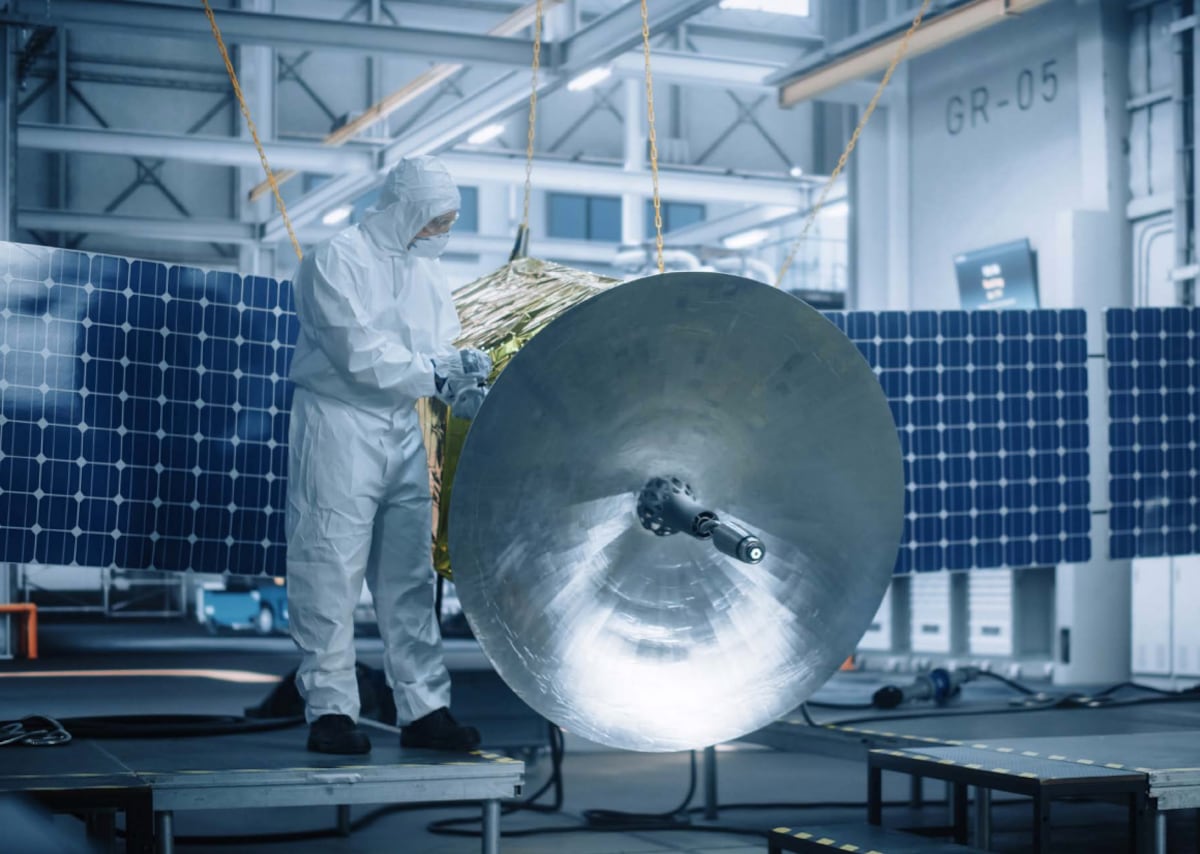
The United States does not have enough engineers, technicians and assemblers to rebuild military space assets destroyed in a war with China or Russia, according to a RAND report published Aug. 31.
The study, “ Breaking Glass, Missing Hands ,” asks how quickly the country could replace satellites and supporting systems lost early in a protracted conflict. It sets the benchmark for reconstitution, the term for restoring lost capability, at 12 to 24 months, a pace much more demanding than the decade or so the report says it typically takes to replace an aging satellite.
The study examines whether the space defense industrial base could meet that timeline between 2027 and 2032. The authors argue that existing workforce gaps could take years to close, putting a 12-to-24-month timeline out of reach.
Gen. Michael Guetlein, now the Golden Dome director, sponsored the study while serving as vice chief of space operations. RAND Project AIR FORCE conducted it as part of a fiscal 2024 project titled “In Emergency, Break Glass,” with Alexandra Gerber as lead author.
Researchers analyzed federal labor and education statistics from October 2024 through March 2025, and interviewed industry representatives and education administrators from May through July 2025.
The report divides the space-supporting workforce into three categories.
The first is engineers who design and test space systems. Nearly 3 million Americans work as engineers in jobs requiring a bachelor’s degree or higher, but only about 3% of them work in industries RAND counted as supporting space: satellite communications, semiconductors and nonmetallic mineral product manufacturing that produces optical glass. RAND calls that grouping a subset of the space industrial base. Aerospace manufacturing was not included.
RAND estimates that those three counted industries account for only about 7,000 of 208,000 annual engineering job openings, noting that the space sector has little leverage against employers in the artificial intelligence, software and data analytics sectors that pay more and offer more flexible work environments.
The second category is “skilled touch labor,” the technicians and assemblers who physically build spacecraft. Using 2023 Bureau of Labor Statistics figures, researchers estimated about 30,000 annual openings for technicians, while only about 11,000 people earn the necessary qualifications each year.
For assemblers, including cleanroom technicians, they found about 244,000 annual openings with just 13,000 credentialed workers each year, a gap of 19 to 1. The space industry accounts for a small share of that demand, but it competes for the same pool as semiconductor manufacturers.
The third category takes the longest to build: specialists who advance infrared and electro-optical detection, and engineers who design systems to survive natural and man-made radiation. Qualified candidates hold master’s or doctoral degrees, and the expertise can take 15 years or more to develop.
Few schools offer advanced degrees in laser and optical engineering, and most specialists come up through electrical or computer engineering programs instead. Of recent doctorates in those fields, 70% went to foreign nationals, the report says, shrinking the pool eligible for classified work.
Security clearances slow hiring even further. In fiscal 2024, initial Secret investigations averaged more than 87 days while Top Secret cases took nearly six months, according to a Trusted Workforce 2.0 progress report RAND cites.
Separately, interviewees said even fully credentialed workers can take up to a year to become productive, and the report notes that cleanrooms and secure work areas cap how fast plants can absorb new hires.
Those interviewed described the central problem as “surging from zero.” Without steady production between contracts, specialized skills atrophy and experienced workers leave, taking with them the institutional knowledge needed to scale. RAND says writing surge-planning requirements into future contracts would help companies prepare to expand before a crisis.
Researchers found no consensus that emergency mobilization would work. Defense Production Act authorities could pull workers from other industries, but interviewees questioned whether that is feasible given security clearances, certifications and domain expertise.
RAND recommends roughly $5 million a year for scholarships, internships and academic outreach, plus an $800,000 study on whether workers from other fields could be retrained for surge production.
The report also suggests advocating for the expansion of the National Imperative for Industrial Skills program and evaluating the Navy’s Talent Pipeline Program as a model for the trades.
Another proposal would let Reserve Officers’ Training Corps graduates satisfy service obligations by working at qualifying space firms, and would extend the same option to SMART scholarship recipients now committed to civilian Defense Department jobs.
RAND assigns the policy lead to the assistant secretary of the Air Force for space acquisition and integration, arguing workforce capacity is a supply-chain and production risk, not an internal Space Force staffing issue.
Interviewees pointed to hiring pipelines and faster clearances, rarely mentioning robotics, process automation or AI as a way to cut the labor hours per satellite. RAND did not independently assess whether automation is feasible, but flags that absence as a gap in reconstitution planning.
Most space producers run at volumes too low to justify the investment in automation, though RAND argues a reconstitution surge could change that math.
Michael Scanlon is a defense journalist covering air and space warfare. A former U.S. Air Force A-10 crew chief, he has supported land and sea programs for the U.S. Army, Navy, Marine Corps and Coast Guard.
根据兰德公司8月31日发布的一份报告,美国没有足够的工程师、技术人员和装配工人来重建在与中国或俄罗斯的战争中被摧毁的军事航天资产。
这项名为《破碎的玻璃,缺失的双手》的研究探讨了在旷日持久的冲突中,一个国家需要多快才能替换早期损失的卫星及其配套系统。研究将重建(即恢复丧失的能力)的基准时间设定为12至24个月,这一速度远高于报告所述的通常更换一颗老旧卫星所需的十年左右的时间。
该研究探讨了太空国防工业基础能否在 2027 年至 2032 年之间满足这一时间表。作者认为,现有的劳动力缺口可能需要数年时间才能弥补,因此 12 至 24 个月的时间表是无法实现的。
现任金顶大楼主任迈克尔·盖特莱因将军在担任太空作战副部长期间发起了这项研究。兰德公司空军项目组开展了这项研究,作为2024财年名为“紧急情况下,打破常规”项目的一部分,由亚历山德拉·格伯担任首席作者。
研究人员分析了 2024 年 10 月至 2025 年 3 月的联邦劳工和教育统计数据,并于 2025 年 5 月至 7 月采访了行业代表和教育管理人员。
该报告将航天支持人员分为三类。
第一类是设计和测试航天系统的工程师。近300万美国人从事工程师工作,这些职位需要学士或以上学历,但其中只有约3%的人在兰德公司认定的航天支持行业工作,这些行业包括卫星通信、半导体以及生产光学玻璃的非金属矿物制品制造。兰德公司将这些行业称为航天工业基础的一个子集。航空航天制造业并未包含在内。
兰德公司估计,这三个行业仅占每年 208,000 个工程职位空缺中的约 7,000 个,并指出航天领域与人工智能、软件和数据分析领域的雇主相比几乎没有优势,这些行业的薪酬更高,工作环境也更灵活。
第二类是“技术型体力劳动者”,即负责航天器实际建造的技术人员和装配工。研究人员利用美国劳工统计局2023年的数据估计,每年约有3万个技术人员职位空缺,而每年只有约1.1万人获得必要的资格证书。
对于包括洁净室技术人员在内的装配工人,他们发现每年约有 24.4 万个职位空缺,而每年只有 1.3 万名合格工人,缺口高达 19 比 1。航天工业虽然只占这一需求的一小部分,但它与半导体制造商争夺的是同一批人才。
第三类人才培养周期最长:他们是红外和光电探测领域的专家,以及设计能够抵御自然辐射和人为辐射的系统的工程师。合格的候选人拥有硕士或博士学位,而相关专业技能的培养可能需要15年或更长时间。
很少有学校提供激光和光学工程方面的高级学位,大多数专家都是通过电气或计算机工程专业培养出来的。报告指出,近年来这些领域获得的博士学位中,70%授予了外国公民,这缩小了符合保密工作资格的人才库。
安全审查进一步延缓了招聘进程。兰德公司援引的《可信劳动力2.0》进展报告显示,在2024财年,首次秘密级安全审查平均耗时超过87天,而绝密级安全审查则耗时近六个月。
此外,受访者表示,即使是拥有完整资质的工人也可能需要长达一年的时间才能提高生产力,报告指出,洁净室和安全的工作区域限制了工厂吸收新员工的速度。
受访者将核心问题描述为“从零开始激增”。由于合同之间缺乏稳定的生产,专业技能会逐渐退化,经验丰富的员工会离职,带走扩大规模所需的机构知识。兰德公司表示,在未来的合同中加入应对激增需求的计划条款,将有助于企业在危机爆发前做好扩张准备。
研究人员发现,对于紧急动员是否有效,各方并未达成共识。《国防生产法》授权可以从其他行业抽调工人,但受访者质疑,考虑到安全许可、资质认证和专业技能等因素,这种做法是否可行。
兰德公司建议每年投入约 500 万美元用于奖学金、实习和学术推广,另投入 80 万美元用于研究是否可以对其他领域的工人进行再培训以应对生产激增的情况。
该报告还建议倡导扩大“国家工业技能发展计划”,并评估海军人才培养计划作为技工行业的典范。
另一项提议将允许预备役军官训练团毕业生通过在合格的航天公司工作来履行服役义务,并将同样的选择扩展到目前致力于国防部文职工作的 SMART 奖学金获得者。
兰德公司将政策领导权交给空军负责太空采购和整合的助理部长,认为劳动力能力是供应链和生产风险,而不是太空部队内部人员配备问题。
受访者主要关注招聘渠道和更快捷的审批流程,很少提及机器人技术、流程自动化或人工智能等方法来减少每颗卫星的工时。兰德公司并未独立评估自动化的可行性,但指出这一缺失是重建计划中的一个漏洞。
大多数太空生产商的产量太低,不足以证明投资自动化是合理的,不过兰德公司认为,重建浪潮可能会改变这种局面。
迈克尔·斯坎伦是一位报道空天战的国防记者。他曾是美国空军A-10攻击机的机组长,并为美国陆军、海军、海军陆战队和海岸警卫队的陆地和海上项目提供支持。