Watch This RC-135 Spy Plane Make A Frightening Crosswind Landing In England (Updated)观看这架RC-135侦察机在英国惊险地进行侧风着陆(更新)
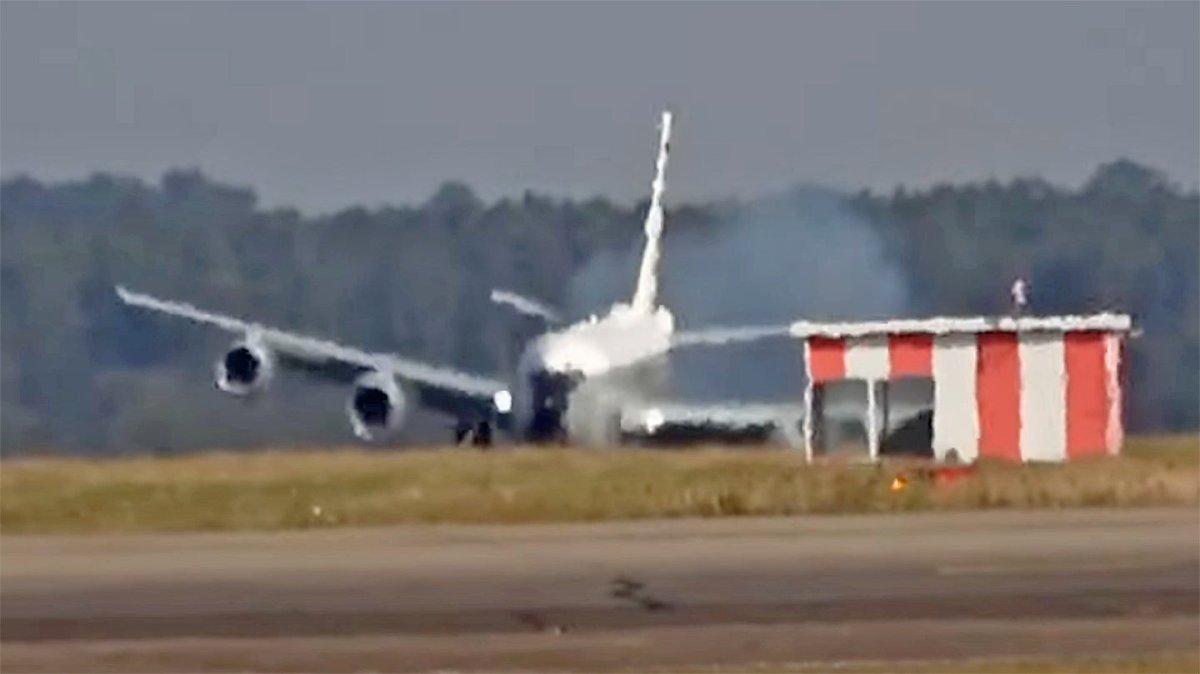
The RC-135 Combat Sent slams down before its left wing dips dangerously low and the jet goes careening down the runway.
新闻视频
Updated Sep 20, 2021 1:10 PM EDT
On September 7, 2021, an RC-135U Combat Sent electronic intelligence-gathering aircraft, one of just two in existence, made a frightening crosswind landing at RAF Mildenhall in England. The RC-135 had returned from an intriguing mission that saw the spy plane circumnavigate the border of Russia’s Kaliningrad exclave .
The video comes to us from the YouTube channel Airshow World , via a heads up from our friend and a must-follow on Twitter, @thenewarea51 . It shows the RC-135U, often lovingly referred to as ‘U-Boat’ due to its designation, making a crabbed approach to Runway 28 at RAF Mildenhall. It then appears to struggle to ‘kick-out’ the crab on landing, with its left wing suddenly dipping in a highly concerning manner. If the crab is not relieved and the aircraft’s nose is not pointed down the runway on touchdown, at least to a substantial degree, it is very hard on the aircraft, and especially the landing gear, putting major lateral loads on the mains.
The crew subsequently wrangled the RC-135 and straightened it up during its roll-out, but its rudder is still seen kicking around frantically even after it has come to a slow taxi. While the landing looks very “eventful” for the pilots, the folks in the back must have had a very chilling experience.
If the video does not automatically advance, the landing in question occurs at 17:55.
A substantial number of the venerable C-135 family were re-engined, including the RC-135s, with low-hanging CFM56 high-bypass turbofan engines. While this greatly improved the aircraft’s performance and reliability, it made the type more sensitive to bank angles on landing as the outboard engines hung so much lower than their predecessors.
A track of the RC-135U’s mission that day. , Flightradar24
Note the dramatic altitude and speed changes during its intel collection run., Flightradar24
The aircraft’s route back to RAF Mildenhall., Flightradar24
One KC-135 pilot told me that they are limited to just a few degrees of bank on landing, any more could cause ‘pod (nacelle) strike’ which is a very unwelcome and dangerous occurrence. As a result, a wing-low landing is not really an option to correct for a crosswind. That’s why the video is especially concerning—seeing a jet that is not supposed to bank so much on touchdown, doing so.
The winds at the base at the time of the landing were at about 10 knots directly perpendicular to the runway. So the crosswind component would have been pretty much total. There may have been gusts that would have complicated the situation, although we can’t say for sure.
RC-135U refueling. , USAF
Still, at least for the KC-135, which is the cousin of the RC-135, the crosswind limit is 25 knots. So, barring any major gusts, this landing occurred well below that limit.
With all that in mind, it really isn’t clear what occurred here. Was it just a crosswind landing that went a bit off the rails, or perhaps some sort of flight control issue? We have reached out to some of our contacts with experiencing flying these aircraft to provide some insights, and will report back when they do.
Our friend, veteran RC-135 pilot , writer of the KC-135 ‘bible,’ and War Zone
contributor , Robert Hopkins, told us that although the building and berm block a clear view, the aircraft appears to have made a three-point landing or even landed on its nose wheel, which could have accounted for the wobble rollout. Damage to the nose wheel and/or its steering is possible.
Adding extra details, Hopkins told The War Zone:
The way the jet lurched forward, I think the pilot flying flared high, realized it, then pushed the nose over to try and land, the other pilot took over, and the best s/he could do was a 3-point plant with (likely) a pod [engine necelle] drag. The best thing to do in a premature flare in a crosswind is to go around. Never push the nose down.
As to if the aircraft was indeed damaged, we don’t know for sure, although one Twitter uses claims it was with the following picture, which we cannot authenticate at this time:
Contact the author: Tyler@thedrive.com
Comments couldn’t be loaded. Please refresh the page.
更新于美国东部时间2021年9月20日下午1:10
2021年9月7日,一架RC-135U“战斗哨兵”电子情报收集飞机——全球仅有两架——在英国米尔登霍尔皇家空军基地进行了一次惊险的侧风着陆。这架RC-135刚刚完成一项引人入胜的任务,该任务中,这架侦察机绕俄罗斯加里宁格勒飞地的边界飞行了一圈。
这段视频来自 YouTube 频道 Airshow World,由我们的一位好友兼推特账号 @thenewarea51 提供,强烈推荐关注。视频显示,RC-135U(因其型号名称,常被亲切地称为“U型潜艇”)在米尔登霍尔皇家空军基地28号跑道进行横向进近。着陆时,飞机似乎难以纠正横向姿态,左翼突然以一种令人担忧的方式下沉。如果横向姿态无法纠正,且飞机着陆时机头未能充分指向跑道,将会对飞机,尤其是起落架造成极大的冲击,使主起落架承受巨大的横向载荷。
机组人员随后控制住了RC-135,并在滑行过程中将其扶正,但即使飞机已经缓慢滑行,其方向舵仍然剧烈摆动。虽然这次着陆对飞行员来说似乎“惊险刺激”,但后座乘客肯定经历了一场不寒而栗的体验。
如果视频没有自动播放,则相关着陆发生在 17:55。
相当一部分久经考验的C-135系列飞机,包括RC-135,都进行了发动机更换,换装了低位安装的CFM56高涵道比涡扇发动机。虽然这极大地提升了飞机的性能和可靠性,但由于外侧发动机的安装位置比之前的发动机低得多,也使得该机型在着陆时对倾斜角度更加敏感。
当天RC-135U任务的飞行轨迹。,Flightradar24
注意其情报收集过程中高度和速度的剧烈变化。(Flightradar24)
飞机返回米尔登霍尔皇家空军基地的航线。(Flightradar24)
一位KC-135飞行员告诉我,他们着陆时的倾斜角度被限制在几度之内,任何过大的倾斜都可能导致“吊舱(发动机舱)撞击”,这是一种非常危险且令人担忧的情况。因此,低翼着陆实际上并不能用来修正侧风。这就是为什么这段视频尤其令人担忧——看到一架不应该在着陆时倾斜这么大的喷气式飞机,却真的这么做了。
飞机着陆时,基地风向约为10节,风向与跑道垂直。因此,侧风分量几乎完全抵消了侧风的影响。虽然我们无法确定,但可能存在阵风,这会使情况更加复杂。
RC-135U空中加油。,美国空军
不过,至少对于KC-135(RC-135的同系机型)来说,侧风极限是25节。因此,除非出现强阵风,否则这次着陆的侧风远低于这个极限。
考虑到以上所有因素,目前尚不清楚事故原因。是侧风着陆时稍稍偏离了预定轨道,还是飞行控制系统出现了问题?我们已联系了一些有驾驶经验的飞行员,希望他们能提供一些见解,待收到回复后我们会及时汇报。
我们的朋友,资深RC-135飞行员,KC-135“圣经”的作者,以及《战区》一书的作者。
投稿人罗伯特·霍普金斯告诉我们,虽然建筑物和路堤阻挡了视线,但飞机似乎是三点着陆,甚至可能是前轮着地,这或许可以解释其滑行时的摇晃。前轮和/或转向系统可能受损。
霍普金斯向《战区》补充了一些细节:
飞机猛地向前冲去,我认为飞行员当时拉起了拉起机头,意识到情况不对后,又试图压低机头着陆,另一名飞行员接手后,最终只能勉强三点着地,而且很可能还受到了发动机吊舱阻力的影响。在侧风中过早拉起机头时,最好的办法是复飞。千万不要压低机头。
至于飞机是否真的受损,我们尚不确定,虽然一位推特用户声称飞机受损并附上了以下图片,但我们目前无法核实该图片的真实性:
联系作者:Tyler@thedrive.com
评论加载失败,请刷新页面。