Navy’s Super Hornet Boss On The Jet’s Game-Changing Infrared Search And Track Sensor海军超级大黄蜂战机负责人谈战机颠覆性的红外搜索与跟踪传感器
We go in-depth with the Navy's Super Hornet program manager on the new sensor's capabilities, genesis, and how it ended up mounted on a fuel tank.
Published Jul 27, 2020 3:42 PM EDT
The Navy’s fleet of F/A-18E/F Super Hornets keeps getting better with age as it soars into the middle of its service life. The latest Block III upgrade package, which will be applied to many earlier Super Hornets and new build models going forward, will offer a big suite of improvements that you can read all about in detail here . These Super Hornets and earlier Block II ones will soon be able to take advantage of an old concept that has become incredibly relevant once again, not to mention far more potent with an injection of new technologies—the Infrared Search and Track system, commonly referred to as IRST.
The Navy has gone without any form of an IRST for nearly a decade and a half, but that is about to change as the Super Hornet’s IRST is slated to enter operations with the fleet in September of 2021, and it really couldn’t come sooner. With the proliferation of stealth technology and advanced electronic warfare capabilities, being able to leverage a passive sensor, one that uses the infrared spectrum alone, to detect and track airborne targets far beyond-visual-range is becoming essential. Not only can the IRST do this independently, but now, leveraging the latest in sensor-fusion capabilities, it can provide another critical sensor data stream that can corroborate a flight crew’s situational air-to-air ‘picture’ at any given time. It can do this while being totally immune to electromagnetic jamming and other electronic attacks, and it can see right through radar-evading stealth technology.
F/A-18F equipped with an IRST. , Lockheed Martin
Captain Jason Denney, head of the Super Hornet and Growler program for the U.S. Navy, was kind enough to field an in-depth interview and share his enthusiasm for this critical new capability with The War Zone . The discussion below answers a lot of questions many may have about the Navy’s IRST ‘renaissance’ of sorts, such as how the Super Hornet’s IRST ended up in the nose of an external fuel tank and how the sensor differs from its evolutionary predecessor found on the F-14D Super Tomcat before its retirement.
Captain Jason Denney, USN
For complete context and background, you can read an in-depth primer I wrote on IRSTs some time ago by clicking here .
Now, without further ado, lets launch into the fascinating and potentially game-changing world of cutting-edge Infrared Search and Track systems with Navy’s officer tasked with leading the Super Hornet into the future:
TR: The last time the Navy fielded an IRST was on the F-14D Super Tomcat. That aircraft was pulled from service 14 years ago. What capability was lost with its retirement?
CD: So, an IRST is just another part of the spectrum. So, yes, when we retired the F-14 and we didn’t have the follow-on IRST readily available, we lost access to that part of the spectrum. So, if you think about the spectrum, I like to use analogy because I can get the concepts that I want across without broaching anything that is sensitive or classified. So, if you think about the electromagnetic spectrum, you’ve got parts of it that are widely used and have a lot of traffic like I-5 [the Interstate 5 highway], right? And then, you’ve got other parts of it that not a whole lot of traffic, they’re kind of like that side road, that country road that’s got a lot of stoplights and things.
If you’re trying to get to grandma’s house, I-5 is probably the quickest, most direct way to go. You can get there via the side road, but they may not have been cleared from the latest snow, or you’re going to run into some traffic in small towns, but it’s a viable way to get there. So, when we didn’t have the IRST ready to go when we retired the last F-14 squads [squadrons], we kind of lost that off-ramp into that side road and we’re kind of limited to I-5. So, you can see that when you get a traffic jam on I-5, you’re either stuck or if you have the ability to get off and take that road, you have another viable way to get there.
F-14D with its chin pod holding the AN/AAS-42 IRST on the left side and the Television Cameras System on the left. , USN
TR: Why does the service want the capability back now?
CD: It wasn’t wanting it back now… You got to look at what aircraft were out there at the time, and then, what were we doing at the time with those aircraft. So, throughout the ’80s and ’90s, you have the Tomcat and that was our air-to-air interceptor. We could do some air-to-ground stuff, but it was an air-to-air machine. And I’m a former Tomcat guy, I was a B guy, I never flew the D, but that thing was an air-to-air machine. Then you had the F-18 [Hornet] that was designed as a replacement for the A-4 and the A-7 with a limited amount of air-to-air capability, right? And then, going throughout Navy fighter history, the dark times of the ’90s where Tomcat 21 got shut down, Navy Advanced Tactical Fighter didn’t go anywhere, A-12 got shut down, and the Navy is staring at a blank slate going “What’s our plan?” And so, that’s when they came up with the Super Hornet. “Hey, let’s build a bigger, better Hornet,” if you will.
So, it wasn’t a “We got out of the IRST business.” It was just kind of where the aircraft were going at the time and what they were designed to do. If you look at the F-18, one of the aspects that it has that none of the other aircraft that carry an IRST in the nose have, is the location of the gun. Our gun is squarely right in the nose of the aircraft. The other closest one is the F-14, where it’s kinda underneath the aircrew. So, there’s really no good place to put it in the nose without completely redesigning the whole nose of the aircraft. That was not what they had planned to do with the E/F [Super Hornet]. They needed it, they needed it online now, the cost and the schedule were paramount. So, they said, “Hey, let’s get the airframe out there and then we will catch up with the sensors when we need to.” Then, fast forward… So, that’s the Block I Super Hornet.
In the Block II Super Hornet, they were focused on redesigning the forward fuselage and to integrate the APG-79 AESA [active electronically-scanned array radar], because we wanted that monster radar in there. About the time that this was going on was the early 2000s and we accelerated getting out of the Tomcat business a couple of years early.
The Super Hornet’s AN/APG-79 AESA radar and M61 Vulcan 20mm cannon take up nearly the entire nose of the aircraft., USN
So now, about the time that we got Block II [Super Hornet] out the door, with AESAs at a point where we could field that, now we’re looking saying, “Okay, what capability do we need to bring back, now that we’ve retired the Tomcat?” IRST, first on the list. So, that’s when they came in, and our first CDD for that, our Capability Design Document, was in 2007.
That kind of matches right about when we had got that first tranche of Block II capability, which had new mission computers, a new software language, the APG-79, all that stuff in there that we were able to actually now start integrating.
TR: The IRST21 that is being fielded on the Super Hornet is based on the F-14D’s AAS-42. What improvements have been made to the sensor in 30 years since it was first fielded?
CD: Yeah, great question. So, for the sensor itself, we’ve improved the optical design and the detector technology to get up with the 30 years of advancements, and then to provide some improved sensitivity and performance. That’s pretty much all I’ll say about that. The rest of it really has been a lot of reliability and maintainability stuff. We put a new IMU [Inertial Measurement Unit] in there and upgraded the gyro electronics, so that it could maintain a track more accurately, in line with where we are with technology today. Then a lot of the R&M [Reliability and Maintainability] stuff… We couldn’t get the circuit cards anymore, so they were completely obsolete. So, we had to go redesign those and use more modern chipsets and things like that.
Then, things, even just for keeping it on the wing longer, if you will, there’s a gear drive that they use to control the elevation, and we found that it was susceptible to getting dust in it and the gears not working properly, so we replaced that with a band drive. Then things like brushless motors, those types of things, just so that when we finally field it again, it has more time on the aircraft and less time being down for maintenance, which was one of the things that really hurt the Tomcat IRST.
TR: What’s the current state of the program? Have operational units received any early production models? What is the current fielding schedule and how many are each squadron slated to get when it does hit the fleet?
CD: Alright. So, some of that belongs in CNAF’s [Commander, Naval Air Forces] wheelhouse and we can talk about that later, but let me talk at the end of your question… I’m gonna jump around a little bit, because right now, we are in developmental tests of Block II. That’s going through developmental tests this year and we’re gonna transition to operational tests sometime next year, for the Block II IRST. Now, originally, the Block II IRST was the original IRST that we wanted on the airplane. Due to sequestration, budget cuts, and things going on in the earlier part of this decade, they split it apart, so you have the Block I and the Block II [IRST]. For various reasons, we did not put the Block I out into the fleet as per the plan and a lot of that had to do with folks not really understanding how to use the IRST. We can talk a little bit about that later. So right now, that’s where we are, in developmental tests on Block II.
IRST21 built into the centerline tank on the Super Hornet during tests. , USN
For acquisition planning purposes, we have an idea of how many will go to each squadron, but that’s just so that we can budget out how many we need to buy a year, how much that’s gonna cost, so Congress can hold us accountable and things like that. We have a number in mind for what each squadron would have, but once it’s fielded, that’s all up to CNAF. They’re gonna learn how reliable and maintainable it is, or maybe the tactics, techniques, and procedures. There was an assumption made when we said, “Hey, we’re only to give half a dozen to each squadron at fielding.” They say, “No, we’re gonna use it in a different way now. And now we need 10 or 12 in each squadron.” So, they’ll move those assets around, and we’ve done that with everything from ATFLIR [Advanced Targeting Forward Looking Infrared], to ALR-67 [radar warning recievers], to the ALQ-214 jammer. So, that’s all just depending on the fleet use…
TR: What type of testing has been done to validate the system? Is there any work being done with the Air Force, which is running a very similar program for the F-15 and potentially the F-16?
CD: Yeah, we did full DT [developmental testing] on the Block I, and like I said, we’re in DT for the Block II now. We’ve done carrier suitability and various things like that, just to make sure that the system noise and vibration, all those types of things, and on performance, like going, “Hey, run it against the sensor, against different scenarios,” and things like that. So, that’s really how we do developmental test. Operational test, as you know, is where we give it to the operational testers and they try and use it, kind of how they would think that they would use it in the fleet and say, “Hey, is this operationally suitable or effective?”
TR: Right. And that’s upcoming still at this point?
So, you’d asked a question about the Air Force. We haven’t done anything specifically, co-development-wise with the Air Force. There are certain [common] aspects of the IRST, what they’re developing and ours. So, with the hardware modifications, things like that, we’ve kept a lot of those common, and commonality helps us when it comes down to configuration management or being able to buy huge blocks of them. If we all had, say, the same circuit card, for example, then, hey, we combine the Air Force and the Navy buys and then we all get a better price for it. But other than that, we really haven’t done a whole lot of close coordination because their requirements and their implementation are very different than ours.
F-15C carrying Lockheed’s IRST carrying Legion Pod., USAF
TR: The IRST for the Super Hornet is being fitted on a centerline external fuel tank in a package form where it’s all together in one. Why was this chosen over mounting it somewhere internally? I know we talked a little bit about the gun being an issue, but what about another podded form, like, say, on the intake station, or on a wing station?
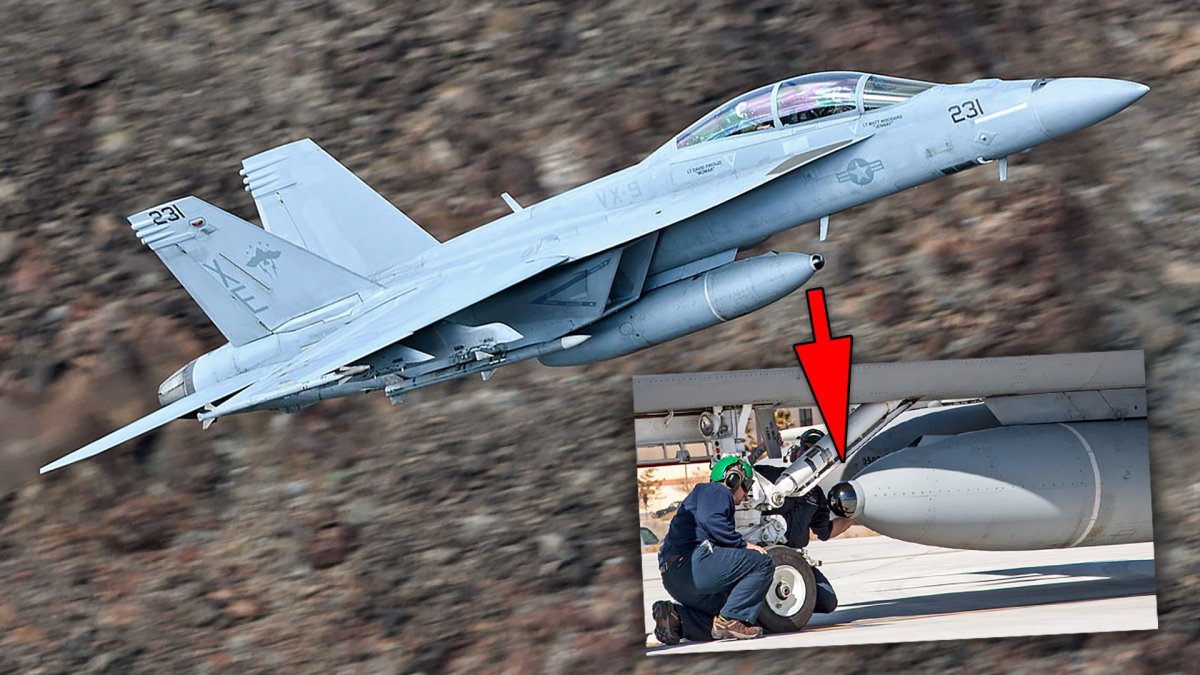
CD: Yeah, so that’s a great question. I was actually a lieutenant in my first tour of the VX-31 [Air Test and Evaluation Squadron 31] when this debate began, and I will tell you, there were a lot of opinions and a lot of heated discussions about it. But ultimately, it came down to, you got a balance of the size/weight/power/cooling requirements of what the IRST would be, what’s available on the aircraft versus how much money it costs to develop and integrate that form factor. Then you balance that against the field of regard versus giving up a weapon station versus giving up fuel. So, there were all kinds of discussions on, “Hey, if we put it in a dedicated pod kinda like the Air Force has done, on the centerline, okay, that mitigates the fact that we don’t have room in the nose. And that gives you a pretty good field of regard left and right, but now I’ve given up 3,300 pounds of gas.”
Okay, well, that’s no good, especially on the Super Hornet. Now, you’re limited to having to carry double-bubble fuel tanks. “Well, okay, now I’ve given up two weapon stations instead of one.” So, there are all these iterations of, “Hey, where can we put this thing?”
Then, again, back in 2006-2007, when we were having these discussions, we were right in [the] middle of OEF [Operation Enduring Freedom in Afghanistan] and OIF [Operation Iraqi Freedom]. So, having the ability to carry varied loadouts and maximum flexibility on what you could carry meant that nobody was really willing to give up a weapon station. So, they weighed all of those options and it came down to, “Hey, if we put it in a fuel tank on the centerline, we get the best field of regard that we can, because if you put it on the left or the right wing, you’re blanking one side of the aircraft or the other.” It’s kind of odd to put a sensor in a fuel tank, but now I’m only giving up 900 pounds of fuel instead of 3,300 pounds of fuel.
A conceptual diagram of how the IRST21 sensor is mounted in the fuel tank for the Super Hornet. , Lockheed Martin
That was kind of the trade-offs that went into, “Okay, why are we doing it this way?” And those are the big things, plus, like we said, trying to find room for it in the nose, you’d have to remotely mount the electronics for the optics and they didn’t really know how to do that at the time, to work around the gun. So, cost and integration-wise, it was supposed to be simpler and easier to put it where it is.
TR: There have been some questions regarding that location where it’s on the centerline, that it would block a lot of the sensor’s upward field of view, but it’s good left, right, and down. How does this actually work in practice? Is it a major limitation?
CD: I can’t get into details of what the field of regard is, but I will say that, in general, unless you are lined up pretty much exactly on centerline, really close and really high, the IRST is gonna see you. Its field of regard is actually surprisingly good, because remember, you’re down and aft. So, like in the Tomcat, if I was up close to the chin and underneath the nose, that nose is blocking more angles than maybe if I’m further down and away from the nose. And then, we never fight by ourselves, so I’m going to have a wingman out there, hopefully he’s offset enough and has enough range that his IRST is gonna be able to pick up what mine doesn’t and vice-versa.
Test F/A-18F with the IRST. , Lockheed Martin
TR: Right. How will the Super Hornet pilot use an IRST? Is it integrated and fused into the mission systems on the aircraft? What do they see in a cockpit, information-wise, when they employ it?
CD: Interestingly enough, in the Tomcat, it was completely separated. And I, as a RIO [Radar Intercept Officer], my job was managing all the sensors. So, when I talk to some of my F-14D RIO buddies, that was one of the things that the pilot used, the IRST, and the RIO managed the radar, and then they kinda correlated together as they got closer to try and figure out what the information was telling them. Obviously, that doesn’t work very well in a single-seat cockpit like the F-18E. So, there will be much tighter integration with the systems.
We do have our version of fusion, it’s called MSI. It was originally Multi-Sensor Integration, but it’s kinda changed to Multi-Source Integration since we added Link 16 into the mix. What that does is, it was originally designed for the legacy Hornet, was to be able to correlate an IFF [Identification Friend or Foe] hit with the radar track. If the computer says, “Hey, okay, I’ve got an IFF hit here and I got a radar track here, yes, those are the same track.” So, we’ve added Link 16 over the years, and now IRST is going to be a contributor to that as well. So hopefully, what the pilot will see is a fused track on his display that says, “I’ve got a contribution from the radar, IFF, Link 16, and an IRST.”
TR: And for stealthy targets, that means if it doesn’t show up on radar, you’re still going be able to get some sort of sensor location off of it, hopefully. That’d be the goal, correct?
CD: Yes. So, depending on what’s out there, maybe there’s a Link 16 track that’s somehow able to either not get jammed, or they’re in a different band of radar, that says, “Hey, we’ve got somebody here and the IRST can correlate with that,” sure, absolutely. But they’re supposed to, hopefully, see some sort of information out there correlated with the other information that’s in the jet.
With stealth technology now proliferating around the globe, both in terms of fighter designs like the J-20 above, cruise missiles, and especially drones, the IRST will be critical to spotting these threats before it is too late. , PLAAF
TR: Are there different modes that the sensor can operate in, kind of like a radar? Does it provide an actual image to the pilot of the target for them to even get an idea of what it is, if it’s a fighter or what type even?
CD: So, that would be specific capabilities and we’re not gonna talk about the image piece of it. But as far as the different modes, yeah, actually it’s much more akin to a mechanically-scanned radar than it is anything else. Which is interestingly enough, with this generation of JOs [Junior Officers] that have grown up with AESA , to go back and teach them, “Hey, you’ve gotta actually have dedicated mechanics to make sure the thing’s pointed where you want it to,” has been interesting to see, because I grew up with mechanically-scanned radar and it was almost a joke to go to AESA.
So, yeah, it has a couple of modes, more like the Track While Scan [TWS], if you’re familiar with TWS on mechanically-scanned radars. So, it’s TWS-Manual, TWS-Auto, where either you pick where the sensor’s looking or it picks where the sensor’s looking based on what track it sees. So, it’s very much in line with a mech-scan radar construct.
TR: It can track multiple targets at one time?
CD: Yes, it can track more than one target at a time.
TR: I know range figures are confidential, but is there any way you can just speak to sort of what it’s supposed to be able to see, just generally, and how weather and whatnot would impact a sensor like this?
CD: We won’t get into specifics, that’s capabilities, but you’re really talking about physics now at this point. So range, if you think about the submarine using its sonar , it’s the same kind of thing, it’s a passive sensor. I can get a line of bearing from it, but other information? Now I’ve gotta do something. So, if I take a line of bearing on anything, and then I move, and I take another line of bearing, and I take another line of bearing. Eventually, I can get kind of a sense of where that thing might be. And if that’s a stationary target, that’s easier. If it’s a moving target, or if I’m stationary and the target’s moving, okay, I take a cut, take a cut, take a cut, I can then tell generally which direction he’s going, but without knowing something about the range or something about the velocity, I gotta make some assumptions… If it’s really close to me, then it may be going really slow to have that same angular displacement in the same amount of time as if it’s really far away from me, then it’s gotta be going ungodly fast in order to have the same angular displacement, right? So, in order to determine range and things like that, there’s a whole lot of crazy math that has to go on, and in the end, your radar is a much better range sensor than an IRST is. Does that make sense?
TR: Yeah. And I’d imagine since you’re all data linked together, you could have a couple of Hornets working together with their IRSTs to figure out triangulation and that sort of thing using that same math, correct?
CD: Well, so that would go into specific capability, but like I said before, I have Link 16 tracks coming across, so if somebody else has a range on a track and now my IRST can correlate to it, then I can start correlating my sensors.
A render of Block III Super Hornets packing IRSTs. , Boeing
It’s an extra tool in the toolbox that gives me options that I wouldn’t have otherwise if I didn’t have it. Then to your question on weather and things like that. Yeah, just like every other IR sensor out there it is also a slave to physics, which is beautiful because physics doesn’t care what side of the conflict you’re on, it plays fairly both ways. There are parts of the spectrum where either oxygen or water vapor really crush your transmissivity, or if I’ve got a lot of water droplets or things in the air, it’s gonna decrease the amount of infrared radiation that’s able to make it to my sensor, and it’s going to degrade performance. Believe it or not, that happens to our radar as well. If I see enough water vapor or… Well, not water vapor, but water droplets in the air, my radar can pick that up, and it’s actually a useful thing because now I have basically a poor man’s weather radar. I can steer myself around thunderstorms and such.
So, there are gonna be limitations to it, and we just have to work through those, and sometimes you can turn them into an advantage. If you think about a submarine that’s got the different thermal layers it has to deal with, it actually uses those to hide rather than complain about, “Well, my sonar doesn’t work going through a thermal layer.” So, these are all kinds of things that, going forward, what kind of mindset do you have? Is it, the degraded performance, is that really always a bad thing or maybe it’s helping hide me from them as well?
TR: Right. Will it be able to work in a missile defense role? Or checking out surface targets? Detecting stealthy surface targets, that sort of thing in the future? And is this something that would be tied into CEC?
CD: Yeah, that’s all capabilities and TTP. Sorry, Ty.
TR: No worries. Obviously, you’ve gotten a lot of pilot feedback because this thing has been in the air in some form for years now. What are they telling you? What’s their perspective on the new sensor and how do they see it fitting into their potential gameplans during their training and operations?
Topgun is giving us a lot of good feedback right now, believe it or not, because they’re working through trying to figure out what the TTPs are going to be so when we fleet release, the fleet has them ready to go. So, a lot of the feedback we’ve gotten is, like I said, the, “Hey, once you have to manage another sensor and get used to using a mechanically-scanned sensor again,” and they’ve wrapped their heads around that, the feedback’s generally been very positive. A lot of the other feedback we’ve got is more crew-vehicle interface and the ability to… Maybe I can slave it to the radar or I can slave the radar to the IRST, things that we used to do in the Tomcat. But just how that plays out, so that either in an E-cockpit or an F-cockpit, the aircrew can maximize the potential benefits of the sensor. But generally, the feedback has been very positive.
F/A-18F takes to the air with its centerline fuel tank/IRST. , Lockheed martin
TR: Has the Marine Corps shown any interest in maybe adding something like this to their legacy Hornets that are getting the upgraded with the AESA radar and everything else?
CD: Yeah. So, that’s not a priority for them right now, at least IRST, the legacy radar upgrade is. And it’s just management of resources and the amount of time they have left on that platform. It takes time to integrate these things, and are they going to get a return on investment by the time they get it on to, by the time that they have to wind down the platform. So, that’s the calculus the Marine Corps is going through right now. But right now, they’re not purchasing it.
TR: The IRST is kind of an advantage for a fourth-plus generation fighter, that you can put something like this on it without having it screw around with a stealth fighter’s low observability. At the same time, obviously, this is being fielded for low observable targets as one of the driving factors. F-35, has there been any work to kind of see if they could work together with an F-35, a Super Hornet with an IRST, and anyway that the IRST could help that team?
CD: Yeah. Well, and you’re exactly right. So, what we say here at Super Hornet is we have the capacity to augment the F-35’s capability. So, as an air wing, we want to make sure that we have the ability to go out and fight as a cohesive force, the whole 4th, 5th gen mix. So, yeah, there are discussions going on of how the capabilities on the Super Hornet are going to augment what the F-35 is capable of. And that’s pretty much all I can say about that.
DAWDC F/A-18E/F Super Hornets fly alongside F-35Cs, USN
TR: Any talk about loading this on to an MQ-25 or even a ship? Using it as a sensor on a surface combatant?
CD: I can’t really talk about that. MQ-25 is… It is hard-over that the MQ-25A is a tanker only. I’m sure there’s probably some discussions going on at Boeing about trying to throw it on there, but that’s not a Navy requirement right now. And then for a ship, I haven’t personally seen anything on that. I suppose it’s possible. I just don’t know… I don’t know what it would buy the ship. I’d have to see what their requirement is, what they think that they’re gonna do with it.
We want to give a huge thanks to Captain Denney for sharing all these wonderful insights into the Navy’s IRST program. We would also like to thank Gulianna Dunn for working with us to make this piece a reality.
Contact the author: Tyler@thedrive.com
Comments couldn’t be loaded. Please refresh the page.
发布于美国东部时间2020年7月27日下午3:42
随着海军的F/A-18E/F“超级大黄蜂”战斗机机队逐渐迈入服役中期,其性能却在不断提升。最新的Block III升级包将应用于许多早期型号的“超级大黄蜂”以及未来新生产的机型,它将带来一系列显著的改进,您可以在这里阅读详细信息。这些“超级大黄蜂”以及更早期的Block II型号将很快能够利用一项古老的概念——红外搜索与跟踪系统(IRST)。这项概念如今焕发新生,并融合了多项新技术,使其威力倍增。
美国海军近十五年来一直没有配备任何形式的红外搜索跟踪系统(IRST),但这种情况即将改变。超级大黄蜂战斗机的IRST计划于2021年9月正式列装舰队,可谓是千呼万唤始出来。随着隐身技术和先进电子战能力的普及,利用仅使用红外光谱的被动传感器来探测和跟踪远超视距的空中目标变得至关重要。IRST不仅可以独立完成这项任务,而且现在,借助最新的传感器融合技术,它还能提供另一条关键的传感器数据流,随时验证机组人员对空作战态势的判断。此外,它完全不受电磁干扰和其他电子攻击的影响,并且能够穿透雷达规避隐身技术。
配备红外搜索跟踪系统(IRST)的F/A-18F战斗机,洛克希德·马丁公司
美国海军“超级大黄蜂”和“咆哮者”项目负责人杰森·丹尼上校欣然接受了《战区》的深度采访,并分享了他对这项关键新能力的热情。以下讨论解答了许多关于海军红外搜索跟踪系统(IRST)“复兴”的疑问,例如“超级大黄蜂”的IRST为何最终安装在副油箱的前端,以及该传感器与其在F-14D“超级雄猫”退役前使用的前身有何不同。
美国海军上校杰森·丹尼
如需了解完整的背景信息,您可以点击此处阅读我之前撰写的关于红外搜索望远镜 (IRST) 的深入入门指南。
现在,事不宜迟,让我们跟随海军负责引领超级大黄蜂战机走向未来的军官,一同进入这个引人入胜且可能改变游戏规则的尖端红外搜索与跟踪系统的世界:
TR:海军上一次装备红外搜索跟踪系统(IRST)是在F-14D超级雄猫战斗机上。那架飞机14年前就退役了。它的退役造成了哪些能力的损失?
CD:所以,红外搜索跟踪系统(IRST)只是频谱的一部分。是的,当我们退役F-14战斗机,而后续的IRST又无法立即投入使用时,我们就失去了对那部分频谱的控制权。说到频谱,我喜欢用类比,因为这样既能表达我想传达的概念,又不会涉及任何敏感或机密信息。想想电磁频谱,有些部分使用广泛,就像5号州际公路一样繁忙,对吧?而有些部分则使用较少,就像那些有很多红绿灯的乡村小路一样。
如果你想去奶奶家,I-5 高速公路可能是最快、最直接的路线。你也可以走辅路,但辅路可能还没清理完积雪,或者在小镇上会遇到交通堵塞,不过这仍然是一条可行的路线。所以,当我们最后一批 F-14 战斗机中队退役时,IRST 系统还没准备好投入使用,我们就失去了那条通往辅路的匝道,只能走 I-5 高速公路了。因此,你可以看到,当 I-5 高速公路堵车时,要么你被困住,要么如果你能找到出口走辅路,你就有了另一条可行的路线到达目的地。
F-14D战斗机,其机头下方的吊舱左侧装有AN/AAS-42红外搜索跟踪系统(IRST),右侧装有电视摄像系统。(美国海军)
TR:为什么该部门现在想要恢复这项功能?
CD:当时我们并不想把飞机收回去……你得看看当时有哪些飞机,以及我们当时用这些飞机做什么。所以,在80年代和90年代,我们有“雄猫”战斗机,那是我们的空对空截击机。我们也能进行一些空对地作战,但它本质上是一架空对空战机。我以前是“雄猫”的飞行员,我开的是B型,没飞过D型,但它确实是一架空对空战机。然后是F-18“大黄蜂”,它是作为A-4和A-7的替代品设计的,也具备一定的空对空作战能力,对吧?然后,回顾海军战斗机的历史,90年代是黑暗时期,“雄猫21”项目被叫停,“海军先进战术战斗机”项目停滞不前,“A-12”项目也被叫停,海军面对着一张白纸,茫然不知所措,不知道“我们的计划是什么?”于是,他们就想出了超级大黄蜂的方案。“嘿,咱们来造一架更大、更好的大黄蜂吧。”
所以,这并不是“我们放弃了红外搜索跟踪系统(IRST)业务”。这只是当时飞机的发展方向和设计用途所决定的。如果你看看F-18,它与其他在机头搭载IRST的飞机相比,有一个共同的特点,那就是机炮的位置。我们的机炮就位于机头正中央。位置最接近的是F-14,它的机炮位于机组人员下方。所以,如果不彻底重新设计整个机头,就很难找到合适的位置来安装机炮。这并非他们最初对E/F型(超级大黄蜂)的计划。他们需要它,需要它立即投入使用,成本和进度至关重要。所以,他们说:“嘿,先把机身做好,等需要的时候再来完善传感器。”然后,快进到……这就是第一代超级大黄蜂。
在第二代超级大黄蜂战斗机中,他们专注于重新设计前机身并集成APG-79有源相控阵雷达(AESA),因为我们想要那款性能强大的雷达。大约在2000年代初期,我们加速退出了“雄猫”战斗机项目,比原计划提前了几年。
超级大黄蜂的AN/APG-79有源相控阵雷达和M61火神20毫米机炮几乎占据了整个机头。(美国海军)
所以,大约在我们推出Block II型(超级大黄蜂)战斗机,AESA雷达也达到可以部署的水平时,我们开始考虑:“既然我们已经退役了F-14‘雄猫’战斗机,那么我们需要恢复哪些能力?”IRST雷达系统位列榜首。于是,IRST雷达系统应运而生,我们的第一份能力设计文档(CDD)于2007年发布。
这与我们获得第一批 Block II 能力的时间大致吻合,Block II 具备新的任务计算机、新的软件语言、APG-79 等所有这些东西,我们现在终于可以开始将它们整合起来了。
TR:目前装备在超级大黄蜂战斗机上的IRST21红外搜索跟踪系统是基于F-14D战斗机的AAS-42改进而来的。自该传感器首次投入使用以来的30年间,它有哪些改进?
CD:嗯,问得好。就传感器本身而言,我们改进了光学设计和探测器技术,以跟上过去30年的技术进步,并提高了灵敏度和性能。关于这方面我就说这么多。其余的改进主要集中在可靠性和可维护性方面。我们安装了一个新的惯性测量单元(IMU),并升级了陀螺仪电子元件,使其能够更精确地保持跟踪,符合我们目前的技术水平。然后还有很多可靠性和可维护性方面的工作……我们再也找不到原来的电路板了,它们完全过时了。所以,我们不得不重新设计这些电路板,并使用更现代的芯片组等等。
然后,为了延长飞机在机翼上的使用寿命,我们还做了一些改进。他们用齿轮传动装置来控制俯仰角,但我们发现它容易进灰,导致齿轮运转不正常,所以我们用带式传动装置替换了它。此外,我们还采用了无刷电机之类的改进,这样当飞机最终重新投入使用时,它的使用寿命会更长,停机维护的时间会更少。停机维护是严重影响“雄猫”红外搜索跟踪系统(IRST)性能的一大问题。
TR:该项目目前进展如何?作战部队是否已收到早期生产型?目前的部署计划是什么?每个中队计划在装备舰队后获得多少架?
CD:好的。其中一些问题属于海军航空兵司令的职责范围,我们稍后再谈。不过,在你提问的最后,我想先说说我的看法……我得稍微跳跃一下,因为目前我们正在进行Block II的研发测试。Block II红外搜索跟踪系统(IRST)今年会进行研发测试,明年某个时候会过渡到作战测试。最初,Block II IRST是我们计划安装在飞机上的首款IRST。但由于预算削减、预算削减以及本世纪初发生的一些事情,他们将其拆分,所以就有了Block I和Block II两个版本。由于各种原因,我们没有按计划将Block I部署到部队,其中很大一部分原因是人们不太了解如何使用IRST。我们稍后可以详细讨论一下。所以,目前我们正处于Block II的研发测试阶段。
在测试期间,IRST21被安装在超级大黄蜂战斗机的中心线油箱上。
出于采购计划的目的,我们大致估算了每个中队需要配备多少装备,但这只是为了方便我们制定预算,估算每年的采购量和成本,以便国会能够监督我们的执行情况等等。我们心中已经有了每个中队装备数量的预估,但一旦装备部署完毕,最终决定权就掌握在空军司令手中。他们需要了解装备的可靠性和可维护性,以及相关的战术、技术和程序。我们之前说过“部署时每个中队只需配备六套”,但后来他们说“不,我们现在要以不同的方式使用这些装备。现在每个中队需要十到十二套。”所以,他们会重新分配这些装备,我们已经对从ATFLIR(先进目标前视红外系统)到ALR-67(雷达告警接收机)再到ALQ-214干扰机等所有装备都进行了这样的调整。所以,这一切都取决于车队的使用情况……
TR:为了验证该系统,已经进行了哪些类型的测试?空军正在开展一个非常类似的F-15(以及可能还有F-16)项目,目前是否正在与空军合作?
CD:是的,我们对Block I进行了全面的DT(开发测试),就像我刚才说的,我们现在正在进行Block II的DT。我们已经完成了航母适用性测试以及其他各种测试,以确保系统的噪声和振动等性能指标都符合要求,比如“测试传感器在不同场景下的表现”等等。这就是我们进行开发测试的方式。至于作战测试,正如你所知,我们会把设备交给作战测试人员,让他们尝试在实际舰队作战环境中使用它,并评估“这套系统是否适用于作战环境或是否有效?”
TR:好的。那目前还在筹备中吗?
所以,您问到了关于空军的问题。就联合研发而言,我们并没有和空军进行任何具体的合作。IRST(红外搜索跟踪系统)在某些方面与他们正在研发的以及我们研发的方面有一些共同之处。例如,在硬件改进等方面,我们尽可能地保持了这些共同点,而这种通用性在配置管理或批量采购方面对我们大有裨益。如果我们都使用相同的电路板,那么空军和海军的采购就可以合并,从而获得更优惠的价格。但除此之外,我们并没有进行太多的密切协调,因为他们的需求和实施方案与我们截然不同。
美国空军的F-15C战斗机搭载了洛克希德公司的IRST飞行侦察吊舱“军团”吊舱。
TR:超级大黄蜂的红外搜索跟踪系统(IRST)是集成在一个组件中的,安装在机身中线外挂油箱上。为什么选择这种方式而不是将其安装在机身内部?我知道我们之前讨论过机炮安装的问题,但是其他吊舱式安装方式呢?比如安装在进气口或机翼挂架上?
CD:是的,这是一个很好的问题。当时我还是个中尉,在VX-31(第31空中测试与评估中队)服役,这场争论就开始了。我可以告诉你,当时有很多不同的意见,也引发了很多激烈的讨论。但最终,问题归结为:你需要权衡IRST的尺寸、重量、功率和冷却要求,以及飞机上现有的空间,还要考虑开发和集成这种外形所需的成本。然后,你还要权衡视野范围、放弃一个武器挂架以及增加燃油消耗。所以,当时有很多讨论,比如,“如果我们把它装在一个专用的吊舱里,就像空军那样,挂在机身中心线上,这样就能弥补机头空间不足的问题。而且左右视野也相当不错,但这样就损失了3300磅的燃油。”
好吧,这可不行,尤其是在超级大黄蜂上。现在,你只能携带双泡式副油箱了。“好吧,现在我放弃了两个武器挂架,而不是一个。”所以,问题就变成了:“嘿,我们该把这玩意儿装在哪儿?”
再说,在2006-2007年我们进行这些讨论的时候,正值阿富汗持久自由行动(OEF)和伊拉克自由行动(OIF)期间。因此,能够携带多种不同的载荷,并拥有最大的携带灵活性,意味着没有人愿意放弃任何武器挂点。所以,他们权衡了所有方案,最终得出结论:“如果我们把它放在机身中线的油箱里,就能获得最佳的视野,因为如果放在左翼或右翼,就会遮挡飞机的一侧。”把传感器放在油箱里确实有点奇怪,但这样一来,我只需要损失900磅燃油,而不是3300磅。
这是洛克希德·马丁公司出品的超级大黄蜂战斗机IRST21传感器在油箱内安装方式的概念图。
这就是我们权衡利弊后得出的结论:“好吧,我们为什么要这样做?”这些都是主要原因。此外,就像我们之前说的,要在机头找到合适的空间,就必须远程安装光学瞄准镜的电子设备,而当时他们还不知道该如何绕过火炮来实现这一点。所以,从成本和集成角度来看,把它放在现在的位置应该更简单、更容易。
TR:有人质疑它位于中心线上的位置,说会遮挡传感器向上的大部分视野,但它向左、向右和向下都有效。这在实际应用中效果如何?这算是一个主要限制吗?
CD:我不能详细说明探测范围,但一般来说,除非你几乎完全对准中心线,而且位置非常近、高度很高,否则IRST都能探测到你。它的探测范围其实相当不错,因为记住,你是在低位和后方。所以,就像在F-14“雄猫”战斗机上一样,如果我靠近机头下方,机头会阻挡更多角度的探测,而如果我位置更低、远离机头,情况可能就不同了。而且,我们从来不单独作战,所以我通常会有僚机,希望他的位置足够靠前,探测距离也足够远,这样他的IRST就能探测到我的探测不到的目标,反之亦然。
使用红外搜索跟踪系统(IRST)测试F/A-18F战斗机。,洛克希德·马丁公司
TR:没错。超级大黄蜂飞行员将如何使用红外搜索跟踪系统(IRST)?它是否集成到飞机的任务系统中?当他们使用它时,驾驶舱内会显示哪些信息?
CD:有趣的是,在F-14“雄猫”战斗机上,各个系统是完全分离的。而我,作为一名雷达拦截官(RIO),我的职责是管理所有传感器。所以,当我跟一些F-14D的RIO战友交流时,他们告诉我,飞行员使用红外搜索跟踪系统(IRST),而RIO则负责管理雷达,然后在接近目标的过程中,他们会相互协作,试图理解雷达信息的含义。显然,这种方式在像F-18E这样的单座座舱中行不通。因此,F-18E的系统集成度会更高。
我们确实有自己的融合技术,叫做MSI。它最初是多传感器融合(Multi-Sensor Integration)的意思,但自从我们把Link 16数据链整合进来之后,它就变成了多源融合(Multi-Source Integration)。MSI最初是为老式“大黄蜂”战斗机设计的,目的是将敌我识别(IFF)信号与雷达航迹关联起来。如果计算机显示:“好的,我这里有一个敌我识别信号,这里也有一个雷达航迹,是的,它们是同一条航迹。”多年来,我们不断加入Link 16数据链,现在红外搜索跟踪系统(IRST)也将加入其中。所以,飞行员最终应该能在显示屏上看到一条融合后的航迹,上面会显示:“我收到了来自雷达、敌我识别、Link 16和红外搜索跟踪系统的联合数据。”
TR:对于隐蔽目标来说,这意味着即使它没有被雷达探测到,你仍然能够通过某种传感器定位信息来获取它的位置,希望如此。这应该是我们的目标,对吗?
CD:是的。所以,根据实际情况,也许Link 16的跟踪数据能够以某种方式避免被干扰,或者它们位于不同的雷达频段,从而显示“嘿,我们这里有目标,IRST可以将其与目标关联起来”,当然,绝对可以。但他们应该能够看到一些外部信息,并将其与飞机上的其他信息关联起来。
随着隐形技术在全球范围内迅速普及,无论是像上文提到的歼-20这样的战斗机设计、巡航导弹,还是无人机,红外搜索跟踪系统(IRST)对于在为时已晚之前发现这些威胁至关重要。——中国人民解放军空军
TR:这个传感器是否有不同的工作模式,有点像雷达?它能否向飞行员提供目标的实际图像,让他们了解目标是什么,比如是不是战斗机,或者是什么型号?
CD:所以,这指的是具体功能,我们不谈图像部分。但就不同的模式而言,是的,实际上它更类似于机械扫描雷达,而不是其他任何雷达。有趣的是,对于这一代从小就接触AESA雷达的初级军官来说,回过头来教他们“嘿,你得有专门的机械师来确保它指向你想要的方向”,这很有意思,因为我从小就接触机械扫描雷达,那时候换成AESA雷达简直就像个笑话。
是的,它有几种模式,更像是扫描跟踪(TWS),如果你熟悉机械扫描雷达上的TWS功能的话。它有手动TWS和自动TWS两种模式,你可以选择传感器的扫描方向,或者它根据探测到的目标轨迹自动选择扫描方向。所以,它的结构与机械扫描雷达非常相似。
TR:它可以同时追踪多个目标吗?
CD:是的,它可以同时跟踪多个目标。
TR:我知道探测范围数据是保密的,但您能否大致谈谈它应该能看到什么,以及天气等因素会对这样的传感器产生什么影响?
CD:我们不深入探讨具体细节,那是技术层面的问题,但现在你实际上是在谈论物理学。比如,说到探测距离,想想潜艇使用声呐,原理是一样的,它是一种被动传感器。我可以从中获取方位角,但其他信息呢?这就需要我主动获取了。所以,如果我先测量一个目标的方位角,然后移动位置,再测量另一个方位角,如此反复,最终我就能大致判断出目标的位置。如果是静止目标,那就更容易了。如果目标是移动的,或者我静止不动而目标在移动,那么,我进行多次扫描,就能大致判断出它的移动方向。但是,在不知道距离或速度的情况下,我必须做出一些假设……如果目标离我很近,那么它的速度可能非常慢,才能在相同的时间内获得相同的角位移;而如果目标离我很远,那么它的速度必须非常快才能获得相同的角位移,对吧?所以,为了确定距离之类的信息,需要进行大量的复杂计算。最终,雷达的测距能力远胜于红外搜索跟踪系统(IRST)。明白了吗?
TR:是的。我想既然你们的数据都连接在一起了,就可以让几架大黄蜂战机利用它们的红外搜索跟踪系统(IRST)协同工作,用同样的数学方法进行三角测量之类的操作,对吧?
CD:嗯,这涉及到具体功能,但就像我之前说的,我有 Link 16 的航迹数据,所以如果其他人有航迹的距离信息,而我的 IRST 可以与之关联,那么我就可以开始关联我的传感器了。
波音公司出品的配备红外搜索跟踪系统的Block III型超级大黄蜂战斗机渲染图。
它就像工具箱里的一个额外工具,让我拥有了如果没有它就无法实现的选项。至于你问的天气之类的问题,是的,就像其他所有红外传感器一样,它也受制于物理定律。这其实很奇妙,因为物理定律不分敌我,它对双方都公平。在光谱的某些部分,氧气或水蒸气会严重降低传感器的透射率;或者,如果空气中有很多水滴或其他杂质,就会减少到达传感器的红外辐射量,从而降低其性能。信不信由你,我们的雷达也会遇到同样的问题。如果我探测到足够的水蒸气,或者……好吧,不是水蒸气,而是空气中的水滴,我的雷达就能探测到,这其实很有用,因为我现在基本上拥有了一个简易版的气象雷达。我可以借此避开雷暴之类的天气。
所以,它肯定会有一些局限性,我们必须克服这些局限性,有时甚至可以化劣势为优势。想想潜艇,它需要应对不同的热层,但它实际上会利用这些热层来隐藏自己,而不是抱怨“我的声呐穿过热层就失效了”。所以,这些都是需要考虑的问题,展望未来,你该如何看待这些问题?性能下降真的总是坏事吗?或者它反而可能有助于我隐藏自己?
TR:没错。它未来能否用于导弹防御?或者探测水面目标?探测隐形水面目标之类的?这是否会与协同电子通信(CEC)系统集成?
CD:是的,这就是全部功能和TTP了。抱歉,Ty。
TR:别担心。显然,你们已经收到了很多飞行员的反馈,因为这玩意儿已经以某种形式服役好几年了。他们都跟你们说了些什么?他们对这种新传感器有什么看法?他们觉得它如何融入到他们训练和作战计划中?
信不信由你,Topgun 目前给了我们很多积极的反馈,因为他们正在努力确定战术、技术和程序 (TTP),以便在正式发布时,所有部队都能立即投入使用。正如我之前提到的,我们收到的很多反馈都集中在“嘿,一旦你需要管理另一个传感器,并重新习惯使用机械扫描传感器”这个问题上。他们已经理解了这一点,总体来说,反馈非常积极。我们收到的其他反馈还包括更多关于机组人员与飞机交互界面以及相关功能……比如,我可以将传感器与雷达联动,或者将雷达与红外搜索跟踪系统 (IRST) 联动,就像我们在“雄猫”战斗机上做的那样。关键在于如何实现这一点,以便在电子座舱或飞行员座舱中,机组人员都能最大限度地发挥传感器的潜在优势。但总的来说,反馈非常积极。
F/A-18F战斗机携带中线副油箱/红外搜索跟踪系统(IRST)升空。洛克希德·马丁公司
TR:海军陆战队是否对在其正在升级AESA雷达和其他设备的旧款“大黄蜂”战机上添加类似这样的设备表现出任何兴趣?
CD:是的。所以,至少对他们来说,IRST(红外搜索跟踪系统)目前并非优先事项,而传统雷达的升级才是。这涉及到资源管理以及他们在这个平台上剩余的使用时间。集成这些系统需要时间,而且在完成集成、平台退役之前,他们能否获得投资回报?这就是海军陆战队目前正在权衡的问题。但就目前而言,他们不会采购这项升级。
TR:对于第四代及以后的战斗机来说,IRST(红外搜索跟踪系统)算是一种优势,因为你可以在上面安装这样的设备,而不会影响隐形战斗机的低可探测性。同时,很显然,IRST 的主要用途之一就是针对低可探测目标。F-35,是否有任何研究探讨过 F-35 和配备 IRST 的超级大黄蜂能否协同作战,以及 IRST 能否以某种方式帮助这个团队?
CD:是的。你说得完全正确。我们“超级大黄蜂”项目组认为,我们有能力增强F-35的作战能力。作为一支航空联队,我们希望确保我们能够作为一个整体,作为一个协同作战的力量,将第四代和第五代战机完美融合,共同作战。所以,目前正在讨论如何利用“超级大黄蜂”的作战能力来增强F-35的作战能力。关于这一点,我只能透露这么多了。
DAWDC F/A-18E/F 超级大黄蜂战斗机与美国海军的 F-35C 战斗机并肩飞行
TR:有没有讨论过将它装载到MQ-25无人机甚至舰艇上?用作水面作战舰艇的传感器?
CD:我不太好谈论这个。MQ-25……MQ-25A 基本上只能作为加油机使用。我确信波音公司可能正在讨论将其改装到舰艇上,但这并非海军目前的需求。至于舰艇改装,我个人还没有看到任何相关信息。我想这并非不可能。我只是不知道……我不知道改装后能给舰艇带来什么好处。我得看看他们的具体需求,以及他们打算如何使用这架无人机。
我们衷心感谢丹尼上校分享了关于海军红外搜索跟踪系统(IRST)项目的诸多精彩见解。同时,我们也要感谢古莉安娜·邓恩与我们合作,使这篇文章得以完成。
联系作者:Tyler@thedrive.com
评论加载失败,请刷新页面。