French-German fighter program on life support as Dassault blames Airbus法德联合战斗机项目岌岌可危,达索公司指责空客公司
“If Airbus maintains its position of not wanting to work with Dassault, the matter is dead,” said Dassault boss Eric Trappier.
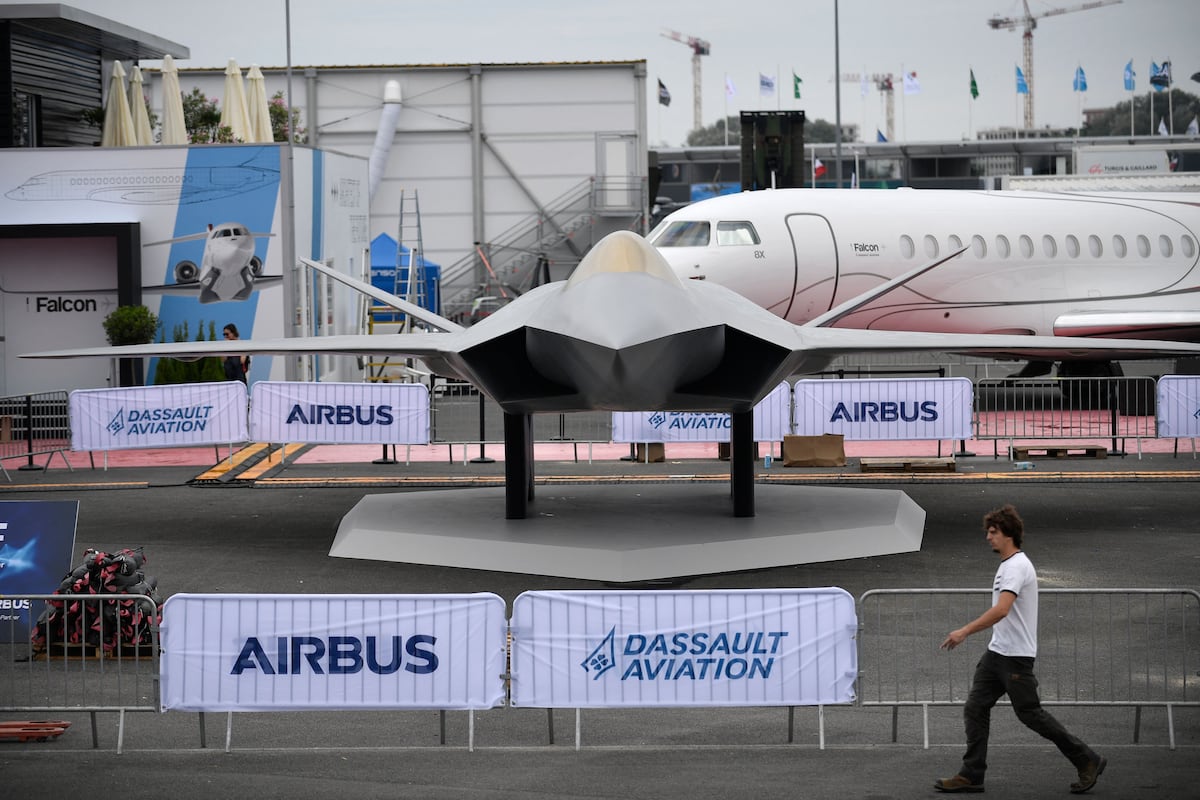
PARIS — The French-German project to develop a future combat air system appeared closer to failure on Wednesday, after aircraft maker Dassault Aviation blamed partner Airbus for no longer wanting to work together on the next-generation fighter at the heart of the plans.
“If Airbus maintains its position of not wanting to work with Dassault, the matter is dead,” Dassault Aviation Chief Executive Officer Eric Trappier said at a press conference outside Paris on Wednesday, where he showed a slide on FCAS with only a question mark, saying, “I don’t know.’’
French President Emmanuel Macron and then-Chancellor Angela Merkel announced the future air combat project in 2017, and work has been split up in several so-called pillars, including a new engine, drones and a combat data cloud. Dassault and Airbus, the partners for the next-generation fighter in FCAS, have been bickering for years over project authority and work share.
France was designated as the lead nation for the combat aircraft at the start of the project, with Dassault Aviation assigned the leader of the pillar, based on a joint decision by the partner countries, according to Trappier. “Not everyone is happy with this, but I believe that in order to develop combat aircraft of this level for the future, we need a leader.”
The CEO said an effective program requires “a real leader” who decides on whether subcontractors are performing, on the shape of the aircraft, and who will take responsibility for getting the aircraft to fly. He said Airbus would like to reduce Dassault Aviation’s role as part of a “co-co-co construction, on which I don’t agree.”
Dassault is abiding to the letter of its contract, and Airbus is not sticking to the “intial equation,” according to Trappier, who said it’s now up to the governments to arbitrate. He declined to speculate when or what France and Germany might decide on the future of the project.
German Chancellor Friedrich Merz said in an interview last month his country doesn’t currently need the same aircraft as France, which requires a fighter able to operate from an aircraft carrier and deploy nuclear weapons to ensure sovereign capabilities. Trappier said that while he hasn’t spoken to Merz, he was assured by French authorities there is agreement on operational requirements.
Trappier said Airbus is not looking to resolve its dispute with Dassault, and accused Airbus of communicating via labor union IG Metall and the German Aerospace Industries Association BDLI rather than “saying it loud and clear.” IG Metall in December said it would no longer work with Dassault Aviation, while the BDLI said on Feb. 6 it favored a “ two-aircraft solution ” for FCAS.
Airbus would support a two-fighter solution to break the deadlock, and is “committed to playing a leading role in such a reorganized FCAS,” Airbus CEO Guillaume Faury said during a press conference in February.
Trappier said neither Dassault Aviation nor France back the idea of having two aircraft as part of FCAS, in comments on the sidelines of the press conference, though “if France asked me to develop a combat aircraft, I would do it,” Trappier said.
Airbus declined to comment.
Dassault Aviation would be able to develop a next-generation aircraft by itself, and would be able to do so for “well below” a budget of €50 billion, Trappier said.
Trappier said Airbus does not have the skill set of Dassault Aviation in building combat jets, just like his company doesn’t build commercial jets. The executive said that while Dassault is always being accused of arrogance, “where is the arrogance today?”
The Dassault CEO said the German partner for the next-generation fighter is Airbus Germany, which he suggested may want a program setup for FCAS similar to the Eurofighter rather being in a subcontractor position.
Trappier said he demanded “clear leadership” from the start, and the organization was agreed that way. With one company in the team “better than the other,” the other partner has a legitimate demand to gain expertise, “but just because you’re learning doesn’t mean you have to be a co-leader right away,” Trappier said.
Trappier said while work on phase 1 of the FCAS fighter is being finalized, negotiations on phase 2 haven’t started yet due to “a certain number of difficulties.” That had delayed development of a demonstrator, according to the Dassault Aviation CEO, who said unresolved questions include who would lead the test-flight program.
Meanwhile, the company expects to negotiate a contract with India for 114 Rafale jets this year, and will continue to work on a combat aircraft for the post-Rafale era, “which is to say well after the 2040s.”
Dassault Aviation expects the F5 standard of the Rafale, which will included an unmanned stealthy loyal wingman drone, to enter service around 2035.
Rudy Ruitenberg is a Europe correspondent for Defense News. He started his career at Bloomberg News and has experience reporting on technology, commodity markets and politics.
巴黎——周三,法国和德国合作开发未来作战空中系统的项目似乎更接近失败,此前飞机制造商达索航空公司指责合作伙伴空中客车公司不再愿意共同开发该计划的核心——下一代战斗机。
“如果空客坚持不愿与达索合作的立场,那么这件事就完了。”达索航空首席执行官埃里克·特拉皮耶周三在巴黎郊外举行的新闻发布会上说道。他在会上展示了一张关于未来空中交通系统(FCAS)的幻灯片,上面只有一个问号,并说道:“我不知道。”
法国总统马克龙和时任总理默克尔于2017年宣布了未来空中作战系统(FCAS)项目,该项目的工作被分为几个所谓的支柱,包括新型发动机、无人机和作战数据云。作为FCAS下一代战斗机的合作伙伴,达索和空客多年来一直在项目权限和工作分工方面争论不休。
据特拉皮耶称,项目伊始,法国就被指定为战斗机项目的牵头国,达索航空公司则被指定为该项目的主导方,这是各合作国家共同做出的决定。“并非所有人都对此感到满意,但我认为,为了研发未来这种级别的战斗机,我们需要一个领导者。”
这位首席执行官表示,一个有效的项目需要“真正的领导者”,由他来决定分包商是否履行合同、飞机的外形,以及谁将负责确保飞机能够飞行。他还表示,空客希望通过“三方合作模式”来减少达索航空的角色,而他并不认同这种模式。
特拉皮耶表示,达索公司严格遵守合同条款,而空客公司则没有坚持“最初的约定”,现在应该由两国政府进行仲裁。他拒绝猜测法国和德国何时或会就该项目的未来做出何种决定。
德国总理弗里德里希·默茨上个月在接受采访时表示,德国目前不需要像法国那样的战机。法国需要一种能够从航空母舰上起飞并部署核武器的战斗机,以确保其自主作战能力。特拉皮耶表示,虽然他没有与默茨交谈过,但法国当局向他保证,双方在作战需求方面已达成一致。
特拉皮耶表示,空客无意解决与达索的争端,并指责空客通过德国金属工业工会(IG Metall)和德国航空航天工业协会(BDLI)进行沟通,而不是“直接明确地表达立场”。德国金属工业工会于去年12月宣布将不再与达索航空合作,而德国航空航天工业协会则在2月6日表示,其倾向于为未来空中作战系统(FCAS)采用“双机方案”。
空客公司首席执行官纪尧姆·福里在2月份的新闻发布会上表示,空客将支持采用双战斗机方案来打破僵局,并“致力于在重组后的FCAS中发挥领导作用”。
特拉皮耶在新闻发布会间隙表示,达索航空公司和法国都不支持将两架飞机纳入未来空中作战系统(FCAS)的想法,不过特拉皮耶说:“如果法国要求我开发一款战斗机,我会去做。”
空客公司拒绝置评。
特拉皮耶表示,达索航空有能力自行研发下一代飞机,而且研发预算“远低于”500亿欧元。
特拉皮耶表示,空客在制造战斗机方面不具备达索航空的技术水平,就像他的公司不制造商用飞机一样。这位高管说,尽管达索总是被指责傲慢自大,“但如今的傲慢在哪里呢?”
达索公司首席执行官表示,下一代战斗机的德国合作伙伴是空客德国公司,他暗示空客德国公司可能希望未来空中作战系统(FCAS)的项目架构类似于欧洲战斗机项目,而不是作为分包商。
特拉皮耶表示,他从一开始就要求“明确的领导层”,而组织内部也对此达成了一致。团队中一家公司“比另一家更优秀”,另一家公司有理由要求获得专业知识,“但这并不意味着你必须马上成为共同领导者,”特拉皮耶说道。
特拉皮耶表示,虽然FCAS战斗机第一阶段的工作正在收尾,但由于“一些困难”,第二阶段的谈判尚未开始。达索航空首席执行官表示,这导致验证机的研发工作有所延误,而尚未解决的问题包括由谁来领导试飞项目。
与此同时,该公司预计今年将与印度就 114 架阵风战斗机的合同进行谈判,并将继续研发后阵风时代的战斗机,“也就是说,研发工作将持续到 2040 年代之后”。
达索航空预计,阵风战斗机的F5标准型(包括无人隐形忠诚僚机)将于2035年左右投入使用。
鲁迪·鲁伊滕贝格是《防务新闻》的欧洲记者。他的职业生涯始于彭博新闻社,拥有报道科技、大宗商品市场和政治方面的经验。