The U.S. Air Force’s Last Tail Gunner Has Retired美国空军最后一名尾炮手退役
Chief Master Sergeant Rob Wellbaum had been the last airman still on duty to have served as an aerial defense gunner.
新闻视频
By Joseph Trevithick
Updated Jul 3, 2020 4:26 AM EDT
Whenever someone retires, it marks the end of an era in their personal life. When U.S. Air Force Chief Master Sergeant Rob Wellbaum leaves the service he’ll end an entire era of aerial combat as America’s last bomber tail gunner.
On May 12, 2017, Wellbaum retired after three decades in the Air Force. When he first joined up in 1987, the non-commissioned officer had signed up for Specialty Code 111X0—Aerial Defense Gunner.
“I went into the recruiter’s office and asked them what jobs they had for enlisted [personnel] to fly,” Wellbaum recalled in an interview . “My recruiter listed off loadmaster, boom operator, and B-52 aerial defensive gunner. The gunner job sounded like the coolest job out of the three so that is what I applied for.”
For the next five years, he served in that role on a B-52 Stratofortress bomber. This aircraft – more lovingly referred to as the Big Ugly Fat Fellow , or BUFF – was the last in service to even have a tail gun.
Chief Master Sergeant Rob Wellbaum and his family pose in front of one of the 15th Wing’s KC-10A Extender tankers., USAF
When the first B-52 prototype rolled out of Boeing’s plant in Seattle in 1952, aircraft defensive armament was already in a period of flux. For more than a decade at that point, American heavy bombers, as well many smaller attack and maritime patrol aircraft had featured various guns for self-protection against enemy fighters and interceptors.
The American workhorses of World War II, Boeing’s B-17 Flying Fortress and Consolidated’s B-24 Liberator both bristled with machine guns by the end of their service life. Both companies specifically designed the armament configurations to provide maximum coverage. So, in addition to weapons in the nose and sticking out the sides and the top and bottom of the fuselage, another gunner’s position was installed in the tail. From there a member of the crew could cover the vulnerable rear flank.
The U.S. Army Air Force’s entire bomber doctrine revolved around this defensive armament. The lumbering aircraft would fly together in tight “boxes” in order to provide mutually supporting firepower. U.S. military proponents of heavy bombing felt this method of operation, combined with superior aircraft designs, might even obviate the need for escorting fighter planes altogether.
The tail gun position on a World War II-era B-29 bomber., USAF
The World War II experience in both the Europe and Pacific theaters showed this notion was a pipedream. Over Germany especially, American crews suffered horrific losses until sufficient escorting aircraft became available. After one raid on Nazi factories in Schweinfurt on Oct. 14, 1943, the Eight Air Force effectively lost more than 25 percent of its entire force.
“With the Schweinfurt missions went the virtual end of the idea that the heavy bomber could ‘go it alone’,” according to one 1955 Air Force history . “The debate that had continued since the early 1930’s was now all but over.”
Though this didn’t stop bombers from carrying weapons, it did begin to reduce crews’ reliance on their own guns for self-defense. Boeing’s B-29 Superfortress , which became iconic of the fight against the Japanese, still had multiple machine gun positions, including then state-of-the-art remote control dorsal and ventral turrets. Its particularly deadly tail gun position, often referred to as the plane’s “stinger,” packed a pair of .50 caliber M2 machine guns flanking a single 20mm M2 cannon. But with the Japanese Army and Navy air arms all but crushed, American crews began leaving some or all of those weapons back at base to reduce weight and increase flying time.
Many immediate post-war bomber designs for the brand new, separate Air Force continued to come with full suites of defensive weapons. The B-50 , a suped-up B-29, had the same gun positions. The initial prototypes of Consolidated’s massive B-36 Peacemaker had numerous, retractable remotely-operated turrets with 20mm cannons, along with a tail gun.
But technological advances were making much of this obsolete. Most importantly, surface-to-air and air-to-air missiles gave anti-aircraft teams on the ground and fighter pilots the ability to attack bombers from increasingly long distances, well outside of the range of a bomber’s guns.
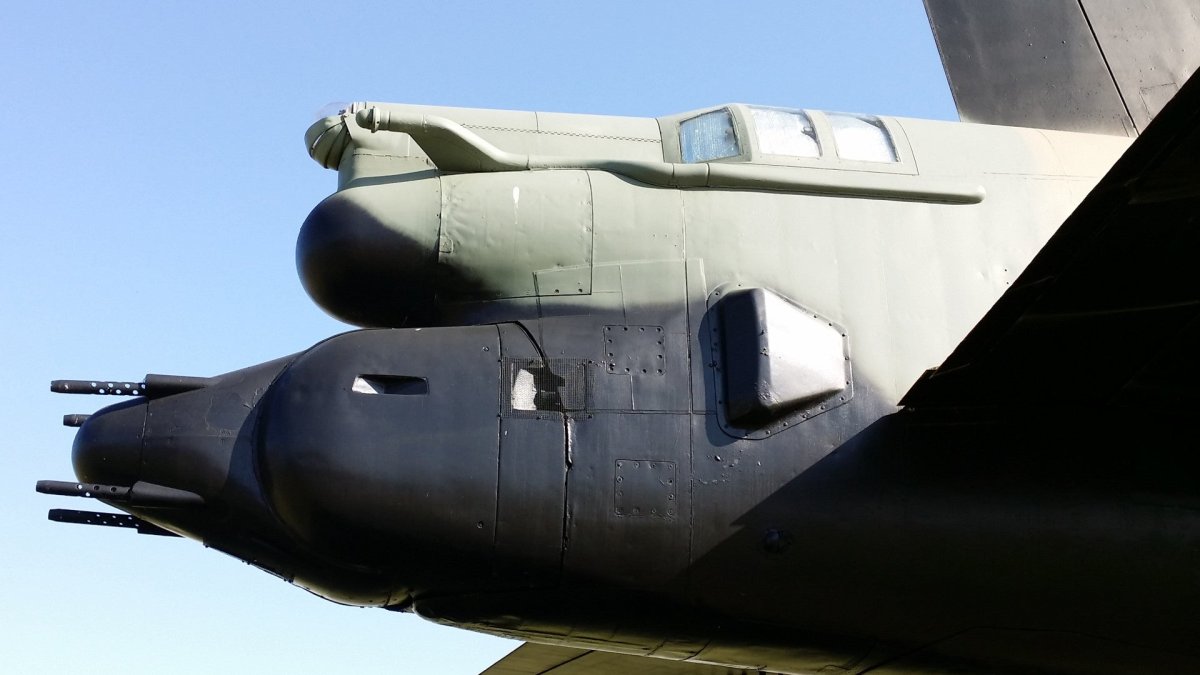
The tail gun position on a B-52D., USAF
So, Boeing’s B-47 Stratojet and B-52 both dispensed with guns in the nose and fuselage completely. On both aircraft, tail guns were the only traditional defensive weapons. Nearly all of the B-52 variants featured a radar-assisted tail position with four M3 machine guns, each firing at a rate of 1,200 rounds per minute. The ultimate version, the B-52H, came with a single 20mm M61 Vulcan cannon, able to spit out up to 100 shells every second, in their place. In addition, the air search radar for the guns was powerful enough to act as a navigational aid and help keep bombers in formation, according to an article in Air Force Magazine . On top of that, it could help guide trailing bombers in a single cell toward their destination through bad weather.
Still, physically separated from the rest of the crew at the other end of the plane’s enormous fuselage, it sounds like it would have been a lonely job. However, starting with the B-52G, the gunner joined the rest of the crew in the main cabin. The Air Force Magazine piece explains this was done in order to allow the crew to better coordinate during the flight and finally put the gunner in an ejection seat like everyone else, but “many gunners rued the loss of their wide-screen view.”
A view from inside the tail gunner’s position on a B-52D., USAF
Convair’s super-sonic B-58 Hustler had a similar arrangement with a single Vulcan cannon. At the same time, electronic countermeasures and chaff to jam and confuse enemy radars, along with bright-burning flares to distract heat-seeking missiles, increasingly became the primary means of defense.
Fast-forward to the 1970s and the B-52 was Americans sole remaining heavy bomber. It was also the service’s last aircraft to even feature a tail gun, whatever its utility might have been at that point. Over Southeast Asia, B-52D bombers scored just two kills. Both instances occurred over North Vietnam in 1972.
A B-52H bomber with its tail gun still installed., USAF
“When the target got to 2,000 yards, I notified the crew that I was firing,” Airman 1st Class Albert Moore, who was responsible for the second kill, explained later . “I fired at the bandit until it ballooned to three times in intensity then suddenly disappeared from my radar scope at approximately 1,200 yards, 6:30 low. I expended 800 rounds in three bursts.”
A gunner in another nearby B-52 confirmed Moore had blasted a North Vietnamese MiG-21. This was the last time a tail gunner from any air force scored a kill.
“On the way home I wasn’t sure whether I should be happy or sad. You know, there was a guy in that MiG,” Moore wrote afterwards. “I’m sure he would have wanted to fly home too. But it was a case of him or my crew. I’m glad it turned out the way it did. Yes, I’d go again. Do I want another MiG? No, but given the same set of circumstances, yes, I’d go for another one.”
The bomber Moore served on, nicknamed Diamond Lil and with the tail number 55-083, continued to serve until 1983. It now sits near the north entrance to the Air Force Academy in Colorado Springs, Colorado. Moore died in 2009.
After the Vietnam War ended, the Air Force continued to train enlisted personnel like Chief Master Sergeant Wellbaum to man the guns on the remaining B-52s. After the fall of the Soviet Union in 1991, the service finally decided it wasn’t worth the trouble.
“My decision to eliminate the guns from the ‘BUFF’ was not an easy one,” General George L. Butler, then head of Strategic Air Command (SAC), wrote to the aerial gunner community in the fall of 1991. “It stemmed from the collapse of the soviet threat and the leading edge of very sharp budget cuts… Our Air Force is going to go through a lengthy period of turmoil as we adapt to a dramatically changing world.”
The tails of two B-52H bombers in 2012, with the guns obviously missing., USAF
By 1992, the Air Force had removed the guns from all its remaining B-52Gs and Hs. The service’s 111X0s, including Wellbaum, transitioned to other jobs. Neither the B-1 Bone nor the B-2 Spirit bombers ever had tail guns.
“We knew something was in the works but we weren’t expecting to be cut,” Wellbaum said of the Air Force’s decision to remove the BUFF’s weapons for good and eliminate tail gunners. “However, the Air Force did take care of us and opened up a lot of AFSCs, one of which was flight engineer.”
In total, Wellbaum accumulated more than 1,000 flight hours as a B-52 tail gunner. His last position was as the superintendent of the 15th Operations Group, the flying component of Pacific Air Force’s composite 15th Wing, which is situated at Hickam Air Force Base in Hawaii.
Update 5/16/2017: Since this story was published, multiple readers have reached out to inform us that there are in fact other former aerial defense gunners still on duty. Initially, it appeared as if the 15th Wing’s public affairs office had only been referring to individuals within the active component and not counted personnel who had gone on to serve in the Air National Guard. However, a representative of the Air Force Gunners Association explained that there were in fact at least two of its members still in active component units. It’s unclear how the error occurred, but it seems safe to say that the last B-52 gunner still has yet to leave the service.
Contact the author: joe@thedrive.com
Comments couldn’t be loaded. Please refresh the page.
作者:约瑟夫·特雷维西克
更新于美国东部时间2020年7月3日凌晨4:26
任何人的退休都标志着其个人生活中一个时代的结束。当美国空军首席军士长罗伯·韦尔鲍姆退役时,作为美国最后一位轰炸机尾炮手,他将终结一个空战时代。
2017 年 5 月 12 日,韦尔鲍姆在空军服役三十年后退役。他于 1987 年首次入伍时,这位士官报名参加了专业代码 111X0——空中防御炮手。
“我走进征兵办公室,问他们有哪些适合入伍人员的飞行员职位,”韦尔鲍姆在一次采访中回忆道。“我的征兵官列举了装卸长、空中加油操作员和B-52轰炸机空中防御炮手。炮手的工作听起来最酷,所以我申请了这个职位。”
在接下来的五年里,他在一架B-52同温层堡垒轰炸机上担任这一职务。这架飞机——人们更亲切地称之为“又大又丑的胖子”(简称BUFF)——是最后一架仍在服役且配备尾炮的飞机。
美国空军第15联队的一架KC-10A加油机前,首席军士长罗伯·韦尔鲍姆和他的家人合影留念。
1952年,当第一架B-52原型机从波音公司位于西雅图的工厂下线时,飞机防御武器系统正处于变革时期。在此之前的十多年里,美国重型轰炸机以及许多小型攻击机和海上巡逻机都配备了各种机炮,用于自卫,抵御敌方战斗机和拦截机的攻击。
二战时期美国的两大主力轰炸机——波音公司的B-17“飞行堡垒”和康索利德公司的B-24“解放者”——在其服役末期都布满了机枪。两家公司都专门设计了武器配置,以提供最大程度的火力覆盖。因此,除了机头、机身两侧以及顶部和底部的机枪外,还在机尾加装了一个炮手位置。这样,机组人员就可以从那里掩护脆弱的后侧翼。
美国陆军航空队的整个轰炸机作战理论都围绕着这种防御性武器展开。这些笨重的飞机将以紧密的“方阵”形式协同飞行,以提供相互支援的火力。美国军方重型轰炸的支持者认为,这种作战方式,再加上更先进的飞机设计,甚至可能完全消除护航战斗机的必要性。
二战时期B-29轰炸机的尾炮位置,美国空军
二战期间欧洲和太平洋战场的经验表明,这种想法不过是痴人说梦。尤其是在德国上空,美军机组人员损失惨重,直到有足够的护航飞机可用才有所缓解。1943年10月14日,在对施韦因富特纳粹工厂的一次空袭之后,第八航空队实际上损失了超过四分之一的兵力。
根据1955年的一份空军史料记载,“施韦因富特任务的完成,标志着重型轰炸机‘单打独斗’理念的终结。自20世纪30年代初以来一直持续的争论,如今几乎已经结束。”
尽管这并未阻止轰炸机携带武器,但确实开始减少机组人员对自身武器进行自卫的依赖。波音公司的B-29超级堡垒轰炸机,作为抗日战争的标志性机型,仍然配备多个机枪位,包括当时最先进的遥控背部和腹部炮塔。其威力尤为强大的尾部机枪位,通常被称为飞机的“毒刺”,配备了两挺.50口径M2机枪,两侧各有一门20毫米M2机炮。但随着日本陆海军航空兵几乎被彻底摧毁,美国机组人员开始将部分或全部武器留在基地,以减轻重量并增加飞行时间。
许多战后初期为新成立的空军设计的轰炸机仍然配备了全套防御武器。B-50,作为B-29的升级版,也采用了相同的机炮配置。康索利德公司巨型B-36“和平缔造者”轰炸机的早期原型机配备了多个可伸缩的遥控炮塔,炮塔上装有20毫米机炮,此外还有一门尾炮。
但技术进步使得其中许多措施过时了。最重要的是,地对空导弹和空对空导弹使地面防空部队和战斗机飞行员能够从越来越远的距离攻击轰炸机,远远超出轰炸机机炮的射程。
B-52D轰炸机的尾炮位置,美国空军
因此,波音公司的B-47“同温层喷气”轰炸机和B-52轰炸机都完全取消了机头和机身的机炮。在这两款飞机上,尾炮是唯一的传统防御武器。几乎所有B-52的改进型都配备了雷达辅助的尾炮,装有四挺M3机枪,每挺机枪的射速为每分钟1200发。最终型号B-52H则用一门20毫米M61“火神”机炮取而代之,该机炮每秒可发射多达100发炮弹。此外,据《空军杂志》的一篇文章报道,这些机炮的空中搜索雷达功能强大,足以作为导航辅助设备,并帮助轰炸机保持编队。不仅如此,它还能在恶劣天气下引导编队中的后续轰炸机飞向目的地。
尽管炮手在飞机庞大机身的另一端与机组其他成员物理隔离,听起来这份工作应该很孤独。然而,从B-52G轰炸机开始,炮手被安排到主舱与其他机组成员一起工作。《空军杂志》的文章解释说,这样做是为了让机组人员在飞行过程中更好地协调,并最终让炮手像其他人一样拥有弹射座椅,但“许多炮手都对失去宽阔的视野感到惋惜”。
从美国空军B-52D轰炸机尾炮手位置内部拍摄的画面。
康维尔公司的超音速B-58“盗贼”轰炸机也采用了类似的配置,配备一门火神炮。与此同时,电子对抗措施和箔条干扰敌方雷达,以及用于干扰热寻导弹的明亮照明弹,日益成为主要的防御手段。
时间快进到20世纪70年代,B-52是美国仅存的重型轰炸机。它也是美军最后一款配备尾炮的飞机,无论当时尾炮的用途如何。在东南亚战场上,B-52D轰炸机仅取得两场击落战绩。这两场战绩都发生在1972年的北越上空。
一架尾炮仍安装在机上的B-52H轰炸机,美国空军
“当目标接近到2000码时,我通知机组人员我要开火了,”负责击落第二架敌机的空军一等兵阿尔伯特·摩尔后来解释说。“我向敌机射击,直到它的强度增加到原来的三倍,然后突然从我的雷达屏幕上消失,当时距离目标大约1200码,低空6点30分。我分三次射击,一共发射了800发子弹。”
附近另一架B-52轰炸机上的炮手证实,摩尔击落了一架北越的米格-21战斗机。这是空军尾炮手最后一次取得击落敌机的战果。
“回家的路上,我不知道自己该高兴还是该难过。你知道,那架米格战机里还有个人,”摩尔事后写道。“我相信他也想回家。但当时的情况是,要么他,要么我的机组人员。我很庆幸事情最终是这样的结果。是的,我会再去一次。我想要另一架米格战机吗?不,但如果情况相同,是的,我会再去一次。”
摩尔曾服役的那架轰炸机,绰号“钻石莉莉”,尾号55-083,一直服役到1983年。现在它停放在科罗拉多州科罗拉多斯普林斯空军学院北入口附近。摩尔于2009年去世。
越战结束后,空军继续训练像韦尔鲍姆总军士长这样的士官,让他们操作剩余B-52轰炸机的机枪。1991年苏联解体后,空军最终认为这样做不值得。
“我决定从‘水牛’(BUFF)上拆除机炮并非易事,”时任战略空军司令部(SAC)司令的乔治·L·巴特勒将军在1991年秋季写给空中炮手们的信中说道。“这源于苏联威胁的瓦解以及预算的大幅削减……我们的空军将经历一段漫长的动荡时期,以适应这个剧烈变化的世界。”
2012年两架B-52H轰炸机的尾翼,机炮明显缺失。(美国空军)
到1992年,空军已将其所有剩余的B-52G和B-52H型轰炸机上的机枪全部拆除。包括韦尔鲍姆在内的111X0型轰炸机也被转用于其他用途。B-1“骨头”和B-2“幽灵”轰炸机从未配备过尾炮。
“我们知道空军正在酝酿一些事情,但没想到会被裁撤,”韦尔鲍姆谈到空军永久移除BUFF战斗机武器并取消尾炮手岗位的决定时说道。“不过,空军也照顾到了我们,开放了很多空军专业代码(AFSC),其中就包括飞行工程师。”
韦尔鲍姆作为B-52轰炸机的尾炮手,累计飞行时间超过1000小时。他最后的职位是第15作战大队的队长,该大队是太平洋空军第15联合联队的飞行部队,驻扎在夏威夷的希卡姆空军基地。
2017年5月16日更新:自本文发表以来,多位读者联系我们,告知我们实际上还有其他前防空炮手仍在服役。最初,第15联队公共事务办公室似乎只指现役部队中的人员,而没有将那些转入空中国民警卫队服役的人员计算在内。然而,空军炮手协会的一位代表解释说,实际上至少有两名协会成员仍在现役部队服役。目前尚不清楚这一错误是如何发生的,但可以肯定的是,最后一位B-52炮手尚未退役。
联系作者:joe@thedrive.com
评论加载失败,请刷新页面。