‘Imminent’ threat? Hegseth escalates tone on China in key Asia speech“迫在眉睫的”威胁?赫格塞斯在重要的亚洲演讲中升级对华语气
The assessment is a major departure for the U.S. government, and it came with a nudge that nations must choose between Washington and Beijing.
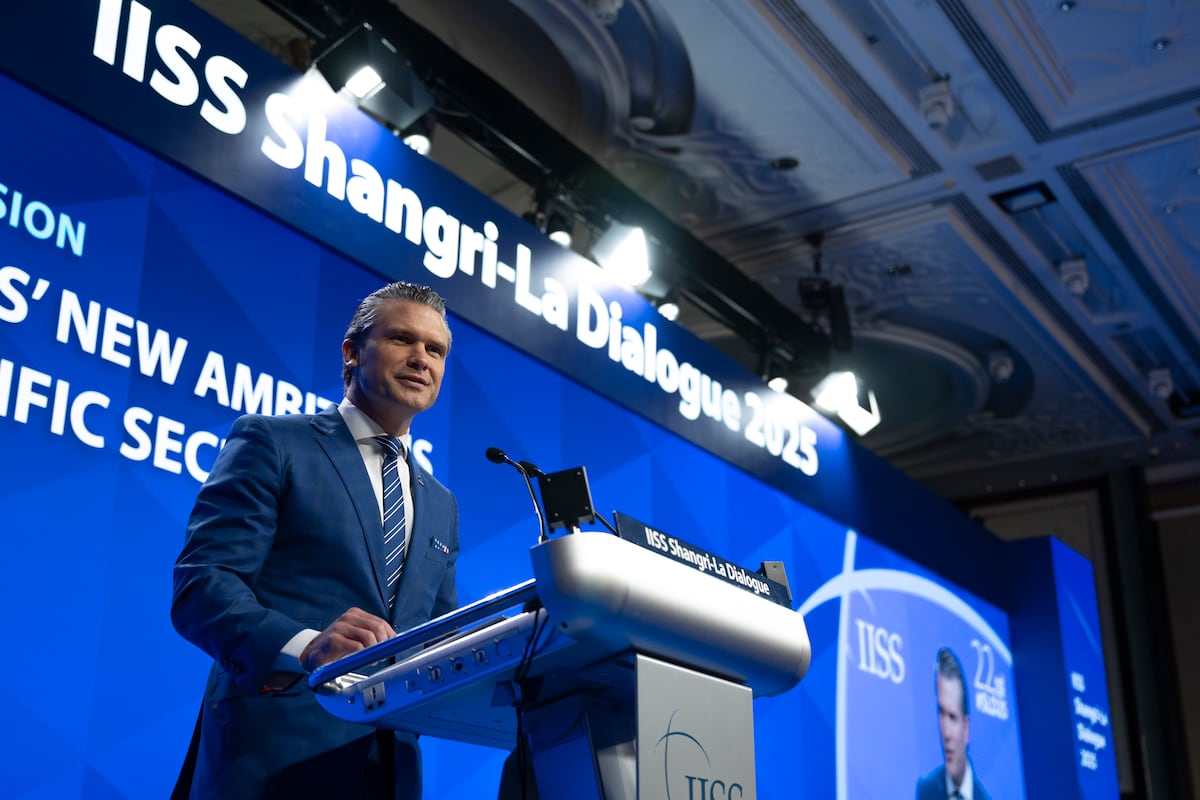
SINGAPORE — U.S. Defense Secretary Pete Hegseth urged allies to raise defense spending and warned that China may pose an “imminent” military threat in a landmark speech on the Trump administration’s approach to Asia.
“There’s no reason to sugarcoat it. The threat China poses is real, and it could be imminent,” Hegseth said at the Shangri-La Dialogue, a defense summit held in Singapore.
The assessment is a major departure for the United States government, where officials spent the last several years arguing that conflict with China “is neither imminent nor inevitable.”
But the shift reflected the Trumpian view of the region Hegseth offered — one in which countries may need to choose between dueling superpowers and U.S. allies should do far more to counter China’s threat.
“We are preparing for war in order to deter war to achieve peace through strength,” Hegseth said.
His remarks Saturday had been highly anticipated as countries across Asia try to understand the Trump administration’s approach to the region. The secretary’s speech in Singapore is seen as a guide to America’s policy toward the Indo-Pacific, and Hegseth is the most senior member of the U.S. government to address the topic this year.
Adding to the interest was China’s decision not to send its defense minister to the conference, a departure from tradition. A senior U.S. defense official told the traveling press that the Pentagon hoped to exploit that gap, and Hegseth mentioned it in his speech.
“We are here this morning, and somebody else isn’t,” he said.
Hegseth visited the Philippines and Japan in March, where he signaled the Trump administration would remain focused on the region. But other signals from the Defense Department have since been mixed.
During a bombing campaign in Yemen earlier this year, Hegseth redirected U.S. military assets away from Asia toward the Middle East. And the Pentagon still lacks nominees to run policy for China and the Indo-Pacific overall.
In the speech, Hegseth affirmed that the region is still America’s “priority theater,” which has been a consensus in Washington for the last decade. While he skewered the Biden Pentagon for years of “deferred maintenance” on the military, his remarks mostly represented continuity with the last four years.
The secretary mentioned multiple times how much the U.S. values its allies and partners. He said America’s military would continue sending forces to the western Pacific. And he even mentioned several initiatives started under the previous administration as examples of American focus.
But far different were Hegseth’s comments on defense spending. Keeping with the administration’s approach thus far, he argued that U.S. allies needed to accept a larger military burden rather than rely on America’s longtime role guaranteeing the region’s security.
“We ask, and indeed we insist, that our allies and partners do their part,” Hegseth said of other countries’ defense budgets.
In an ironic twist that Hegseth himself acknowledged, he urged that countries in the Indo-Pacific look to the example of Europe, which is now increasing military spending after seeing the U.S. hedge on its commitment to defend the continent.
In recent years, U.S. allies from Australia to Japan have announced increases in defense spending, though some officials now in the Pentagon have argued those pledges still don’t match the severity of the moment.
Days before the conference, Elbridge Colby, the Pentagon’s head of policy, posted on X that countries should aim to spend 5% of GDP on defense, a goal NATO is trying to meet over the next decade.
“This is the new standard for our allies around the world, especially Asia,” Colby wrote.
Going further, Hegseth warned nations against splitting their relationship between Washington and Beijing, even along different lines.
“We know that many countries are tempted by the idea of seeking both economic cooperation with China and defense cooperation with the United States. Now that is a geographic necessity for many, but beware the leverage that the CCP seeks with that entanglement,” Hegseth said, referring to the Chinese Communist Party.
While many nations in the region prefer to rely on America for security, China is also their main trading partner and hence a force they can’t ignore. Hegseth’s predecessor, Lloyd Austin, used his speeches at the Shangri-La Dialogue to reassure such countries they wouldn’t need to take sides in the larger competition between the two superpowers.
French President Emanuel Macron, who gave the keynote address at the conference on Friday, warned against changing that policy.
“The main risk today is a risk of division of the world and the division between the two superpowers and the instruction given to all the others: ‘You have to choose your side,’” Macron said.
Sen. Tammy Duckworth, D-Ill., who is leading a bipartisan delegation from Congress on a trip to the region, agreed, calling Hegseth’s tone “patronizing.”
“We don’t need that kind of language. We just need to stand with our allies,” she told a group of reporters.
Despite the sharp rhetoric, Hegseth argued that the U.S. doesn’t want to “dominate or strangle China” and certainly doesn’t seek conflict. But he said America wouldn’t accept China’s increasingly aggressive behavior toward it or its allies.
Specifically, he mentioned China’s actions in the South China Sea — where it’s rammed Philippine coast guard and fishing vessels — and around Taiwan, a self-governing island China claims as its own territory and has threatened to take by force.
In recent years, the People’s Liberation Army has staged more complex military drills around Taiwan. The head of U.S. Indo-Pacific Command has called these “rehearsals” for a future blockade or invasion, a description the secretary also used.
Hegseth also repeated a claim by President Donald Trump that China would not invade Taiwan in the next four years and that America’s primary goal was to avoid such a conflict.
“But if deterrence fails,” he said, “we are prepared to do what the Department of Defense does best and fight and win decisively.”
Noah Robertson is the Pentagon reporter at Defense News. He previously covered national security for the Christian Science Monitor. He holds a bachelor’s degree in English and government from the College of William & Mary in his hometown of Williamsburg, Virginia.
新加坡——美国国防部长皮特·赫格塞斯在特朗普政府对亚洲政策的重要演讲中敦促盟友增加国防开支,并警告称中国可能构成“迫在眉睫的”军事威胁。
“没有必要粉饰太平。中国构成的威胁是真实存在的,而且可能迫在眉睫。”赫格塞斯在新加坡举行的香格里拉对话防务峰会上说道。
这一评估对美国政府而言是一个重大转变,此前几年,美国官员一直辩称与中国的冲突“既不迫在眉睫,也不不可避免”。
但这种转变反映了赫格塞斯提出的特朗普式的地区观点——在这种观点中,各国可能需要在相互对抗的超级大国之间做出选择,而美国的盟友应该采取更多措施来对抗中国的威胁。
“我们正在为战争做准备,以阻止战争,从而通过实力实现和平,”赫格塞斯说。
周六,他的讲话备受瞩目,亚洲各国都在试图了解特朗普政府对该地区的政策方针。这位国务卿在新加坡的演讲被视为美国印太政策的风向标,而赫格塞斯也是今年就此议题发表讲话的美国政府最高级别官员。
更引人关注的是,中国决定不派国防部长出席此次会议,这打破了惯例。一位美国高级国防官员告诉随行记者,五角大楼希望利用这一漏洞,赫格塞斯在演讲中也提到了这一点。
“今天早上我们来了,但其他人没来,”他说。
赫格塞斯三月份访问了菲律宾和日本,期间他表示特朗普政府将继续关注该地区。但此后国防部释放的其他信号却喜忧参半。
今年早些时候,在也门的一次轰炸行动中,赫格塞斯将美国军事力量从亚洲转移到了中东。而五角大楼仍然缺乏负责对华政策和整个印太地区政策的提名人选。
在演讲中,赫格塞斯重申,该地区仍然是美国的“优先战区”,这在过去十年中一直是华盛顿的共识。尽管他抨击拜登政府的五角大楼多年来对军事设施的“延期维护”,但他的讲话总体上与过去四年的政策一脉相承。
这位部长多次提到美国高度重视其盟友和伙伴。他表示,美军将继续向西太平洋地区派遣部队。他还列举了上届政府启动的几项举措,以此作为美国关注重点的例证。
但赫格塞斯对国防开支的评论则截然不同。他与本届政府迄今为止的立场一致,认为美国盟友需要承担更大的军事负担,而不是依赖美国长期以来在保障地区安全方面所扮演的角色。
“我们要求,而且确实坚持,我们的盟友和伙伴要尽到自己的责任,”赫格塞斯在谈到其他国家的国防预算时说道。
具有讽刺意味的是,赫格塞斯本人也承认,他敦促印太地区的各国效仿欧洲的做法,因为美国在保卫欧洲大陆的承诺上有所犹豫,欧洲现在正在增加军费开支。
近年来,从澳大利亚到日本,美国的盟友都宣布增加国防开支,尽管五角大楼的一些官员认为,这些承诺仍然不足以应对当前形势的严峻性。
会议召开前几天,五角大楼政策主管埃尔布里奇·科尔比在X网站上发帖称,各国应争取将国内生产总值的5%用于国防,北约正努力在未来十年内实现这一目标。
科尔比写道:“这将成为我们世界各地盟友,特别是亚洲盟友的新标准。”
赫格塞斯进一步警告各国,即使沿着不同的路线,也不要将与华盛顿和北京的关系割裂开来。
“我们知道,许多国家都渴望同时与中国开展经济合作,与美国开展防务合作。对许多国家来说,这在地理上是必要的,但要警惕中共试图利用这种关系来获取筹码,”赫格塞斯说道,他指的是中国共产党。
尽管该地区许多国家更倾向于依赖美国的安全保障,但中国也是它们的主要贸易伙伴,因此是一股它们无法忽视的力量。赫格塞斯的前任劳埃德·奥斯汀曾在香格里拉对话会上发表讲话,向这些国家保证,它们无需在中美两大超级大国之间的竞争中选边站队。
法国总统马克龙周五在会议上发表主旨演讲时警告不要改变这一政策。
马克龙说:“当今世界面临的主要风险是世界分裂的风险,是两大超级大国分裂的风险,以及向所有其他国家发出的指令:‘你们必须选择自己的阵营’。”
伊利诺伊州民主党参议员塔米·达克沃斯率领一个由国会两党成员组成的代表团访问该地区,她对此表示赞同,称赫格塞斯的语气“居高临下”。
“我们不需要那种语言。我们只需要与盟友站在一起,”她对一群记者说。
尽管言辞激烈,赫格塞斯辩称,美国并不想“支配或扼杀中国”,当然也不想挑起冲突。但他表示,美国不会接受中国对美国及其盟友日益咄咄逼人的行为。
他特别提到了中国在南海的行动——中国曾撞击菲律宾海岸警卫队和渔船——以及在台湾周边的行动。台湾是一个自治岛屿,中国声称对其拥有主权,并威胁要武力夺取。
近年来,中国人民解放军在台湾周边地区举行了更为复杂的军事演习。美国印太司令部司令称这些演习是为未来封锁或入侵做准备,美国国防部长也使用了同样的措辞。
赫格塞斯还重申了唐纳德·特朗普总统的说法,即中国在未来四年内不会入侵台湾,美国的首要目标是避免此类冲突。
“但如果威慑失败,”他说,“我们准备发挥国防部的专长,进行决胜的战斗并取得胜利。”
诺亚·罗伯逊是《防务新闻》的五角大楼记者。他此前曾为《基督教科学箴言报》报道国家安全新闻。他拥有弗吉尼亚州威廉斯堡威廉与玛丽学院的英语和政治学学士学位。