Behold These Awesome Shots Of A Navy P-8A Poseidon Carrying Its Big Secretive Radar Pod瞧瞧这些令人惊叹的照片,海军P-8A“海神”反潜巡逻机携带着它那神秘的大型雷达吊舱。
The Advanced Airborne Sensor is a powerful and shadowy intelligence gathering and targeting tool carried by a small number of P-8As.
By Joseph Trevithick
Updated May 15, 2020 11:05 AM EDT
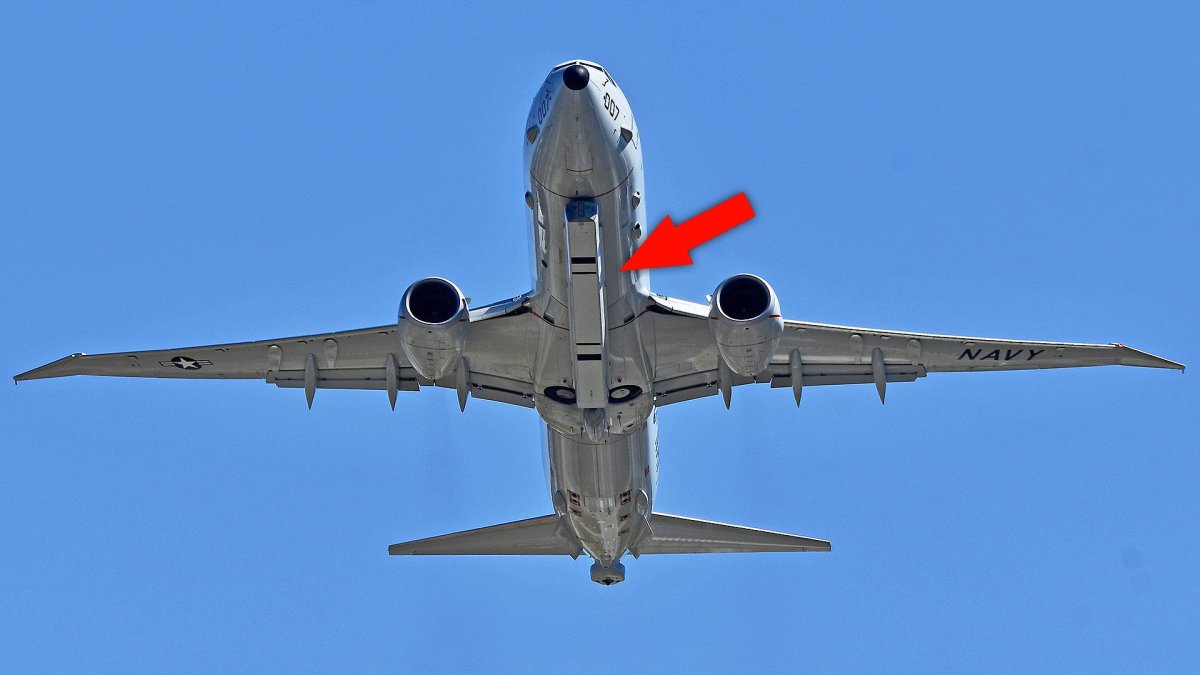
One of the U.S. Navy’s P-8A Poseidon maritime patrol planes recently visited Moffett Field in California. The aircraft in question was carrying an elongated pontoon-like pod underneath, known as the AN/APS-154 Advanced Airborne Sensor , or AAS, a powerful and secretive radar system.
A planespotter, photographer, and War Zone reader named Fred, who also goes by the Twitter handle cvvhrn , took the pictures of this particular P-8A, which is also known by the Bureau Number 169007, at Moffett on May 3, 2020. He was kind enough to share them with us so we could share them with you.
The pictures offer an excellent view of the underside of the AN/APS-154, as well as the P-8A carrying it. The pod is attached to the bottom of the aircraft using a special, extendable cradle known as the Special Mission Pod Deployment Mechanism (SMPDM), which Aviation Week
was first to report on in July 2019. By extending the pod well below the fuselage while in flight, the radar’s fields of view are no longer obstructed by the plane’s two engines.
You can also see a pair of vertical strakes, one on either side of the bottom of the P-8A’s rear fuselage. These are unique to aircraft that have been configured to carry the AN/APS-154.
The two strakes are visible in this picture under the rear of the fuselage., @cvvhrn
Specific details about the pod itself and the capabilities of the radar inside, all of which Raytheon developed almost entirely in secret, are limited. The radar is known to be an active electronically-scanned array (AESA) type with moving target indicator (MTI) and synthetic aperture functionality. What this means is that the system is capable of tracking moving targets below at sea and on land, as well as taking high-quality radar imagery of objects of interest for further analysis, even at night or in poor weather.
The AAS is also specifically designed to work in littoral regions where it might have to scan both water and land areas simultaneously. Traditional surface search radars are typically optimized for one environment or the other, or have dedicated modes for each, and generally have difficulty covering both at the same time.
All of this makes it a powerful information-gathering tool for the P-8A, which is set to not only replace the Navy’s P-3C Orion patrol planes, but also partially assume the missions of its specialized intelligence variants of that aircraft, such as the EP-3E Aeries II . The AN/APS-154 is itself a direct follow-on to the equally secretive AN/APS-149 Littoral Surveillance Radar System , another podded Raytheon AESA radar that some P-3Cs carry. The AAS is also just one bolt-on sensor suite that is in development for the Poseidon, as well.
In addition, the AN/APS-154, combined with the P-8A’s networking and data-sharing capabilities, will enable planes carrying the pod to be powerful stand-off targeting platforms for other assets in the air, at sea, or on land, as well as its itself. The Navy is now working to integrate various stand-off weapons onto its Poseidons, which you can read about more in this past War Zone piece . The AAS would also allow the aircraft to conduct rapid assessments of any strikes.
A P-8A carrying four AGM-84D Harpoon anti-ship missiles under its wings., USN
Beyond that, being an AESA type radar, the AN/APS-154 might have secondary electronic warfare capabilities. You can read much more about this sensor and what it offers to the Navy’s Poseidon fleet here .
It’s not clear how many AAS pods the Navy has now, how many of its P-8As are configured to carry them, or what units those aircraft are assigned to. The Navy first contracted Raytheon to develop the radar system in 2009 and began testing it in 2014. As of August 2019, at least seven different Posiedons , including this particular aircraft, have been observed carrying the pods at various times. Some of these aircraft have been linked to some of the Navy’s most shadowy aviation units, which is the topic of a War Zone feature that will be coming in the near future.
There have been more sightings of AAS-equipped P-8As in the last year or so, which along with the appearance of 169007 at Moffett Field, indicate that the Navy’s is making increasingly regular use of these powerful sensors.
Special thanks again to Fred for sharing these awesome pictures with us.
Contact the author: joe@thedrive.com
Comments couldn’t be loaded. Please refresh the page.
作者:约瑟夫·特雷维西克
更新于美国东部时间2020年5月15日上午11:05
美国海军的一架P-8A“海神”海上巡逻机近日到访了加利福尼亚州的莫菲特机场。这架飞机下方挂载着一个细长的浮筒状吊舱,名为AN/APS-154先进机载传感器(AAS),是一种功能强大且高度保密的雷达系统。
一位名叫弗雷德的飞机爱好者、摄影师兼《战区》杂志读者(他的推特账号是 cvvhrn)于 2020 年 5 月 3 日在莫菲特空军基地拍摄了这架 P-8A 的照片,该机的编号为 169007。他慷慨地与我们分享了这些照片,以便我们也能与大家分享。
这些照片清晰地展示了AN/APS-154吊舱的底部以及搭载它的P-8A反潜巡逻机。该吊舱通过一种名为“特种任务吊舱部署机构”(SMPDM)的特殊可伸缩支架固定在飞机底部。《航空周刊》报道了这一情况。
最早于 2019 年 7 月报道了此事。通过在飞行中将吊舱延伸到机身下方很远的地方,雷达的视野不再被飞机的两个发动机遮挡。
您还可以看到P-8A后机身底部两侧各有一条垂直翼片。这是改装用于携带AN/APS-154雷达的飞机所特有的特征。
从这张照片中可以看到机身尾部下方的两根翼条。@cvvhrn
关于吊舱本身及其内部雷达的具体细节,由于雷神公司几乎完全秘密研发,因此信息有限。已知该雷达为有源电子扫描阵列(AESA)雷达,具备动目标指示器(MTI)和合成孔径功能。这意味着该系统能够跟踪水下和陆地上的移动目标,并能对目标进行高质量雷达成像,以便进行后续分析,即使在夜间或恶劣天气条件下也能正常工作。
AAS的设计初衷是为了在近岸区域作业,因为它可能需要同时扫描水域和陆地。传统的地面搜索雷达通常针对其中一种环境进行优化,或者针对每种环境配备专用模式,因此通常难以同时覆盖两者。
所有这些都使它成为P-8A强大的信息收集工具。P-8A不仅将取代海军的P-3C“猎户座”巡逻机,还将部分承担该系列飞机特有情报型号的任务,例如EP-3E“爱丽丝II”。AN/APS-154本身是同样高度保密的AN/APS-149近岸监视雷达系统的直接后续产品,后者是另一款由雷神公司制造的吊舱式有源相控阵雷达,部分P-3C也配备了该系统。此外,AAS也是正在为“海神”反潜巡逻机开发的众多外挂式传感器套件之一。
此外,AN/APS-154吊舱结合P-8A的联网和数据共享能力,将使携带该吊舱的飞机成为强大的远程目标指示平台,可用于对空中、海上或陆地上的其他目标以及自身进行目标指示。海军目前正致力于将各种远程武器集成到其“海神”反潜巡逻机上,您可以在之前的“战区”文章中了解更多信息。AAS系统还能使飞机对任何打击行动进行快速评估。
一架P-8A反潜巡逻机,机翼下挂载四枚AGM-84D“鱼叉”反舰导弹。(美国海军)
此外,作为一款AESA雷达,AN/APS-154可能还具备辅助电子战能力。您可以在这里阅读更多关于这款传感器及其为海军“海神”水下机器人系统带来的功能。
目前尚不清楚海军拥有多少套AAS吊舱,有多少架P-8A反潜巡逻机配备了这些吊舱,以及这些飞机隶属于哪些部队。海军于2009年首次与雷神公司签订合同开发该雷达系统,并于2014年开始测试。截至2019年8月,至少有七架不同的“海神”反潜巡逻机(包括这架飞机)在不同时间被发现携带过这些吊舱。其中一些飞机与海军一些最为神秘的航空部队有关,这将是《战区》栏目近期推出的专题报道的主题。
在过去一年左右的时间里,人们多次目击到配备 AAS 的 P-8A,再加上 169007 号飞机出现在莫菲特机场,这表明海军正在越来越频繁地使用这些强大的传感器。
再次特别感谢Fred与我们分享这些精彩的照片。
联系作者:joe@thedrive.com
评论加载失败,请刷新页面。