Articulated Gun Pods Allowed Soviet Aircraft To Fire Backwards, Downwards, And Even Sideways可伸缩机枪吊舱使苏联飞机能够向后、向下甚至向侧面射击。
The Cold War-era gun pods were a bizarre solution for strafing ground targets, but some linger on today.
新闻视频
Updated Apr 12, 2021 2:27 PM EDT
Despite manufacturers’ and air forces’ efforts to do away with gun armament on aircraft in the earlier years of the Cold War, these weapons consistently proved their utility and never went away. It was the Soviet Union’s efforts to boost the firepower of its tactical jets that saw some of the most radical ways of putting more guns on aircraft, with some ingenious podded weapons capable of firing forward, backward, and even sideways.
Paralleling developments in the United States, the Soviet Union’s first fighter jets after World War II were provided with guns as their main armament, before, in the late 1950s, guns began to be done away with altogether, leaving fighters armed with (not always reliable) guided missiles. But the lessons of close air combat in the Middle East and Southeast Asia during the 1960s showed that guns were still vital in many air combat situations. At the same time, the increasing importance of ground-attack missions also called for gun armament — typically of the heavier-hitting 23mm or 30mm caliber in the Soviet Union.
An array of Soviet-designed guns, many of which appeared in podded form. The rotary weapons here are, from left to right: GShG-7,62, GSh-6-23, GSh-6-30, and the naval AK-630. , Vitaly V. Kuzmin/Wikimedia Commons
By the early 1970s, a new generation of attack-optimized, gun-armed tactical fighter jets were beginning to be fielded by the Soviet Union, and to provide even greater firepower, development was also underway on a range of increasingly ingenious, and potentially devastating gun pods.
In 1971, the Soviet launched production of a gun pod for tactical jets and assault helicopters that simply lifted the 23mm GSh-23 autocannon from the late-model MiG-21 Fishbe d and MiG-23 Flogger fighters and installed it in a “unified gun container,” Unifitsirovannyi Pushechnyi Konteyner in Russian, or UPK-23-250 to give it its full name.
As well as the twin-barreled GSh-23 series cannon , the 10-foot 5-inch UPK-23-250 carries 250 rounds of ammunition and an electrical drive unit. More conventional than the pods that followed, the UPK-23-250 is aimed by simply directing the aircraft toward the target. Nevertheless, it remains in production and is now the most widely used gun pod in the Russian inventory, arming a wide range of tactical jets and rotorcraft.
A UPK-23-250 gun pod at the ARMY-2018 arms exhibition at Kubinka outside Moscow., Boevaya mashina/Wikimedia Commons
While the UPK-23-250 has proven reliable and hard-hitting, it has always been constrained by the requirement of the pilot to keep flying directly toward the target being attacked, putting their own aircraft at risk of counter-fire from the ground. One way to avoid this was a movable gun mount, allowing targets to be engaged ahead of the aircraft’s flight path (if firing forward) or behind the aircraft (if the pod was mounted firing to the rear). In the post-war era, at least, it seems that only the Soviet Union developed and fielded these types of weapons.
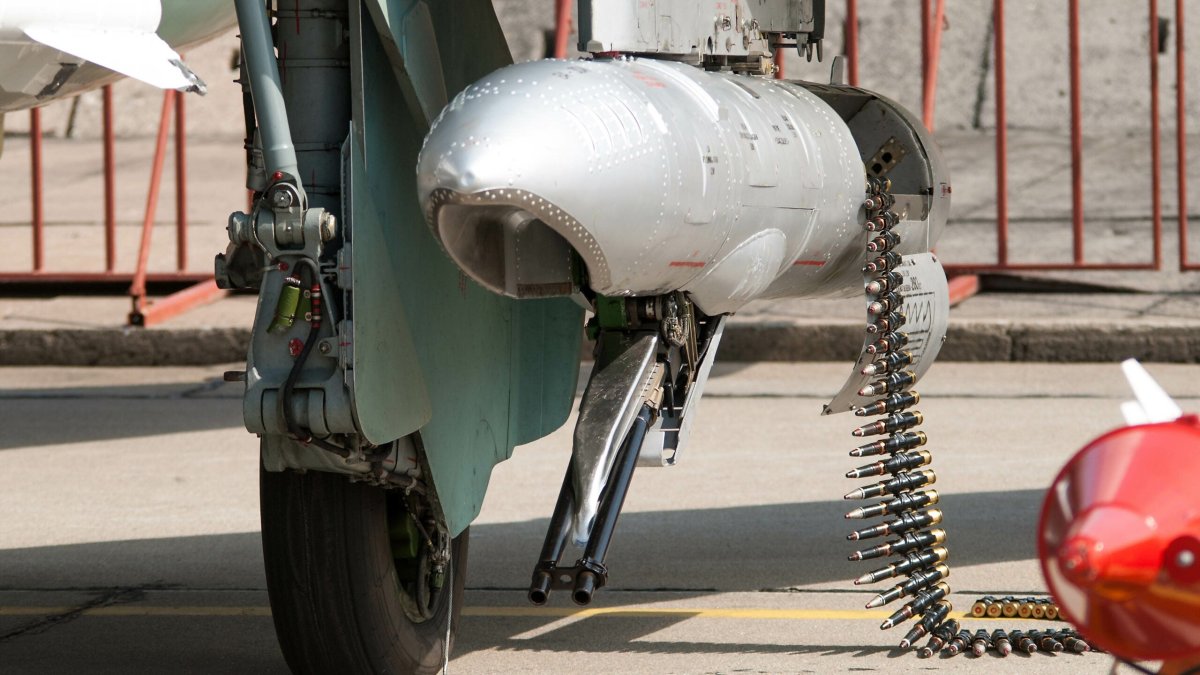
The initial result was the “detachable movable gun mount,” or Syomnaya Podvizhnaya Pushechnaya Ustanovka, and the first of these to be fielded was the SPPU-22-01. This again uses the proven twin-barreled GSh-23 cannon, with 250 rounds of ammunition. The barrels are mounted on an articulated mechanism that angles them 23° downwards, with the flight computer ensuring that they continue to track the target as the aircraft maneuvers. The angle of the gun has to be selected prior to the mission and can’t be changed once in flight.
An SPPU-22-01 carried by a Polish Air Force Su-22 Fitter ground-attack aircraft, showing the twin gun barrels angled downward., Łukasz Golowanow/Wikimedia Commons
Weighing 705 pounds when loaded with ammunition, the 12-foot 6-inch SPPU-22-01 is primarily associated with the Su-17/Su-22 Fitter swing-wing ground-attack aircraft — it’s possible, in fact, that the ‘22’ in the pod’s designation refers to this platform.
Both these gun pods feature twin-barreled cannons in which the firing action of one barrel operates the mechanism of the other. This reduces the wear compared to a single-barrel arrangement and also ensures a faster rate of fire. However, by the mid-1970s, the Soviet Union was working on rotary cannons, similar in principle to the classic American M61 Vulcan . While the U.S. gun fires 20mm ammunition, the Soviets always preferred larger calibers, either 23mm or 30mm. Six-barrel rotary cannons were produced in both these forms and armed the MiG-31 Foxhound interceptor and Su-24 Fencer strike aircraft (both 23mm), as well as the MiG-27 Flogger ground-attack aircraft (30mm).
The six-barrel 30mm weapon also found its way into the AK-630 series of naval artillery for close-in air defense of warships and later provided the gun component for both the land-based Tunguska and Pantsir family, plus the naval Kortik/Kashtan combined gun/missile air defense systems.
A video showing the Kortik combined gun/missile air defense system firing its 30mm guns onboard a Russian Navy warship:
Meanwhile, the six-barrel 23mm gun, the GSh-6-23, was adapted for the most unusual Soviet gun pod yet, the SPPU-6, which entered production in 1976. This retains the articulated mounting proven in the SPPU-22-01, but this time, the entire gun assembly can be tilted 45° downwards, as well as 12° to the side, obviating the need for the aircraft to dive directly toward the target. While the previous pods with moveable guns were depressible only, this new weapon could move on two axes.
A GSh-6-23M cannon from a MiG-31 interceptor, preserved as a museum exhibit., Vyacheslav Bukharov/Wikimedia Commons
The 16-foot 7-inch low-drag pod also contains the gun control system and 400 rounds of ammunition. The total weight, when loaded, is over 1,150 pounds. Again, the pod can be mounted with the barrels facing forward, or to the rear of the aircraft, for strafing in the rear hemisphere. Furthermore, both “left-handed” and “right-handed” versions of the pod were produced, with the cannon mounted on different sides. The only aircraft so far confirmed to carry the pod is the Su-24, which can carry a maximum of three.
An SPPU-6 preserved in an armaments museum, with the gun arranged to fire downward and to the side., via Twitter
The SPPU-6 has been rarely seen in service, suggesting it may not have been as successful as hoped, but it can be imagined that, at the very least, it could have an enormous psychological effect on any troops unfortunate to be confronted by it. In effect, it would turn a Su-24 into a supersonic gunship , with trainable Gatling guns under the wings, one more under the belly, plus a similar weapon in the standard fixed installation under the fuselage. Having said that, the duration of fire provided by the pods, at least, is strictly limited. With a rate of fire of 4,000 to 6,000 rounds per minute, the ammunition in each pod would be exhausted in as little as four seconds.
The SPPU-6 gun pod was intended for fixed-wing aircraft, and its considerable weight and recoil meant it was only suitable for larger attack aircraft. However, thought was also given to developing smaller, lighter pods specifically to arm assault helicopters. In the late 1970s the Vympel design bureau, famous for its work on air-to-air missiles , developed the GUV-8700, GUV standing for Gondola Universalnaya Vertolotnaya, or universal helicopter pod.
The GUV-8700 is modular, with two different loading possibilities. In its simplest form, it contains a single 30mm Plamya-A grenade launcher with 300 grenades, adapting the popular infantry weapon for aircraft use. The other option contains one YakB-12.7 .50-caliber machine gun with 750 rounds and two GShG-7,62 .30-caliber machine guns with 1,800 rounds each. Each of these guns is a four-barreled rotary type, the GShG-7,62 being the equivalent of the iconic M134 Minigun . When loaded, the 9-foot 10-inch GUV pod weighs just under 1,000 pounds.
One further Soviet gun pod from this period is known, this time in 30mm caliber, although it seems never to have progressed beyond the prototype stage. This was the SPPU-687 pod with a depressible mounting carrying a single-barrel GSh-30-1 cannon, of the same type used in the MiG-29 Fulcrum , Su-27 Flanker , and others. The pod reportedly carried 200 rounds, but little more is known of the project.
A poor-quality, but rare image purportedly showing the 30mm SPPU-687 pod., via Twitter
As long-term proponents of artillery , it’s perhaps little wonder that the Soviets went to such great efforts to turn their combat aircraft into “flying artillery,” too. Today, however, most of these weapons are rarely seen, with only the UPK-23-250 enduring. Exactly why they have generally fallen from favor is unclear, but the rapid removal of the MiG-27 and Su-17 from service soon after the Cold War ended couldn’t have helped.
Overall, these weapons were likely somewhat limited in terms of accuracy and complex to operate. It could also be that the vibration of the larger gun pods had an adverse effect on aircraft airframes, and their fall from favor may also be related to changes in tactics, focusing on standoff range wherever possible. On the other hand, Russian tactical aircraft do still make considerable use of unguided bombs and rockets , which have limitations in terms of range and accuracy. Whatever the reason, these gun pods remain some of the most intriguing aircraft weapons developed in the post-war years.
Contact the author: thomas@thedrive.com
Comments couldn’t be loaded. Please refresh the page.
更新于美国东部时间2021年4月12日下午2:27
尽管冷战初期制造商和空军都曾努力取消飞机上的机炮,但这些武器不断证明了自身的实用性,最终并未被淘汰。苏联为了提升其战术喷气式飞机的火力,探索了一些最为激进的飞机加装机炮方式,例如一些巧妙的吊舱式武器,能够向前、向后甚至向侧方射击。
与美国的发展类似,苏联二战后的第一批战斗机也以机炮作为主要武器。到了20世纪50年代末,机炮开始被逐步淘汰,战斗机转而装备(但并非总是可靠的)导弹。然而,20世纪60年代中东和东南亚近距离空战的经验表明,在许多空战情况下,机炮仍然至关重要。与此同时,对地攻击任务日益重要,这也需要机炮——在苏联,通常采用威力更大的23毫米或30毫米口径机炮。
一系列苏联设计的火炮,其中许多采用吊舱式结构。图中旋转火炮从左至右依次为:GShG-7,62、GSh-6-23、GSh-6-30 和海军型 AK-630。(图片来源:Vitaly V. Kuzmin/Wikimedia Commons)
到 20 世纪 70 年代初,苏联开始部署新一代攻击型、配备机炮的战术战斗机,为了提供更强大的火力,苏联还在开发一系列越来越巧妙、可能具有毁灭性威力的机炮吊舱。
1971年,苏联开始生产一种用于战术喷气机和攻击直升机的机炮吊舱,该吊舱简单地将后期型米格-21“鱼嘴”和米格-23“鞭挞者”战斗机上的23毫米GSh-23自动炮吊起,并安装在一个“统一机炮容器”(俄语为Unifitsirovannyi Pushechnyi Konteyner,全称为UPK-23-250)中。
除了双管GSh-23系列机炮外,10英尺5英寸的UPK-23-250机炮还携带250发炮弹和一个电动驱动装置。与后来的吊舱相比,UPK-23-250的瞄准方式更为传统,只需引导飞机朝向目标即可。尽管如此,它仍在生产,并且现在是俄罗斯装备中最广泛使用的机炮吊舱,装备于多种战术喷气式飞机和旋翼机上。
莫斯科郊外库宾卡举行的 ARMY-2018 武器展上的 UPK-23-250 机枪吊舱。, Boevaya mashina/Wikimedia Commons
虽然UPK-23-250已被证明可靠且威力强大,但它始终受限于飞行员必须始终朝着攻击目标直线飞行,这使得飞行员的飞机容易遭到地面反击。一种避免这种情况的方法是使用可移动的机炮支架,这样就可以攻击飞机飞行路径前方(向前射击)或后方(向后射击)的目标。至少在战后时期,似乎只有苏联研发并装备了这类武器。
最初的成果是“可拆卸移动式机炮架”(希腊语:Syomnaya Podvizhnaya Pushechnaya Ustanovka),首架投入使用的型号是SPPU-22-01。该机炮再次采用成熟的双管GSh-23机炮,备弹250发。炮管安装在铰接机构上,可向下倾斜23°,飞行计算机确保飞机机动时炮管仍能持续跟踪目标。机炮角度必须在任务开始前设定,飞行中无法更改。
一架波兰空军苏-22“装配匠”攻击机携带的SPPU-22-01型机炮,图中可见其双管炮管向下倾斜。(图片来源:Łukasz Golowanow/Wikimedia Commons)
SPPU-22-01 吊舱长 12 英尺 6 英寸,装载弹药时重 705 磅,主要与 Su-17/Su-22“装配匠”可变后掠翼地面攻击机有关——事实上,吊舱名称中的“22”可能指的就是这个平台。
这两种机炮吊舱都采用双管机炮,其中一根炮管的射击动作会带动另一根炮管的机械结构。与单管机炮相比,这种设计可以减少磨损,并确保更高的射速。然而,到了20世纪70年代中期,苏联开始研发旋转式机炮,其原理与经典的美国M61“火神”机炮类似。虽然美制机炮发射的是20毫米弹药,但苏联始终偏爱更大口径的弹药,例如23毫米或30毫米。苏联生产了六管旋转式机炮,分别装备于米格-31“猎狐犬”截击机和苏-24“击剑手”攻击机(均为23毫米口径),以及米格-27“鞭挞者”攻击机(30毫米口径)。
这款六管 30 毫米武器也被用于 AK-630 系列海军火炮,用于军舰的近距离防空,后来又为陆基通古斯卡和铠甲系列防空系统以及海军科尔提克/卡什坦组合式火炮/导弹防空系统提供了火炮组件。
一段视频显示,俄罗斯海军军舰上的“科尔蒂克”组合式火炮/导弹防空系统正在发射其30毫米火炮:
与此同时,六管23毫米机炮GSh-6-23被改装到当时苏联最独特的机炮吊舱——SPPU-6上,该吊舱于1976年投入生产。SPPU-6保留了SPPU-22-01上久经考验的铰接式安装结构,但这一次,整个机炮组件可以向下倾斜45°,并向侧面倾斜12°,从而无需飞机直接俯冲攻击目标。此前的可移动机炮吊舱只能进行俯仰运动,而这种新型武器可以沿两个轴向移动。
一门来自米格-31截击机的GSh-6-23M型机炮,现作为博物馆展品保存。图片来源:Vyacheslav Bukharov/Wikimedia Commons
这款长16英尺7英寸的低阻力吊舱还包含火炮控制系统和400发炮弹。满载后的总重量超过1150磅。该吊舱的炮管可以朝前安装,也可以朝后安装,以便对后方进行扫射。此外,该吊舱还生产了“左旋”和“右旋”两种版本,火炮分别安装在不同的两侧。目前已确认唯一能够携带该吊舱的飞机是苏-24,其最多可携带三个。
一门保存在军火博物馆中的SPPU-6自行榴弹炮,其火炮被改装成向下和向侧面射击。(图片来自推特)
SPPU-6 战机很少在服役中出现,这表明它可能并未达到预期效果。但可以想象,至少它能对任何不幸遭遇它的部队造成巨大的心理威慑。实际上,它能将苏-24变成一架超音速武装直升机,机翼下装有可旋转的加特林机枪,机腹下也装有一挺,机身下方的标准固定安装位置也装有类似的武器。不过,这些吊舱的火力持续时间非常有限。以每分钟4000到6000发的射速计算,每个吊舱的弹药可能在短短四秒内就会耗尽。
SPPU-6型机炮吊舱原本是为固定翼飞机设计的,但由于其重量和后坐力较大,仅适用于大型攻击机。然而,人们也曾考虑开发更小、更轻的吊舱,专门用于武装攻击直升机。20世纪70年代末,以空空导弹研发闻名的维姆佩尔设计局开发了GUV-8700,GUV是“Gondola Universalnaya Vertolotnaya”(通用直升机吊舱)的缩写。
GUV-8700采用模块化设计,有两种不同的装载方式。最简单的配置是搭载一门30毫米Plamya-A榴弹发射器,配备300枚榴弹,将这款广受欢迎的步兵武器改装后用于飞机。另一种配置是搭载一挺YakB-12.7型.50口径机枪(配备750发子弹)和两挺GShG-7,62型.30口径机枪(每挺配备1800发子弹)。这两挺机枪均为四管旋转式机枪,其中GShG-7,62型机枪相当于经典的M134迷你机枪。装载完毕后,长9英尺10英寸的GUV吊舱重量略低于1000磅。
已知苏联在这一时期还研制过另一种机炮吊舱,口径为30毫米,但似乎从未超越原型阶段。这款吊舱名为SPPU-687,采用可下压式安装,搭载一门GSh-30-1单管机炮,与米格-29“支点”、苏-27“侧卫”等战斗机所使用的机炮类型相同。据报道,该吊舱可携带200发炮弹,但除此之外,关于该项目的信息知之甚少。
一张质量较差但十分罕见的图片,据称展示了30毫米SPPU-687吊舱。(图片来自推特)
作为火炮的长期拥护者,苏联不遗余力地将战斗机也打造成“空中炮兵”也就不足为奇了。然而,如今这些武器大多已难觅踪迹,只有UPK-23-250仍在服役。它们为何逐渐失宠尚不明确,但冷战结束后不久米格-27和苏-17的迅速退役无疑加剧了这一趋势。
总体而言,这些武器在精度方面可能存在一定局限性,且操作复杂。大型机炮吊舱的振动也可能对飞机机身造成不利影响,而它们逐渐被淘汰或许也与战术的转变有关,即尽可能地采用防区外打击。另一方面,俄罗斯战术飞机仍然大量使用非制导炸弹和火箭弹,这些武器在射程和精度方面都存在局限性。无论原因如何,这些机炮吊舱仍然是战后时期研发的最引人入胜的机载武器之一。
联系作者:thomas@thedrive.com
评论加载失败,请刷新页面。