Raven Rock Author Tells Us How Our Government Plans For Its Own Annihilation《乌鸦岩》作者告诉我们,我们的政府是如何计划自我毁灭的
We chat all about how the government secretly prepares for the end of the world as we know it and the fortresses and technologies that will protect the chosen few.
新闻视频
Updated Jul 5, 2020 7:03 PM EDT
The War Zone had a long discussion with Garrett Graff , the author of the fascinating new book, Raven Rock: The U.S. Government’s Secret Plan To Save Itself While The Rest Of Us Die . We talked about everything from secret bunkers to how nukes spawned that development of modern communications, and of course all about government after America as we know it has been turned to ashes. It was a lively, eye opening, and bizarre discussion to say the least—just as one should expect when discussing the fine details of America’s shadowy continuity of government plans.
Starting in the mid 1940s, a change swept across America and the world that catalyzed the growth of a massive and unprecedented security apparatus. Can you explain a bit about what continuity government is and where it springs from?
It’s the term of art for a whole series of plans that grew up over the course of the Cold War, beginning during the Truman years that focused on how nuclear war would unfold, who would be involved, and then what would happen to America in the hours, days and weeks afterwards. And these plans focused not just on, you know, the officials and how they would be evacuated, and where they would be evacuated, but also what parts of the US government would continue, and how the country would try to rebuild and reconstruct and sort of reconnect with whatever citizenry and whatever was left of the country after a nuclear war.
This came about after the first atomic bomb was dropped, and the onset of the realities of the atomic age. Before that, as you describe in your book, Truman could just walk across the street without a security detail. And then the atomic bomb became a reality, and things began to change.
Really, this book is the story of an unfolding technology revolution, and how nuclear weapons reshaped and created the modern presidency. Because they did two things. First was the president and other government officials needed to be in command and control and communication at all times. You couldn’t have people lose touch for an hour or two, or even a day or two at a time. And that was a huge transition for the presidency, where in the 1800s and early 1900s you would have presidents take off from Washington for weeks or months at a time to travel around the country with very little command and control back in Washington.
Then once nuclear weapons arrived and then got stronger and then more plentiful, you had the beginning of the idea that entire cities could be wiped off the face of the planet with just a few hours notice at first, and then, by the end of the Cold War, with just a few minutes notice.
Truman’s VC-54C “Sacred Cow” airplane awaits at Washington National Airport in December of 1945. , National Archives
Over the course of the Cold War, the U.S. government built a massive crescent of continuity of government facilities or sorts. These included elaborate communication sites, personnel bunkers, and command and control posts, ranging from southern Pennsylvania all the way to North Carolina. What are some of these shadowy facilities and how does Raven Rock, which is also the name of your book, fit into this invisible constellation of fortresses that dot America’s east.
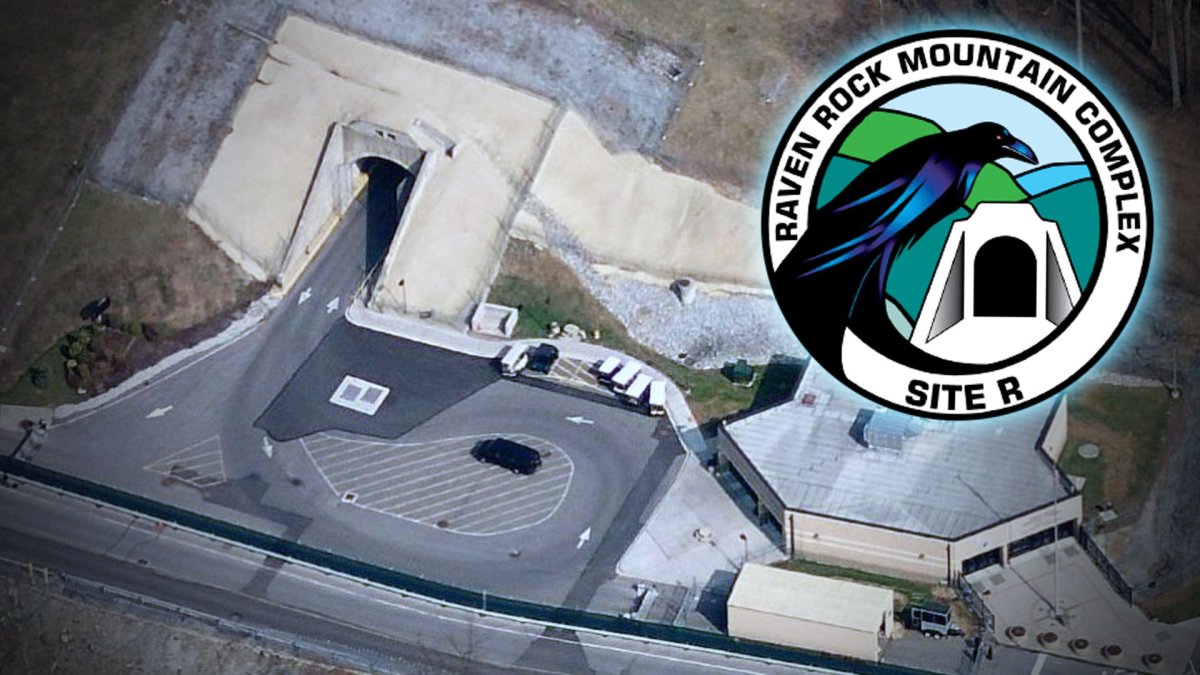
Raven Rock, the name of the book, comes from the government’s main bunker, just over the Pennsylvania state line, near Camp David. That was going to be the alternate Pentagon, the place where the US military would have relocated in the event of an attack, or the threat of an attack, on Washington.
But Raven Rock, which is this enormous city within a mountain, could hold about five thousand people and is still in operation today, 24 hours a day, 365 days a year. It is just one of scores of these bunkers in relocation facilities scattered around, as you say, what was known as the “relocation arc,” this large stretch from Pennsylvania on down through Maryland, Virginia, West Virginia, and then even down into North Carolina. And it included lots of bunkers, but also some more unhardened nuclear relocation facilities.
The state department set up its operations at a large farm. A beef cattle research farm in Virginia. And the US Information Agency built a massive radio transmitter facility down in North Carolina. The Supreme Court would have actually relocated to a mountain resort in Asheville, North Carolina, where they would’ve held court sessions in one of the reception halls.
And the bunkers, there were more than a hundred of them at the peak, one for almost every key government agency, and one for almost every cabinet department, with the big ones at Raven Rock, and then Mount Weather, which is where the president and his cabinet officials would have gone. Mount Weather is also still in operation today. And then the Greenbrier in West Virginia, which is where congress would have gone to a bunker that was hidden under a luxury resort in White Sulphur Springs.
We know some of these facilities still exist today, and that some of them don’t. Are there other ones that are out there that we still have no idea about, such as where they are or what they do?
Absolutely. Many of these facilities were shut down in the wake of the Cold War, but many still exist in all corners of the country. FEMA runs all of these continuity government programs—many people don’t know that—and has a whole series of regional command bunkers around the country in places like Texas, Maryland, and Massachusetts.
And then there are bunkers like NORAD, which was made famous by the movie War Games in the 1980s. That bunker was originally shut down in the early 2000s and has actually been re-opened and re-activated in recent years in order to combat the possibility of a cyber attack, or an attack by a rogue nation.
FEMA’s Mount Weather facility. A small city lays deep below carved into large granite caverns. , FEMA
Beyond the secret bunkers and Cold War intrigue , your book is really as much a story of about the development of modern communications as anything else. The ability to reliably communicate was probably more important than any other factor when it came to building a credible nuclear deterrent, and pursuing t he idea of continuity government. How did the nuclear age spawn great leaps in communications?
This is part of what I found really fascinating in researching this book, is understanding how nuclear war, which obviously, at least yet, has never happened, in many ways created the modern world that we interact with on a daily basis. I mean, the Interstate Highway System was in many ways a creation of the Eisenhower era’s needs to try to ensure an easy evacuation from the center of urban areas, and the ability to speed war materiel around the country in the event of an attack.
And then the internet itself grew out of the Pentagon’s desire to have a decentralized communication system that could survive a nuclear war. This sort of fundamental tool of modern life really grew out of doomsday planning. In fact, the very technology we use whenever we go online to book an airplane ticket through Kayak or Orbitz, actually is just a descendant of the original air defense system built to track Soviet bombers coming towards the United States. And every chat program that we use in daily life—from Slack to Facebook Messenger—is a descendant of the first chat program which was used to help these emergency bunkers communicate during a national crisis.
Inside an EC-135 Looking Glass aircraft in 1979. For over 29 years, a Looking Glass aircraft was airborne at all times. Major revolutions in communications technology occurred out of a need to maintain command and control during and after a nuclear exchange. , USAF
Some of the continuity of government and civil defense plans you describe are totally bizarre, like harvesting pets for protein. What are some of the wildest parts of this type of planning you’ve found?
Every government agency had its own post nuclear functions. The post office was in charge of registering the dead and figuring out who was still alive. The National Park Service would help run the refugee camps, because the thinking was the national parks wouldn’t have been targeted in a nuclear strike.
When you begin to talk about how to preserve the US government, you ask this very existential question of W hat is American ? Are you trying to preserve the presidency? Are you trying to preserve the three branches of government? Or are you trying to preserve the historical totems and artifacts of our that sort of unite our country?
The National Archives sat down and decided that they were going to save the Declaration of Independence before they save the Constitution. The Library of Congress sat down and decided that they were going to save the Gettysburg Address before they save the George Washington Military Commission.
There was even a specially trained team of park rangers in Philadelphia whose job it was, during the Cold War, to evacuate The Liberty Bell in the event of a Soviet attack. And so this question about how do you save and preserve and restart America ends up being a deeply philosophical one, in addition to the very basic question of, you know, how do you actually just save and preserve the individual elected officials who lead the country?
Is there a continuity of government scenario following a massive nuclear attack that won’t lead to some sort of dictatorship, even if it’s a temporary one?
Part of what’s striking is the extent to which the people who really got involved in this planning, effectively said, during the Cold War—and even after 9/11—that to the extent that the US government actually implemented any of these plans, it would generally involve suspending normal peacetime civil liberties, and it would generally involve effectively declaring some form of martial law.
There was the nuclear bomber age, where we had hours of warning before an attack. It seemed almost survivable as there was time to prepare, and even a credible air defense system in place to deal with some of those aircraft. Then we hit the advent of the intercontinental ballistic missile (ICBM) and everything changed. How did continuity of government planning change once the ICBM came on the scene?
In the early years, atomic war was something that seemed potentially survivable, that you would have a long warning time before bombers could arrive. The first atomic bombs were powerful, but not unthinkably powerful, and then they’re also just weren’t that many atomic bombs in the early years of the Cold War.
Then all three of those things changed over the course of the Cold War, where you have ICBMs introduced, which cut that warning time down from about eight hours to 15 to 30 minutes. You have the arrival of thermonuclear bombs built to deliver unimaginable destruction on an urban area. And then just the sheer volume and plentifulness of atomic weapons and thermonuclear weapons reach a point where the idea of war was just insane, which is how you got to the eventual theory of mutually assured destruction.
So over the course of that arc you see the US government’s hopes and dreams shift and shrink from being able to actually protect a large chunk of the civilian population, in the 1950s and early 1960s, until what you basically have show up later in the Cold War, when effectively the American people were going to be left totally on their own. And if we were lucky a small number of senior government officials were going to be able to evacuated to safety.
An Atlas ICBM launch. , DoD
Wouldn’t Congress and the Supreme Court be nearly irrelevant after a major nuclear attack?
Yes, absolutely. You sort of saw these plans shrink over the course of the Cold War to something that I describe as basically trying to preserve the spirit of the Constitution, but not the letter of the Constitution.
Congress really understood that it was going to be pretty irrelevant in the immediate aftermath of a nuclear war. And that the Supreme Court was going to be entirely irrelevant for months after a nuclear attack, and their plans to preserve and protect those officials sort of shrank away and even disappeared. And the modern incarnation of these plans, which are known as enduring a constitutional government, remain the most secret of all of the continuity of government plans in modern life. We don’t really know how they preserve or cease to preserve the three branch structure that we’re used to in peacetime.
But what we’ve guessed based on publicly available information is they will probably provide super-empowered powers to a small group of congressional members—perhaps as few as two to four to eight of them—who are able to sort of serve as a “rump congress” until congress is actually able to reconstitute itself at some point in the future.
The 1st Helicopter Squadron with their vintage Twin Hueys is one of a handful of special helicopter units tasked with scooping up key individuals and evacuating them to bunkers throughout the region. Whether or not these aircraft could actually get to any of these select power players before the nuclear warheads arrive is highly questionable, but a standby VH-3D or VH-60N from HMX-1 may be able to grab the President or the Vice President in time. , USAF
Some of our leaders were seemingly more realistic about what nuclear war would actually look like, and the results of it, than others. Eisenhower stated that after a nuclear exchange there wouldn’t be enough bulldozers to scrape the bodies off the streets. Now that’s a pretty eye opening statement. How did different Commanders In Chief generally look at continuity of government, and which do you think had the best handle on it?
I think actually what’s interesting about this is the extent to which planning for doomsday, and planning for nuclear war, really shaped the way the presidents thought about nuclear war. And the extent to which you really saw officials at the top of government, including almost every president of the Cold War, go through these doomsday exercises—these nuclear war exercises aboard a nuclear doomsday airborne command post or in one of these bunkers, and conduct an evacuation drill and nuclear war exercises, and just how worrying those exercises were for the Commanders In Chief.
You see it with Eisenhower, Kennedy, Johnson, Nixon, Carter and Reagan. And for each of them, they really thought long and hard about nuclear war in the context of thinking through these doomsday plans. And I think that the exercise and that experience helped shape their decision making during some key Cold War crises—when they all took steps back from the precipice, rather than push forward into war.
Ronald Reagan in the situation room. , National Archives
Does it worry you that there are a lot of reports stating President Trump doesn’t seem very interested in details like this? This is reportedly the case across the full range of the government, and he has supposedly delegated decision making authority to the military on a fairly unprecedented level, at least in modern times.
Yes. And I think that you have a president also who has made very troubling comments about his own appreciation of nuclear weapons, and the extent to which he would like to see nuclear weapons spread in the world. Which goes against decades of US policies to try and limit nuclear proliferation around the world.
Does a more perceptually effective continuity of government plan, including elaborate infrastructure like massive bunkers, fleets of evacuation helicopters, and airborne command posts, where government officials, and even their families in certain cases, might be able to survive a nuclear change, make an exchange or getting involved in nuclear conflict more acceptable or attractive in any way?
Well, I think we have seen that a lot of emphasis since 9/11, really since the 1990s, but definitely since 9/11, has been put on the idea of devolving control of the US government. Which is this idea that we may be less likely today to face an all out global thermonuclear war with Russia, that blankets the entire country, but that we are more at risk of today’s threats from a terrorist group or from a rogue state like Iran or North Korea. And these threats may manifest themselves in a surprise attack that wipes out a major US city like Washington DC. And then how do you devolve power within the US government to people who exist outside of Washington on a regular basis. And that’s one of the reasons that all of these bunkers are to this day fully staffed, 24 hours a day, 365 days a year. Like Raven Rock, and Mount Weather, and others around the country.
SecDef Donald Rumsfeld aboard an E-4B National Airborne Operations Center in 2005. The aircraft, which were designed in the ’70s specifically as a survivable command and control platform for a doomsday scenario, now have other roles as well, including acting as a command post and communications relay system for FEMA during a national disaster and carrying the Secretary of Defense on trips abroad. The aging E-4B fleet was going to be retired under Rumsfeld without a replacement, but the plan was stopped and they have since received drastic upgrades., DoD
That sounds more like planning based on a shadow government of sorts, or maybe a stand-in government as opposed to relying on traditional evacuation plans alone, correct?
Yes. I mean that’s sort of a very exclusive part of this. Most Americans think that the president is just a person that we elect every four years. In the modern age, the presidency actually encompasses several hundred people where you have a line of succession. The vice president, speaker of the house, president pro tem of the senate, and then all of the cabinet officials. But then each of those cabinet officials also have their own line of succession of 12, 15, 20 people or more. And so when you sort of think about that emergency government that might emerge after an attack on Washington, you’re talking about a cadre of several hundred people who are all part of these lines of succession, and would be in line to be evacuated to different facilities depending on their rank, and would be stepping into these roles after after an attack.
During Donald Trump’s inauguration, outgoing Homeland Security Secretary Jeh Johnson was the designated survivor that would assume the presidency if say Washington DC were nuked in a surprise attack. Shulkin was taken to a secure location and had a security detail assigned to him, as well as a military attaché carrying the dreaded “nuclear football” just in case. , AP
After over a half century of planning and ungodly sums of money spent preparing for what comes after the country is basically destroyed, that massive apparatus failed miserably on 9/11. What went wrong that day and how did it change the way we plan for doomsday and other major disasters?
9/11 is the only time that most of these plans have ever been activated on any sort of large scale. They just fall apart entirely, and they fell apart for some predictable reasons. It turned out that Washington, DC had a lot of traffic, and that they were sort of gridlocked trying to get officials outside of Washington. And they fell apart because on any given day you have a lot of government officials traveling. And so you have a lot of senior government officials who were in different places doing different things and it was hard to track them down.
And then what we also saw was the tension that had existed in continuity planning all along, which is you can’t generally keep someone safe and keep them in communication at the same time. So you have a lot of officials that were being evacuated, including the President of the United States, who was in Florida and was put aboard Air Force One and sent up into the sky, and were really struggling to stay in communication with anyone on the ground and to stay abreast of a rapidly unfolding situation.
Vice President Dick Cheney and members of the Bush administration cabinet were relegated to hiding in the White House bunker on 9/11. The facility proved to be woefully inadequate for the job at hand, as were strategic communications on that terrible day. The White House bunker has since been totally revamped and expanded under a secretive project that saw large swathes of the White House lawn dug up for a long period of time. The White House bunker is not the Situation Room., AP
We know that Air Force One has far better communications than it did on 9/11, and there have been upgrades to the Situation Room and the White House Bunker, and so on. Are there other much larger systemic changes that were made following 9/11 to improve America’s continuity of government plans and to fix the issues that were exposed by 9/11?
Certainly some changes have been made. Communications today are vastly better than they were. You see a lot of improvement in the readiness and preparedness of places like Raven Rock, NORAD, and Mount Weather in terms of what they are capable of and how there is staff there on a daily basis. But at the same time, you know, part of the challenge with all of these plans is that as in any attack or in any war, you can make very, very detailed neat and clean looking plans on paper, but in reality they are going to unfold in chaotic ways that make it very hard to understand what might actually transpire.
NORAD’s complex built into Cheyenne Mountain has 25 ton blast doors at its entrances. The site was reactivated in 2015 after a stint of being kept on standby. , AP
Your book describes such a massive and bewilderingly costly apparatus built up around the continuity of government concept. Is continuity of government planning really just a giant form of mental masturbation? Not even our most capable bunkers can sustain direct hits from thermonuclear weapons and it seem like all the planning would likely fail to hold up to the realities of a major nuclear exchange. One could argue that the whole idea has become a manifestation of the “self-licking ice cream cone” that is the defense-industrial complex more than anything else. I mean is this worth investing in at all?
Certainly many of these plans would have never worked anywhere close to the way that one would expect them to on paper. But at the same time, you know, I think there is value in thinking through some of these questions. Because of just how awful any sort of large-scale attack is going to be, you want to make sure you have a plan, and as best a chance as you can have of ensuring that something is left to rebuild the country.
Russia has its own form of continuity government plans . We saw them at work during a 2016 drill where tens of millions of people were involved. In Moscow alone, millions were put into shelters below the city. And generally the Russians seem to have adopted a different viewpoint on all this where saving the citizenry is a focal tenet of their doomsday planning. How are Russia’s plans different than America’s, and do they know something we don’t know?
You know, this was sort of a hard thing to parse all through the Cold War—whether the Soviet Union actually had a better civil defense strategy than we did. You know that famous scene in Doctor Strangelove , where they’re debating and worrying and fretting over the possibility of “mineshaft gap?” Actually, the US government was afraid of a mineshaft gap during the Cold War. And that we were afraid of Russia’s civil defense ability. We were literally out there mapping abandoned mine shafts and caves around the country for possible fall-out shelters for the civilian population, and our government leaders.
You wrote about how the US had terrible problems with their command and control computer systems during the Cold War. One of the scenarios you outlined was the fault of a bad 46 cent circuit that made NORAD think armageddon was on its way in the form of a barrage of Russian ICBMs. Considering we supposedly had some sort of computer edge over the Russians during that period of time, are you surprised that the Soviet Union didn’t have similar issues, and that those issues didn’t lead to a nuclear exchange of some sort?
Yeah, and to me that was a very humbling part of researching the Cold War—going back and understanding just how miraculous it was that we escaped without major incident. Because there are plenty of times during the Cold War where war would have been the more likely, and perhaps even more politically expedient, option for leaders on both sides.
You know, when Eisenhower left government, he said the thing that he was most proud of was keeping the peace, and that it didn’t just happen. And I think that one of the lessons, when you go back and you read these histories, and really understand the extent to which some of these scenarios could have spiraled out of control very quickly, you come to understand, just how lucky we are that we had such good leaders during the Cold War.
SAC headquarters in Omaha, Nebraska ran on some ancient computer technology. Here you see the “big board” in all its glory. , US Library of Congress
In Raven Rock, you touched frequently on some past elements of emergency planning that sound like the domain of the conspiracy theory crowd, but it was all too true. Primarily I am talking about concentration-like camps. For instance, you mention orders for citizens to be told to register at a local Walmart and to shelter there with thousands of other people—with plans that call for those people to sleep head-to-toe in unrealistically neat rows and that these facilities have far too few bathrooms to support such a plan in the first place. You also talk about the rounding up foreigners and the FBI being sent to go grab targeted individuals during a national emergency or nuclear attack situation. What do you think the continuity government plans today have in them that would probably be alarming for most people to hear?
Well, I think that most of these plans still exist in some modern form. You know, we don’t really have any sense of what it means to have these continuity of government plans for the three branches of government in modern times. We don’t really know what role Congress would do after an attack. We don’t know if the Supreme Court would have any role whatsoever. And what I think almost everyone understands, is that after a nuclear attack, the President of the United States would be effectively a dictator for some period of time, until we were able to restore something that was a kin to the constitution that we normally expect.
You wrote about how it was a common occurrence during high-level nuclear exercises that the guy playing the president wouldn’t press the button to launch the nukes even though it was clearly a simulated event. Is this an indicator that if it really came down to it, even the actual president wouldn’t be able to initiate a nuclear counterstrike?
Yeah, and I think that’s one of the things that is really sobering about this is realizing how much people struggled, even in exercises, to consider launching a simulated nuclear weapon. And whether or not at the end of the day, even if one side or another did launch some weapons, whether the other side would’ve ever actually retaliated.
The nuclear football is rarely more than a matter of steps away from the President or the Vice President. Here a Navy officer carries the case aboard Air Force One before departing on President’s Trump’s nine day international trip., AP
What prompted you to write this book? It is pretty apparent that putting it together was one hell of an undertaking.
Yeah, it was. It was about four years of research which is longer than I was anticipating. The short answer is, you know, I bumped up against these programs a lot in Washington. I’m sure you have too writing and reporting on these things. You talk to people who have been to these facilities. You would talk to people who would have been, of were evacuated to some of these facilities on 9/11. And then what sort of really got me interested in the topic was when one of my colleagues found a government ID on the floor of a parking garage here that he brought in to me to turnover—to give to me to give back to the guy, figuring that since I reported on the stuff, I would know how to get it back to him.
When I turned the ID over, it had these detailed evacuation instructions on the back. And so I got on Google Maps and Google Satellite, and followed those instructions, which were driving directions out into West Virginia. And discovered that they led to this road that disappeared into what were clearly concrete bunker doors in the side of a mountain. And it was an unmarked mountain that wasn’t on any map. And no one nor I had ever heard of this facility. I was like, wow, this is part of the new post 9/11, you know, continuity government plans. And this is something that’s probably worth looking into more.
What facility was that?
It was actually the facility that I talk about right at the end of the book, which is Allegany Ballistics Laboratory.
Did you try to get a tour of one of these facilities like Raven Rock or Mount Weather?
I couldn’t get into Mount Weather or Raven Rock, but I did have the opportunity to tour NORAD, which is similar physically to the others, and a little bit more open. And then a lot of these facilities are also now tourist attractions of one sort or another. For instance, the Greenbrier congressional bunker in West Virginia, as well as some of these older retired bunkers like John F Kennedy’s presidential escape bunker in Palm Beach, Florida, out on Peanut Island, actually just across the harbor from Trumps house at Mar-a-Lago. And when you get into that one, you definitely realize that it is not a place you would have wanted to have spent a nuclear war.
A huge thanks to Garrett Graff for taking the time to talk to us (he worked us in around CNN!). I will be posting a formal review on Raven Rock soon as well.
Contact the editor: Tyler@thedrive.com
Comments couldn’t be loaded. Please refresh the page.
更新于美国东部时间2020年7月5日晚上7:03
《战区》栏目与加勒特·格拉夫进行了长时间的讨论,他是引人入胜的新书《渡鸦岩:美国政府自救计划,任由我们其他人死去》的作者。我们探讨了从秘密掩体到核武器如何催生现代通信发展等方方面面,当然也谈到了美国化为灰烬后政府的运作模式。这是一场生动、发人深省且离奇的讨论——正如人们在讨论美国政府秘密延续计划的细节时所预期的那样。
从20世纪40年代中期开始,一场变革席卷美国乃至全世界,催生了规模空前庞大的安全机构。您能否解释一下什么是“连续性政府”,以及它的由来?
“核战后重建”是冷战期间一系列计划的专业术语,这些计划始于杜鲁门时期,主要关注核战争将如何展开、哪些人会卷入其中,以及战后数小时、数天和数周内美国将面临怎样的局面。这些计划不仅关注官员的撤离方式和撤离地点,还关注美国政府哪些部门将继续运作,以及国家如何在核战争后重建和恢复,并与残存的民众和国家重新建立联系。
这一切发生在第一颗原子弹爆炸之后,原子时代的现实开始显现。正如你在书中描述的那样,在此之前,杜鲁门总统可以无需安保人员就能过马路。但原子弹的出现改变了一切。
实际上,这本书讲述的是一场技术革命的展开,以及核武器如何重塑并塑造了现代总统制。因为核武器带来了两方面的影响。首先,总统和其他政府官员需要时刻保持指挥、控制和沟通。哪怕只是一两个小时,甚至一两天,都不能与外界失去联系。这对总统制来说是一次巨大的变革。在19世纪和20世纪初,总统经常离开华盛顿数周甚至数月,在全国各地巡视,而华盛顿方面几乎没有任何指挥控制。
后来,核武器出现,威力增强,数量增多,人们开始认为,只需几个小时的通知,整个城市就可以从地球上消失;到了冷战结束时,只需几分钟的通知,就可以将整个城市从地球上抹去。
1945年12月,杜鲁门总统的VC-54C“神圣之牛”号飞机停在华盛顿国家机场。(美国国家档案馆)
在冷战期间,美国政府建造了一系列庞大的政府设施,形成了一个新月形的连续网络。这些设施包括复杂的通信站点、人员掩体以及指挥控制中心,从宾夕法尼亚州南部一直延伸到北卡罗来纳州。这些神秘的设施有哪些?而您的书名“渡鸦岩”又如何融入这片遍布美国东部的隐形堡垒网络呢?
书名《渡鸦岩》取自美国政府位于宾夕法尼亚州边界附近、戴维营附近的主要掩体。那里原本计划作为备用五角大楼,一旦华盛顿遭到袭击或面临袭击威胁,美军将迁往那里。
但雷文岩(Raven Rock)——这座位于山中的巨型城市——可以容纳约五千人,至今仍在运作,全年365天,每天24小时运转。正如你所说,它只是众多此类掩体之一,这些掩体散布在所谓的“核设施转移弧”上,这条弧线从宾夕法尼亚州一直延伸到马里兰州、弗吉尼亚州、西弗吉尼亚州,甚至远至北卡罗来纳州。这条弧线不仅包含许多掩体,也包含一些较为简易的核设施转移场所。
国务院将办公地点设在弗吉尼亚州一家大型肉牛研究农场。美国新闻署则在北卡罗来纳州建造了一座巨型无线电发射设施。最高法院原本计划迁至北卡罗来纳州阿什维尔的一处山地度假村,并在其中一个接待大厅举行庭审。
山顶上还有一百多个掩体,几乎每个重要的政府机构和内阁部门都有一个,其中最大的几个位于雷文岩(Raven Rock),还有气象山(Mount Weather),那是总统和内阁官员的避难所。气象山至今仍在运作。此外,还有位于西弗吉尼亚州的绿蔷薇(Greenbrier),国会议员会前往位于白硫磺泉(White Sulphur Springs)一家豪华度假村地下的掩体。
我们知道其中一些设施至今仍然存在,而另一些则已经不存在了。是否还有其他我们一无所知的设施,例如它们的位置或功能?
当然。冷战结束后,许多这类设施都被关闭了,但全国各地仍然有很多在运行。联邦紧急事务管理署(FEMA)负责运营所有这些政府应急项目——很多人并不知道这一点——并在德克萨斯州、马里兰州和马萨诸塞州等地设有一系列区域指挥中心。
还有像北美防空司令部(NORAD)这样的掩体,它因上世纪80年代的电影《战争游戏》而闻名。该掩体最初在21世纪初关闭,但近年来为了应对网络攻击或流氓国家的攻击,实际上已经重新开放并重新启用。
联邦紧急事务管理署(FEMA)的芒特韦瑟设施。一座小城市位于其下方深处,由巨大的花岗岩洞穴开凿而成。
抛开秘密掩体和冷战阴谋不谈,你的书实际上讲述的也是现代通信的发展历程。在构建可信的核威慑力量和推行政府连续性理念的过程中,可靠的通信能力或许比任何其他因素都更为重要。核时代是如何推动通信技术飞速发展的呢?
在研究这本书的过程中,我发现最引人入胜的部分之一,就是理解核战争——显然,至少目前为止,它从未发生过——是如何在很多方面塑造了我们如今每天与之互动的现代世界。我的意思是,州际公路系统在很多方面都是艾森豪威尔时代为了确保在城市中心能够迅速疏散民众,以及在遭受攻击时能够快速将战争物资运送到全国各地而建造的。
互联网本身的诞生,源于五角大楼希望建立一个能够在核战争中幸存下来的去中心化通信系统。这种现代生活的基本工具,实际上起源于末日应对计划。事实上,我们每次通过Kayak或Orbitz等网站预订机票时所使用的技术,实际上只是最初用于追踪苏联轰炸机飞向美国的防空系统的后代。而我们日常生活中使用的所有聊天程序——从Slack到Facebook Messenger——也都源自最初用于在国家危机期间帮助应急掩体进行通信的聊天程序。
1979年,在一架EC-135“镜子”飞机内部。在长达29年的时间里,“镜子”飞机始终保持飞行状态。为了在核战争期间和之后维持指挥控制,通信技术发生了重大变革。(美国空军)
你描述的一些政府和民防连续性计划简直匪夷所思,比如为了获取蛋白质而宰杀宠物。你发现这类计划中最离谱的部分是什么?
每个政府机构都有各自的核战后职能。邮局负责登记死者信息,并确定幸存者身份。国家公园管理局会协助管理难民营,因为当时人们认为国家公园不会成为核打击的目标。
当你开始讨论如何维护美国政府时,你会问到一个非常根本性的问题:什么是美国?你是想维护总统制?你是想维护政府的三权分立?还是想维护那些维系我们国家的历史象征和文化遗产?
美国国家档案馆坐下来商议,决定先保存《独立宣言》,再保存《宪法》。美国国会图书馆坐下来商议,决定先保存《葛底斯堡演说》,再保存乔治·华盛顿军事委员会文件。
冷战期间,费城甚至有一支经过专门训练的公园护林员队伍,他们的职责是在苏联发动袭击时疏散自由钟。因此,除了如何拯救和维护领导国家的民选官员这一最基本的问题之外,如何拯救、维护和重建美国这个问题最终也变成了一个深刻的哲学问题。
在遭受大规模核攻击后,是否存在一种政府延续方案,既不会导致某种形式的独裁统治,即使是暂时的独裁统治?
令人震惊的是,真正参与这项计划的人们在冷战期间,甚至在 9/11 事件之后,都曾明确表示,如果美国政府真的实施了这些计划,通常都会涉及暂停正常的和平时期公民自由,并且通常都会涉及实际上宣布某种形式的戒严令。
在核轰炸机时代,我们通常能在袭击发生前几个小时收到预警。由于有时间准备,而且当时已经建立了可靠的防空系统来应对部分轰炸机,所以当时的形势似乎尚可接受。然而,随着洲际弹道导弹(ICBM)的出现,一切都发生了改变。洲际弹道导弹问世后,政府的规划连续性发生了哪些变化?
在冷战初期,原子战争似乎并非不可避免,因为轰炸机到达之前会有很长的预警时间。第一批原子弹威力虽大,但并非难以想象,而且冷战初期原子弹的数量也并不多。
冷战期间,这三件事都发生了变化:洲际弹道导弹的出现,将预警时间从大约八小时缩短到15到30分钟;热核武器的出现,其威力足以对城市地区造成难以想象的破坏;原子武器和热核武器的数量和种类之多,使得战争本身变得荒谬可笑,最终导致了相互确保摧毁理论的出现。
因此,在这一发展历程中,我们可以看到美国政府的希望和梦想不断转变和萎缩:从20世纪50年代和60年代初能够真正保护大部分平民,到冷战后期美国民众实际上将被完全抛弃,只能依靠自身力量。如果幸运的话,或许只有少数高级政府官员能够撤离到安全地带。
阿特拉斯洲际弹道导弹发射。,美国国防部
发生重大核攻击后,国会和最高法院岂不是几乎失去了作用?
是的,绝对是这样。在冷战期间,这些计划逐渐萎缩,最终演变成我所描述的那种基本上只维护宪法精神,而不维护宪法条文的东西。
国会确实明白,在核战争爆发后的最初几个月里,它将变得无关紧要。最高法院在核攻击后的几个月内也将完全失去作用,因此,他们为维护和保护这些官员而制定的计划逐渐萎缩,甚至消失。而这些计划的现代版本,即所谓的“宪政延续计划”,仍然是现代社会所有政府连续性计划中最神秘的一个。我们并不真正了解他们是如何维护或终止我们在和平时期习以为常的三权分立结构的。
但我们根据公开信息推测,他们可能会赋予一小群国会议员(可能只有两到四到八人)超强的权力,让他们能够充当“残余国会”,直到国会在未来的某个时候能够真正重组为止。
第一直升机中队装备着老式双休伊直升机,是少数几支负责接走关键人物并将其撤离到该地区各处掩体的特种直升机部队之一。这些飞机能否在核弹头抵达前抵达这些特定权力人物的所在地尚存疑问,但HMX-1中队的一架待命的VH-3D或VH-60N或许能够及时接走总统或副总统。
我们的一些领导人似乎比其他人更现实地看待核战争的真正面貌及其后果。艾森豪威尔曾说过,核战争结束后,就算有足够的推土机也清理不了街上的尸体。这番话着实令人震惊。历任三军统帅通常如何看待政府的连续性问题?你认为哪一位在这方面做得最好?
我认为真正有趣的是,末日计划和核战争计划在多大程度上真正影响了总统们对核战争的看法。而且,你确实能看到,包括冷战时期几乎所有总统在内的政府高层官员,都参与了这些末日演习——在核末日空中指挥所或掩体中进行的核战争演习,包括疏散演练和核战争演习,而这些演习对三军统帅来说是多么令人担忧。
艾森豪威尔、肯尼迪、约翰逊、尼克松、卡特和里根的例子都证明了这一点。他们每个人都认真思考过核战争的可能性,并将其纳入末日计划的考量之中。我认为,这种演练和经验帮助他们在一些关键的冷战危机中做出决策——在那些危机时刻,他们都选择了从战争的边缘退后一步,而不是贸然发动战争。
罗纳德·里根在战情室。(美国国家档案馆)
很多报道都指出,特朗普总统似乎对这类细节不太感兴趣,这是否让你感到担忧?据说这种情况在政府各个层面都存在,而且他似乎已经将决策权以前所未有的程度下放给了军方,至少在现代历史上是如此。
是的。而且我认为,你们的总统也发表过一些非常令人不安的言论,涉及他对核武器的看法,以及他希望看到核武器在世界范围内扩散的程度。这与美国几十年来为限制核扩散而采取的政策背道而驰。
一个在感知上更有效的政府连续性计划,包括像大型掩体、撤离直升机队和空中指挥所这样的复杂基础设施,可以让政府官员,甚至在某些情况下他们的家人,在核变革中幸存下来,这是否会使参与核冲突或进行核战争在任何方面都更容易被接受或更具吸引力?
我认为,自9/11事件以来,尤其是从上世纪90年代开始,美国政府权力下放的理念受到了广泛关注。这种理念认为,我们今天可能不太可能面临与俄罗斯爆发席卷全国的全面核战争,但我们更容易受到来自恐怖组织或伊朗、朝鲜等流氓国家的威胁。这些威胁可能以突袭的形式出现,摧毁像华盛顿特区这样的美国大城市。那么,如何将美国政府的权力下放给那些经常居住在华盛顿以外的人呢?这也是为什么所有这些地下掩体,比如雷文岩、气象山以及全国各地的其他掩体,至今仍然全年365天、每天24小时都有人员值守的原因之一。
2005年,国防部长唐纳德·拉姆斯菲尔德登上了一架E-4B国家空中作战中心预警机。这种飞机于上世纪70年代设计,最初是作为末日场景下的生存型指挥控制平台,如今也承担着其他任务,包括在国家灾难期间作为联邦紧急事务管理署(FEMA)的指挥所和通信中继系统,以及搭载国防部长出访海外。拉姆斯菲尔德上任之初,老旧的E-4B机队原本计划退役且不进行替换,但该计划被叫停,此后这些飞机都进行了大幅升级。
这听起来更像是基于某种影子政府或代理政府的规划,而不是仅仅依靠传统的疏散计划,对吗?
是的。我的意思是,这其实是一个非常特殊的部分。大多数美国人认为总统只是我们每四年选举一次的人。但在现代社会,总统职位实际上涵盖数百人,并且存在一个继任顺序。副总统、众议院议长、参议院临时议长,以及所有内阁成员。而每位内阁成员又都有自己的继任顺序,通常有12人、15人、20人甚至更多。因此,当你设想在华盛顿遭受袭击后可能出现的紧急政府时,你实际上是在谈论一个由数百人组成的团队,他们都属于这些继任顺序,并会根据各自的级别被疏散到不同的设施,在袭击发生后接任这些职务。
在唐纳德·特朗普的就职典礼上,即将卸任的国土安全部长杰·约翰逊被指定为总统继任者,以防华盛顿特区遭到核弹袭击。舒尔金被转移到安全地点,并配备了安保人员,还有一名武官携带令人闻风丧胆的“核足球”以备不时之需。(美联社)
经过半个多世纪的规划和巨额资金的投入,为国家基本毁灭后的情况做准备,这套庞大的机制在9/11事件中彻底失效。那天究竟出了什么问题?它又如何改变了我们应对世界末日和其他重大灾难的计划方式?
9/11事件是这些计划大规模启动的唯一一次。它们彻底失败了,而且失败的原因也在意料之中。事实证明,华盛顿特区交通拥堵,官员们在试图撤离华盛顿时几乎陷入瘫痪。计划失败的原因还在于,每天都有大量政府官员在外奔波。因此,许多高级官员身处不同地点处理不同事务,很难追踪到他们的下落。
我们还看到,应急预案中一直存在着一种矛盾,那就是你通常无法同时保证人员安全和保持沟通。因此,许多官员都被撤离,包括身在佛罗里达的美国总统。他被送上空军一号,升空后,很难与地面人员保持联系,也难以掌握瞬息万变的局势。
9·11事件当天,副总统迪克·切尼和布什政府内阁成员被迫躲进白宫地堡。事实证明,这个地堡根本无法应对当时的危机,战略通讯在那可怕的一天也同样失灵。此后,白宫地堡在一项秘密工程中进行了彻底的改造和扩建,期间白宫草坪的大片区域被长时间挖掘。美联社报道称,白宫地堡并非战情室。
我们知道,空军一号的通讯能力比9/11事件时好得多,白宫战情室和地堡等设施也进行了升级。那么,9/11事件后,为了改进美国政府的连续性计划并解决9/11事件暴露出的问题,是否还有其他更大规模的系统性变革?
当然,情况已经发生了一些变化。如今的通讯比以前好得多。像雷文岩、北美防空司令部和气象山这样的机构,其战备水平和日常人员配备都得到了显著提升。但与此同时,你也知道,所有这些计划都面临着一个挑战:就像任何袭击或战争一样,你可以在纸上制定非常详细、整齐划一的计划,但实际上,事态的发展往往是混乱的,让人很难预料最终会发生什么。
北美防空司令部(NORAD)在夏延山建造的综合设施入口处装有重达25吨的防爆门。该设施在处于待命状态一段时间后,于2015年重新启用。(美联社)
你的书中描述了一个围绕政府连续性概念构建的庞大且令人眼花缭乱的昂贵体系。政府连续性规划真的只是一种巨大的精神自慰吗?即使是我们最坚固的掩体也无法抵御热核武器的直接命中,而且所有这些规划似乎都经不起大规模核战争的考验。有人可能会说,整个理念与其说是其他任何东西,不如说是国防工业复合体“自恋式”运作的体现。我的意思是,这真的值得投资吗?
当然,这些计划中的许多都不可能像纸面上设想的那样奏效。但与此同时,我认为认真思考这些问题是有价值的。因为任何大规模袭击都会造成极其可怕的后果,所以我们必须确保制定好计划,并尽最大努力确保国家能够重建。
俄罗斯有自己一套政府应急预案。我们在2016年的一次演习中就见识到了这些预案的运作,当时有数千万人参与其中。仅在莫斯科,就有数百万人被安置在城市地下的避难所。总的来说,俄罗斯人似乎对这一切持有不同的观点,拯救民众是他们末日计划的核心原则。俄罗斯的计划与美国的有何不同?他们是否掌握着我们所不知道的信息?
你知道,在整个冷战时期,这个问题一直很难厘清——苏联的民防战略是否真的比我们更胜一筹。你还记得《奇爱博士》里那个著名的场景吗?他们争论不休,忧心忡忡地讨论着“矿井缺口”的可能性。事实上,美国政府在冷战期间也确实担心会出现“矿井缺口”。我们害怕的是俄罗斯的民防能力。我们当时真的在全国各地勘测废弃的矿井和洞穴,寻找可能成为平民和政府领导人避难所的地方。
你曾写到冷战期间美国指挥控制计算机系统存在严重问题。你列举的其中一个例子是,一个价值46美分的电路故障导致北美防空司令部误以为世界末日即将到来,俄罗斯洲际弹道导弹正以密集轰炸的形式袭来。考虑到当时我们据说在计算机技术上对苏联有一定优势,你是否对苏联没有出现类似问题,以及这些问题最终没有导致核战争感到惊讶?
是的,对我来说,研究冷战最让我感到谦卑的部分就是——回过头来,我才意识到我们能够平安度过冷战是多么奇迹。因为在冷战期间,有很多次战争对双方领导人来说都是更有可能发生,甚至在政治上也更有利的选择。
你知道,艾森豪威尔卸任时曾说过,他最引以为豪的是维护了和平,而和平并非凭空而来。我认为,当你回顾这些历史,真正理解某些局势原本可能迅速失控的程度时,你会明白,我们在冷战时期拥有如此优秀的领导人是多么幸运。
位于内布拉斯加州奥马哈的战略空军司令部(SAC)总部使用的是一种非常古老的计算机技术。这里展示的是它那块“大屏幕”,它当时可是相当壮观。(美国国会图书馆)
在《渡鸦岩》一书中,你多次提及一些过去应急计划的内容,这些内容听起来像是阴谋论者的专属领域,但却都是事实。我主要指的是类似集中营的设施。例如,你提到过要求公民到当地沃尔玛登记,并与其他数千人一起在那里避难——计划要求这些人头脚相接地睡在不切实际的整齐排排里,而且这些设施的卫生间数量本来就少得可怜,根本无法支撑这样的计划。你还谈到了在国家紧急状态或核攻击情况下,政府会抓捕外国人,并派遣联邦调查局去抓捕特定人员。你认为如今的政府应急预案中,有哪些内容会让大多数人感到震惊?
嗯,我认为这些计划大多以某种现代形式仍然存在。你知道,我们其实并不真正了解在现代社会,为政府三权分立制定这些政府连续性计划意味着什么。我们并不清楚国会在遭受攻击后会扮演什么角色。我们也不知道最高法院是否会发挥任何作用。但我认为几乎所有人都明白,在核攻击之后,美国总统实际上会在一段时间内成为独裁者,直到我们能够恢复到我们通常所期望的那种类似于宪法的体制。
你曾写道,在高级核演习中,扮演总统的人经常会拒绝按下发射核弹的按钮,即使这显然是模拟演习。这是否表明,如果真的到了需要核打击的时候,即使是真正的总统也无法发动核反击?
是的,我认为这件事最令人警醒的地方之一在于,人们意识到即使在演习中,考虑发射模拟核武器也需要付出多大的努力。而且,最终,即使一方真的发射了核武器,另一方是否真的会进行报复,也仍然是个未知数。
核足球几乎总是离总统或副总统只有几步之遥。图中,一名海军军官在特朗普总统开始为期九天的国际访问前,将核足球箱带上空军一号。(美联社)
是什么促使你写了这本书?很明显,把它写出来是一项极其艰巨的任务。
是的,确实如此。这项研究持续了大约四年,比我预想的要长。简单来说,你知道,我在华盛顿经常接触到这些项目。我相信你报道这些事情的时候也遇到过。你会和去过这些设施的人交谈,也会和911事件中被疏散到这些设施的人交谈。真正让我对这个话题产生兴趣的是,我的一位同事在停车场地板上捡到了一张政府身份证,他拿来给我,让我转交给那个人,因为他觉得既然我报道过这些事情,我应该知道如何把身份证还给他。
我翻过身份证,发现背面有详细的疏散指南。于是我打开谷歌地图和谷歌卫星地图,按照指南上的指示开车前往西弗吉尼亚州。我发现这条路通向一条山腰,山腰上显然是混凝土掩体的大门。那是一座地图上找不到的山,没有任何标记。我和其他人之前都从未听说过这个地方。我当时就想,哇,这难道是911事件后政府新推出的应急预案的一部分?这或许值得深入调查。
那是什么设施?
实际上,我在书的结尾处提到的就是阿勒格尼弹道实验室。
你有没有尝试参观过像雷文岩或气象山这样的设施?
我没能进入韦瑟山或雷文岩,但我有机会参观了北美防空司令部(NORAD),它与其他设施在物理结构上类似,而且更加开放一些。现在,很多这样的设施也都成了各种各样的旅游景点。例如,西弗吉尼亚州的格林布赖尔国会掩体,以及一些更老旧的退役掩体,比如位于佛罗里达州棕榈滩花生岛上的约翰·F·肯尼迪总统逃生掩体,它实际上就在特朗普位于海湖庄园的港口对面。当你进入那个掩体后,你肯定会意识到,在核战争爆发时,你绝对不想待在那里。
非常感谢 Garrett Graff 抽出时间接受我们的采访(他特意在 CNN 的采访间隙安排了时间!)。我很快也会发布一篇关于 Raven Rock 的正式评测。
联系编辑:Tyler@thedrive.com
评论加载失败,请刷新页面。