Europe ponders how to ready industry for war, without being at war欧洲正在思考如何在不卷入战争的情况下做好工业备战准备。
European leaders have been reluctant to adopt the dramatic rhetoric of French President Emmanuel Macron, who has called for a shift to a “war economy."
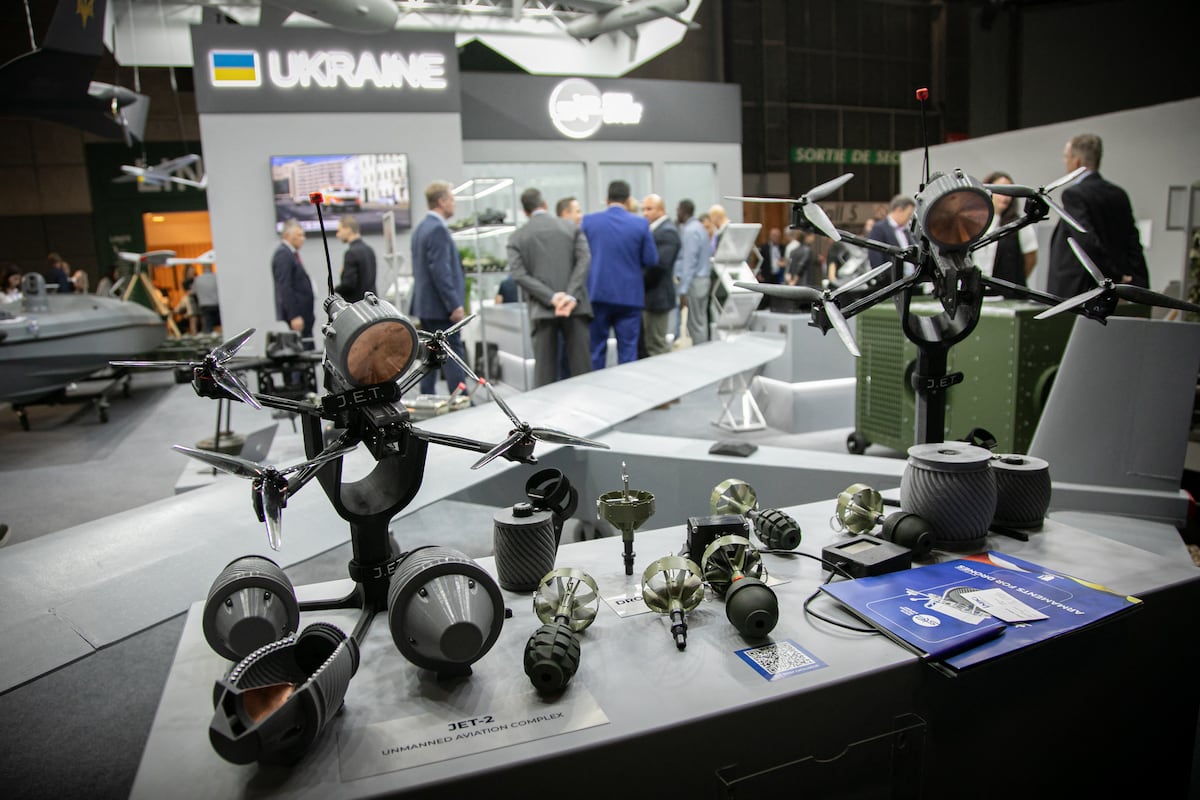
PARIS — It’s a head-scratcher for European governments: getting their defense industries ready to pump out hundreds of thousands of drones or other pieces of armament in case of possible war, without ending up with warehouses full of obsolete kit.
Europe has yet to resolve the conundrum, said Francois Arbault, the European Commission’s director for defense industry, at the Forum Innovation Défense in Paris last week.
“How can we be ready, in that we’re ready to embrace the scale that it takes to be at war, or in a conflict of whatever sort, without actually piling up equipment?” Arbault said. “That’s probably one of the most core questions that we need to be able to answer today. How is it to be defense-ready, when you are not yet at war?”
European leaders have been reluctant to adopt the dramatic rhetoric of French President Emmanuel Macron, who called for a shift to a “war economy” several months after Russia’s invasion of Ukraine in 2022. And while all European NATO members have lifted defense spending, none have retooled their economy to prioritize the war effort – France included.
Ukraine has something “essential and different from us, and that is they have a need to survive,” said Jérôme Cerisier, the chief executive officer of French night-vision equipment maker Exosens, speaking on a panel about future industry and the war economy. “We’re not as confronted as they are by the need to go very, very fast.”
Ukraine as a country at war “has no choice but to frantically scramble” to develop counters and offensive edges, and the same war mode cannot be expected from European countries, the European Commission’s Arbault said.
“But we have to be ready,” Arbault said. “And we see that innovation is going so fast that readiness doesn’t mean piling up thousand or hundreds of thousands of drones in a warehouse, because if one day we’re attacked, those drones will for sure be totally obsolete.”
The drone-development cycle in Ukraine is around eight to ten weeks, while product development in Western Europe is counted in months or years, according to André Loesekrug-Pietri, chairman of the Joint European Disruptive Initiative, a non-governmental organization looking to accelerate European innovation, who cited a recent visit to the country.
A way to circumvent the equipment stockpiling dynamic is having industrial and technological building blocks and components available “from which we’re going to make lots of possible systems,” said Marie Nicod, general partner at investment firm Jolt Capital. “From there, we have a mass of things, but which are not immobilized stock, and which will be used for many different use cases.”
Exosens has been scaling up its production capacity for drone cameras “little by little” in order to be ready to react quickly should the need arise, without taking too much initial risk, Cerisier said.
“We really need to talk about the war economy not necessarily in terms of implementation, but already in terms of preparation,” Cerisier said. He said companies need not just orders but also visibility on future demand to justify investments, something France’s military budget programming can bring.
The defense industry should prepare for a larger conflict by training scenarios of accelerated production to see where processes break down and to identify bottlenecks, said Sylvain Rousseau, CEO of Aresia, which makes aerospace equipment including weapon-release systems for aircraft.
“What’s stopping us from tripling our capacity, maybe it’s just a single machine, maybe just one piece of technology,” Rousseau said.
The European Union in March 2024 presented its first defense-industrial strategy, calling for “defense industrial readiness,” with then-European Commissioner Thierry Breton saying a few months later the European defense industries need to “move into a war economy mode ,” one of the rare instances of the term being used at a European level.
Some European governments other than France have recently been pushing the industrial aspect of defense, with Dutch Defence Minister Ruben Brekelmans in March saying the war in Ukraine has become a war between industries, calling a strong defense industry “the backbone of our security.”
Sweden in June announced a new defense-industry strategy that specifically mentioned a goal of high production capacity.
Meanwhile, Polish Prime Minister Donald Tusk said in March that Russia has started an arms race that Europe must win.
The comparison with Russia is problematic, because that country is at war “and that’s not the case for us,” said Olivier Lecointe, in charge of industrial policy at France’s Directorate General for Armament. While speeding up production is part of getting industry war-ready, France isn’t going to build stocks to last through a war, as use would be uncertain and stocks would expire.
“So what matters is ensuring that the industry is able to produce,” Lecointe said. “You can’t go from a few thousand to hundreds of thousands at the snap of your fingers. You have to renovate production facilities, buy machines, hire people. And that, of course, requires investment.”
The defense industry still has many old machines in operation that remain useful, but production rates would be higher with modern tools, according to Lecointe.
“We could obviously imagine putting in place budgets to purchase production capacity, but if we purchase production capacity and then orders don’t come in, it’s actually money down the drain,” Lecointe said. “In terms of public spending, I think no French citizen would appreciate that.
Machinery is expensive, and solutions will have to be found through the business plan, which comes down to companies receiving increased orders, Lecointe said.
The level of production required for a high-intensity conflict will also mean designing new systems that can be mass-produced, according to Lecointe. He said the DGA is working on this particularly in the field of drones, “but there may be other applications.”
The DGA is working with a few companies to look at how civilian industrial manufacturing lines “not at all designed for this” can be adapted to mass produce something else by modifying only a few tools, according to Lecointe. The directorate then acts as a go-between with the weapons industry, which provides a design that can be modified to become mass-producible.
“At some point, we will certainly sign a contract to test it, but again, before buying tens of thousands, we will need the budgets,” Lecointe said. “The goal in this case is to be ready for the day when the crisis level justifies placing this kind of order – today we are not there yet – but we will be able to press the button and start production.”
Shifting civilian manufacturing lines to military production “comes at a huge cost,” which raises the question who will pay for the preparation, which entails significant risk as long as there are no orders, according to Rousseau at Aresia.
While some companies may be willing to take on some of that risk, they will need financial support to prepare for “more significant scenarios,” as the economics won’t motivate firms to sacrifice production capacity for military purposes, according to Rousseau.
Lecointe said that while there are opportunities for automotive suppliers as defense subcontractors to help scale up arms manufacturing, car-industry volumes are typically tens of thousands of vehicles per year, whereas production of for example Caesar cannons is counted in dozens.
“We’re not at all on the same economic models, on the same volumes,” Lecointe said. “So we have to be realistic about what we’re talking about.”
Armed forces are increasingly willing to test new equipment, similar to how Ukraine tests material on the battlefield, according to Lecointe, who said that clashes with some of the habits of France’s defense-capacity programming. He said the testing feedback loop between users and manufacturers needs to become “much faster.”
“Today, we are no longer in a context where we fire a missile once every 10 years. If we are preparing for a high-intensity war, it is not the same thing at all, and so we need to find new ways of working and dialoguing with industry on equipment.”
Rudy Ruitenberg is a Europe correspondent for Defense News. He started his career at Bloomberg News and has experience reporting on technology, commodity markets and politics.
巴黎——对于欧洲各国政府来说,这是一个令人费解的问题:如何在可能发生的战争中,让国防工业做好准备,生产数十万架无人机或其他武器装备,同时又不至于让仓库里堆满过时的装备。
欧盟委员会国防工业主管弗朗索瓦·阿尔博上周在巴黎举行的国防创新论坛上表示,欧洲尚未解决这一难题。
“我们如何在不实际囤积大量装备的情况下,做好应对战争或任何形式冲突所需规模的准备?”阿尔博说,“这或许是我们今天最需要解答的核心问题之一。在尚未开战的情况下,如何才能做好防御准备?”
欧洲领导人一直不愿采纳法国总统马克龙的激烈言辞。马克龙在2022年俄罗斯入侵乌克兰几个月后,呼吁转向“战时经济”。尽管所有欧洲北约成员国都增加了国防开支,但没有一个国家调整经济结构以优先考虑战争——法国也不例外。
法国夜视设备制造商Exosens的首席执行官杰罗姆·塞里西耶在一次关于未来产业和战争经济的小组讨论中表示:“乌克兰与我们有着本质的不同,那就是他们需要生存。我们不像他们那样面临着必须快速发展的压力。”
欧盟委员会的阿尔博表示,乌克兰作为一个处于战争状态的国家“别无选择,只能疯狂地争先恐后地发展反击和进攻手段”,不能指望欧洲国家采取同样的战争模式。
“但我们必须做好准备,”阿尔博说。“我们看到创新发展如此迅速,做好准备并不意味着在仓库里堆积成千上万架无人机,因为如果有一天我们遭到攻击,这些无人机肯定会完全过时。”
据致力于加速欧洲创新的非政府组织“欧洲联合颠覆性倡议”主席安德烈·洛塞克鲁格-皮特里 (André Loesekrug-Pietri) 称,乌克兰的无人机研发周期约为八到十周,而西欧的产品研发周期则以月或年计算。他最近访问了乌克兰,并表示乌克兰的无人机研发周期约为八到十周。
投资公司Jolt Capital的普通合伙人玛丽·尼科德表示,规避设备囤积问题的办法是拥有工业和技术基础模块及组件,“我们可以用它们构建许多可能的系统”。“这样一来,我们就拥有了大量的资源,但这些资源并非停滞不前的库存,而是可以用于许多不同的用途。”
塞里西耶表示,Exosens 一直在“逐步”扩大其无人机相机的生产能力,以便在需要时能够迅速做出反应,而不会承担过多的初期风险。
“我们确实需要讨论战时经济,不一定非要从实施层面,而是从准备层面着手,”塞里西耶说道。他表示,企业不仅需要订单,还需要对未来需求的清晰认知才能证明投资的合理性,而法国的军费预算规划恰好可以提供这种清晰的指引。
Aresia公司首席执行官Sylvain Rousseau表示,国防工业应该通过加速生产的训练场景来为更大的冲突做好准备,以了解流程在哪些环节出现问题并找出瓶颈。Aresia公司生产航空航天设备,包括飞机武器投放系统。
“是什么阻止我们将产能提高三倍呢?也许只是一台机器,也许只是一项技术,”卢梭说道。
2024 年 3 月,欧盟提出了首个国防工业战略,呼吁“国防工业做好准备”。几个月后,时任欧盟委员会委员蒂埃里·布雷顿表示,欧洲国防工业需要“进入战时经济模式”,这是该术语在欧洲层面极少数被使用的情况之一。
除法国外,一些欧洲国家政府最近一直在推动国防的工业化方面。荷兰国防部长鲁本·布雷克尔曼斯在 3 月份表示,乌克兰战争已经演变成一场工业之间的战争,称强大的国防工业是“我们安全的支柱”。
瑞典在6月份宣布了一项新的国防工业战略,其中特别提到了提高生产能力的目标。
与此同时,波兰总理唐纳德·图斯克在3月份表示,俄罗斯已经发动了一场军备竞赛,欧洲必须赢得这场竞赛。
法国军备总局工业政策负责人奥利维耶·勒孔特表示,将法国与俄罗斯进行比较是有问题的,因为俄罗斯正处于战争状态,“而我们并非如此”。虽然加快生产是使工业做好战时准备的一部分,但法国不会建立足以维持整个战争的库存,因为战争期间的用途尚不明朗,而且库存也会过期。
“所以,关键在于确保这个行业能够正常生产,”勒孔特说。“你不可能一蹴而就地从几千人变成几十万人。你必须翻新生产设施,购买机器,雇佣员工。而这当然需要投资。”
勒孔特表示,国防工业仍然有很多老旧机器在运行,这些机器仍然很有用,但如果使用现代化工具,生产率会更高。
“我们当然可以设想拨出预算来购买生产能力,但如果我们购买了生产能力,却没有订单,那实际上是在白白浪费钱,”勒孔特说。“就公共支出而言,我认为没有哪个法国公民会乐见这种情况。”
勒孔特表示,机械设备价格昂贵,必须通过商业计划来寻找解决方案,而商业计划最终取决于公司能否获得更多的订单。
勒孔特表示,高强度冲突所需的生产水平也意味着需要设计能够大规模生产的新系统。他说,法国国防装备总局(DGA)正在无人机领域开展这方面的工作,“但也可能涉及其他应用”。
据勒孔特称,法国国防采购局(DGA)正与几家公司合作,研究如何通过改造少量工具,将“原本并非为此设计的”民用工业生产线改造为大规模生产其他产品。该局随后将作为中间人与武器工业界对接,由武器工业界提供可进行修改以实现大规模生产的设计方案。
“我们肯定会在某个时候签署测试合同,但同样,在采购数万台之前,我们需要足够的预算,”勒孔特说。“我们的目标是做好准备,一旦危机程度达到可以下达此类订单的水平——目前我们还没到那一步——但我们届时就能按下按钮,开始生产。”
据 Aresia 的 Rousseau 称,将民用生产线转向军用生产“代价巨大”,这就引出了一个问题:谁来为准备工作买单?只要没有订单,准备工作就蕴含着巨大的风险。
卢梭表示,虽然有些公司可能愿意承担部分风险,但它们需要财政支持来应对“更重大的情况”,因为经济因素不会促使企业为了军事目的而牺牲产能。
勒孔特表示,虽然汽车供应商有机会作为国防分包商帮助扩大武器制造规模,但汽车行业的产量通常是每年数万辆,而例如凯撒大炮的产量则以几十辆计。
勒孔特说:“我们的经济模式和业务量完全不同,所以我们必须对我们所讨论的内容保持务实的态度。”
勒孔特表示,武装部队越来越愿意测试新装备,类似于乌克兰在战场上测试装备的方式。但他同时指出,这与法国国防能力规划的一些做法存在冲突。他认为,用户和制造商之间的测试反馈机制需要“大幅加快”。
“如今,我们不再处于每十年才发射一次导弹的时代。如果我们准备应对一场高强度战争,情况就完全不同了,因此我们需要找到与工业界就装备问题开展合作和对话的新方法。”
鲁迪·鲁伊滕贝格是《防务新闻》的欧洲记者。他的职业生涯始于彭博新闻社,拥有报道科技、大宗商品市场和政治方面的经验。