Trump appointees asked a federal cybersecurity agency to secretly hack a voting machine特朗普任命的官员要求联邦网络安全机构秘密入侵一台投票机。
The request shocked staffers, who feared they were being asked to take part in political interference.
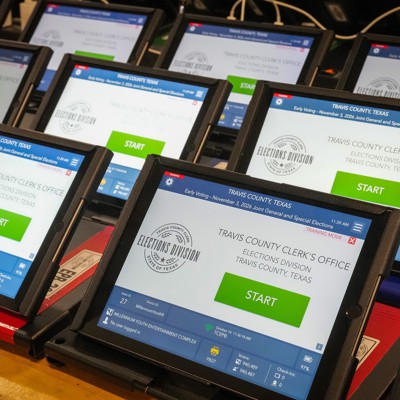
Electronic poll books are prepared at the Travis County Clerk's Office on Oct. 14, 2026, in Austin, Texas. Jay Janner/The Austin American-Statesman via Getty Images
The request shocked staffers, who feared they were being asked to take part in political interference.
Andy Mannix and Doug Bock Clark , ProPublica
A few months into President Donald Trump’s second term, political appointees at the Department of Homeland Security made an unusual request of its agency focused on cybersecurity: Secretly acquire a voting machine and hack it.
The appointees wanted the Cybersecurity and Infrastructure Security Agency to procure the machine, examine it and report back the findings so they could be given to the White House, according to two former administration officials with knowledge of the request.
The proposition was shocking to CISA’s career staffers, according to one of the former officials. CISA typically worked to thwart hackers. Moreover, the agency had been directed not to alert the voting machine company if it uncovered flaws, contrary to its standard practices. The request made the CISA employees fear they were being asked to take part in political interference.
“My thought was they could keep it in their back pocket to invalidate any [election] results they don’t like,” one of the former officials said. “This goes against everything CISA represents.”
The CISA employees repeatedly told the political appointees that their request was impossible, in part because the agents capable of pulling off such an operation had just been laid off by Elon Musk’s Department of Government Efficiency initiative. The appointees eventually stopped pressing CISA.
Though not acted on, the request shows how the Trump administration has tried to use the agency for its own ends while draining it of resources for one of its critical missions: protecting the nation’s voting systems.
In Trump’s second term, his administration has laid off or pushed out more than 1,000 CISA employees, shrinking the agency by about one-third. The president’s 2027 budget proposal would reduce funding for the agency by another $700 million, which could necessitate 900 additional layoffs.
In response, Democratic lawmakers have called for an investigation into CISA’s ability to do its job and demanded answers as to why federal funds are not being used to support election security as directed by Congress.
Since Trump signed the CISA Act in 2018, the agency has worked with state authorities and voting machine vendors to help protect election infrastructure from cyberattacks. During Trump’s second term, though, CISA has abandoned much of this work. Several state election authorities said the agency provided them no assistance — and no explanation for its absence — during the most critical planning stages for the upcoming midterms.
“There is a difference between deprioritizing and being nonexistent,” said Ryan Macias, an election technology and cybersecurity expert who has worked as a consultant for CISA. In 2025 and through mid-September 2026 — when the bulk of preparations for the election typically would have been completed — “they were nonexistent. Literally nonexistent.”
While Trump has repeatedly warned that America’s elections are vulnerable to hacking, in some cases repeating disproven claims, experts said his administration is undermining the federal government’s role in helping secure them.
Though CISA re-emerged in September with a last-minute security plan for the election, some state officials told ProPublica they fear that what is left of the agency has been compromised by a conspiracy-obsessed presidential administration. In recent months, in reviving debunked theories about the 2020 election, the Trump administration has declassified troves of records, including sensitive material that state officials provided to CISA. Some state authorities said they no longer trusted the administration enough to share information with CISA, a key to the agency’s success in past elections.
“They’ve violated the entire premise of that information-sharing relationship,” said one former high-ranking federal cybersecurity official who now advises state governments on national security. “There’s no fucking way they’re ever going to give any information to CISA. And it’s unclear if they ever will in the future.”
A spokesperson for the White House declined an interview request but defended Trump’s handling of election security in an emailed statement. “President Trump has done more than any other President to ensure we have free and fair elections,” said Lauren Bis.
Bis referred specific questions about CISA’s handling of elections to DHS. DHS and CISA did not respond to interview requests or to a detailed list of questions.
Current and former CISA employees and state election officials describe an agency that has become significantly less equipped to help states fight legitimate cyber threats. State leaders say they have used their own resources to shore up gaps left by CISA, such as paying for sensor technology that can detect unusual activity in election networks. But some services, like intel on foreign actors, can’t be replicated. Some people interviewed said they were worried that Trump and his allies continue to ratchet up rhetoric about voting security, particularly about threats to voting machines. Officials in one large voting jurisdiction said they have met privately with machine vendors to come up with a contingency plan if the federal government seizes their machines or declares them unusable.
“I don’t pay attention to what the president says. I pay attention to what his administration does,” Arizona Secretary of State Adrian Fontes said. “And what they’ve done is basically cut us off and left us on our own.”
Defending elections from hackers wasn’t always part of DHS’s remit.
Throughout the mid-1990s and 2000s, a series of cyberattacks rocked the federal government, demonstrating the emerging threat. In 2007, hackers broke into the Pentagon and stole terabytes of sensitive data. The digital heist, by an unknown foreign adversary, was so damaging that one intelligence leader later described it as an “espionage Pearl Harbor.”
Under George W. Bush, DHS underwent a reorganization to more effectively combat terrorism and respond to disasters like Hurricane Katrina. The department dedicated resources under an office called the National Protection and Programs Directorate to help fortify advanced cyber defense systems and important infrastructure. The office’s work ranged from helping secure events like the Super Bowl to protecting chemical plants to issuing cybersecurity warnings to the private sector and the public. In 2018, Trump signed a bill making the office a stand-alone agency, allowing for more federal funding and transforming it into, essentially, the ultimate tech support desk for anything DHS designated “critical infrastructure.” The bill renamed the agency CISA.
Though Trump helped create CISA, he didn’t much appreciate the work the agency did under its old name to expose the extent of Russia’s meddling in the 2016 presidential election. Russian agents had unleashed a massive disinformation campaign, with a Kremlin-backed troll farm creating thousands of social media accounts posing as Americans and promoting Trump, according to bipartisan reports from the U.S. Senate Select Committee on Intelligence released before the 2020 election. A dozen Russian military agents were indicted for what the Justice Department described as “a sustained effort to hack into the computer networks of the Democratic Congressional Campaign Committee, the Democratic National Committee, and the presidential campaign of Hillary Clinton.”
Trump publicly downplayed this interference, but DHS leadership saw the Russia attack as an escalation. In January 2017, before Trump took office, DHS upgraded America’s elections to the status of critical infrastructure. This placed the polls and all voting technology used in federal elections under the watch of what would soon become CISA.
To carry out this function, CISA needed help. But states and voting machine vendors were wary about sharing data on weaknesses in voting systems, fearing it could be exploited if certain details were to become public. State officials were also reluctant to cede any role in election preparation to the federal government.
Gradually, though, CISA and state election officials negotiated a fragile trust. At its center was a commitment: The sensitive information states and vendors shared with CISA would be kept confidential.
“It took years and years of building trust, of talking to election officials, of hiring people with elections experience who could be validators for the work that CISA wanted to do, before they finally built strong working relationships,” said Derek Tisler, who specializes in election security as counsel for the nonprofit Brennan Center for Justice, a nonpartisan institute based out of New York University School of Law.
Under Director Chris Krebs, CISA hosted penetration testing in which its agents would try to hack into a state’s system to locate weaknesses that could then be patched, along with tabletop exercises simulating a series of potential catastrophes around elections. CISA also offered regular secret-level briefings to secretaries of state to share federal intelligence. And CISA paid for sensor technology that looked for potential malicious online activity on election networks, notifying officials about emerging threats.
“The staffing was there, the expertise was there, the visibility was there, the funding was there,” Macias said.
The consortium shared data as run of the mill as spambots as well as more serious threats. If Virginia caught unusual activity in its system, it could let other states know to be vigilant.
While CISA had prepared for attacks from the Chinese and Russian governments, or lone wolf hackers, few there had expected the threat to elections would come from inside the White House. But when Trump refused to concede to Joe Biden in 2020, claiming the vote had been rigged, CISA became a key component of the guardrails that ultimately led to the election results being certified.
The agency, in a statement co-signed by secretaries of state and voting machine vendors, vouched for the election’s integrity, calling it “the most secure in American history.” When Krebs publicly rebutted claims amplified by the White House as “unsubstantiated” or “technically incoherent,” Trump fired him over Twitter.
As Congress prepared to vote on certifying the election results, it was members of CISA, along with the FBI, who convinced then-Attorney General Bill Barr that the conspiracy theories embraced by the president could be explained by human error, not systemic fraud or hacking.
When Trump returned to the White House in January 2025, his administration immediately started to dismantle CISA. The administrative notices were sent out just a couple of weeks after the inauguration and included the team in charge of dispelling disinformation.
For the employees under the DOGE microscope, work became impossible, said one former senior CISA employee. “Those groups couldn’t even order a pizza.”
DOGE laid off people critical to the agency’s election work, including those who’d worked closely with states. The Trump administration cut funding for the technology that monitored web and election servers, blinding the federal government to breaches it had detected.
When it came time for states to prepare for the 2026 midterms, CISA had disappeared.
On the evening of July 16, in the Black Hills of South Dakota, dozens of election officials and their staffs gathered for a reception near Mount Rushmore. It was the third night of an annual conference for secretaries of state, drawing participants from red and blue states. They’d spent the week discussing state voter roll maintenance and voter ID — issues that at times made for disagreements.
At about 8 p.m., a wave of discomfort swept through the crowd, visible on attendees’ faces as they glanced frequently at their phones, according to people at the event. Any minute now, Trump was going to address the nation on election security. Some at the reception worried he would declare a national emergency, as his allies had urged him to do months earlier, and use it as a pretext to direct the government to seize voting machines.
Then reports on the speech began rolling in, and the mood shifted. The claims Trump was making were unsubstantiated and outlandish. Many had been examined ad nauseam, including by those at the reception, and roundly debunked. The collective anxiety that was palpable moments earlier melted away, as many saw the speech as another attempt to revive disproved theories unlikely to be taken seriously by most voters.
“Everyone just sort of guffawed and put their phones away and went to the bar,” recalled Quinn Raymond, co-founder of VoteShield, a nonprofit that works with states to help monitor voter registration data, who was at the event.
Still, if the speech made little impact, records published by the Trump administration to support the president’s claims damaged the already eroding relationship between CISA and state election officials. The material included raw information states had shared with the agency that was supposed to remain private, such as a log of communications from Election Day 2020 detailing activity being monitored in several states.
“It betrayed the trust of all partners who were willing to share information at the time,” said Geoff Hale, who worked on CISA’s elections team from the agency’s inception until last year. Now he specializes in election security at the Center for Democracy & Technology, a nonprofit that advocates for digital and civil rights.
Bis, the White House spokesperson, denied that the Trump administration broke any agreements in releasing the information. “The release of such information is exactly the sort of transparency news organizations should applaud,” she said. Bis also defended Trump’s speech, saying it had been fact-checked “by the agencies whose evidence was released and did not mischaracterize any information.”
Hale and others said the speech was one of several instances demonstrating the Trump administration’s reckless attitude toward sensitive data collected by CISA. Earlier this year, Politico reported that acting CISA Director Madhu Gottumukkala had uploaded records to ChatGPT, even though DHS had barred its employees from using the unsecure program. A CISA spokesperson told Politico that Gottumukkala had been permitted to use the technology for a “short-term and limited” basis.
Last May, an independent journalist named Brian Krebs exposed that CISA published private data, including passwords, cloud keys and other information, on its public GitHub page, in a folder labeled “Private-CISA.” A CISA spokesperson told the journalist there was no indication that sensitive data was compromised.
Some state election authorities were also alarmed to see the lengths to which the Trump administration went to legitimize the president’s fixation on the 2020 race.
In fall 2025, Missouri election officials produced a memo stating Andrew McCoy Warner, a Department of Justice official and prominent 2020 election conspiracy theorist, had called several clerks asking for access to voting machines . Tulsi Gabbard, then the director of national intelligence, had also led an operation in Puerto Rico to seize election machines. When the private cybersecurity contractor hired to examine the machines, Mojave Research Inc., failed to find evidence supporting claims about 2020, the federal government became “dissastified” with its services and stopped renewing its contract, its CEO later told reporters.
A spokesperson for the Office of the Director of National Intelligence told reporters in August that Mojave’s work ceased because it had completed its contract. Testifying before Congress in March, Gabbard said the seizing of voting machines came at the request of an assistant U.S. attorney in Puerto Rico.
“What happened in the second Trump administration is from almost day one — I mean, literally the first two months — they took all that was built up by Trump 1 and just decimated it,” said David Becker, founder of the nonpartisan Center for Election Innovation and Research, a nonprofit that works with state election authorities. “Election officials lost trust in the federal government.”
It didn’t help that, in his speech, the president mocked CISA’s defense of the 2020 election, calling the statement about it being the most secure in history a “very pat line” concocted as part of a deep-state cover-up. One former career CISA employee described being crestfallen at the Trump administration’s erosion of all they’d accomplished.
“We worked so hard to build that trusted relationship,” said Caitlin Durkovich, former DHS assistant secretary for infrastructure protection and co-founder of the cybersecurity firm Civira Partners. “I don’t know how you put it back together.”
A few weeks after Trump’s speech, the state election officials gathered once more, this time for a video call with Nick Andersen, who had replaced Gottumukkala as CISA’s acting director.
Though the primaries were already under way, this was the first time many had met Andersen, a former cybersecurity adviser to Trump’s White House who had joined CISA a year earlier. Andersen is also a district representative for the Republican Party in Virginia, according to the party’s website. In March, he gave a speech to the Fairfax GOP chapter titled “Fighting Democrat Redistricting.”
Speaking over video in August, the boyish-faced former Marine Corps engineer announced that DHS was preparing to release a plan on how it would work together with state officials to secure the election, according to five people who were present at the video meeting, some of whom shared notes with ProPublica.
Many on the call were stunned at what they perceived as a lack of understanding of election planning. Early voting for the general election was just around the corner. They had spent over a year preparing for the midterms, and there was no more time for ambitious work.
Some peppered Andersen with questions: Where had CISA been when there was still time to make improvements?
Andersen blamed any lapses or perceived breaches in trust on the federal government shutdown in fall 2025, twirling his pen uncomfortably and sipping from a Monster energy drink.
Fontes, Arizona’s secretary of state, was blunt about his feelings regarding working with Andersen and CISA, according to several of the people on the call.
“I told him I didn’t trust him,” Fontes recalled in an interview. “I did raise my voice a little bit, because I’m frustrated — very frustrated — that they would have the temerity to come in, clear the entire deck of competent professionals, stop supporting the states, eviscerate the coordination efforts that they had and then suddenly come in and say: ‘Oh, we’re from the federal government. We’re here to help.’”
Indeed, one recently departed CISA official said attempting to do the agency’s typical election work now would be futile. In previous years, CISA had finished almost all its preparations with the states by Labor Day.
“That ship has sailed,” the official said.
CISA published its security plan for the 2026 election on Sept. 24. The 13-page document describes how, over the past two years, CISA has “recommitted to its statutory mission and remains resolute in strengthening the security of elections.”
State officials said their planning will ensure a secure election, even without help from CISA. Yet they and cybersecurity experts worry that Trump will say the election was hacked if Republicans don’t win in November.
The security plan calls for “leveraging collaborative partnerships” with states the agency has abandoned since Trump took office. Shenna Bellows, Maine’s secretary of state, said she’d welcome that but was skeptical of the agency’s motivations.
“For CISA to promise election officials now, at this point in time, that they are going to be a resource for the 2026 election is too little, too late,” she said.
Jen Fifield contributed reporting. Mariam Elba contributed research.
NEXT STORY: Hundreds of federal websites lack key defense against spies, senator says
2026年10月14日,在德克萨斯州奥斯汀市特拉维斯县书记官办公室,工作人员正在准备电子投票簿。图片来源:Jay Janner/The Austin American-Statesman via Getty Images
这一要求令工作人员感到震惊,他们担心自己被要求参与政治干预。
安迪·曼尼克斯和道格·博克·克拉克,ProPublica
在唐纳德·特朗普总统第二个任期开始几个月后,国土安全部的政治任命官员向其专注于网络安全的机构提出了一项不同寻常的要求:秘密获取一台投票机并将其入侵。
据两位了解此事的政府前官员透露,这些被任命者希望网络安全和基础设施安全局采购这台机器,对其进行检查,并将检查结果报告给白宫。
据一位前官员透露,这一提议令CISA的资深员工感到震惊。CISA通常致力于阻止黑客攻击。此外,该机构还被指示,如果发现投票机系统存在漏洞,不得通知投票机公司,这与CISA的惯例相悖。这一要求让CISA员工担心他们被要求参与政治干预。
一位前官员表示:“我的想法是,他们可以把这项技术留着,用来否决任何他们不喜欢的选举结果。这完全违背了网络安全和基础设施安全局(CISA)的宗旨。”
CISA员工多次告知这些政治任命官员,他们的请求不可能实现,部分原因是能够执行此类行动的特工刚刚被埃隆·马斯克的政府效率提升计划解雇。最终,这些任命官员停止了向CISA施压。
虽然没有得到回应,但这一请求表明,特朗普政府是如何试图利用该机构达到自身目的,同时又耗尽其资源来执行一项关键任务:保护国家的投票系统。
在特朗普的第二个任期内,他的政府已经裁减或解雇了超过1000名网络安全和基础设施安全局(CISA)员工,使该机构规模缩减了约三分之一。总统提出的2027财年预算案将再次削减该机构7亿美元的预算,这可能导致额外900人失业。
对此,民主党议员呼吁对网络安全和基础设施安全局 (CISA) 履行职责的能力进行调查,并要求解释为什么联邦资金没有按照国会的指示用于支持选举安全。
自特朗普2018年签署《网络安全和基础设施安全局法案》(CISA法案)以来,该机构一直与各州政府和投票机供应商合作,帮助保护选举基础设施免受网络攻击。然而,在特朗普的第二个任期内,CISA放弃了大部分相关工作。多个州选举机构表示,在即将到来的中期选举最关键的筹备阶段,CISA没有向他们提供任何帮助,也没有解释其缺席的原因。
“降低优先级和完全不存在之间是有区别的,”曾担任美国网络安全和基础设施安全局 (CISA) 顾问的选举技术和网络安全专家瑞安·马西亚斯 (Ryan Macias) 说。在 2025 年以及 2026 年 9 月中旬——通常情况下,大部分选举准备工作应该已经完成——“他们完全不存在。真的完全不存在。”
尽管特朗普一再警告美国选举容易受到黑客攻击,在某些情况下甚至重复已被证伪的说法,但专家表示,他的政府正在削弱联邦政府在保障选举安全方面的作用。
尽管网络安全和基础设施安全局(CISA)在9月份重新出现,并制定了一项针对大选的紧急安全计划,但一些州官员告诉ProPublica,他们担心该机构残存的力量已被一个痴迷于阴谋论的总统政府所削弱。近几个月来,特朗普政府为了重提已被证伪的2020年大选阴谋论,解密了大量记录,其中包括州官员提供给CISA的敏感材料。一些州官员表示,他们不再信任特朗普政府,不再愿意与CISA分享信息——而这正是该机构在以往选举中取得成功的关键。
一位曾任联邦高级网络安全官员、现为州政府提供国家安全咨询的人士表示:“他们完全违背了信息共享关系的前提。他们绝不会向网络安全和基础设施安全局(CISA)提供任何信息。而且,他们未来是否会提供信息也尚不明确。”
白宫发言人拒绝了采访请求,但在一份电子邮件声明中为特朗普处理选举安全问题的方式进行了辩护。“特朗普总统为确保我们拥有自由公正的选举所做的工作比任何一位总统都多,”劳伦·比斯说。
Bis将有关CISA处理选举的具体问题转给了国土安全部。国土安全部和CISA均未回应采访请求或详细的问题清单。
现任和前任CISA员工以及州选举官员表示,该机构在帮助各州应对合法网络威胁方面的能力已显著下降。州领导人表示,他们已动用自身资源来弥补CISA留下的漏洞,例如付费购买能够检测选举网络中异常活动的传感器技术。但有些服务,例如有关外国行为者的情报,是无法复制的。一些受访者表示,他们担心特朗普及其盟友会继续加大对投票安全的宣传力度,尤其是对投票机所受威胁的宣传。一个大型选区的官员表示,他们已与机器供应商私下会面,制定应急预案,以应对联邦政府扣押或宣布其机器无法使用的情况。
“我不关注总统说了什么,我只关注他的政府做了什么,”亚利桑那州州务卿阿德里安·丰特斯说。“而他们所做的,基本上就是切断了我们的联系,让我们自生自灭。”
保护选举免受黑客攻击并非国土安全部一直以来的职责范围。
在20世纪90年代中期和21世纪初,一系列网络攻击撼动了美国联邦政府,凸显了网络威胁的日益严峻。2007年,黑客入侵五角大楼,窃取了数TB的敏感数据。这次由身份不明的外国敌对势力实施的数字窃取行动破坏性极大,以至于一位情报官员后来将其比作“间谍版的珍珠港事件”。
在乔治·W·布什执政期间,国土安全部进行了重组,以更有效地打击恐怖主义并应对诸如卡特里娜飓风之类的灾难。该部门设立了一个名为“国家保护与项目局”的办公室,专门负责加强先进的网络防御系统和重要基础设施。该办公室的工作范围广泛,从协助保障超级碗等大型活动的安全,到保护化工厂,再到向私营部门和公众发布网络安全警告。2018年,特朗普签署了一项法案,将该办公室设立为一个独立的机构,从而获得更多联邦资金,并将其转变为国土安全部指定的“关键基础设施”的终极技术支持中心。该法案将该机构更名为“网络安全和基础设施安全局”(CISA)。
尽管特朗普曾协助创建网络安全和基础设施安全局(CISA),但他对该机构以旧名开展的工作——揭露俄罗斯干预2016年总统大选的程度——并不十分赞赏。根据美国参议院情报特别委员会在2020年大选前发布的两党报告,俄罗斯特工发动了一场大规模的虚假信息宣传活动,一个由克里姆林宫支持的“网络水军”创建了数千个冒充美国人的社交媒体账户,为特朗普造势。十几名俄罗斯军事人员因司法部所称的“持续入侵民主党国会竞选委员会、民主党全国委员会以及希拉里·克林顿总统竞选团队的计算机网络”而被起诉。
特朗普公开淡化了此次干预,但国土安全部领导层却将俄罗斯的攻击视为事态升级。2017年1月,在特朗普就职之前,国土安全部将美国选举提升为关键基础设施。这使得联邦选举中使用的投票站和所有投票技术都置于后来成为网络安全和基础设施安全局(CISA)的机构的监管之下。
为了履行这项职责,CISA需要帮助。但各州和投票机供应商对共享投票系统漏洞数据持谨慎态度,担心一旦某些细节公开,就会被人利用。州政府官员也不愿将选举筹备工作的任何角色让渡给联邦政府。
然而,CISA与各州选举官员逐渐建立起一种脆弱的信任。其核心是一项承诺:各州和供应商与CISA共享的敏感信息将严格保密。
“他们花了多年时间建立信任,与选举官员交谈,聘请有选举经验的人员来验证 CISA 想要开展的工作,最终才建立了牢固的工作关系,”德里克·蒂斯勒说道。他是非营利组织布伦南司法中心(一家位于纽约大学法学院的无党派机构)的顾问,专门从事选举安全方面的工作。
在克里斯·克雷布斯担任局长期间,CISA开展了渗透测试,其特工尝试入侵各州的系统,以发现漏洞并进行修复。此外,CISA还组织了桌面演练,模拟选举期间可能发生的各种灾难。CISA还定期向各州州务卿提供秘密级别的简报,分享联邦情报。同时,CISA还出资购置了传感器技术,用于监测选举网络上潜在的恶意网络活动,并及时向官员通报新出现的威胁。
“人员配备到位了,专业知识到位了,知名度到位了,资金也到位了,”马西亚斯说。
该联盟共享的数据既包括常见的垃圾邮件机器人,也包括更严重的威胁。如果弗吉尼亚州在其系统中发现异常活动,它可以通知其他州提高警惕。
尽管美国网络安全和基础设施安全局 (CISA) 已做好应对来自中国和俄罗斯政府或独狼式黑客攻击的准备,但几乎没有人预料到选举威胁会来自白宫内部。然而,当特朗普在 2020 年拒绝承认败选,并声称选举舞弊时,CISA 成为最终确保选举结果得到认证的关键保障措施之一。
该机构在一份由各州州务卿和投票机供应商共同签署的声明中,保证了选举的公正性,称其为“美国历史上最安全的选举”。当克雷布斯公开反驳白宫放大的说法,称其“未经证实”或“技术上不连贯”时,特朗普在推特上解雇了他。
在国会准备投票表决是否认证选举结果之际,正是网络安全和基础设施安全局 (CISA) 的成员以及联邦调查局 (FBI) 说服了当时的司法部长比尔·巴尔,总统所信奉的阴谋论可以用人为错误来解释,而不是系统性欺诈或黑客攻击。
2025年1月特朗普重返白宫后,他的政府立即开始解散网络安全和基础设施安全局(CISA)。行政通知在就职典礼后仅几周就发出,其中包括负责辟谣的团队。
一位前CISA高级员工表示,对于那些受到DOGE严格审查的员工来说,工作变得不可能了。“这些团队甚至连订个披萨都做不到。”
宾夕法尼亚州政府雇员联合会(DOGE)裁减了对该机构选举工作至关重要的员工,其中包括一些与各州密切合作的人员。特朗普政府削减了用于监控网络和选举服务器的技术经费,导致联邦政府对已发现的安全漏洞视而不见。
当各州开始准备 2026 年中期选举时,CISA 却消失了。
7月16日晚,在南达科他州黑山地区,数十名选举官员及其工作人员齐聚拉什莫尔山附近,参加一场招待会。这是州务卿年度会议的第三晚,与会者来自共和党和民主党控制的州。他们用一周的时间讨论了州选民名册维护和选民身份识别等问题——这些问题有时会引发分歧。
晚上8点左右,人群中弥漫着一股不安的气氛,据在场人士透露,与会者不时低头看手机,脸上明显流露出这种不安。特朗普随时可能就选举安全问题向全国发表讲话。一些参加招待会的人担心,他会像几个月前他的盟友敦促的那样,宣布国家进入紧急状态,并以此为借口指示政府没收投票机。
随后,有关特朗普演讲的报道纷至沓来,气氛也随之转变。特朗普的言论毫无根据,荒诞不经。许多说法早已被反复驳斥,包括在场的宾客也进行了驳斥。此前弥漫的集体焦虑瞬间消散,许多人认为这不过是又一次试图重拾已被证伪的理论,而这些理论不太可能被大多数选民认真对待。
“大家都哈哈大笑,然后把手机收起来去了酒吧,”VoteShield 的联合创始人奎因·雷蒙德回忆道,他当时也在现场。VoteShield 是一家与各州合作帮助监测选民登记数据的非营利组织。
尽管总统的讲话影响甚微,但特朗普政府公布的、旨在支持总统言论的记录,却进一步损害了网络安全和基础设施安全局(CISA)与各州选举官员之间本已岌岌可危的关系。这些材料包括各州与该机构分享的、本应保密的原始信息,例如2020年大选日当天记录的通信日志,详细列出了多个州正在接受监控的活动。
“这辜负了当时所有愿意分享信息的合作伙伴的信任,”杰夫·黑尔说道。他从网络安全和基础设施安全局(CISA)成立之初就在该机构的选举团队工作,直到去年。现在,他在民主与技术中心(一家倡导数字权利和公民权利的非营利组织)专门从事选举安全方面的工作。
白宫发言人比斯否认特朗普政府在发布这些信息时违反了任何协议。她说:“发布此类信息正是新闻机构应该赞扬的透明度。”比斯还为特朗普的讲话辩护,称其内容已经过“相关机构的核实,没有歪曲任何信息”。
黑尔等人表示,此次演讲只是特朗普政府对网络安全和基础设施安全局(CISA)收集的敏感数据漠不关心的众多事例之一。今年早些时候,《政客》杂志报道称,CISA代理局长马杜·戈图穆卡拉曾将记录上传至ChatGPT,尽管国土安全部已禁止其员工使用这款不安全的程序。CISA发言人告诉《政客》,戈图穆卡拉获准在“短期和有限”的范围内使用该技术。
去年五月,一位名叫布莱恩·克雷布斯的独立记者曝光,美国网络安全和基础设施安全局(CISA)在其公开的GitHub页面上,将包括密码、云密钥和其他信息在内的私有数据发布在一个名为“Private-CISA”的文件夹中。CISA发言人告诉该记者,没有迹象表明敏感数据遭到泄露。
一些州选举机构也对特朗普政府为使总统对 2020 年大选的执着合法化而采取的种种手段感到震惊。
2025年秋季,密苏里州选举官员出具了一份备忘录,称司法部官员、2020年大选阴谋论的知名人士安德鲁·麦考伊·华纳曾致电多名选举工作人员,要求查看投票机。时任国家情报总监图尔西·加巴德也曾在波多黎各领导了一次行动,扣押了选举机。受雇检查这些机器的私营网络安全承包商莫哈韦研究公司(Mojave Research Inc.)未能找到支持2020年大选阴谋论的证据,该公司首席执行官后来告诉记者,联邦政府对其服务“不满意”,并停止续签合同。
国家情报总监办公室发言人8月份告诉记者,莫哈韦公司停止工作是因为其合同已完成。加巴德3月份在国会作证时表示,扣押投票机是应波多黎各一名助理联邦检察官的要求。
“特朗普第二任期几乎从一开始就毁掉了——我是说,确切地说,是头两个月——他们把特朗普第一任期建立的一切彻底摧毁了,”无党派选举创新与研究中心创始人戴维·贝克尔说道。该中心是一家与各州选举机构合作的非营利组织。“选举官员对联邦政府失去了信任。”
更糟糕的是,总统在演讲中嘲讽了网络安全和基础设施安全局(CISA)对2020年大选的辩护,称其关于此次选举是史上最安全的声明是“老生常谈”,是“深层政府”掩盖真相的伎俩。一位曾在CISA工作多年的资深员工表示,特朗普政府对他们所有努力的破坏感到无比沮丧。
“我们付出了巨大的努力才建立起这种信任关系,”美国国土安全部前基础设施保护助理部长、网络安全公司Civira Partners联合创始人凯特琳·杜尔科维奇说,“我不知道该如何重建这种关系。”
在特朗普发表讲话几周后,该州选举官员再次聚集在一起,这次是与接替戈图穆卡拉担任CISA代理主任的尼克·安德森进行视频通话。
尽管初选已经开始,但这是许多人第一次见到安德森。安德森曾是特朗普白宫的网络安全顾问,一年前加入网络安全和基础设施安全局(CISA)。据共和党网站显示,安德森还是弗吉尼亚州共和党的地区代表。今年3月,他曾在费尔法克斯共和党分部发表题为“反对民主党重新划分选区”的演讲。
据五位参加视频会议的人士透露,这位面容稚嫩的前海军陆战队工程师在八月份通过视频宣布,国土安全部正准备发布一项计划,说明它将如何与州政府官员合作以确保选举安全。其中一些人与 ProPublica 分享了会议记录。
许多与会者对他们认为对方缺乏选举筹备知识感到震惊。大选提前投票即将开始。他们花了超过一年的时间准备中期选举,已经没有时间再进行其他雄心勃勃的工作了。
一些人向安德森抛出一连串问题:在还有时间进行改进的时候,CISA 在哪里?
安德森将任何疏忽或被认为违反信任的行为归咎于 2025 年秋季的联邦政府停摆,他不安地转动着手中的钢笔,一边啜饮着 Monster 能量饮料。
据几位参加电话会议的人士透露,亚利桑那州州务卿丰特斯直言不讳地表达了他对与安达信会计师事务所和网络安全与基础设施安全局 (CISA) 合作的感受。
“我告诉他我不信任他,”丰特斯在一次采访中回忆道。“我的确提高了音量,因为我非常生气——真的非常生气——他们竟然有胆量进来,把所有能干的专业人员都赶走,停止支持各州,破坏他们原有的协调工作,然后突然冒出来说:‘哦,我们是联邦政府派来的。我们是来帮忙的。’”
事实上,一位近期离职的CISA官员表示,现在试图开展该机构以往的选举工作是徒劳的。往年,CISA几乎在劳动节前就与各州完成了所有准备工作。
“那件事已经过去了,”这位官员说。
CISA 于 9 月 24 日发布了其 2026 年大选安全计划。这份 13 页的文件描述了 CISA 在过去两年中如何“重申其法定使命,并坚定不移地加强选举安全”。
州政府官员表示,即使没有网络安全和基础设施安全局 (CISA) 的帮助,他们的计划也能确保选举安全。然而,他们和网络安全专家都担心,如果共和党在11月的大选中落败,特朗普会声称选举遭到黑客攻击。
该安全计划呼吁与自特朗普上任以来该机构已放弃合作的各州“建立合作关系”。缅因州州务卿申娜·贝洛斯表示,她对此表示欢迎,但对该机构的动机持怀疑态度。
她说:“对于CISA来说,在这个时候向选举官员承诺,他们将成为2026年大选的资源,这太少也太迟了。”
Jen Fifield参与了报道。Mariam Elba参与了研究。
下一篇报道:参议员称数百个联邦网站缺乏关键的防间谍防御措施