More enhanced community health posts across the island to bring health services closer to seniors在全岛范围内增设更多社区卫生站,以便为老年人提供更便捷的医疗服务。
Singapore enhances community health posts to bring basic health services closer to seniors as the nation becomes super-aged. Read more at straitstimes.com.
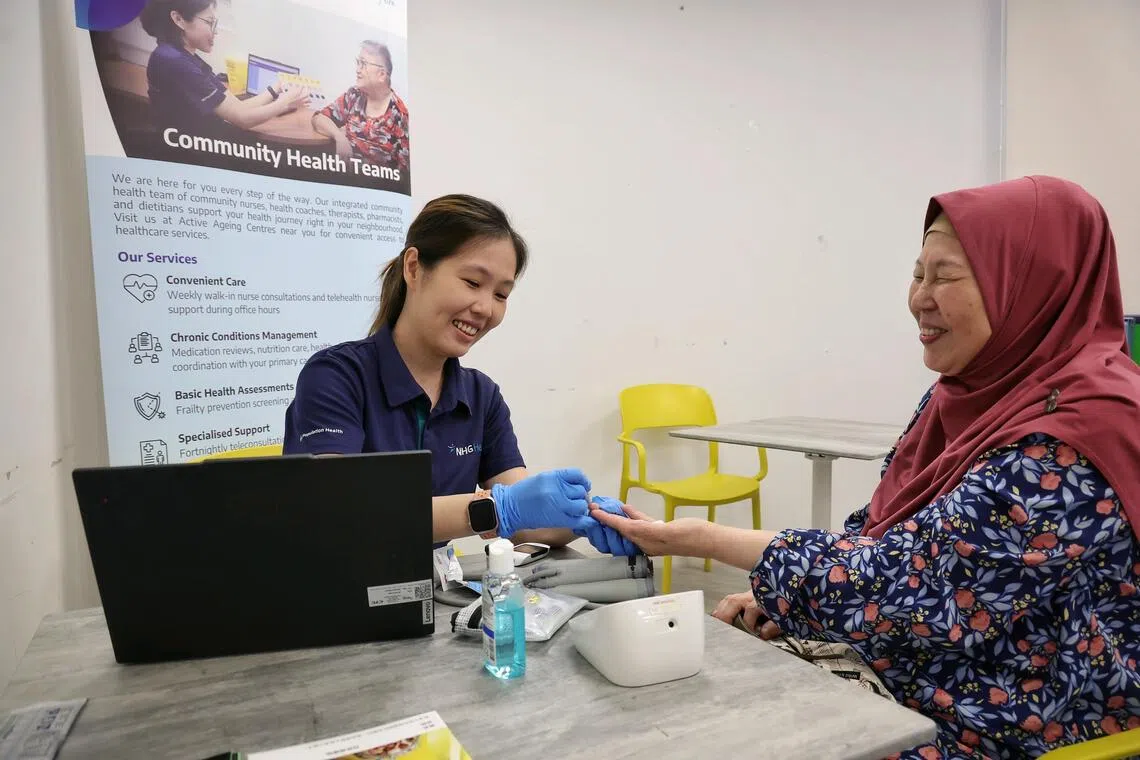
Seow Mei Poh (left), NHG Health’s senior staff nurse, said her work involves making seniors aware of the healthcare services available to them.
Published Nov 01, 2026, 05:00 AM
Updated Nov 01, 2026, 05:00 AM
Singapore is expanding community health posts as it becomes a super-aged society, with 21.4% of people aged 65 or older, according to the Population in Brief report.
NHG Health, SingHealth and NUHS have upgraded services at many posts, adding frailty screening, telehealth, medication reviews and weekly walk-ins closer to seniors.
Officials said the aim is to manage chronic illness earlier, support healthy ageing and reduce hospital demand, with more enhanced posts planned by March 2027.
SINGAPORE - As Singapore enters super-aged status, community health posts around the island are enhancing their services to better meet the needs of its rapidly ageing population.
Singapore’s three public health clusters – the National University Health System, NHG Health and SingHealth – have upgraded services at 35 such posts in 2026, with more to be enhanced by 2027.
Community health posts are neighbourhood spaces where residents can access personalised health coaching and chronic disease management just a few minutes from home. Enhanced services include caregiver support and post-discharge follow up.
The boost comes as Singapore officially crossed over into becoming a super-aged society in 2026, with 21.4% of Singaporeans now aged 65 or older, according to the latest Population in Brief report by the National Population and Talent Division.
Located within community spaces such as active ageing centres (AACs) and places of worship, community health posts aim to provide access to basic health services closer to seniors.
In October last year Health Minister Ong Ye Kung announced that these posts would offer enhanced services from 2026 – including frailty screening and telehealth consultations – beginning with those in the north of Singapore.
NHG Health, which oversees central and north Singapore, said it enhanced services at 27 such posts at AACs across four towns – Woodlands, Sembawang, Yishun and Toa Payoh.
By March 2027, another 12 posts in these four neighbourhoods will be enhanced.
These posts now operate on a weekly basis, compared to a monthly arrangement previously, offering basic health assessments as well as support for preventive health and disease management, including health coaching and medication reviews.
SingHealth meanwhile said it had introduced five enhanced community health posts, located within AACs in Bedok and Tiong Bahru-Redhill.
In May the two areas were announced as Age Well Neighbourhoods - where enhanced care services and senior-friendly infrastructure are introduced in towns with more seniors.
SingHealth deputy group chief executive of its regional health system Lee Chien Earn told ST services at these enhanced posts include onsite medication collection, teleconsultations with doctors from SingHealth Polyclinics and medication review with community nurses.
The posts will also offer community pharmacy and nutrition services, in addition to existing services such as weight management and smoking cessation counselling, he added.
“All enhanced community health posts are open at least once a week and will continue to accept walk-in requests from residents,” he said.
Lee noted that SingHealth currently has more than 150 such posts within AACs, as well as other accessible locations such as community centres and places of worship.
“To date, our SingHealth community health posts have seen approximately 58,800 unique residents for chronic conditions such as frailty, cognitive decline, diabetes mellitus, hypertension and hyperlipidaemia,” he added.
Together with its partners, SingHealth is constantly evaluating and exploring new sites and services to be provided by such posts, he added.
The National University Health System (NUHS) said it had been progressively rolling out its enhanced community health posts since May, with three such sites at AACs in Bukit Panjang, which was also identified as an Age Well Neighbourhood in May.
Another four CHP sites will be enhanced by end-March 2027, the NUHS spokesperson said.
Enhanced services at these posts include “structured care bundles” tailored to the individual needs of residents, packaging services such as frailty and chronic management together with health talks and lifestyle coaching.
Early indicators are encouraging, with increased attendance and walk-ins observed at the enhanced community health posts, the spokesperson added.
NHG Health population health chief operating officer Ong Jing Fang said different towns require different approaches and interventions, adding her cluster looks at the demographics and health profiles of each town to see what their health needs are.
“In parts of the north, for example, we see higher prevalence of diabetes and hypertension and lower levels of physical activity. In a mature estate such as Toa Payoh, healthy ageing, frailty and maintaining independence become increasingly important,” she said.
“The health priorities of the community should determine how we organise our efforts around residents,” she said.
Seow Mei Poh, a community health senior staff nurse with NHG Health, said her work involves making seniors aware of the various avenues for healthcare available to them.
“The AAC staff build a rapport with the seniors and tell them, why not come and see the nurse to share your problems,” said Seow, who works with community health posts in the Toa Payoh area.
This allows the community health nurses to better understand their situation and refer them to the appropriate services when necessary, she said, adding that this in turn allows more issues to be managed within the community, reducing the burden on the tertiary health system.
NHG Health’s Ong said moving healthcare into the community allows for residents to receive support before they become seriously ill, rather than waiting until they need hospital care.
“Ultimately, success is not measured by how many people come into our hospitals. It is measured by how many never need to,” she said.
Zhaki Abdullah is a correspondent at The Straits Times. He is on the health beat, in addition to occasionally covering science, environmental, tech and Muslim affairs issues.
National University Hospital
NHG Health 的高级护士 Seow Mei Poh(左)表示,她的工作包括让老年人了解他们可以获得的医疗保健服务。
发布于 2026 年 11 月 1 日上午 5:00
更新于2026年11月1日上午5:00
根据《人口简报》报告,新加坡正步入超老龄化社会,65 岁及以上人口占 21.4%,因此正在扩大社区卫生站的规模。
新加坡国民健康集团 (NHG Health)、新加坡保健集团 (SingHealth) 和新加坡国立大学健康系统 (NUHS) 已在许多机构升级了服务,增加了老年虚弱筛查、远程医疗、药物审查和每周一次的免预约服务,方便老年人就近就诊。
官员表示,此举旨在更早地控制慢性疾病,支持健康老龄化,并减少对医院的需求,计划到 2027 年 3 月设立更多强化岗位。
新加坡——随着新加坡进入超老龄化时期,岛上各地的社区卫生站正在加强服务,以更好地满足其快速老龄化人口的需求。
新加坡的三大公共卫生集团——国立大学医疗系统、NHG医疗集团和新加坡保健集团——在2026年升级了35个此类岗位的服务,到2027年还将提升更多岗位的服务。
社区卫生站是居民可以在家附近几分钟路程内获得个性化健康指导和慢性病管理服务的场所。增强型服务包括照护者支持和出院后随访。
新加坡将于 2026 年正式迈入超老龄化社会,根据国家人口与人才署最新发布的《人口简报》,目前新加坡 65 岁及以上人口占 21.4%,这一增长势头也随之而来。
社区卫生站设在社区空间内,例如活跃老龄化中心 (AAC) 和宗教场所,旨在为老年人提供更便捷的基本医疗服务。
去年 10 月,卫生部长王乙康宣布,这些岗位将从 2026 年起提供更完善的服务,包括老年虚弱症筛查和远程医疗咨询,首先从新加坡北部开始。
负责新加坡中部和北部地区的NHG Health表示,已加强了兀兰、三巴旺、义顺和大巴窑四个城镇的AAC的27个此类岗位的服务。
到 2027 年 3 月,这四个社区的另外 12 个岗位也将得到提升。
这些岗位现在每周运营一次,而以前是每月一次,提供基本的健康评估以及预防保健和疾病管理方面的支持,包括健康指导和药物审查。
与此同时,新加坡保健集团表示,已在勿洛和中峇鲁-红山的AAC区域内增设了五个强化型社区卫生站。
5 月,这两个地区被宣布为“安享晚年社区”,在老年人口较多的城镇引入了更完善的护理服务和对老年人友好的基础设施。
新加坡保健集团旗下区域医疗系统副首席执行官李建安告诉《海峡时报》,这些加强后的站点提供的服务包括现场取药、与新加坡保健集团综合诊所的医生进行远程会诊以及与社区护士进行药物审查。
他还补充说,这些岗位除了提供体重管理和戒烟咨询等现有服务外,还将提供社区药房和营养服务。
他说:“所有加强型社区卫生站每周至少开放一次,并将继续接受居民的现场就诊请求。”
李指出,新加坡保健集团目前在无障碍设施内设有 150 多个此类岗位,并在社区中心和宗教场所等其他无障碍地点设有岗位。
“迄今为止,我们的新加坡保健集团社区卫生站已为大约 58,800 名患有慢性疾病的居民提供服务,例如体弱、认知能力下降、糖尿病、高血压和高脂血症,”他补充道。
他补充说,新加坡保健集团正与其合作伙伴一起,不断评估和探索此类岗位可以提供的新岗位和服务。
新加坡国立大学医疗系统 (NUHS) 表示,自 5 月以来,他们一直在逐步推出加强型社区卫生站,其中在武吉班让的 AAC 设有三个这样的站点,武吉班让也在 5 月份被确定为老年福祉社区。
新加坡国立大学医院发言人表示,到 2027 年 3 月底,另外四个 CHP 站点也将得到升级改造。
这些机构提供的强化服务包括根据居民的个人需求量身定制的“结构化护理包”,将虚弱症和慢性病管理等服务与健康讲座和生活方式指导相结合。
发言人补充说,初步迹象令人鼓舞,加强后的社区卫生站的就诊人数和无需预约的就诊人数均有所增加。
NHG Health 人口健康首席运营官 Ong Jing Fang 表示,不同的城镇需要不同的方法和干预措施,她补充说,她的团队会研究每个城镇的人口统计数据和健康状况,以了解它们的健康需求。
“例如,在北部部分地区,糖尿病和高血压的患病率较高,而身体活动水平较低。在像大巴窑这样的成熟社区,健康老龄化、应对体弱问题和保持独立生活能力变得越来越重要,”她说道。
“社区的健康优先事项应该决定我们如何围绕居民组织工作,”她说。
NHG Health 的社区健康高级护士 Seow Mei Poh 表示,她的工作包括让老年人了解他们可以获得的各种医疗保健途径。
“AAC 的工作人员会与老年人建立融洽的关系,并告诉他们,为什么不来找护士倾诉自己的问题呢?”在 Toa Payoh 地区社区卫生站工作的 Seow 说。
她表示,这使得社区卫生护士能够更好地了解他们的情况,并在必要时将他们转介到适当的服务机构;她还补充说,这反过来又使得更多的问题能够在社区内得到解决,从而减轻三级医疗系统的负担。
NHG Health 的 Ong 表示,将医疗保健服务转移到社区可以让居民在病情严重之前获得支持,而不是等到需要住院治疗时才获得支持。
“归根结底,衡量成功的标准不是有多少人来我们医院就诊,而是有多少人根本不需要来医院,”她说道。
扎基·阿卜杜拉是《海峡时报》的记者。他主要负责健康新闻报道,偶尔也报道科学、环境、科技和穆斯林事务等议题。
国立大学医院