Sweden’s Saab launches family of AI agents for future aircraft projects瑞典萨博公司推出用于未来飞机项目的AI代理系列
Key to the autonomous project is Saab’s AI Fighter Jet Pilot Academy, designed to develop the agents and, in parallel, establish infrastructure necessary to “create, train and evaluate” them, says the firm.
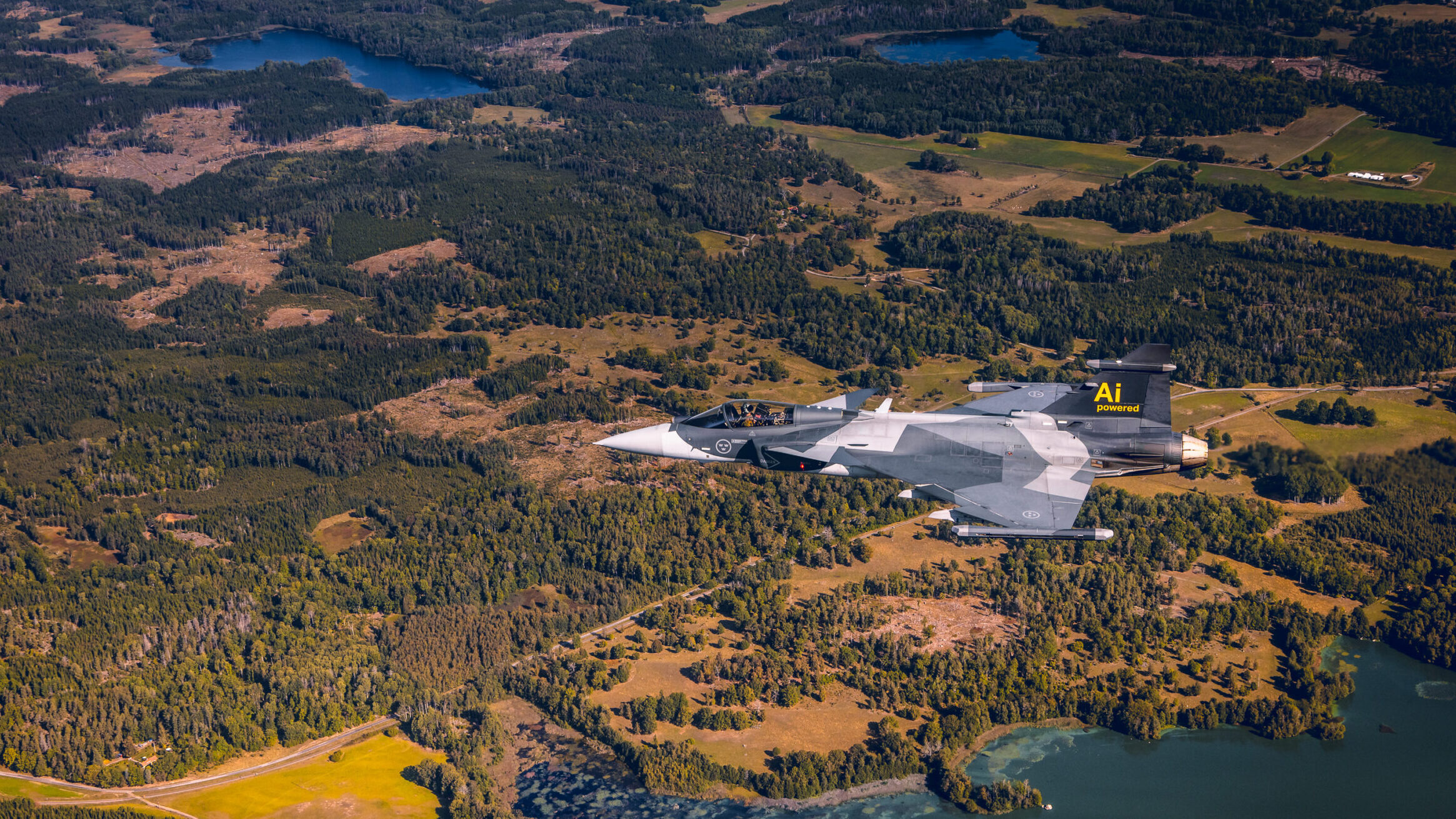
Saab has tested AI agents on the company's Gripen E multirole fighter jet (Saab)
BELFAST — Swedish manufacturer Saab has unveiled a suite of inhouse AI agents designed for future aircraft platforms, following testing of the new technologies on a Gripen E multirole fighter jet.
The move demonstrates the firm’s “ability to develop, train, and fly its own Al for air combat” operations, according to a company statement released today.
The company added that the agents use “various Al techniques to master tactical decision-making in complex operational environments.” They can also work with a pilot inside a cockpit or from its own uncrewed air vehicle.
Key to the autonomous project is Saab’s AI Fighter Jet Pilot Academy, designed to develop the agents and, in parallel, establish infrastructure necessary to “create, train and evaluate” them, noted the Saab statement.
“The harder question is how we turn this success [of flying with the agents] into a dependable capability that can learn, improve, and be relevant over time,” Peter Nilsson, head of Advanced Programs at Saab’s aeronautics unit, told Breaking Defense and other media ahead of the announcement. “[T]hat is the true purpose of the AI Fighter Pilot Academy.”
He stressed that the “strategic advantage” of producing AI-driven data, “increasingly comes from reducing the distance between experience, learning, and field-led capability.”
It is of “enormous value to have a software-driven fighter like Gripen who can cope with this [computer processing] speed,” added Nilsson.
To date, the AI agents have predominately been tested and integrated with the fighter jet under Beyond Visual Range (BVR) combat conditions, much like a similar flight test campaign from 2025 , when Helsing’s Centaur AI tool was used to take control of the fighter jet and autonomously complete a number of BVR maneuvers. Longer term however, Saab plans on leveraging the inhouse AI technology to advance development of its future air programs. As Breaking Defense previously reported , the manufacturer is developing a trio of unmanned aircraft — the A1, A2 and A3 — on the path toward the design of a new loyal wingman drone.
The company’s latest foray into AI-based Gripen testing follows a handful of similar flight tests in 2025 when Helsing’s Centaur AI tool was used to take control of the fighter jet and autonomously complete a number of BVR maneuvers.
Meanwhile, in an effort to scale computer capacity for the AI agents, the firm has also decided to become partial founder in a Swedish government-backed initiative dubbed Sferical Al.
Nilsson said that without Sferical AI, “otherwise you have to go to Google or Amazon … and pay some money” meaning, “you maybe don’t have full control of your data.”
To retain such a capability in Sweden is “enormous” for Saab, he added, noting that the new initiative was formally inaugurated during a ceremony in Stockholm last month.
Per a Saab slide shared by Nilsson, Sferical Al is built using Nvidia’s DGX SuperPOD architecture that makes it possible to develop Large Language Model and Vision-Language Model capabilities to aid agent and operator communications.
When Sferical Al is applied to a one-hour simulated training flight, it can produce the equivalent of one billion flight hours for a human pilot. “The exponential [computational] curve is … really hard to comprehend,” explained Nilsson.
Breaking Defense Video
Qatar’s domestic weapons, Turkey’s drone arsenal and the Mecca pact’s next test
3 congressional races that matter for defense
How General Atomics views Europe’s unmanned future
A more flexible way to defend maneuver forces from drones that doesn’t tie them down [Sponsored]
What’s haunting the Pentagon this Halloween?
The new must-have capabilities for drones [Sponsored]
Army’s tech chief talks autonomy, acquisition and the future of drones
Drones take over AUSA, plus the Army’s plan to bring in new vendors
Hegseth talks autonomy at AUSA, a key show focus
Army doubles down on autonomy, stakes out Indo-Pacific role: AUSA Day 2
萨博公司已在其“鹰狮E”多用途战斗机上测试了人工智能代理(萨博)
贝尔法斯特——瑞典制造商萨博公司推出了一套专为未来飞机平台设计的内部人工智能代理系统,此前该公司已在鹰狮E多用途战斗机上测试了这些新技术。
根据该公司今天发布的一份声明,此举表明该公司“有能力开发、训练和驾驶自己的人工智能进行空战行动”。
该公司补充说,这些特工使用“各种人工智能技术来掌握复杂作战环境中的战术决策”。他们还可以与驾驶舱内的飞行员合作,或从自己的无人飞行器上进行操作。
萨博公司声明指出,自主项目的关键在于萨博的人工智能战斗机飞行员学院,该学院旨在开发智能体,并同时建立“创建、训练和评估”这些智能体所需的基础设施。
“更难的问题在于,我们如何将这种(与智能体共同飞行)的成功经验转化为一种可靠的能力,使其能够学习、改进并随着时间的推移保持相关性,”萨博航空部门高级项目负责人彼得·尼尔森在宣布该项目之前告诉《防务新闻》和其他媒体。“这才是人工智能战斗机飞行员学院的真正目的。”
他强调,人工智能驱动数据的“战略优势”越来越来自于“缩小经验、学习和现场主导能力之间的差距”。
尼尔森补充说:“拥有像鹰狮这样能够应对这种(计算机处理)速度的软件驱动型战斗机具有巨大的价值。”
迄今为止,人工智能代理主要在超视距(BVR)作战条件下与战斗机进行测试和集成,这与2025年进行的类似飞行测试活动非常相似。在2025年的测试中,赫尔辛的“半人马座”(Centaur)人工智能工具将控制战斗机并自主完成一系列超视距机动动作。然而,从长远来看,萨博计划利用其自主研发的人工智能技术来推进未来航空项目的开发。正如《防务新闻》(Breaking Defense)此前报道,这家制造商正在开发三款无人机——A1、A2和A3——最终目标是设计一款新型的忠诚僚机无人机。
该公司最近一次涉足基于人工智能的鹰狮战斗机测试,是在 2025 年进行的一系列类似飞行测试之后进行的。当时,赫尔辛公司的 Centaur 人工智能工具控制了这架战斗机,并自主完成了一系列超视距机动。
与此同时,为了扩大人工智能代理的计算机容量,该公司还决定成为瑞典政府支持的名为 Sferical Al 的计划的部分创始成员。
尼尔森表示,如果没有 Sferical AI,“否则你就得去谷歌或亚马逊……并支付一些钱”,这意味着“你可能无法完全控制你的数据”。
他补充说,对于萨博来说,在瑞典保留这样的能力是“意义重大的”,并指出这项新举措已于上个月在斯德哥尔摩举行的仪式上正式启动。
根据 Nilsson 分享的 Saab 幻灯片,Sferical AI 是使用 Nvidia 的 DGX SuperPOD 架构构建的,这使得开发大型语言模型和视觉语言模型功能成为可能,以辅助代理和操作员之间的通信。
当球面人工智能应用于一小时的模拟训练飞行时,它可以产生相当于人类飞行员十亿小时的飞行训练量。“指数级的计算曲线……真的很难理解,”尼尔森解释道。
突破性防御视频
卡塔尔的国产武器、土耳其的无人机武库以及麦加条约的下一次测试
3场对国防至关重要的国会选举
通用原子公司如何看待欧洲的无人化未来
一种更灵活的防御机动部队免受无人机攻击的方式,不会限制其行动[赞助]
今年万圣节,五角大楼究竟闹鬼?
无人机必备的新功能 [赞助内容]
陆军技术主管谈无人机的自主性、采购和未来
无人机主导了美国陆军协会(AUSA)的会议,此外,陆军还计划引入新的供应商。
Hegseth 在 AUSA 大会上谈到了自主性,这是本次大会的一个重点议题。
陆军加倍强调自主性,明确印太地区角色:AUSA第二天