US Army launches new Indo-Pacific multi-domain command美国陆军成立新的印太多域司令部
The move combines traditional formations with some of the service’s cyber, space, unmanned systems and electronic warfare capabilities.
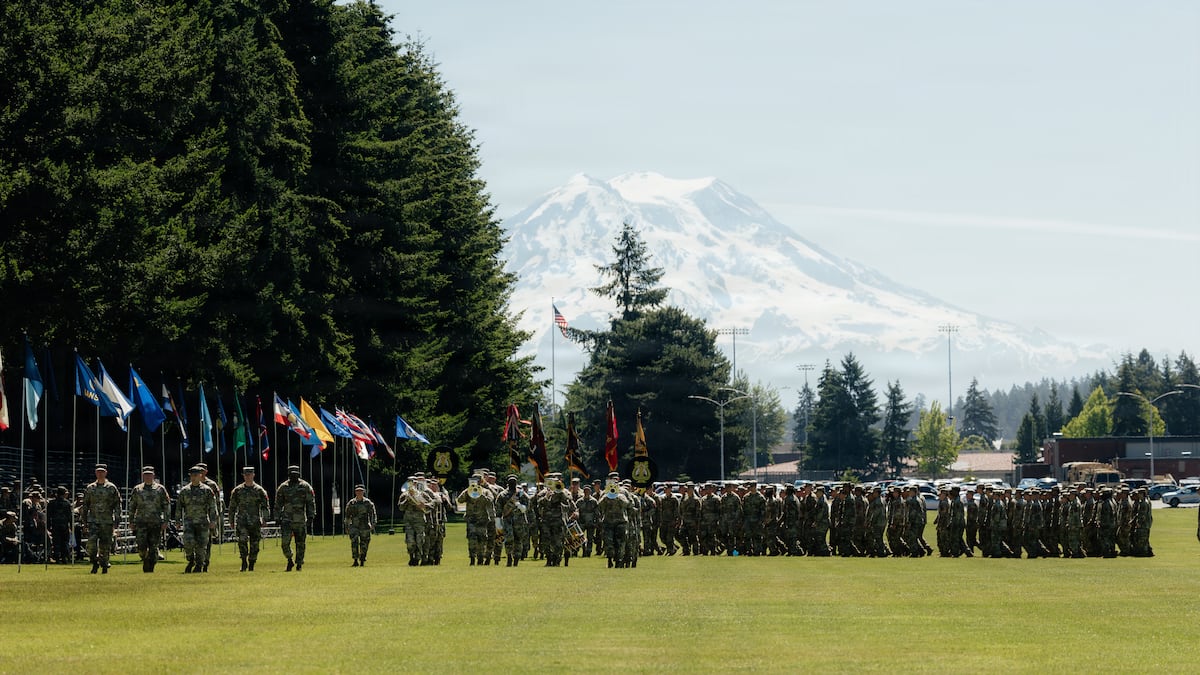
The Army on Thursday launched a new Indo-Pacific command that combines traditional formations with some of the service’s cyber, space, unmanned systems and electronic warfare capabilities, the service announced Friday.
Soldiers at Joint Base Lewis-McChord cased the colors of the 1st Multi-Domain Task Forces Headquarters and 7th ID Headquarters Support Company and uncased the 7th Infantry Division (Multi-Domain Command-Pacific) Headquarters and Headquarters Battalion colors, in a merger that was first announced earlier this year.
“We are merging the operational endurance, flexibility and protection of our proven Stryker formations with the long-range sensing and precision fires of our multi-domain task force,” Maj. Gen. Bernard J. Harrington, the commanding general of the 7th ID (MDC-PAC), said in the Army release.
Central to the new command is what the Army calls the Cross Domain Contact Layer, a framework designed to connect intelligence gathering, electronic warfare and artificial intelligence into a continuous network.
It will combine sensors, drones, precision weapons and digital networks into a single architecture spanning land, air, sea, space and cyberspace.
“Through our emerging Cross Domain Contact Layer concept, our division will employ capabilities such as unmanned surface vessels; long-range, one-way attack drones; and launched effects to penetrate the adversary’s anti-access/area-denial network,” Harrington said in the release. “Every radar that emits, every node that transmits, every headquarters that commands, we aim to hold continuously at risk alongside our joint partners and allies.”
The change is part of the Army’s broader transformation initiative. According to the release, the redesignation reflects the service’s push to distribute advanced capabilities across maneuver formations operating in contested environments.
The redesignation builds on years of innovation in the Indo-Pacific, the Army said, including deployments by the 1st Multi-Domain Task Force, or MDTF, and collaboration with the Armed Forces of the Philippines.
“These soldiers have invested wholeheartedly in experimenting, deploying, and employing capabilities that work from the heavens to the earth, from the air to the sea, and flow with all the digits that go in between,” said Col. Charles W. Kean, the 7th ID (MDC-PAC) deputy commanding officer-effects and former 1st MDTF commander. “It has truly been inspirational to watch them in action.”
Eve Sampson is a reporter and former Army officer. She has covered conflict across the world, writing for The New York Times, The Washington Post and The Associated Press.
J.D. Simkins is Editor-in-Chief of Military Times and Defense News, and a Marine Corps veteran of the Iraq War.
美国陆军于周四成立了新的印太司令部,该司令部将传统编制与陆军的一些网络、太空、无人系统和电子战能力相结合。陆军于周五宣布了这一消息。
在刘易斯-麦克乔德联合基地,士兵们收起了第1多域特遣部队司令部和第7步兵师司令部支援连的军旗,并展开了第7步兵师(太平洋多域司令部)司令部和司令部营的军旗。此次合并是今年早些时候首次宣布的。
“我们将久经考验的‘斯特瑞克’装甲车部队的作战持久性、灵活性和防护能力,与我们多域特遣部队的远程感知和精确火力相结合,”第7步兵师(MDC-PAC)指挥官伯纳德·J·哈灵顿少将在陆军新闻稿中表示。
新指挥部的核心是陆军所称的跨域联络层,这是一个旨在将情报收集、电子战和人工智能连接成一个连续网络的框架。
它将把传感器、无人机、精确武器和数字网络整合到一个涵盖陆地、空中、海洋、太空和网络空间的单一架构中。
哈灵顿在新闻稿中表示:“通过我们正在构建的跨域接触层概念,我们部门将运用无人水面舰艇、远程单向攻击无人机以及发射效应物等能力,渗透敌方的反介入/区域拒止网络。我们的目标是与联合伙伴和盟友一起,持续威胁每一个发射雷达、每一个传输节点、每一个指挥中心。”
此次调整是陆军更广泛转型计划的一部分。根据新闻稿,此次重新命名体现了陆军致力于将先进能力分散到在对抗环境中作战的各个机动部队的努力。
陆军表示,此次重新命名建立在印太地区多年来的创新之上,包括第一多域特遣部队(MDTF)的部署以及与菲律宾武装部队的合作。
“这些士兵全身心投入到试验、部署和运用各种能力中,这些能力涵盖了从天到地、从空中到海洋的各个领域,并能与所有相关领域无缝衔接,”第7步兵师(太平洋多学科司令部)副指挥官(后勤保障)兼前第1多学科特遣部队指挥官查尔斯·W·基恩上校说道,“亲眼目睹他们的行动,真是令人振奋。”
伊芙·桑普森是一名记者,也是一名前陆军军官。她曾报道过世界各地的冲突,为《纽约时报》、《华盛顿邮报》和美联社撰稿。
JD Simkins 是《军事时报》和《防务新闻》的总编辑,也是参加过伊拉克战争的海军陆战队老兵。