US Marines in Okinawa receive first MADIS, NMESIS platforms驻冲绳的美国海军陆战队首次接收了MADIS和NMESIS平台
The delivery marks the service’s latest integration of modernized defenses in the increasingly contested Indo-Pacific.
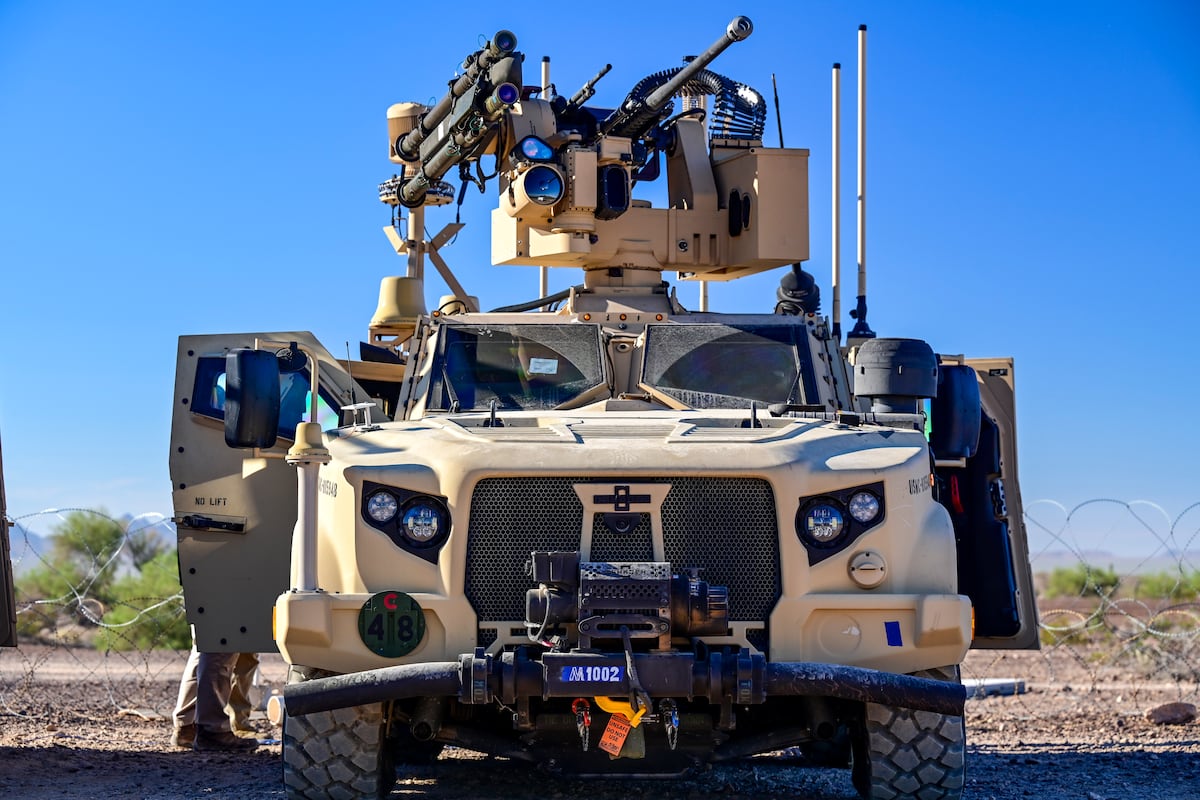
U.S. Marines in Okinawa this month formally received the installation’s first Navy-Marine Expeditionary Ship Interdiction System and Marine Air Defense Integrated System, the service announced . The delivery is the service’s latest integration of modernized defenses in the increasingly contested Indo-Pacific.
The two systems, NMESIS and MADIS, were welcomed by personnel from the 12th Marine Littoral Regiment, 3rd Marine Division, as key pieces in those threat recalibration efforts.
The NMESIS is a ground-based ship-killing missile system designed to be deployed in sea denial operations near coastlines.
The system features a Naval Strike Missile system — fixed to a Joint Light Tactical Vehicle — that can operate through both semi-autonomous and fully autonomous launches.
The short-range, surface-to-air defense capabilities of the MADIS make the highly mobile platform especially potent for low altitude air defense personnel taking on helicopters, fixed wing aircraft and small unmanned aircraft systems, or sUAS.
Mounted aboard two 4x4 Joint Light Tactical Vehicles, MADIS operates as a complementary duo, with one vehicle primarily performing the role of counter-sUAS detection and elimination — via 360-degree radar, a command-and-control suite and an electronic warfare system — while the second vehicle combats fixed wing and rotary aircraft courtesy of a multi-Stinger missile pod, 30mm cannon and electronic warfare capabilities.
The 3rd Marine Division’s Hawaii-based 3rd MLR was the first unit to receive the NMESIS and MADIS. Since then, the Marine Corps has pushed to field the new tech across the Indo-Pacific to match the rapid evolution of regional threats.
Marines with the 3rd MLR in May deployed the NMESIS across multiple islands, as part of the Balikatan 26 exercise, after hitching rides aboard Air Force C-130Js and Army LCU-2000 landing craft.
Operating for three days in the Batanes Islands archipelago, Marines ran through a series of dry fire missions in which they practiced denying warships access to the Luzon Strait.
Days earlier, Marines in Zambales demonstrated the capabilities of the MADIS in knocking quad-copters and fixed-wing drones out of the sky.
J.D. Simkins is Editor-in-Chief of Military Times and Defense News, and a Marine Corps veteran of the Iraq War.
美国海军陆战队本月正式接收了驻冲绳基地首套海军陆战队远征舰拦截系统和海军陆战队防空综合系统,该军种宣布了这一消息。此次交付是海军陆战队在竞争日益激烈的印太地区推进现代化防御体系的最新举措。
NMESIS 和 MADIS 这两个系统受到了第 3 海军陆战师第 12 海军陆战队近岸团人员的欢迎,他们认为这是重新校准威胁的关键组成部分。
NMESIS 是一种陆基反舰导弹系统,设计用于在海岸线附近的海上拒止行动中部署。
该系统配备了海军打击导弹系统——固定在联合轻型战术车辆上——可以通过半自主和完全自主发射进行操作。
MADIS 的短程地对空防御能力使这款高度机动的平台对于低空防空人员来说尤其强大,可以对抗直升机、固定翼飞机和小型无人机系统(sUAS)。
MADIS 系统安装在两辆 4x4 联合轻型战术车辆上,以互补组合的形式运行。其中一辆车主要负责反无人机系统的探测和清除——通过 360 度雷达、指挥控制系统和电子战系统——而另一辆车则依靠多枚毒刺导弹吊舱、30 毫米机炮和电子战能力来对抗固定翼和旋翼飞机。
驻扎在夏威夷的第三海军陆战师第三海军陆战队后备队是首个接收NMESIS和MADIS系统的部队。此后,海军陆战队一直致力于在整个印太地区推广这项新技术,以应对区域威胁的快速演变。
5 月,作为“肩并肩 26”演习的一部分,第 3 海军陆战队后备队的陆战队员搭乘空军 C-130J 运输机和陆军 LCU-2000 登陆艇,将 NMESIS 部署到多个岛屿上。
在巴丹群岛进行了三天的演习,海军陆战队员进行了一系列实弹射击任务,练习阻止军舰进入吕宋海峡。
几天前,赞巴莱斯的海军陆战队员展示了 MADIS 系统击落四旋翼无人机和固定翼无人机的能力。
JD Simkins 是《军事时报》和《防务新闻》的总编辑,也是参加过伊拉克战争的海军陆战队老兵。