In AUKUS, Navy eyes a full-service submarine garage in Asia-Pacific在奥库斯项目中,海军计划在亚太地区建立一个全方位服务的潜艇车库。
Leaders are slated to announce details of the landmark agreement next week, as some U.S. lawmakers are wary of the industrial practicalities.
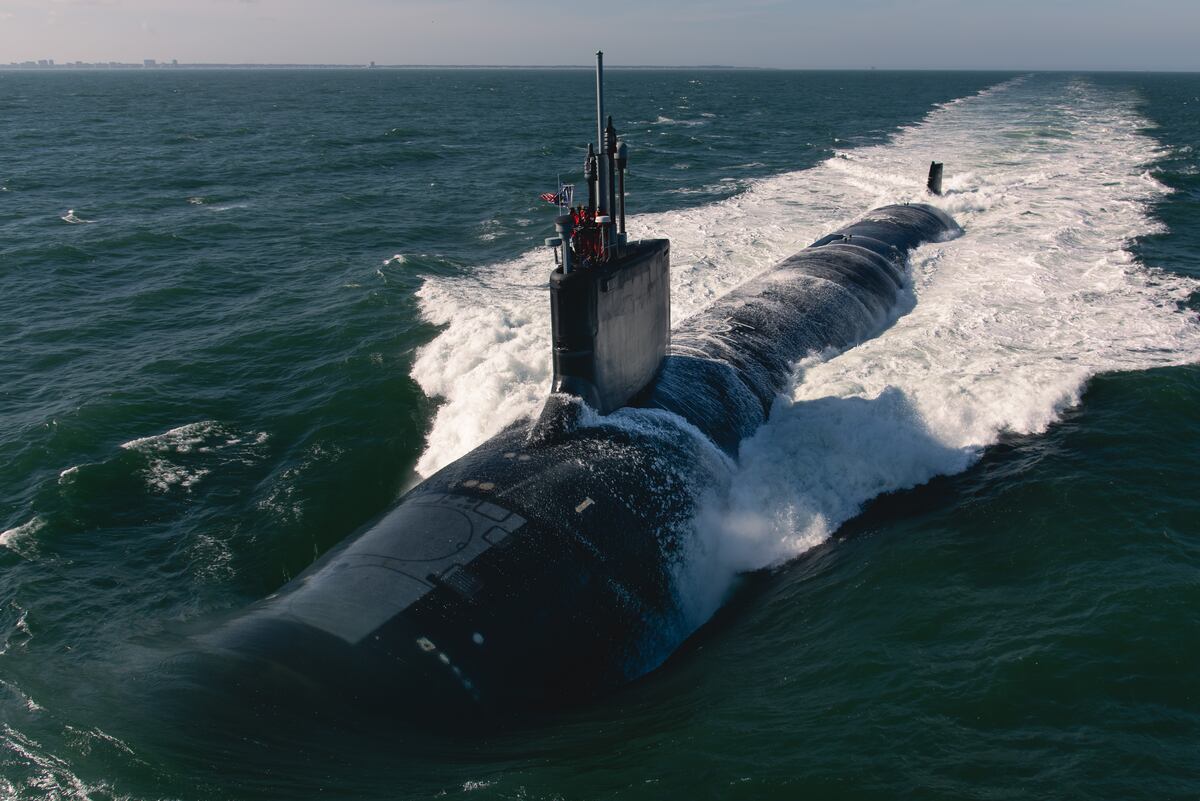
WASHINGTON — The U.S. Navy envisions a submarine hub in Australia from which the service can oversee the entire range of undersea activities in the Asia-Pacific region, from boat production to repairs to missions, service Secretary Carlos del Toro said last month.
His comments, made ahead of a major announcement about the U.S.-U.K.-Australian submarine partnership dubbed AUKUS, reveal how Washington views its future relationship with Australia as a key foothold in closer proximity to rival China.
Bloomberg reported earlier this week President Joe Biden, British Prime Minister Rishi Sunak and Australian Prime Minister Anthony Albanese are expected to address the way ahead in the pact on March 13 in San Diego, California.
With most of the plans for a fleet of nuclear-powered boats for Canberra still up in the air, the U.S. sea service has its eyes on the near-term benefit of being able to base and repair U.S. Virginia-class attack submarines in Australian ports.
Del Toro told Defense News last month AUKUS is all about “being able to repair our submarines much further out, being able to build them in Australia as well, too, and create that much more presence in the Indo-Pacific where we need it the most.”
He later said at the National Press Club “the ability of the United States Navy to be able to do forward-based repair and maintenance is critical to us; it’s part of why we’re actually proceeding down the AUKUS path as well, too, with regards to submarine capability in the future.”
This comes as the U.S. Navy has conducted an auxiliary ship repair in India and is now eyeing yards in the Philippines and Singapore for future Navy ship repair periods, Del Toro said. The United States in February announced an expansion to an agreement with the Philippines that allows for greater access to bases there for training and prepositioning equipment for certain missions like humanitarian assistance and disaster relief.
Leaders from the three partner nations are expected to announce next week exactly how they envision the submarine portion of the AUKUS pact; there’s also a separate track for breakthrough technology sharing.
One thing has become clear during the 18-month study phase announced at the pact’s start in September 2021: it could be decades before Australia gets its nuke-powered subs.
Reuters reported Wednesday the eventual submarine design will be British, with U.S. Virginia-class boats intended as gap-fillers until then. Options for operating American submarines entail deploying dual U.S.-Australian crews on American subs and building up to five new boats, officials told the news service.
Lawmakers here have been saying for months the prospect of selling U.S. submarines to Australia will further tax an already-strained industrial base.
House Armed Services Committee Vice Chairman Rob Wittman, R-Va., said March 8 he supports AUKUS, but doesn’t believe the U.S. has the capacity now to fulfill both U.S. and Australian naval requirements. He added that selling the subs would disincentivize Australia from ramping up its own domestic submarine building capacity from scratch.
Wittman said he’d prefer dual U.S.-Australian crews on new Virginia-class subs that can operate in the Pacific. These subs would be jointly tasked by the U.S. and Australian navies and have a U.S. commander and Australian executive officer, he said.
“I don’t have an issue if we go from two submarines to three submarines a year and then we have the ability to produce enough to where we’re going to meet our equipment and we can sell some to the Australians,” Wittman said. “That’s not where we’re at right now.”
The lawmaker was referring to a backlog in Navy submarine production that limits output to less than two per year today. Congress has pushed to increase the rate to three, but companies have said they lack the capacity.
The submarine industrial base is also beset by labor shortages. Following a meeting with the chief executive of sub builder General Dynamics Electric Boat, which is seeking more than 5,000 new hires, Sen. Richard Blumenthal, D-Conn., said expanding sub building capacity would require more federal spending on skills training programs.
“I have yet to see a strategy, or a strategy that seems to work,” Blumenthal said of AUKUS.
The U.S. Navy today has 49 attack submarines — three Seawolf-class, 25 Los Angeles-class and 21 Virginia-class — compared to a stated requirement for 66 to 72, according to the most recently released analysis of future fleet needs.
The submarine industrial base had fallen behind in deliveries even before the COVID-19 pandemic, and from April 2020 to February 2022 the industrial base delivered no new submarines to the Navy, compared to the planned two-a-year delivery schedule.
Meanwhile, the British have three nuclear submarine programs in build or design phases, but only one is being touted as a possible participant for AUKUS.
The Dreadnought-class nuclear missile submarines, set to provide the Royal Navy with its nuclear deterrent by the early 2030s, and the new Astute-class attack boats, still in fielding, appear to have been discounted.
The Royal Navy took delivery of the fifth of seven Astute-class boats last month with handover of the final two boats scheduled by 2026.
The replacement for those submarine, eyed for fielding in the 2040s and conceptually dubbed Submersible Ship Nuclear Replacement, is a likely contender for AUKUS, analysts in London say.
Platform builder BAE Systems and nuclear power plant provider Rolls-Royce were each awarded £85 million ($101 million) contracts in September 2021 to start a three-year effort helping define the approach to replacing the Astute boats.
Andrew Chuter in London contributed to this report.
Megan Eckstein is the naval warfare reporter at Defense News. She has covered military news since 2009, with a focus on U.S. Navy and Marine Corps operations, acquisition programs and budgets. She has reported from four geographic fleets and is happiest when she’s filing stories from a ship. Megan is a University of Maryland alumna.
Joe Gould was the senior Pentagon reporter for Defense News, covering the intersection of national security policy, politics and the defense industry. He had previously served as Congress reporter.
Sebastian Sprenger is associate editor for Europe at Defense News, reporting on the state of the defense market in the region, and on U.S.-Europe cooperation and multi-national investments in defense and global security. Previously he served as managing editor for Defense News. He is based in Cologne, Germany.
华盛顿——美国海军部长卡洛斯·德尔·托罗上个月表示,美国海军设想在澳大利亚建立一个潜艇中心,以便该军种能够监督亚太地区所有水下活动,从潜艇生产到维修再到任务执行。
在他发表关于美英澳三国潜艇合作项目“AUKUS”重大声明之前的评论,揭示了华盛顿如何看待其与澳大利亚的未来关系,将其视为更接近竞争对手中国的关键立足点。
彭博社本周早些时候报道称,美国总统乔·拜登、英国首相里希·苏纳克和澳大利亚总理安东尼·阿尔巴尼斯预计将于 3 月 13 日在加利福尼亚州圣地亚哥就该协议的未来走向发表讲话。
由于堪培拉核动力舰艇舰队的大部分计划仍悬而未决,美国海军将目光投向了近期能够将美国弗吉尼亚级攻击型潜艇部署在澳大利亚港口并进行维修的利益。
德尔·托罗上个月告诉《防务新闻》,AUKUS 的全部意义在于“能够让我们在更远的地方维修潜艇,也能在澳大利亚建造潜艇,并在我们最需要的印太地区建立更大的存在”。
他后来在国家新闻俱乐部表示:“美国海军能否进行前沿维修和维护对我们至关重要;这也是我们未来在潜艇能力方面继续推进 AUKUS 项目的原因之一。”
德尔托罗表示,此前美国海军已在印度完成了一艘辅助舰艇的维修,目前正考虑将菲律宾和新加坡的船厂作为未来海军舰艇维修的地点。今年2月,美国宣布扩大与菲律宾的协议,允许美军更便捷地使用菲律宾的基地进行训练,并为人道主义援助和灾害救援等特定任务预先部署装备。
预计下周,三个伙伴国家的领导人将宣布他们对 AUKUS 协议中潜艇部分的具体设想;此外,还有一个单独的突破性技术共享渠道。
在 2021 年 9 月该协议启动时宣布的为期 18 个月的研究阶段中,有一件事已经很清楚:澳大利亚可能要几十年后才能拥有核动力潜艇。
路透社周三报道称,最终的潜艇设计将采用英国方案,在此之前,美国的弗吉尼亚级潜艇将作为过渡方案。官员们告诉路透社,美国潜艇的运行方案包括在美国潜艇上部署美澳双籍艇员,以及建造多达五艘新潜艇。
几个月来,澳大利亚的立法者一直表示,向澳大利亚出售美国潜艇的前景将进一步加重本已捉襟见肘的工业基础的负担。
美国众议院军事委员会副主席、弗吉尼亚州共和党众议员罗伯·威特曼3月8日表示,他支持奥库斯计划,但认为美国目前没有能力同时满足美国和澳大利亚的海军需求。他还补充说,出售这些潜艇会削弱澳大利亚从零开始提升本国潜艇建造能力的动力。
维特曼表示,他更倾向于在可在太平洋作战的新型弗吉尼亚级潜艇上采用美澳双籍艇员配置。他说,这些潜艇将由美国和澳大利亚海军联合指挥,并配备一名美国指挥官和一名澳大利亚执行官。
“如果我们每年建造的潜艇数量从两艘增加到三艘,我并不反对,这样我们就能生产出足够的潜艇来满足自身需求,还能卖一些给澳大利亚人,”维特曼说。“但我们现在的情况并非如此。”
这位议员指的是海军潜艇生产积压问题,目前导致其年产量不足两艘。国会一直力推将产量提高到三艘,但各公司表示产能不足。
潜艇工业基地也面临劳动力短缺的困境。康涅狄格州民主党参议员理查德·布卢门撒尔在与潜艇制造商通用动力电船公司首席执行官会面后表示,该公司正在寻求招聘5000多名新员工,扩大潜艇建造能力需要联邦政府增加对技能培训项目的投入。
“我还没有看到任何有效的策略,或者说,还没有看到任何有效的策略,”布卢门塔尔谈到 AUKUS 时说道。
根据最新发布的未来舰队需求分析报告,美国海军目前拥有 49 艘攻击型潜艇——3 艘海狼级、25 艘洛杉矶级和 21 艘弗吉尼亚级——而既定需求量为 66 至 72 艘。
即使在 COVID-19 疫情爆发之前,潜艇工业基地的交付进度也已经落后。从 2020 年 4 月到 2022 年 2 月,该工业基地没有向海军交付任何新潜艇,而原计划是每年交付两艘。
与此同时,英国有三个核潜艇项目处于建造或设计阶段,但只有其中一个被认为是 AUKUS 项目的可能参与者。
计划在 2030 年代初为英国皇家海军提供核威慑力量的“无畏”级核导弹潜艇,以及仍在部署中的新型“机敏”级攻击艇,似乎已被排除在外。
英国皇家海军上个月接收了七艘机敏级潜艇中的第五艘,最后两艘潜艇计划于 2026 年交付。
伦敦的分析人士表示,这些潜艇的替代品,计划在 2040 年代投入使用,概念上被称为“核动力潜艇替代品”,很可能是 AUKUS 的竞争者。
平台制造商 BAE Systems 和核电站供应商劳斯莱斯公司于 2021 年 9 月分别获得 8500 万英镑(1.01 亿美元)的合同,开始为期三年的工作,以帮助确定替换“机敏”级潜艇的方法。
伦敦的安德鲁·丘特对本报道亦有贡献。
梅根·埃克斯坦是《防务新闻》的海军作战记者。自2009年以来,她一直从事军事新闻报道,主要关注美国海军和海军陆战队的行动、采购项目和预算。她曾报道过四个不同地理区域的舰队,最喜欢在舰艇上进行新闻报道。梅根毕业于马里兰大学。
乔·古尔德是《防务新闻》的资深五角大楼记者,负责报道国家安全政策、政治和国防工业的交汇点。他此前曾担任国会记者。
塞巴斯蒂安·斯普伦格是《防务新闻》欧洲版副主编,负责报道该地区的防务市场状况,以及美欧在防务和全球安全领域的合作和多国投资。此前,他曾担任《防务新闻》执行主编。他现居德国科隆。