Turkey’s Aselsan eyes growth in networked, mass-producible weapons, CEO says土耳其阿塞尔桑公司首席执行官表示,该公司着眼于发展联网化、可大规模生产的武器。
“Everything we have talked about today could realistically be in inventory by 2027,” CEO Ahmet Akyol said in an interview.
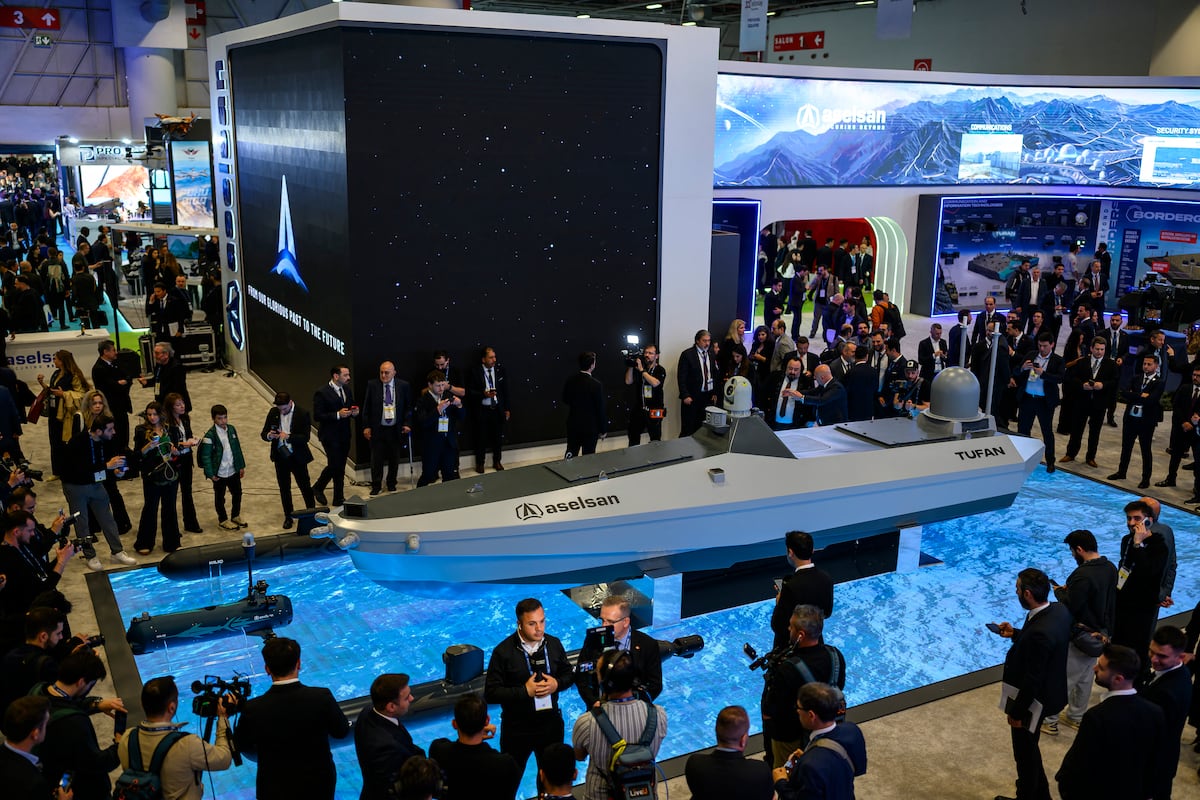
ISTANBUL — Aselsan used the Saha Expo 2026 defense exhibition here to present a vision of future warfare built around autonomous systems, layered air defense and integrated strike networks, as the Turkish defense-electronics giant seeks to expand its role as a domestic systems integrator and growing global exporter.
In an interview with Defence News during the show, Aselsan CEO Ahmet Akyol described the company’s latest launches as part of a broader shift toward networked, high-volume and cost-effective systems designed for modern attritional warfare.
In the maritime domain, this strategy manifested itself in the form of two autonomous naval strike systems designed around swarming operations, low observability and high-volume production.
One of them was the Tufan Unmanned Surface Vehicle (USV), a fast-moving, autonomous platform for both offensive operations and intelligence, surveillance and reconnaissance (ISR) tasks. Akyol described Tufan as Aselsan’s new-generation surface kamikaze vehicle. “It builds on our experience with platforms like Marlin and Albatros [USVs],” he said.
Aselsan General Manager Ahmet Akyol delivers remarks at the SAHA 2026 International Defense, Aerospace and Space Industry Fair at Istanbul Expo Center in Istanbul, Turkey, on May 5, 2026. (Agit Erdi Ulukaya/Anadolu via Getty Images)
The second systems was the Kılıç family of unmanned underwater vehicles (UUVs). Akyol described them as “kamikaze UUVs,” stating that when creating an entirely new operational concept, the terminology also evolves with it.
Akyol said the Kılıç UUVs currently come in two variants, Kılıç 10 and Kılıç 200, designed for long-range and low-signature operations. The swarm-capable systems carry warheads with lightweight torpedo-class punch, and they can operate autonomously or via satellite link. “Kılıç is quite difficult to defend against,” Akyol said.
The company also used Saha Expo to highlight the defensive side of modern networked warfare through a layered mix of air defense, electronic warfare and counter-drone systems. The company presented the systems as part of Turkey’s evolving “Steel Dome” air defense architecture.
“For the electronic warfare layer of Steel Dome, we are launching Koral AD — a completely new product,” Akyol said.
Koral is Aselsan’s main EW systems designed to render enemy radars ineffective. The Koral AD is a long-range radar electronic attack system intended to detect, deceive and jam enemy aircraft radars. The company also launched a new version of the Ilgar electronic warfare system, designed to disrupt communications between combat aircraft and ground control stations.
“It makes it very difficult for enemy aircraft to execute an attack on you — blinding enemy radars or saturating them with false targets, and also capable of jamming the guidance heads of incoming anti-radiation missiles” said Akyol.
Aselsan also revealed new products designed to expand the offensive reach of Turkish unmanned combat aircraft through a new set of integrated sensors, radars and precision-guided munitions.
The Russian invasion of Ukraine and recent conflicts in the Red Sea and the Middle East have highlighted the importance of producing precision-strike systems rapidly and in large quantities.
Akyol said said many of the systems unveiled at Saha Expo 2026 were designed around a commercial-component philosophy rather than a traditional boutique defence industry approach.
“Everything we have talked about today could realistically be in inventory by 2027,” he said.
The company has set a target of raising exports to 40% of total revenues by 2030, up from 25% today and 11% when the ASELSAN Next program launched in 2024.
Cem Devrim Yaylali is a Turkey correspondent for Defense News. He is a keen photographer of military ships and has a passion for writing about naval and defense issues. He was born in Paris, France, and resides in Istanbul, Turkey. He is married with one son.
伊斯坦布尔——土耳其国防电子巨头阿塞尔桑公司利用在伊斯坦布尔举行的 2026 年萨哈国际防务展,展示了其围绕自主系统、分层防空和一体化打击网络构建的未来战争愿景。该公司正寻求扩大其作为国内系统集成商和不断增长的全球出口商的角色。
在展会期间接受《防务新闻》采访时,阿塞尔桑公司首席执行官艾哈迈德·阿克约尔将公司最新推出的产品描述为向网络化、大批量、高性价比系统转变的一部分,这些系统旨在应对现代消耗战。
在海上领域,这一战略表现为两种自主海军打击系统,其设计围绕集群作战、低可观测性和高产量展开。
其中之一是“图凡”无人水面艇(USV),这是一款高速自主平台,可用于进攻作战以及情报、监视和侦察(ISR)任务。阿克约尔将“图凡”描述为阿塞尔桑公司新一代水面“神风特攻队”级舰艇。“它建立在我们之前研发的‘马林’和‘信天翁’等无人水面艇平台的经验之上,”他说道。
2026年5月5日,阿塞尔桑公司总经理艾哈迈德·阿克约尔在土耳其伊斯坦布尔伊斯坦布尔展览中心举行的SAHA 2026国际防务、航空航天及航天工业博览会上发表讲话。(图片来源:Agit Erdi Ulukaya/Anadolu via Getty Images)
第二套系统是Kılıç系列无人水下航行器(UUV)。Akyol将其描述为“神风特攻队型UUV”,并指出,在创造一个全新的作战概念时,术语也会随之演变。
阿克约尔表示,Kılıç无人水下航行器目前有两种型号:Kılıç 10和Kılıç 200,专为远程和低特征作战而设计。这些具备集群作战能力的系统携带轻型鱼雷级战斗部,可以自主运行或通过卫星链路控制。“Kılıç很难防御,”阿克约尔说道。
该公司还利用萨哈国际防务展,重点展示了现代网络化战争的防御能力,其系统融合了防空、电子战和反无人机系统等多层次技术。该公司将这些系统作为土耳其不断发展的“钢铁穹顶”防空体系的一部分进行展示。
“对于钢铁穹顶的电子战层,我们将推出 Koral AD——一款全新的产品,”Akyol 说。
Koral是阿塞尔桑公司的主要电子战系统,旨在使敌方雷达失效。Koral AD是一种远程雷达电子攻击系统,用于探测、欺骗和干扰敌方飞机雷达。该公司还推出了新版Ilgar电子战系统,旨在干扰战斗机与地面控制站之间的通信。
“这使得敌机很难对你发动攻击——使敌方雷达失灵或用虚假目标饱和其雷达,并且能够干扰来袭反辐射导弹的制导头,”阿克约尔说。
阿塞尔桑还推出了旨在通过一套新的集成传感器、雷达和精确制导武器来扩大土耳其无人作战飞机进攻范围的新产品。
俄罗斯入侵乌克兰以及最近在红海和中东发生的冲突凸显了快速、大规模生产精确打击系统的重要性。
Akyol 表示,在 2026 年 Saha Expo 上亮相的许多系统都是围绕商业组件理念设计的,而不是传统的精品国防工业方法。
他说:“我们今天讨论的所有内容,到 2027 年都有可能全部入库。”
该公司已设定目标,到 2030 年将出口额提高到总收入的 40%,高于目前的 25%,也高于 ASELSAN Next 计划于 2024 年启动时的 11%。
杰姆·德夫里姆·亚伊拉利是《防务新闻》驻土耳其记者。他热衷于拍摄军舰,并对海军和国防议题充满热情。他出生于法国巴黎,现居土耳其伊斯坦布尔。他已婚,育有一子。