No, The United States Doesn’t Have An Automatic “Dead Hand” Trigger For Its ICBMs不,美国并没有为其洲际弹道导弹配备自动“死手”引爆装置。
If personnel in a missile alert facility are incapacitated for some reason during a crisis, it doesn't mean that the missiles launch automatically.
新闻视频
By Joseph Trevithick
Updated Feb 10, 2020 11:52 AM EST
A recent Air Force Magazine article has caused something of a stir after it highlighted systems and procedures that the U.S. Air Force employs to ensure it can still launch its Minuteman III intercontinental ballistic missiles, if necessary, even if personnel in individual missile alert facilities are incapacitated for some reason. At first glance, it might appear that the United States has something of a “Dead Hand” arrangement to fire these world-ending weapons, drawing comparisons to systems the Soviet Union reportedly employed and that present-day Russia apparently still uses. However, a closer look at the American protocols shows the system is place is far from automatic and still has a number of checks and balances to prevent an inadvertent missile launch .
Air Force Magazine ‘s Rachel S. Cohen included the mention of the need for watchstanders in missile alert facilities to routinely enter a “stand down” command into their control consoles in a recent story on Air Force Missileers. The publication of the piece followed the launch of an unarmed Minuteman III from Vandenberg Air Force Base in California as part of a routine test of the missile’s accuracy and reliability. The inert re-entry vehicle splashed down as intended some 4,200 miles away in the Pacific Ocean at Kwajalein Atoll in the Marshall Islands.
At present, the Air Force’s three Missile Wings oversee 400 Minuteman IIIs in silos spread across Montana, Nebraska, and North Dakota. Another 278 missiles are in inventory for testing and other purposes. Missileers stand watch in hardened underground alert facilities in the missile fields 24 hours a day, seven days a week, 365 days a year.
“The Airmen also spend their time on routine inspections and sending messages to others in the operation and to the ICBM itself. Missileers must give the weapon system what is essentially a “stand-down” order every six hours,” Air Force Magazine ‘s Cohen wrote in her recent piece . “If they don’t respond to that prompt within 10 minutes, the missiles will assume that its human operators are dead, and start looking for a launch command from one of the Pentagon’s nuclear mission control aircraft.”
For this description, it might seem as if the missile alert facility’s systems would begin initiating a launch sequence on its own if the operators were to miss one of the four prompts they get every day to let the computers known they’re still alive. However, the reality is far less extreme.
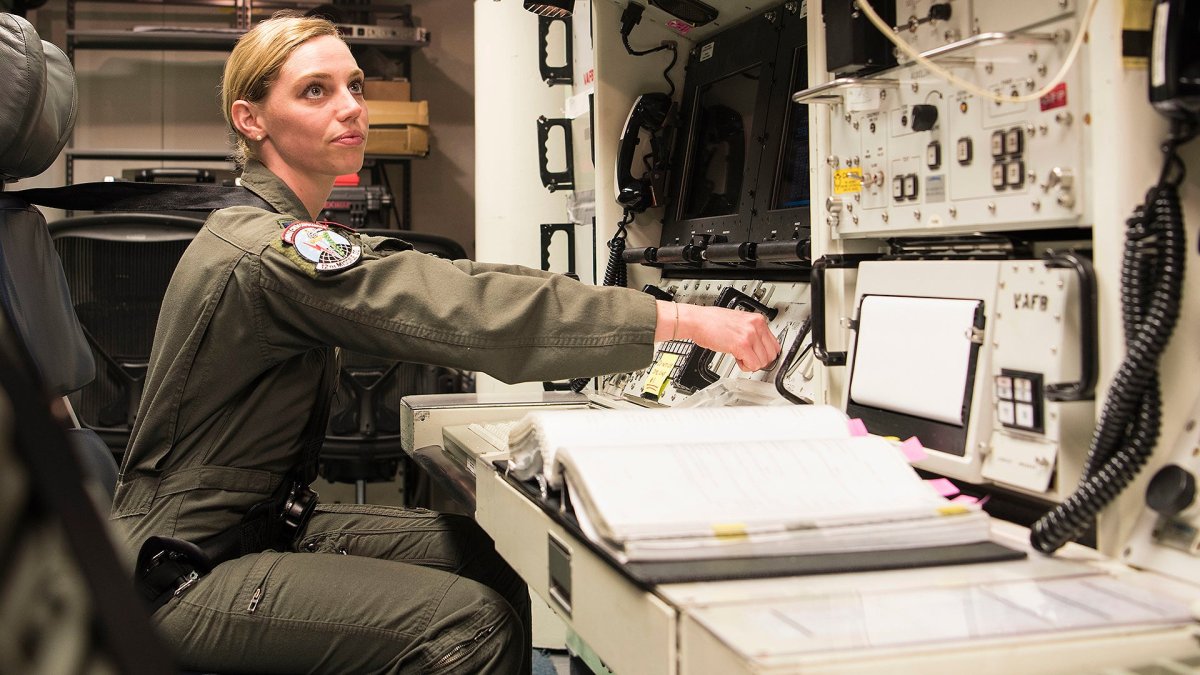
Missileers assigned the 90th Missile Wing, headquartered at F.E. Warren Air Force Base in Wyoming, train in a launch control center within a missile alert facility., USAF
What the Air Force Magazine piece is describing is that missile alert facilities have a built-in backup arrangement where, if it appears that the human operators are no longer capable of performing their duties, it goes into a mode where it cuts them out of the launch sequence. However, it still needs to receive a valid launch code from an outside source and will not automatically fire any missiles on its own.
The U.S. military does have a fleet of E-6B Mercury airborne command post aircraft equipped with the Airborne Launch Control System (ALCS), which you read about in more detail in past War Zone
here and here , that do have the capability to remotely trigger a launch under various circumstances, something that is publicly known. They’re not flying around sending out launch codes by default, though.
“There are ZERO ABNCPs [airborne command posts] in the air to respond to an inquiry,” Robert Hopkins, a retired Air Force pilot and historian, wrote on Twitter. “ANY other [missile alert facility] capsule can respond, and failure to respond DOES NOT trigger a launch. It escalates inquiries.”
It’s also important to note that, in 1991, then-President George H.W. Bush ended the practice of keeping both nuclear-armed bombers and missile alert facilities on a 24-hour alert status that kept a number of them actively poised to strike targets in the Soviet Union and elsewhere at a moments notice. Today, the Air Force has a policy of so-called “ open ocean targeting ,” whereby its Minuteman IIIs are, by default, pointed at open areas of the sea, specifically to prevent a catastrophe from an accidental launch. During an actual crisis, personnel would need to re-target these weapons before firing them.
Today, the primary role of America’s ICBM force within the country’s nuclear triad is to act as as a “sponge” to “soak up” an opponent’s warheads, which could otherwise be employed against other targets. This has long called into question its basic utility, Dead Hand or not, especially when considering the costs of maintaining and modernizing it, something The War Zone
has highlighted in the past.
With regards to this prompt that Missileers get every six hours, it, like so many things about the Minuteman III ICBMs and their launch control systems , it seems like a holdover from the Cold War. President Bush’s 1991 decision to end the standing nuclear alert also led to the decommissioning of the AN/DRC-8 Emergency Rocket Communications System (ERCS). First introduced in 1963, this system consisted of a UHF signal repeater, capable of broadcasting an “Emergency Action Message” – something you can read about in more detail in this past War Zone piece – with a launch code, on top of a rocket. The Blue Scout test and space launch rocket was employed until 1968, when modified Minuteman IIIs took over this role.
During a nuclear attack, the Air Force could fire rockets with the AN/DRC-8, if necessary, which would then fly very low in space across the missile fields broadcasting the launch code. If the operators in the missile alert facilities down below were dead or otherwise incapacitated, one would imagine that the backup system in place would have then received the code and carried out the launch sequence automatically.
A UHF signal repeater payload from the Emergency Rocket Communications System, now on display at the National Museum of the US Air Force., Kelly Michals via Flickr
Again, as is the case today with the E-6Bs, there still would have had to have been an active decision to employ the ERCS, to begin with. Starting in 1967, EC-135 Looking Glass airborne command post aircraft, the predecessors to the E-6B Mercuries, also entered service to supplement the ERCS.
The very idea of an actual automatic “Dead Hand” trigger that could launch a massive nuclear retaliatory strike in the absence of a functioning human-operated command and control system, has been a controversial topic of discussion for decades because of the obvious concerns about possible accidents and malfunctions.
Starting in the 1960s, the Soviet Union reportedly began work on possible Dead Hand triggers, which eventually resulted in the development and fielding of a system called Perimeter . There are relatively few publicly known details about Perimeter to this day, but from what is known, it is very similar to the American ERCS, right down to including a rocket carrying a system to communicate a launch command to the country’s strategic missile forces down below.
There is a debate about just how automated Perimeter is or isn’t. For years, experts and scholars described it as an entirely automatic arrangement, akin to the famous fictional “Doomsday Machine” in Stanley Kubrick’s iconic 1964 Cold War black comedy Dr. Strangelove .
“In a crisis, military officials would send a coded message to the bunkers, switching on the dead hand,” a 1993 New York Times story said. “If nearby ground-level sensors detected a nuclear attack on Moscow, and if a break was detected in communications links with top military commanders, the system would send low-frequency signals over underground antennas to special rockets.”
However, David Hoffman, a longtime journalist, offered details suggesting it was much less automatic in his 2009 book Dead Hand : The Untold Story of the Cold War Arms Race and Its Dangerous Legacy and in subsequent interviews. Stories had already begun to emerge by that point that indicated that Perimeter was actually more “semi-automatic” in its functionality, just like its American counterpart.
“They [the Soviets] thought that they could help those leaders by creating an alternative system so that the leader could just press a button that would say: I delegate this to somebody else. I don’t know if there are missiles coming or not. Somebody else decide,” he told NPR ‘s Terry Gross in 2009. “If that were the case, he [the Soviet leader] would flip on a system that would send a signal to a deep underground bunker in the shape of a globe where three duty officers sat. If there were real missiles and the Kremlin were hit and the Soviet leadership was wiped out, which is what they feared, those three guys in that deep underground bunker would have to decide whether to launch very small command rockets that would take off, fly across the huge vast territory of the Soviet Union and launch all their remaining missiles.
A control room at nuclear missile base outside of Moscow in 1992., Robert Wallis/Corbis via Getty Images
Still, even though the United States, and Russia, based on the most recent reporting, do not have automatic nuclear “Dead Hands” in place, the concept continues to a topic of interest. Deterrence theory relies explicitly on a country maintaining a credible “second strike” capability to respond to hostile nuclear strikes, no matter how devastating they might be. Right now, in the U.S. military, the Navy’s fleet of Ohio class ballistic missile submarines armed with Trident D5 submarine-launched ballistic missiles form the core of this retaliatory capability.
However, some fear that various new strategic weapon developments, such as Russia’s recent fielding of a small number of nuclear-armed Avangard hypersonic boost-glide vehicles, risk invalidating existing command and control protocols and their backups and fail-safes.
In August 2019, War on the Rocks
published a piece in which Dr. Adam Lowther, Director of Research and Education at the Louisiana Tech Research Institute, and Curtis McGiffin, Associate Dean, School of Strategic Force Studies, at the Air Force Institute of Technology, both of whom are also retired U.S. military officers, advocated for an actual American Dead Hand system. This proposal immediately proved to be controversial and prompted criticism from other scholars and experts .
It is worth noting that the U.S. military, while it is not publicly pursuing a Dead Hand of some kind, has been working hard in recent years to upgrade and improve the capabilities of its nuclear command and control architecture and the reliability of new and existing systems, in the face of a variety of threats, including cyberattacks . Last year, the Air Force notably released an entirely revised edition of the unclassified Air Force Instruction 13-550, Air Force Nuclear Command, Control, and Communications (NC3) . The new manual focused heavily on the need for increased “resilience,” that is to say systems that can reliably resist attacks, especially against cyber threats , as well as electromagnetic pulses .
The U.S. military is also seeking improvements to the Airborne Launch Control System and a replacement for the E-6Bs. The future Survivable Airborne Operations Center (SAOC) aircraft are also expected to serve as a replacement for the Air Force’s E-4B Nightwatch airborne command posts and its C-32A Air Force Two VIP transports. The E-4B had briefly carried the ALCS, as well, but no longer have this capability .
This diagram gives a sense of just how complex the existing nuclear command and control neworks are and how the Airborne Launch Control System onboard the E-6B Mercuries fits into that architecture., USAF
The United States is also in the midst of a major modernization of its nuclear capabilities, across the board, and the associated infrastructure that goes along with that deterrent, which estimates have said could cost at least $1.2 trillion over the next 30 years. The upcoming budget proposal from President Donald Trump’s Administration for the 2021 Fiscal Year, which is slated to be released publicly next week, will seek to add billions more in funding for nuclear weapons-related projects. The War Zone has questioned in the past whether this is at all sustainable, or even logical, over such a long period.
Whatever happens to the U.S. government’s plans to modernize the country’s nuclear deterrent capabilities, there’s no indication that it is looking to implement a Dead Hand trigger for its ICBMs, or any other weapon systems. There’s no evidence is has one in place now, either.
Contact the author: joe@thedrive.com
Comments couldn’t be loaded. Please refresh the page.
作者:约瑟夫·特雷维西克
更新于美国东部时间2020年2月10日上午11:52。
《空军杂志》最近的一篇文章引发了不小的轰动,文章重点介绍了美国空军为确保在必要时仍能发射“民兵III”洲际弹道导弹而采取的系统和程序,即便导弹警戒设施的人员因故无法行动。乍一看,美国似乎拥有某种“死手”机制来发射这些足以毁灭世界的武器,这让人联想到苏联据称曾采用、而如今俄罗斯似乎仍在使用的系统。然而,仔细审视美国的规程就会发现,这套系统远非自动化,仍然包含诸多制衡机制,以防止导弹意外发射。
《空军杂志》的瑞秋·S·科恩在最近一篇关于空军导弹兵的文章中提到,导弹警戒设施的值班人员需要定期在其控制台上输入“解除警报”指令。这篇文章发表之前,加利福尼亚州范登堡空军基地发射了一枚未携带弹头的“民兵III”型导弹,这是该导弹精度和可靠性的例行测试。这枚惰性再入飞行器按计划溅落在约4200英里外的太平洋马绍尔群岛夸贾林环礁。
目前,空军的三个导弹联队负责监管分布在蒙大拿州、内布拉斯加州和北达科他州导弹发射井中的400枚民兵III型导弹。另有278枚导弹处于库存状态,用于测试和其他用途。导弹兵在导弹发射场的加固地下警戒设施中,全年365天、每天24小时、每周7天轮班值守。
《空军杂志》的科恩在她最近的文章中写道:“空军人员还要进行例行检查,并向作战部队其他成员和洲际弹道导弹本身发送信息。导弹操作员必须每隔六小时向武器系统发出相当于‘停止运行’的命令。如果他们在十分钟内没有响应,导弹系统就会认为操作员已经死亡,并开始等待五角大楼核任务控制飞机发出的发射指令。”
根据这种描述,人们可能会觉得,如果操作员错过了每天四次向计算机发出的“我仍在工作”的提示中的任何一次,导弹警报设施的系统就会自行启动发射程序。然而,实际情况远没有那么极端。
隶属于驻扎在怀俄明州沃伦空军基地的第90导弹联队的导弹兵们,在导弹警戒设施内的发射控制中心进行训练。
《空军杂志》的文章描述的是,导弹预警设施内置了备用机制:如果操作员无法履行职责,系统会进入一种模式,将他们从发射序列中排除。但是,系统仍然需要从外部接收有效的发射代码,不会自行发射任何导弹。
美军确实拥有一支配备机载发射控制系统(ALCS)的E-6B“水星”空中指挥所飞机机队,您可以在之前的《战区》文章中读到更详细的介绍。
这里和这里都提到,它们确实具备在各种情况下远程触发发射的能力,这一点已是公开的秘密。不过,它们默认情况下并不会到处发送发射代码。
“目前空中没有任何空中指挥所(ABNCP)可以响应问询,”退役空军飞行员兼历史学家罗伯特·霍普金斯在推特上写道。“任何其他导弹预警舱都可以做出回应,而未做出回应并不会触发发射,只会升级调查。”
值得注意的是,1991年,时任总统乔治·H·W·布什终止了将核轰炸机和导弹戒备设施保持24小时戒备状态的做法,这种做法曾使许多核轰炸机和导弹戒备设施随时准备打击苏联及其他地区的目标。如今,美国空军实行所谓的“远海瞄准”政策,其民兵III型导弹默认指向开阔海域,旨在防止意外发射造成灾难性后果。在实际危机情况下,人员需要重新瞄准这些武器才能发射。
如今,美国洲际弹道导弹部队在其核三位一体中的主要作用是充当“海绵”,吸收对手的核弹头,否则这些弹头可能被用于攻击其他目标。这长期以来一直令人质疑其基本效用,无论是否涉及“死亡之手”计划,尤其是在考虑到维护和现代化成本的情况下。《战区》杂志对此进行了探讨。
过去曾重点提及。
关于导弹兵每六小时收到的这个提示,就像民兵III型洲际弹道导弹及其发射控制系统的许多方面一样,似乎是冷战时期的遗留产物。布什总统1991年决定解除核警戒状态,也导致了AN/DRC-8应急火箭通信系统(ERCS)的退役。该系统于1963年首次投入使用,由一个超高频信号中继器组成,能够广播“紧急行动信息”(您可以在之前的“战区”文章中了解更多详情)以及发射代码,并将其安装在火箭顶部。蓝侦察兵试验和航天发射火箭一直服役到1968年,之后由改进型民兵III型导弹接替了这一任务。
在核攻击期间,如有必要,空军可以使用AN/DRC-8导弹发射火箭,这些火箭将低空飞越导弹发射场,并广播发射代码。如果下方导弹警报设施的操作人员阵亡或丧失行动能力,可以想象,备用系统会接收到代码并自动执行发射程序。
这是来自紧急火箭通信系统的超高频信号中继器有效载荷,现陈列于美国空军国家博物馆。(图片来自Flickr用户Kelly Michals)
同样,就像如今的E-6B一样,首先必须主动决定启用ERCS系统。从1967年开始,EC-135“镜子”空中指挥所飞机(E-6B“水星”的前身)也投入使用,作为ERCS系统的补充。
在没有正常运作的人工操作指挥控制系统的情况下,一个能够发动大规模核报复打击的真正自动“死手”触发器的想法,由于人们明显担心可能发生事故和故障,几十年来一直是一个备受争议的话题。
据报道,苏联从20世纪60年代开始研发可能的“死手”触发器,最终开发并部署了名为“周界”(Perimeter)的系统。时至今日,关于“周界”系统的公开细节仍然相对较少,但就目前所知,它与美国的ERCS系统非常相似,甚至包括一枚携带发射指令系统的火箭,用于向地面的战略导弹部队发送发射指令。
关于 Perimeter 系统的自动化程度究竟如何,一直存在争议。多年来,专家和学者将其描述为完全自动化的系统,类似于斯坦利·库布里克 1964 年冷战黑色喜剧《奇爱博士》中著名的虚构“末日机器”。
《纽约时报》1993年的一篇报道称:“在危机情况下,军方官员会向掩体发送加密信息,启动‘死手’系统。如果附近的地面传感器探测到莫斯科遭受核攻击,并且与高级军事指挥官的通信链路中断,该系统将通过地下天线向特制火箭发送低频信号。”
然而,资深记者大卫·霍夫曼在其2009年出版的《死手:冷战军备竞赛及其危险遗产的秘史》一书中,以及随后的采访中,提供了一些细节信息,表明该系统远没有那么自动化。当时已经有一些报道指出,与美国的同类系统一样,“周界”系统在功能上实际上更偏向于“半自动”。
“他们(苏联人)认为,他们可以通过建立一套替代系统来帮助那些领导人,这样领导人只需按下一个按钮,就能说:‘我把这件事委托给别人。我不知道有没有导弹来袭。让别人来决定吧。’”他在2009年接受NPR记者特里·格罗斯采访时说道。“如果真是这样,他(苏联领导人)就会启动一个系统,向一个位于地下深处的球形掩体发送信号,那里有三名值班军官。如果真的有导弹来袭,克里姆林宫遭到袭击,苏联领导层被消灭——这正是他们所担心的——那么,位于地下深处掩体里的这三个人就必须决定是否发射小型指挥火箭,这些火箭会飞越苏联广袤的领土,然后发射所有剩余的导弹。”
1992年,莫斯科郊外核导弹基地的一个控制室。(图片来源:Robert Wallis/Corbis via Getty Images)
尽管根据最新报道,美国和俄罗斯尚未建立自动核打击“死手”机制,但这一概念仍然是人们关注的焦点。威慑理论明确依赖于一个国家保持可信的“二次打击”能力,以应对敌对核打击,无论其破坏性有多大。目前,在美国军方,海军俄亥俄级弹道导弹潜艇舰队,装备三叉戟D5潜射弹道导弹,构成了这一反击能力的核心。
然而,一些人担心,各种新的战略武器发展,例如俄罗斯最近部署的少量携带核武器的“先锋”高超音速助推滑翔飞行器,可能会使现有的指挥控制协议及其备份和故障保护措施失效。
2019年8月,《War on the Rocks》
一篇由路易斯安那理工大学研究所研究与教育主任亚当·洛瑟博士和空军技术学院战略部队研究学院副院长柯蒂斯·麦吉芬(两人均为美国退役军官)撰写的文章中,他们倡导建立一套真正的美国“死亡之手”系统。这一提议立即引发争议,并招致其他学者和专家的批评。
值得注意的是,尽管美国军方并未公开寻求某种形式的“死亡之手”计划,但近年来一直在努力提升其核指挥控制架构的能力,并提高现有和新系统的可靠性,以应对包括网络攻击在内的各种威胁。去年,美国空军发布了修订版的非机密空军指令13-550《空军核指挥、控制和通信(NC3)》。新版手册重点强调了提高“韧性”的必要性,即系统必须能够可靠地抵御攻击,特别是网络威胁以及电磁脉冲攻击。
美国军方也在寻求改进机载发射控制系统,并寻找E-6B预警机的替代机型。未来的生存型机载作战中心(SAOC)飞机预计还将取代空军的E-4B“夜视”空中指挥所和C-32A“空军二号”贵宾运输机。E-4B曾短暂搭载过机载发射控制系统,但目前已不具备此项能力。
这张图清晰地展示了现有核指挥控制网络的复杂性,以及E-6B“水星”预警机上的机载发射控制系统如何融入这一架构。(美国空军)
美国目前正处于全面升级其核能力及其相关基础设施的重大进程中,据估计,这项计划在未来30年内至少需要耗资1.2万亿美元。特朗普政府即将于下周公布的2021财年预算提案,将寻求为核武器相关项目追加数十亿美元的资金。此前,《战区》杂志曾质疑,在如此长的时间跨度内,这种做法是否可持续,甚至是否合乎逻辑。
无论美国政府现代化其核威慑能力的计划最终结果如何,目前没有任何迹象表明美国政府正考虑为其洲际弹道导弹或其他任何武器系统部署“死手”触发器。也没有证据表明美国政府目前已经部署了此类触发器。
联系作者:joe@thedrive.com
评论加载失败,请刷新页面。