A SR-71 Blackbird Has Vanished一架SR-71黑鸟侦察机失踪了
The head of NASA recent teased a new X-plane with an image that recalled the iconic Blackbird. Now one is missing.
新闻视频
By Joseph Trevithick
Published Sep 24, 2026 8:38 PM EDT
Last week, NASA Administrator Jared Isaacman cryptically teased plans for a new high- and fast-flying X-plane with a silhouette of an aircraft that immediately drew comparisons to the famed SR-71 Blackbird as a backdrop. In our report, we looked at what it could mean, including the possibility of reviving the SR-71, or at least using it to inform or even cobble together a new airframe. Now it turns out that an SR-71 that had been on display at NASA’s Armstrong Flight Research Center for years is suspiciously missing.
Steve Trimble, Aviation Week ‘s defense editor and friend of TWZ , was first report of the disappearance of the former NASA SR-71, also known by the tail number 844, at Armstrong. That facility is collocated with Edwards Air Force Base in California. Trimble’s piece says that satellite imagery shows the jet has not been seen since at least May 17. The aircraft in question, which originally carried the U.S. Air Force serial number 61-7980, was the last Blackbird produced and the last one to fly, taking to the skies for the final time in 1999.
A satellite image taken in 2018 showing SR-71, tail number 844, on display outside of the Armstrong Flight Research Center in California. Google Earth
“The current disposition of the aircraft is unclear, but Aviation Week sources suggest that the aircraft was moved into a hangar earlier this year for an inspection,” according to the story. “The presentation and the disappearance of the display SR-71S with the 844 tail number for NASA raises the possibility of a return-to-flight program after a more than 26-year-long hiatus.”
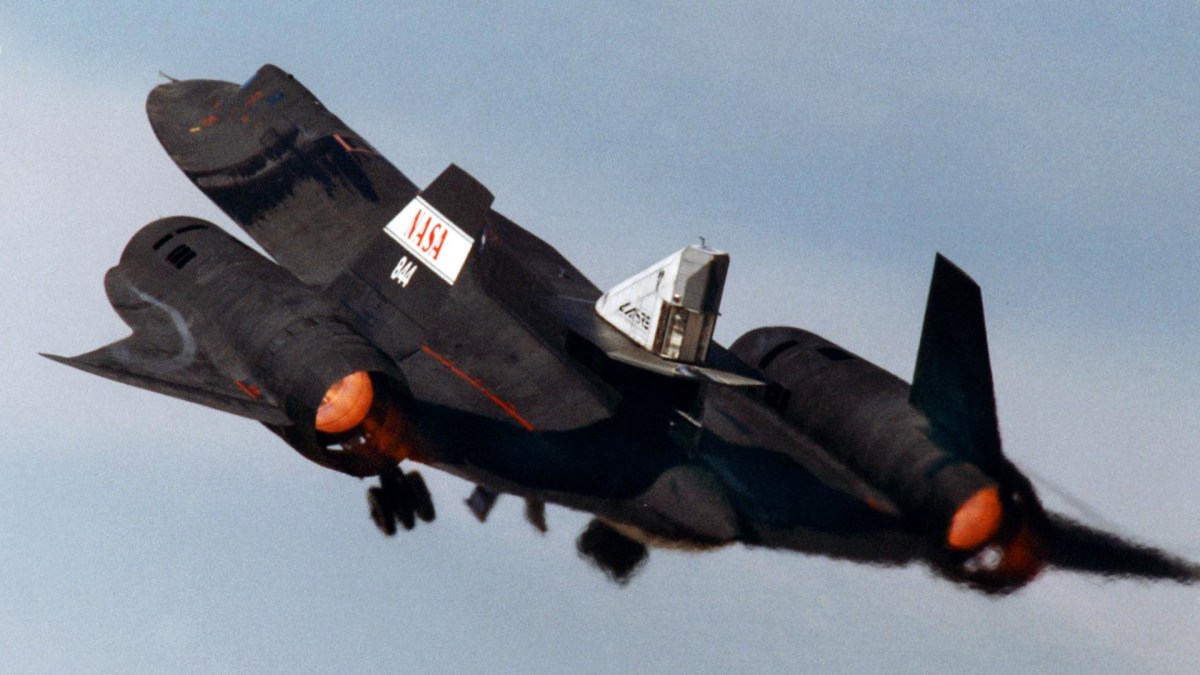
Another look at SR-71 tail number 844 during its service with NASA. This picture was taken on October 31, 1997, during a flight in support of the NASA/Rocketdyne/Lockheed Martin Linear Aerospike SR-71 Experiment (LASRE). NASA
The presentation mentioned above is the one NASA’s Isaacman gave last week at the annual All-In Summit in Los Angeles, California, during which he shared the SR-71-esque silhouette.
“In the service of the first A [aeronautics] in NASA, we are rebuilding our X-plane fleet. The X-59 is researching quiet supersonic flight , but it’s just the beginning,” he said at that time. “As NASA recommits to flight test and works alongside industry to push the boundaries of airframe and propulsion design, it will not be long before NASA once again is flying as high and as fast as we had in decades past, and then even more.”
Isaacman has made expanding NASA’s X-plane fleets a top priority since taking charge of the agency last year.
“You sure that’s a Blackbird?” the NASA administrator said during a live interview that immediately followed his remarks after the image was brought up, but did not offer any further clarification.
NASA Administrator showed this image during a presentation last week while talking about plans for new X-planes. NASA
“NASA has a long history of building and flying experimental aircraft that push the boundaries of what is possible,” NASA told TWZ directly when asked for more information. “As Administrator Isaacman has said, we want to see more X-planes flying in the years ahead, developing the technologies that will allow us to fly higher, farther, and faster than we have in decades. We look forward to sharing more as those efforts progress.”
We have reached back out to NASA in light of Aviation Week ‘s report.
As we wrote in our initial reporting on Isaacman’s comments:
“As for bringing a Blackbird back into operation for high-speed testing, which is now at the forefront of military aeronautics ( and civilian to a lesser degree ) after decades of being sidelined, that would be a very challenging operation. The SR-71s are long retired and have been placed in museums and other display areas. While the Pentagon could technically claw some of them back from their ‘on loan’ status, reconstituting even one of them would be a major undertaking as the entire support ecosystem that once sustained them has been gone for decades. Still, having a Mach 3+ capable jet for testing would be a highly relevant tool in a new age of high-speed flight exploration.”
“On the other hand, building a new test aircraft that aims higher and faster than the SR-71, but may be based on its ‘DNA,’ is certainly possible. Such an aircraft could leverage material science, avionics, flight controls, and engines that are seven decades more modern than its progenitor. Technology demonstrators in this class could also already exist in the classified domain. NASA could possibly assume ownership of one after the Pentagon declassifies it, as well.”
“ Regardless of how such an exotic aircraft is obtained, one of the biggest differentiating factors could be that a NASA aircraft is piloted by a human onboard, instead of it being a drone, but an uncrewed aircraft is possible too. “
Aviation Week ‘s report today notes that tail number 844 would probably be the best available candidate for returning to flight status. In addition to being the last produced and the last to fly, NASA previously upgraded it, including with “an automated digital flight and inlet control system to virtually eliminate the Blackbird’s problem of violent engine unstarts at high speed.” It has also been sitting in a controlled area in the Mojave Desert that is great for preservation.
It is also worth pointing out here that Isaacman is personally aware of the time and resources it takes to reconstitute high-end vintage military aircraft. He founded private ‘red air’ aggressor firm Draken International , making him once the owner of the world’s largest private air force stocked with old jets. His own private collection includes a demilitarized, ex-Ukrainian two-seat MiG-29UB that he flies regularly. He has also been working to restore a former Royal Air Force swing-wing Panavia Tornado F2 interceptor, which would be the most complex private military jet flying, if or when it returned to working condition.
At the same time, the SR-71 is in a completely different category, having been the very definition of a high-demand, low-density asset even at the very peak of its service life with the Air Force. Only 32 of these jets were ever built, and they were notoriously complex and expensive to operate and maintain. The aircraft’s Pratt & Whitney J58 turbojets ran on JP-7 fuel that is no longer in regular production. After 9/11, the possibility was raised of returning a Blackbird to service to support the Global War on Terror, but doing so was projected to cost between $40 and $45 million – and that was just two years after 844’s last flight.
There is also a possibility, in line with Isaacman’s comments last week, that 844 could re-merge in a substantially different, reworked form. There is even the potential it could be retrofitted for uncrewed, or at least pilot-optional, flight. Any such conversion effort would also be a major undertaking, as would sustaining the resulting bespoke jet. As we noted earlier, NASA could also use the SR-71 at Edwards to help inform other future designs.
At the same time, maybe this is all a coincidence and the SR-71 in question is getting some other form of TLC, but its months-long absence is certainly a curious development in light of the current push for new X-planes under Isaacman’s leadership.
Contact the author: joe@twz.com
Comments couldn’t be loaded. Please refresh the page.
作者:约瑟夫·特雷维西克
发布于美国东部时间2026年9月24日晚上8:38
上周,美国宇航局局长贾里德·艾萨克曼神秘地暗示了一项新型高空高速飞行X飞机的计划,他发布的一张飞机轮廓图立刻让人联想到著名的SR-71“黑鸟”侦察机。在我们的报道中,我们探讨了这可能意味着什么,包括SR-71是否可能被重新启用,或者至少会借鉴其经验,甚至拼凑出一个新的机身。然而现在,一架曾在NASA阿姆斯特朗飞行研究中心展出多年的SR-71却离奇失踪了。
《航空周刊》国防编辑、TWZ的好友史蒂夫·特林布尔(Steve Trimble)率先报道了前NASA SR-71侦察机(尾号844)在阿姆斯特朗空军基地失踪的消息。该基地与加利福尼亚州的爱德华兹空军基地毗邻。特林布尔的文章指出,卫星图像显示,这架飞机至少自5月17日起就未曾出现过。这架飞机最初的美国空军序列号为61-7980,是最后一架下线的“黑鸟”侦察机,也是最后一架飞行的“黑鸟”侦察机,于1999年完成了它的最后一次飞行。
这张摄于2018年的卫星图像显示,SR-71侦察机(尾号844)在加利福尼亚州阿姆斯特朗飞行研究中心外展出。(谷歌地球)
报道称,“目前这架飞机的处置情况尚不清楚,但《航空周刊》的消息来源表示,这架飞机今年早些时候被移入机库进行检查。” “这架尾号为844的SR-71S飞机曾被美国宇航局展出,但随后又消失了,这引发了人们对该机型在中断飞行26年后可能重启飞行计划的猜测。”
这是SR-71 844号机在NASA服役期间的另一张照片。这张照片拍摄于1997年10月31日,当时这架飞机正在执行NASA/Rocketdyne/Lockheed Martin线性气动尖锥SR-71实验(LASRE)的飞行任务。
上面提到的演示是美国宇航局的艾萨克曼上周在加利福尼亚州洛杉矶举行的年度全员峰会上所做的演示,期间他展示了类似 SR-71 的轮廓。
“为了服务于NASA的首要任务——航空事业,我们正在重建我们的X系列飞机机队。X-59正在研究静音超音速飞行,但这仅仅是个开始,”他当时说道。“随着NASA重新投入飞行测试,并与业界携手突破机身和推进系统设计的极限,NASA很快就能再次飞到几十年前那样的高度和速度,甚至更高。”
自去年接管美国宇航局以来,艾萨克曼一直将扩大美国宇航局的 X 型飞机机队作为首要任务。
“你确定那是一架黑鸟侦察机吗?”美国宇航局局长在照片被提及后立即接受现场采访时说道,但他没有提供任何进一步的澄清。
美国宇航局局长上周在一次演讲中展示了这张图片,当时他正在谈论新型X系列飞机的计划。
“NASA在建造和试飞不断突破极限的实验飞机方面有着悠久的历史,”NASA在被问及更多信息时直接告诉TWZ。“正如局长艾萨克曼所说,我们希望在未来几年看到更多X系列飞机飞行,开发出能够让我们飞得更高、更远、更快的技术,超越过去几十年的水平。随着这些工作的进展,我们期待与大家分享更多信息。”
鉴于《航空周刊》的报道,我们已再次联系了美国国家航空航天局(NASA)。
正如我们在最初报道艾萨克曼言论时所写的那样:
“至于让黑鸟侦察机重新投入高速飞行测试,这项技术如今已成为军事航空(以及在较小程度上,民用航空)的前沿领域,而此前它已被搁置数十年,但这将是一项极具挑战性的任务。SR-71侦察机早已退役,被安置在博物馆和其他展览场所。虽然五角大楼理论上可以从‘借用’状态中收回一些,但即使只重建一架,也是一项艰巨的任务,因为曾经支撑它们的整个支持体系已经消失数十年了。尽管如此,拥有一架能够以3马赫以上速度飞行的喷气式飞机进行测试,在新时代的高速飞行探索中仍然至关重要。”
另一方面,建造一架目标更高、速度更快的新型测试飞机,其设计可能基于SR-71的“基因”,这当然是可能的。这样的飞机可以利用比其前身先进七十年的材料科学、航空电子设备、飞行控制系统和发动机。此类技术验证机可能已经存在于机密领域。五角大楼解密后,NASA也可能获得其中一架的所有权。
“无论这种奇特的飞机是如何获得的,最大的区别之一可能是,NASA的飞机是由机上人员驾驶的,而不是无人机,但无人驾驶飞机也是有可能的。”
《航空周刊》今日报道指出,尾号为844的黑鸟侦察机可能是目前最有可能恢复飞行状态的机型。它不仅是最后一架下线的黑鸟,也是最后一架飞行的黑鸟。此外,NASA此前还对其进行了升级,包括加装“一套自动化数字飞行和进气控制系统,以彻底解决黑鸟在高速飞行时发动机剧烈熄火的问题”。而且,它一直停放在莫哈韦沙漠一处受控区域内,非常适合保存。
值得一提的是,艾萨克曼本人深知修复高端老式军用飞机所需的时间和资源。他曾创立私人“红方”假想敌公司德拉肯国际,一度拥有世界上最大的私人空军,其机队装备着大量老式喷气式飞机。他自己的私人收藏中就包括一架已退役的乌克兰双座米格-29UB战斗机,他经常驾驶这架飞机。此外,他还致力于修复一架前英国皇家空军的帕纳维亚“旋风”F2可变后掠翼截击机,如果这架飞机能够恢复飞行状态,它将成为目前仍在服役的最复杂的私人军用喷气式飞机。
与此同时,SR-71的情况则完全不同,即使在空军服役的鼎盛时期,它也堪称高需求、低密度资产的典范。这种飞机仅生产了32架,而且众所周知,其结构极其复杂,运营和维护成本也极其高昂。该机使用的普惠J58涡轮喷气发动机采用JP-7燃油,而这种燃油如今已停产。9·11事件后,曾有人提出让一架“黑鸟”重新服役以支援全球反恐战争,但预计耗资4000万至4500万美元——而这距离844号机最后一次飞行仅仅两年。
根据艾萨克曼上周的评论,844号飞机也有可能以截然不同的全新面貌重新组装。它甚至有可能被改装成无人驾驶或至少可选飞行员驾驶的机型。任何此类改装工作都将是一项艰巨的任务,维护这架定制喷气式飞机同样如此。正如我们之前提到的,NASA还可以利用爱德华兹空军基地的SR-71来为未来的其他设计提供参考。
与此同时,也许这一切都只是巧合,这架 SR-71 正在接受其他形式的精心维护,但考虑到艾萨克曼领导下目前正在大力推进新型 X 飞机项目,它长达数月的缺席无疑是一个令人好奇的现象。
联系作者:joe@twz.com
评论加载失败,请刷新页面。