F-102 Delta Dagger’s Weapons Bays Combined Rockets And Missiles In A Feat Of Cold War IngenuityF-102“三角匕首”战斗机的武器舱巧妙地将火箭弹和导弹结合在一起,展现了冷战时期的独创性。
It was the Air Force's first supersonic interceptor. In order to obtain that title, it carried its weapons internally via some remarkable engineering.
新闻视频
Updated Nov 27, 2020 6:27 PM EST
Today, internal weapons carriage is essentially a must-have feature for any next-generation stealth fighter . Designers of the latest low observable aircraft face the significant challenge of cramming often-bulky weapons inside a densely-packed airframe. Back in the early days of the Cold War, the team from the Convair company faced a similar predicament, albeit for other reasons, and managed to do an extremely elegant job with the weapons bays of its F-102 Delta Dagger interceptor.
In the days long before low observability, a whole generation of U.S. tactical jets also carried much — or even all — of their ordnance internally. The reasoning then was that any extraneous protrusions, missiles and rocket pods included, were to be done away with if possible, to minimize drag and ensure that the maximum speed and efficiency could be eked out of the airframe.
First flown in prototype form on October 24, 1953, the F-102 was designed as a destroyer of long-range Soviet bombers and was intended to replace a previous generation of subsonic interceptors primarily armed with guns and unguided rockets then in service with the U.S. Air Force’s Air Defense Command . Convair optimized the Delta Dagger for speed and decided to equip it with radar and with weapons offering longer reach, all with the aim of taking down nuclear-armed Soviet bombers before they could reach their targets.
Ensuring the F-102 achieved its intended straight-line performance was a struggle, hampered by the constraints of engine technology at the time, but above all by the limited understanding of aerodynamics in the supersonic realm. When drafted, the F-102 was planned to reach a top speed of Mach 1.88. But when flown in prototype YF-102 form, the fighter proved unwilling to push beyond Mach 0.98 in level flight. By 1954, the planned maximum speed had been revised to a more modest Mach 1.23 and, after a series of aerodynamic revisions, the delta-winged F-102 duly entered service as the U.S. Air Force’s first supersonic interceptor. A specially prepared YF-102A pre-production aircraft even recorded a speed of Mach 1.535 — the fastest of any Delta Dagger.
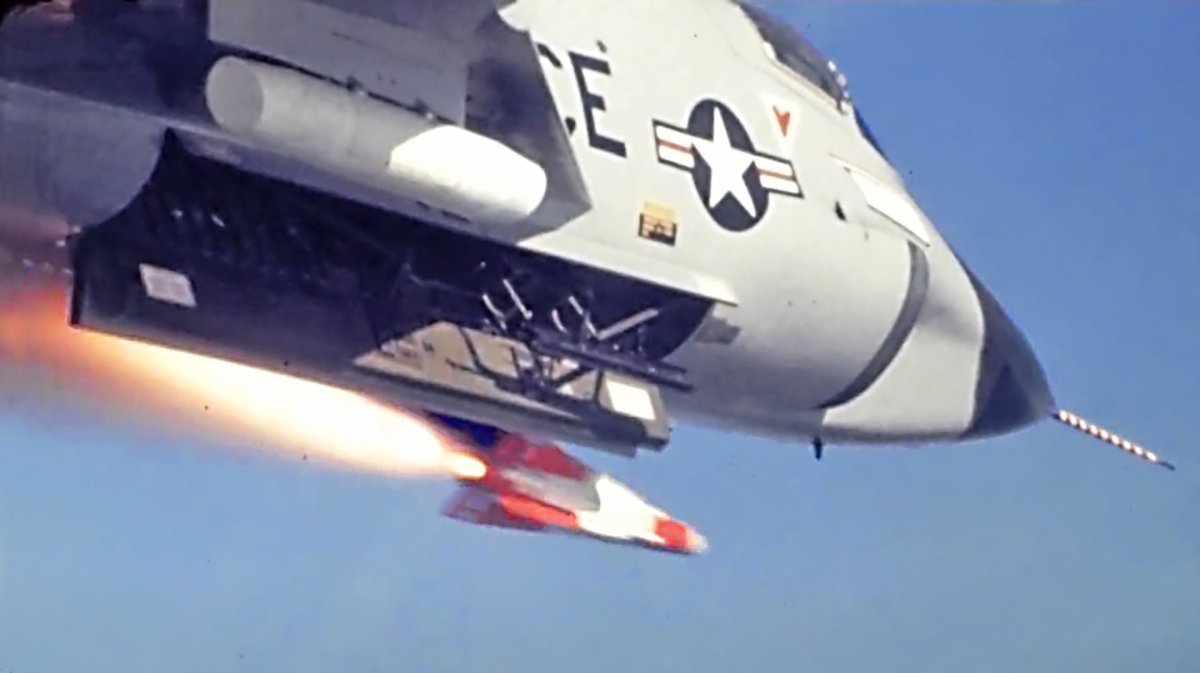
An F-102A prepares to ripple-fire a salvo of three Falcon missiles., SAN DIEGO AIR AND SPACE MUSEUM ARCHIVE
The internal weapons carriage was necessary to ensure the F-102 slipped through the air in supersonic pursuit of its bomber targets. Carrying its full load of weapons in its belly, the smooth lines of the Delta Dagger were interrupted only by the optional external drop tanks, each carrying either 215 or 192 gallons of additional fuel. However, carrying drop tanks limited the maximum speed to Mach 0.95.
From the start, the F-102 was intended to carry six air-to-air missiles (AAMs), all from the Hughes Falcon family, which eventually included variants of the AIM-4 and AIM-26. The F-102 carried its six missiles on trapeze launchers, two of which were installed in tandem in each of three weapons bays: left, center, and right. “You almost had to be a contortionist to load the center rails,” recalled Bill McAuley , a weapons technician with the 142nd Fighter Wing, Oregon Air National Guard.
When selected by the pilot, the appropriate launchers popped out of the bays and three missiles would be fired in a salvo. The timing of this was determined automatically by the radar fire-control system.
From the outset, the F-102’s bays had been designed around the Falcon series of missiles. This first-generation weapon was eventually developed into a wide range of variants, and Delta Dagger pilots were ultimately provided with multiple options when engaging threats with missiles.
An experimental version of the Falcon had been first tested in 1949 and the weapon initially entered service with the U.S. Air Force’s F-89H Scorpion interceptor. The weapon was available in semi-active radar-homing (SARH) and infrared-homing versions, a mix of missiles providing flexibility for engaging targets under different circumstances and when confronting various countermeasures.
A 431st Fighter Interceptor Squadron F-102A with a single Falcon visible in the right-hand bay., USAF/WIKIMEDIA COMMONS
The first of the radar-homing models were known as GAR-1s, while their infrared counterparts were GAR-2s. The effective range parameters for the initial SARH versions were between 5,000 and 25,000 feet. Equivalent data for the GAR-2 is not immediately available, but it seems the weapon’s performance was considered generally disappointing and production came to an end after just 1,600 examples had been completed.
The type designations were later changed to fit a new unified nomenclature system from 1962 onwards, with the base variants of the GAR-1 and 2 becoming the AIM-4 and AIM-4B, respectively.
Two Oregon Air Guardsmen load an AIM-4 Falcon into the weapons bay of an F-102 at Portland Air Base, Oregon, circa 1968., 142nd FW
The Falcon was improved throughout its service life, yielding the radar-guided GAR-1D, later known as the AIM-4A, with improved maneuverability and an increase in ceiling up to 60,000 feet, and the equivalent heat-seeking GAR-2A, or AIM-4C, which had a more sensitive infrared seeker. The AIM-4C was subsequently superseded by the improved AIM-4D, issued from 1963, and which could now be launched from a minimum range of 1,000 feet. This became the definitive infrared-guided Falcon for the F-102, and also featured a further improved seeker head that could lock onto targets at greater ranges.
The AIM-4A through D variants of the Falcons were all armed with a nearly 8-pound warhead that included just 2.7 pounds of explosive since a missile traveling at a speed of Mach 2-3 was judged to be adequate to bring down a bomber-size target. However, these early Falcons did require a direct hit, since they were not equipped with a proximity fuze .
An F-102 driver poses with his jet and a full load of Falcon missiles., SAN DIEGO AIR AND SPACE MUSEUM ARCHIVE
As well as unguided rockets and conventionally armed AAMs, the United States developed harder-hitting bomber-killer weapons during the Cold War too. Such weapons were intended to take out larger or high-priority targets, namely entire formations of bombers. Best known of these is the nuclear-armed AIR-2 Genie unguided air-to-air rocket. While the Genie was never issued to the F-102 force, the Delta Dagger did still receive an AAM with an atomic warhead. This was the GAR-11, later redesignated the AIM-26A, or “Nuclear Falcon,” introduced in late 1961.
Equipped with radar guidance, the new weapon had a top speed of Mach 2 and carried a W54 warhead with a yield of 0.5 kilotons. It also featured a proximity fuze to increase the probability of a kill. This was the only guided nuclear-armed AAM ever deployed by the U.S. Air Force and remained in the inventory until 1972.
The nuclear-armed AIM-26A missile., SAN DIEGO AIR AND SPACE MUSEUM ARCHIVE
As well as the nuclear-tipped AIM-26A, a conventionally armed AIM-26B was also available to F-102 units. Again boasting a proximity fuze, this missile had a much larger (48.5-pound) warhead than the original non-nuclear Falcons and around half the Delta Dagger fleet was converted to carry this potent weapon.
The new AIM-26 series weapons were longer and considerably bulkier than the previous Falcons and required modifications to the trapeze launchers in the center bay, which was the only bay adapted to carry them. In this way, the F-102 could carry two of these missiles in the center, a pair of earlier Falcons in each of the two outboard bays, plus a reduced load of 12 unguided rockets.
Since early AAMs were less than reliable and had a fairly large minimum engagement envelope, the Delta Dagger’s complement of guided missiles was bolstered by a load of folding-fin aerial rockets, or FFARs, cleverly installed in tubes integrated within the weapons bay doors. The rockets were a useful backup in case the main missiles malfunctioned or were spoofed by countermeasures. They also increased the magazine depth of the F-102, allowing it to take out as many bombers as possible if World War III were to have come.
A preserved F-102 with the weapons bays doors open and the Falcon missiles extended on their trapezes. Note also the blue-tipped rockets visible in the weapons bay door., RYAN FROST/WIKIMEDIA COMMONS
The rockets could also be used at lower altitudes where the early AAMs were least effective. For example, it required around 16 seconds between locking on to a target and launching a radar-guided Falcon. That might be acceptable for downing a lumbering bomber at high altitude, but was unlikely to yield success in a lower-level dynamic engagement. The infrared-guided Falcon, meanwhile, performed best when engaging a target flying above the F-102, which reduced the chances of its seeker being confused by ground clutter.
Technicians working in the left weapons bay of an F-102. Six sets of blast tubes were installed in the doors to vent the flame and gasses from the rocket motors., SAN DIEGO AIR AND SPACE MUSEUM ARCHIVE
At first, the rocket armament comprised 36 T-214-2 2-inch FFARs, but these gave way to 24 2.75-inch Mighty Mouse FFARs by mid-1956, being introduced on the 190th production aircraft and then being retrofitted on earlier jets. Weighing 18.5 pounds, each Mighty Mouse carried a 6-pound high-explosive warhead. In this revised form, the F-102’s rocket tubes were arranged as three in each of the four innermost weapons bay doors, each tube carrying a pair of four-foot-long FFARs. The effective range of the Mighty Mouse was around 2 miles.
Preserved at the National Museum of the United States Air Force in Dayton, Ohio, this F-102A retains the original 24-rocket installation., USAF/Ken LaRock
The procedure for launching the FFARs was even more visually impressive than the one for employing missiles. In an era of stealth, it’s a prerequisite that an aircraft’s weapons bay doors are open for the shortest possible period, enabling stores release before detection by enemy radar. That wasn’t a consideration for the Delta Dagger, but the doors were still able to open, unleash all 24 rockets, and then snap closed again within around two seconds. The weapons bay doors themselves were electrically actuated and operated by a complex system of compressed air maintained at a pressure of 1,500 pounds per square inch. Depending on the target, the pilot could choose to fire the rockets in salvos of six, 12, or 24. If rockets were selected, the missile trapezes would not be lowered into the slipstream.
For all the ingenuity of the F-102’s combined missile-and-rocket-toting weapons bay, FFARs as anti-aircraft weapons were, by the late 1950s, clearly from another era. Beginning in 1957, the rocket tubes were removed from the inner doors of the left and right bays, and from the two doors of the center bay, reducing the load to just 12 of the Mighty Mouse projectiles. This remained the standard ‘fit’ until the Delta Dagger was finally retired in 1976, making it the last USAF air defense fighter to carry FFARs in the air-to-air role.
An F-102A from the 509th Fighter Interceptor Squadron armed with AIM-4A and AIM-4D Falcon missiles at Da Nang Air Base, Vietnam, in 1968., USAF
In the end, while the design of the F-102’s weapons installation was admirable, the fighter was only as good as its weapons. According to Peter E Davies’ masterful account of the aircraft, F-102 Delta Dagger Units , pilots were broadly skeptical about the effectiveness of the FFARs, which were prone to fanning out or sometimes colliding. On the other hand, the Falcons were first-generation AAMs with all the limitations that entailed. In particular, they lacked agility and required considerable time to prepare for action. Even the “fire and forget” infrared-guided AIM-4D needed two minutes to cool the seeker before launch. Once committed to combat in Vietnam , the Falcon proved less effective than the AIM-7 Sparrow and AIM-9 Sidewinder , although in that war it was called upon primarily to tackle low-flying, agile targets, which were quite different from the bombers that it had been designed to shoot down.
While the Delta Dagger’s weapons bays were a notably compact solution to providing a Cold War interceptor with a range of weapons options while retaining a low-drag profile, this complex arrangement was not immune to failure, which was sometimes quite dramatic.
The third production F-102A unleashes a full salvo of 24 unguided rockets., SAN DIEGO AIR AND SPACE MUSEUM ARCHIVE
Davies recounts one such incident in a hangar at Thule Air Base, Greenland , in which an electrical fault in an F-102’s weapons bay resulted in an unplanned Falcon launch while the pilot was checking his jet’s fuel pumps. Despite the remaining load of Falcons and FFARs cooking off, there were no injuries to personnel, although both the F-102 and the hangar were wrecked.
Sometimes human error played a part too. Davies recounts the accidental shootdown of a T-33 training jet during a missile evaluation test involving what was supposed to be an inert Falcon in 1958. On this occasion, the F-102 ripple-fired three live Falcons, taking off a portion of the trainer’s tail. The T-33’s two crew ejected safely at 43,000 feet.
Ultimately, the demise of the “Century Series” aircraft spelled the end of internal weapons bays on U.S. fighter jets, at least for a time. The last of the F-106 Delta Darts — a much-improved development of the F-102 — bowed out of frontline service in 1988.
Internal weapons bays were destined to come back into vogue before long, with the emergence of a new generation of stealthy fighters, starting with the F-22 Raptor , which would take to the air in prototype form just two years after the F-106’s retirement. The F-22’s bays also use trapeze launchers — modern-day versions of those used in the F-102.
While we are unlikely to see a Delta Dagger-style combined rocket/missile weapons bay on a jet anytime soon — well, there is the possibility of such an arrangement with laser-guided rockets — work continues to expand stealthy fighters’ internal air-to-air payload options. These include the development of smaller hit-to-kill missiles , Lockheed Martin’s Sidekick to boost the F-35 ’s missile load, and the AIM-260 Joint Air Tactical Missile (JATM). The latter will be the U.S. Air Force’s first known air-to-air missile to be tailored from the outset for internal carriage since the Cold War.
Contact the author: thomas@thedrive.com
Comments couldn’t be loaded. Please refresh the page.
更新于美国东部时间2020年11月27日下午6:27。
如今,内置武器挂载几乎是所有下一代隐形战斗机的必备功能。最新型低可探测性飞机的设计师们面临着一项艰巨的挑战:如何在空间紧凑的机身内塞入通常体积庞大的武器。早在冷战初期,康维尔公司的团队也曾面临类似的困境,尽管原因不同,但他们最终成功地为F-102“三角匕首”截击机设计出了极其精妙的武器舱。
在低可探测性技术出现之前的很久,整整一代美国战术喷气式飞机都将大部分甚至全部弹药内置于机身。当时的理由是,任何外露的部件,包括导弹和火箭发射器,都应该尽可能地去除,以最大限度地减少阻力,确保机身能够发挥出最大的速度和效率。
F-102原型机于1953年10月24日首飞,其设计目标是拦截苏联远程轰炸机,并取代当时美国空军防空司令部服役的、主要装备机炮和非制导火箭的上一代亚音速截击机。康维尔公司对F-102进行了速度优化,并为其配备了雷达和射程更远的武器,其目的在于在苏联核轰炸机抵达目标之前将其击落。
确保F-102达到预期的直线飞行性能并非易事,这不仅受到当时发动机技术的限制,更主要的是由于人们对超音速空气动力学的理解尚不充分。F-102最初的设计目标是达到1.88马赫的最高速度。然而,在YF-102原型机的试飞中,该战斗机在平飞状态下最高速度却难以突破0.98马赫。到1954年,计划的最高速度被修正为更为保守的1.23马赫。经过一系列空气动力学改进后,采用三角翼设计的F-102最终正式服役,成为美国空军的第一款超音速截击机。一架经过特殊改装的YF-102A预生产型飞机甚至创下了1.535马赫的速度纪录——这是所有三角翼战斗机中最快的速度。
一架F-102A战斗机准备齐射三枚“猎鹰”导弹。(圣地亚哥航空航天博物馆档案馆)
为了确保F-102能够以超音速追击轰炸机目标,其内部武器挂架必不可少。F-102的机腹挂载了全部武器,其流畅的机身线条仅被可选装的外挂油箱所打破,每个油箱可携带215或192加仑的额外燃油。然而,携带副油箱会将最大速度限制在0.95马赫。
F-102战斗机从一开始就被设计为携带六枚空空导弹(AAM),全部来自休斯猎鹰系列,该系列最终还包括AIM-4和AIM-26的改进型。F-102使用吊架式发射器携带这六枚导弹,三个武器舱(左侧、中间和右侧)各安装两枚,呈并排排列。“你几乎得是个杂技演员才能把导弹装到中间的挂架上,”俄勒冈州空中国民警卫队第142战斗机联队的武器技师比尔·麦考利回忆道。
飞行员选定目标后,相应的发射装置会从弹舱弹出,并一次性发射三枚导弹。发射时机由雷达火控系统自动确定。
从一开始,F-102的弹舱设计就是围绕着“猎鹰”系列导弹展开的。这种第一代武器最终发展出多种衍生型号,而“三角匕首”战斗机的飞行员在用导弹攻击目标时也拥有了多种选择。
“猎鹰”导弹的实验版本于1949年首次进行测试,该武器最初装备于美国空军的F-89H“蝎子”截击机。该武器有半主动雷达制导(SARH)和红外制导两种版本,多种导弹的组合使其能够灵活地在不同情况下以及面对各种对抗措施时打击目标。
一架隶属于美国空军第431战斗机拦截中队的F-102A战斗机,右侧机舱内可见一枚“战隼”导弹。(图片来源:美国空军/维基共享资源)
第一批雷达制导型导弹被称为GAR-1,而其红外制导版本则被称为GAR-2。最初SARH型号的有效射程参数在5000至25000英尺之间。目前尚无GAR-2的相应数据,但该武器的性能似乎普遍令人失望,仅生产了1600枚后便停止了生产。
从 1962 年开始,为了适应新的统一命名系统,型号名称后来进行了更改,GAR-1 和 GAR-2 的基本型号分别变成了 AIM-4 和 AIM-4B。
大约1968年,在俄勒冈州波特兰空军基地,两名俄勒冈州空军国民警卫队队员将一枚AIM-4“猎鹰”导弹装入一架F-102战斗机的武器舱。(第142战斗机联队)
“猎鹰”导弹在其服役期间不断改进,衍生出雷达制导的GAR-1D(后更名为AIM-4A),其机动性更强,射高可达60,000英尺;以及与之相当的红外制导GAR-2A(即AIM-4C),后者配备了更灵敏的红外导引头。AIM-4C随后被改进型AIM-4D取代,AIM-4D于1963年开始服役,其最小发射距离可达1,000英尺。这成为F-102战斗机最终的红外制导“猎鹰”导弹,并配备了进一步改进的导引头,能够锁定更远距离的目标。
AIM-4A至D型“猎鹰”导弹均配备近8磅重的弹头,但仅包含2.7磅炸药,因为当时认为以2-3马赫速度飞行的导弹足以击落轰炸机大小的目标。然而,这些早期型号的“猎鹰”导弹必须直接命中目标才能击落目标,因为它们没有配备近炸引信。
一名F-102战斗机飞行员与他的战机和满载的猎鹰导弹合影。(圣地亚哥航空航天博物馆档案馆)
除了无制导火箭和常规武装空空导弹外,美国在冷战期间也研发了威力更大的轰炸机反制武器。这类武器旨在摧毁更大或优先级更高的目标,即整个轰炸机编队。其中最著名的当属携带核弹头的AIR-2“精灵”(Genie)无制导空空火箭。虽然“精灵”火箭从未装备F-102战斗机,但“三角匕首”(Delta Dagger)战斗机仍然装备了一种带有核弹头的空空导弹。这种导弹是GAR-11,后被重新命名为AIM-26A,或称“核猎鹰”(Nuclear Falcon),于1961年末投入使用。
这种新型武器配备雷达制导,最高速度可达2马赫,并携带一枚当量为0.5千吨的W54型核弹头。它还配备了近炸引信,以提高杀伤概率。这是美国空军部署的唯一一款制导型核弹头空空导弹,并一直服役到1972年。
携带核弹头的AIM-26A导弹。(圣地亚哥航空航天博物馆档案馆)
除了核弹头的AIM-26A导弹外,F-102部队还可以装备常规武器的AIM-26B导弹。这款导弹同样配备了近炸引信,其弹头比最初的非核“战隼”导弹要大得多(重达48.5磅),大约一半的“三角匕首”战斗机都改装成了可以携带这种威力强大的武器。
新型AIM-26系列导弹比之前的“猎鹰”导弹更长、更笨重,需要对中央弹舱的梯形发射器进行改装,因为只有中央弹舱才能装载这种导弹。这样一来,F-102战斗机可以在中央弹舱携带两枚AIM-26导弹,在两侧弹舱各携带两枚早期的“猎鹰”导弹,此外还可以携带12枚非制导火箭弹。
由于早期空空导弹可靠性欠佳且最小作战半径较大,F-102“三角匕首”战斗机的制导导弹配置得到了大量折叠翼航空火箭(FFAR)的补充。这些火箭巧妙地安装在集成于武器舱门内的发射管中。如果主导弹发生故障或被敌方干扰,这些火箭便可作为有效的备用武器。此外,它们还增加了F-102的弹药库容量,使其能够在第三次世界大战爆发时尽可能多地击落轰炸机。
一架保存完好的F-102战斗机,武器舱门打开,猎鹰导弹从吊架上伸出。请注意武器舱门内可见的蓝色火箭弹头。(图片来源:RYAN FROST/WIKIMEDIA COMMONS)
这些火箭还可以用于早期空空导弹效果最差的低空作战。例如,从锁定目标到发射雷达制导的“猎鹰”火箭大约需要16秒。这对于在高空击落笨重的轰炸机或许可以接受,但在低空动态交战中则难以奏效。而红外制导的“猎鹰”火箭在攻击F-102上方飞行的目标时表现最佳,这降低了其导引头被地面杂波干扰的可能性。
技术人员正在F-102战斗机的左侧武器舱内工作。舱门上安装了六组排气管,用于排出火箭发动机的火焰和气体。(圣地亚哥航空航天博物馆档案馆)
最初,F-102的火箭武器装备包括36枚T-214-2型2英寸FFAR火箭弹,但到1956年中期,这些火箭弹被24枚2.75英寸“大力鼠”(Mighty Mouse)FFAR火箭弹取代,这些火箭弹首先装备于第190架生产型飞机,随后又改装到更早的喷气式飞机上。每枚“大力鼠”火箭弹重18.5磅,携带一枚6磅重的高爆弹头。改进后的F-102的火箭发射管布置在四个最内侧的武器舱门内,每个发射管三个,每个发射管携带两枚4英尺长的FFAR火箭弹。“大力鼠”火箭弹的有效射程约为2英里。
这架F-102A战斗机现藏于俄亥俄州代顿市的美国空军国家博物馆,保留了原有的24枚火箭弹发射装置。(图片来源:美国空军/肯·拉罗克)
发射FFAR火箭的程序比发射导弹的程序更具视觉冲击力。在隐身时代,飞机武器舱门必须尽可能短时间开启,以便在敌方雷达探测到之前投放武器。三角匕首导弹无需考虑这一点,但舱门仍然能够在两秒左右的时间内打开、发射全部24枚火箭,然后迅速关闭。武器舱门本身由电动装置驱动,并由一套复杂的压缩空气系统控制,该系统维持在每平方英寸1500磅的压力。根据目标的不同,飞行员可以选择齐射6枚、12枚或24枚火箭。如果选择齐射火箭,导弹吊架不会下降到气流中。
尽管F-102的导弹和火箭弹组合弹舱设计巧妙,但到了20世纪50年代末,FFAR作为防空武器显然已经过时。从1957年开始,左右弹舱内侧舱门以及中央弹舱两个舱门上的火箭发射管被移除,使FFAR的载弹量减少到仅12枚“大力鼠”火箭弹。这种配置一直沿用至1976年“三角匕首”战斗机最终退役,使其成为美国空军最后一款在空对空作战中使用FFAR的防空战斗机。
1968年,美国空军第509战斗机拦截中队的一架F-102A战斗机,装备有AIM-4A和AIM-4D“猎鹰”导弹,停放在越南岘港空军基地。
最终,尽管F-102的武器系统设计令人称道,但其性能完全取决于武器。根据彼得·E·戴维斯在其著作《F-102三角匕首部队》中对该机的精辟描述,飞行员普遍对FFAR导弹的效能持怀疑态度,因为这些导弹容易散布,有时甚至会发生碰撞。另一方面,F-102“猎鹰”导弹作为第一代空空导弹,存在着诸多固有的局限性。尤其值得注意的是,它们缺乏机动性,且需要相当长的准备时间。即使是“发射后不管”的红外制导AIM-4D导弹,在发射前也需要两分钟来冷却导引头。在越南战争中,“猎鹰”导弹的效能远逊于AIM-7“麻雀”和AIM-9“响尾蛇”导弹,尽管在越南战争中,它的主要任务是攻击低空飞行、机动性强的目标,这与它最初设计用于击落的轰炸机截然不同。
虽然 Delta Dagger 的武器舱设计紧凑,为冷战时期的拦截机提供了多种武器选择,同时保持了低阻力外形,但这种复杂的布局并非不会出现故障,有时故障后果相当严重。
第三架量产型F-102A发射了24枚无制导火箭。(圣地亚哥航空航天博物馆档案馆)
戴维斯讲述了格陵兰岛图勒空军基地机库发生的一起类似事件:一架F-102战斗机的武器舱发生电气故障,导致一枚F-102“猎鹰”火箭弹意外发射,当时飞行员正在检查飞机的燃油泵。尽管机库内剩余的F-102和FFAR火箭弹仍在燃烧,但所幸无人受伤,只是F-102战斗机和机库都损毁了。
有时人为失误也起了作用。戴维斯讲述了1958年一次导弹评估测试中,一架T-33教练机被意外击落的事件。当时,F-102战斗机本应发射一枚惰性“猎鹰”导弹,却意外地发射了三枚实弹,击中了教练机的尾翼。T-33的两名机组人员在43000英尺(约13000米)的高空安全弹射。
最终,“世纪系列”战机的退役标志着美国战斗机内置武器舱的终结,至少在一段时间内是如此。最后一架F-106“三角镖”战斗机——F-102的改进型——于1988年退役。
随着新一代隐形战斗机的出现,内置武器舱注定会很快重新流行起来,其中最引人注目的是F-22“猛禽”战斗机,它在F-106退役仅仅两年后就以原型机的形式首飞。F-22的武器舱也采用了吊架式发射器——这是F-102所用发射器的现代版本。
虽然我们不太可能很快在喷气式飞机上看到类似“三角匕首”导弹发射系统那样的火箭/导弹组合武器舱——当然,如果使用激光制导火箭,这种方案并非不可能——但扩展隐形战斗机内部空空导弹有效载荷的选择范围的工作仍在继续。这些工作包括研发更小的直接命中杀伤导弹、洛克希德·马丁公司用于提升F-35导弹载荷的“侧踢”导弹系统,以及AIM-260联合空空战术导弹(JATM)。后者将是冷战以来美国空军首款从一开始就为内部携带而设计的空空导弹。
联系作者:thomas@thedrive.com
评论加载失败,请刷新页面。