Yes, The U.S. Navy Also Took The Spitfire Into Battle During World War II是的,美国海军在二战期间也曾使用喷火战斗机参战。
On the type's 85th birthday, we celebrate the little-known and short-lived U.S. Navy Spitfire unit that fought a different kind of war over Normandy.
Published Mar 5, 2021 6:24 PM EST
The Supermarine Spitfire, which first took to the air 85 years ago today, is one of the few aircraft that can justifiably be termed iconic. While this classic fighter’s service in the hands of the U.K. Royal Air Force and its Commonwealth allies, and even with the U.S. Army Air Forces, has been recounted in numerous books, articles, movies , and other media, it’s far less well known that it was also taken to war by the U.S. Navy.
The Spitfire’s exploits in World War II have made it a symbol of that conflict, and of its contribution to the heroic defense of the United Kingdom during the Battle of Britain in 1940, in particular. As the tide of the war turned, it helped lead the Allied charge into Nazi-occupied Europe, which is where the U.S. Navy entered the Spitfire story.
Lieutenant Robert F. Doyle, US Naval Reserve (USNR), shakes hands with his wingman, Ensign John F. Mudge, USNR, both of Cruiser Scouting Squadron 7 (VCS-7), after their return from a gunfire-spotting and strafing mission over the German lines, in which they broke up an enemy armored column moving toward the Normandy front., National Archives
On June 6, 1944, the biggest amphibious invasion force in history was assembled for D-Day , poised to begin the grueling work of liberating western Europe . The Navy, by then, had proven the ascendancy of the aircraft carrier as the ultimate arbiter of naval warfare, but it contributed none of these vessels to the Normandy landings.
Instead, Naval Aviation was on hand to operate over the beachhead in support of the battleships and cruisers that would blast German positions along the French coast as the Allies headed ashore. This was the “air spotting” mission and it was traditionally provided by floatplanes, two or three of which could be launched from these warships by catapult, before recovering alongside after a sea landing. Their job was to observe the targets of naval artillery to see where the projectiles were landing, transmitting their observations back by radio so the guns could be corrected accordingly. Additionally, they could also work more like forward air controllers , reporting developments on the battlefield, to help neutralize counterattacks.
Up until then, the air spotting task had been handled by the biplane Curtiss SOC Seagull and the monoplane Vought OS2U Kingfisher, which were rugged and reliable, but which were considered ill-equipped to defend themselves over the beachhead, where they could meet the latest variants of the Luftwaffe’s Messerschmitt Bf 109 and Focke-Wulf Fw 190 fighters. During operations in the Mediterranean in 1943, the SOC and OS2U had been shown to be vulnerable to fighter attack, and efforts were made to retrain the Navy’s spotter pilots to handle fighters like the Curtiss P-40 Warhawk or North American P-51 Mustang , which would give them the chance to fight back.
A Curtiss SOC Seagull of VCS-7 beached at an English airfield after the unit had converted to flying the Spitfire, circa June 1944. Another SOC and a Vought OS2U are parked in the background., National Archives
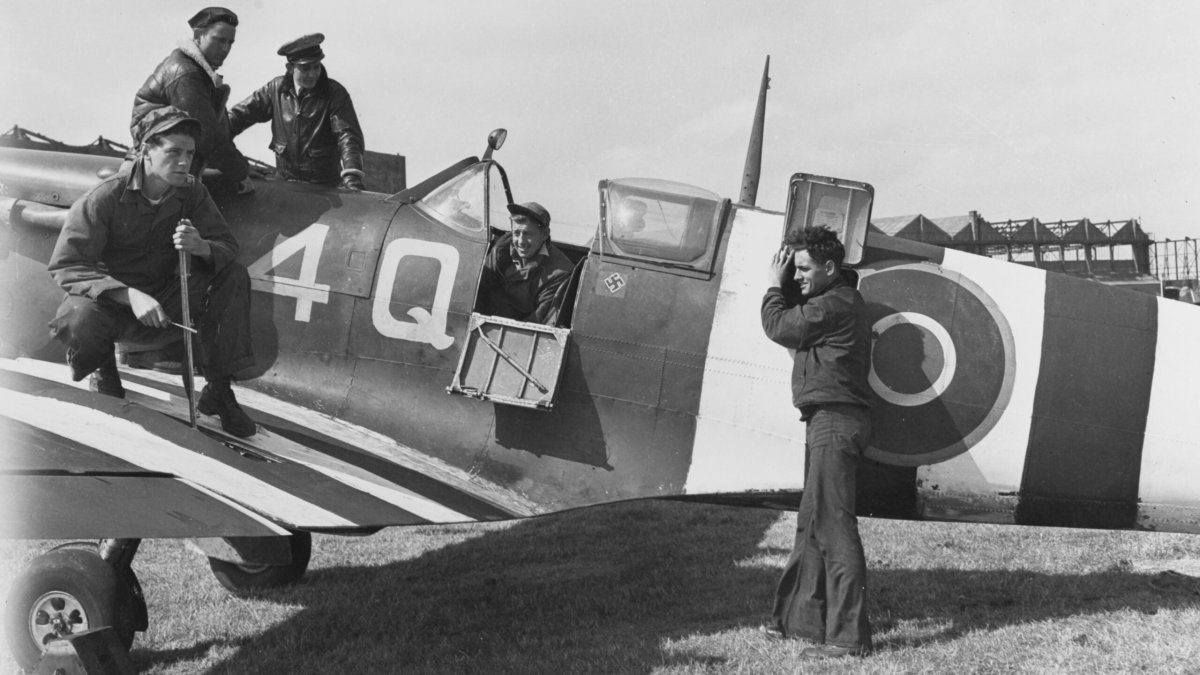
However, rather than getting their hands on any of the U.S. Army Air Forces’ (USAAF) latest single-engine fighters, it was decided that 17 pilots from Cruiser Scouting Squadrons (VCS) and Observation Squadrons (VO) assigned to battleships and cruisers would convert to ex-Royal Air Force Spitfire Mk Vb fighters. Having been introduced to service in 1941, these were hardly state-of-the-art by mid-1944 but were armed with a pair of 20mm cannons and four .303-caliber machine guns for useful defensive firepower.
The aviators were brought together as VCS-7 (although some sources state that VOS-7 was the correct designation, contemporary accounts refute this). Regardless, available evidence suggests this was the only Navy squadron to ever fly the Spitfire. Perhaps, too, it was the shortest-lived Navy flying squadron.
For its part, the USAAF was already well versed with the Spitfire, its units having taken it into battle during the invasion of North Arica in November 1942. Once they started to come back to England, they traded their war-weary British fighters for P-51s and Lockheed P-38 Lightnings . The remaining Army Spitfires were turned over to the 67th Tactical Observation Group, later the 67th Tactical Reconnaissance Group, part of the Ninth Air Force. The 67th used the aircraft for artillery spotting, weather and photo-reconnaissance, and bomb damage assessment. They also flew daring low-level pre-D-Day invasion missions over northern France in the reconnaissance role.
Training for the VCS-7 pilots took place with the 67th Tactical Reconnaissance Group, which was flying Spitfires from Middle Wallop in southern England. The naval aviators were schooled in defensive fighter tactics, aerobatics, navigation, and formation flying, as well as their primary spotting role.
A Spitfire Mk Vb of the 107th Tactical Reconnaissance Squadron, 67th Tactical Reconnaissance Group. , NATIONAL ARCHIVES
On May 28, 1944, VCS-7 was declared operational and moved to its new home at Royal Naval Air Station (RNAS) Lee-on-Solent, on the southern English coast. Its Spitfire Mk Vb aircraft were all second-hand and wore RAF camouflage and markings; at least still one carried a kill marking below the cockpit from its previous operator. Black and white “invasion stripes” were added to wings and fuselages for easy recognition.
At this airfield were no fewer than 10 squadrons, in total, all tasked with air spotting, or for tactical reconnaissance, and comprising five from the RAF, four Royal Navy, plus VCS-7. Collectively, these formed the Air Spotting Pool, 34th Tactical Reconnaissance Wing, 2nd Tactical Air Force. As well as Spitfires, these units flew the type’s carrier-borne cousin, the Seafire, plus Mustangs, and reportedly Hawker Typhoons. For D-Day itself, some of the aircraft were pooled, and VCS-7 was given Seafires and Spitfires.
VCS-7 pilots and English personnel in the ready room Lee-on-Solent, awaiting orders to fly over to France. Ensign Robert J. Adams is drinking a cup of tea, while Lieutenant Alexander A. Smith studies maps, second from the right., NATIONAL ARCHIVES
Their work in the upcoming invasion would be to spot for the Western Naval Task Force, providing fire support to the U.S. troops landing at Utah and Omaha beaches, and the Eastern Naval Task Force, supporting the British landings at Gold, Juno, and Sword beaches.
A map showing the Normandy invasion area including channels cleared of mines, location of vessels engaged in bombardment, and targets on shore, PUBLIC DOMAIN
For VCS-7, operations began at 04:41 AM on June 6, for the first spotting missions of Operation Overlord, as the D-Day landings were codenamed.
The tactics employed by the air spotters are described by Steven D. Hill in Spitfires of the US Navy :
Typical spotting missions utilized two aircraft. The lead plane functioned as the spotter. The wingman, or “weaver,” provided escort and protected the flight against enemy aerial attack. The clocking, or ship control, method was utilized on the majority of spotting sorties. Standard altitude for spotting missions was 6,000 feet, but poor weather forced the spotter to operate between 1,500 and 2,000 feet. Occasionally, missions were flown at even lower altitudes. Drop tanks were used to increase range. A typical spotting sortie lasted close to two hours. This provided 45 minutes on station and one hour in transit.
As it was, the Luftwaffe presence over the beachhead was not as bad as had been feared, although six or seven aircraft from Lee-on-Solent’s 34th Tactical Reconnaissance Wing were lost. Sources disagree whether these fell to anti-aircraft guns or were shot down by German fighters. Four VCS-7 pilots came under attack from Bf 109s and Fw 190s, but all emerged unscathed. It’s worth recalling too, that the Spitfire Mk Vb was, by this time, an aging model, inferior to the latest German fighters, and at least some of these particular airframes had likely seen heavy combat usage already in North Africa.
VCS-7 pilots are briefed before flying a gunfire spotting mission over the Normandy beachheads. From left to right: Wing Commander Robert J. Hardiman, RAF, Commanding Allied Spotter Pilots; Ensign Robert J. Adams, USNR; Major Noel East, British Army Intelligence; Lieutenant Harris Hammersmith, Jr., USNR; and Captain John Ruscoe, Royal Artillery, Gunnery Liaison Officer., National Archives
The only confirmed VCS-7 loss was to anti-aircraft gunfire, which claimed Lieutenant Richard M. Barclay of the USS Tuscaloosa (CA-37). His wingman made it back to base with severe damage to his aircraft. While Barclay’s is the only Normandy campaign loss recorded by the official VCS-7 combat report, there may have been more — other sources list a total of seven or eight of the squadron’s aircraft lost to enemy action throughout its existence, plus one loss not due to enemy action, over the course of 209 sorties. VCS-7’s own report lists 191 sorties between June 6 and 25, most of these on the first three days of the campaign.
One of the VCS-7 pilots, Ensign Robert J. Adams, reportedly became the first Naval aviator to land in France after D-Day, when he landed his damaged Spitfire on an auxiliary landing field in Allied-occupied territory.
By June 26, the Allied invasion force had advanced so far into Normandy that its spearhead was out of the range of the naval guns, and VCS-7 was disbanded. The aviators went back to their ships, bringing with them nine Distinguished Flying Crosses, six Air Medals, and five Gold Stars.
Although it was only a brief, cameo appearance in the Spitfire saga, the U.S. Navy’s role in the story is one that is worth remembering, for the bravery of its pilots and their valuable contribution to the liberation of Europe, on this, the anniversary of the type’s maiden flight.
Contact the author: thomas@thedrive.com
Comments couldn’t be loaded. Please refresh the page.
发布时间 2021 年 3 月 5 日下午 6:24(美国东部时间)
85年前的今天,喷火战斗机首次翱翔蓝天,它是少数几款真正称得上“标志性”的飞机之一。这款经典战斗机曾在英国皇家空军及其英联邦盟国,甚至美国陆军航空队服役,其事迹已被无数书籍、文章、电影和其他媒体所记载,但鲜为人知的是,它也曾被美国海军投入战争。
喷火战斗机在二战中的英勇事迹使其成为那场战争的象征,尤其是在1940年不列颠空战中,它为保卫英国做出了卓越贡献。随着战局的逆转,它助力盟军向纳粹占领的欧洲发起冲锋,美国海军也由此与喷火战斗机结下了不解之缘。
美国海军预备役中尉罗伯特·F·多伊尔与他的僚机、海军预备役少尉约翰·F·穆奇握手。两人均隶属于第7巡洋舰侦察中队(VCS-7),刚刚完成对德军防线的炮火侦察和扫射任务,并在任务中击溃了一支正向诺曼底前线推进的敌军装甲纵队。(美国国家档案馆)
1944年6月6日,历史上规模最大的两栖登陆部队集结完毕,准备进行诺曼底登陆,开始解放西欧的艰苦征程。当时,海军已经证明了航空母舰在海战中的绝对优势,但海军并未向诺曼底登陆部队派出任何一艘航母。
相反,海军航空兵的任务是在滩头阵地上空执行作战任务,支援战列舰和巡洋舰对法国沿岸德军阵地进行炮击,为盟军登陆提供火力支援。这项任务被称为“空中侦察”,传统上由水上飞机执行,两到三架水上飞机可由弹射器从军舰上起飞,并在海上登陆后返回舰边。它们的任务是观察海军炮兵的目标,确定炮弹的落点,并通过无线电将观察结果传回,以便炮兵进行相应的修正。此外,它们还可以像前线空中管制员一样工作,报告战场动态,帮助盟军挫败德军的反击。
在此之前,空中侦察任务一直由寇蒂斯SOC海鸥双翼机和沃特OS2U翠鸟单翼机承担。这两种飞机坚固可靠,但被认为装备不足,难以在滩头阵地上空自卫,因为它们会遭遇德国空军最新型的梅塞施密特Bf 109和福克-沃尔夫Fw 190战斗机。1943年地中海战役期间,SOC和OS2U暴露出易受战斗机攻击,因此海军开始着手重新训练侦察飞行员,使其能够驾驶寇蒂斯P-40战鹰或北美P-51野马等战斗机,从而获得反击的机会。
大约在1944年6月,VCS-7中队的一架寇蒂斯SOC海鸥飞机在换装喷火战斗机后,停泊在英国的一个机场。背景中还停放着另一架SOC和一架沃特OS2U飞机。(英国国家档案馆)
然而,他们并没有选择美国陆军航空队(USAAF)最新的单引擎战斗机,而是决定让17名来自巡洋舰和巡洋舰上的巡洋舰侦察中队(VCS)和观察中队(VO)的飞行员换装前英国皇家空军的喷火Mk Vb战斗机。这些战斗机于1941年服役,到1944年中期已算不上最先进的机型,但配备了两门20毫米机炮和四挺.303口径机枪,具备一定的防御火力。
这些飞行员被编入VCS-7中队(尽管一些资料称VOS-7才是正确的番号,但当时的记载否定了这一点)。无论如何,现有证据表明,这是海军唯一一支驾驶过喷火战斗机的飞行中队。或许,它也是海军历史上存在时间最短的飞行中队。
美国陆军航空队(USAAF)对喷火战斗机早已驾轻就熟,其部队曾在1942年11月北非战役中使用过这种战斗机。部队返回英国后,用P-51和洛克希德P-38闪电战斗机替换了这些饱经战火的英国战斗机。剩余的陆军喷火战斗机则移交给了第九航空队下属的第67战术观察大队(后更名为第67战术侦察大队)。第67大队使用这些飞机进行炮兵观测、气象侦察、照相侦察和轰炸损失评估。他们还在诺曼底登陆前夕,执行了多次大胆的低空侦察任务,飞越法国北部上空。
VCS-7飞行员的训练是在驻扎于英格兰南部米德尔沃洛普的第67战术侦察大队进行的,该大队当时驾驶的是喷火战斗机。海军飞行员接受了防御性战斗机战术、特技飞行、导航和编队飞行等方面的训练,同时也学习了他们的主要侦察任务。
隶属于第67战术侦察大队第107战术侦察中队的一架喷火式Mk Vb战斗机。(美国国家档案馆藏)
1944年5月28日,VCS-7中队宣布投入作战,并迁至位于英格兰南部海岸的皇家海军航空站(RNAS)李昂索伦特站。该中队的喷火式Mk Vb战斗机均为二手,涂装为英国皇家空军的迷彩和标志;至少有一架飞机的座舱下方还保留着前任使用者留下的击落标记。为了便于识别,机翼和机身上都加装了黑白相间的“入侵条纹”。
该机场总共驻扎着不少于10个中队,全部负责空中侦察或战术侦察,其中包括5个英国皇家空军中队、4个英国皇家海军中队以及VCS-7中队。这些中队共同组成了空中侦察池,隶属于第2战术空军第34战术侦察联队。除了喷火战斗机外,这些部队还装备了该机型的舰载版本——海火战斗机,以及野马战斗机,据报道还有霍克台风战斗机。在诺曼底登陆日当天,部分飞机被集中调配,VCS-7中队获得了海火战斗机和喷火战斗机。
VCS-7中队的飞行员和英国人员在李昂索伦特号的准备室里,等待飞往法国的命令。少尉罗伯特·J·亚当斯正在喝茶,而中尉亚历山大·A·史密斯(右数第二位)正在研究地图。(美国国家档案馆)
他们在即将到来的入侵行动中的任务是为西部海军特遣部队提供火力支援,为在犹他海滩和奥马哈海滩登陆的美军提供火力支援;同时为东部海军特遣部队提供火力支援,为在黄金海滩、朱诺海滩和剑滩登陆的英军提供火力支援。
一张显示诺曼底登陆区域的地图,包括已清除水雷的航道、参与炮击的舰船位置以及岸上目标,公共领域
VCS-7 的行动于 6 月 6 日凌晨 4 点 41 分开始,执行“霸王行动”(即诺曼底登陆的代号)的首次侦察任务。
史蒂文·D·希尔在《美国海军的喷火战斗机》一书中描述了空中观察员所采用的战术:
典型的侦察任务使用两架飞机。领头机担任侦察机,僚机(或称“编队机”)负责护航并保护编队免受敌方空中攻击。大多数侦察飞行任务采用编队飞行控制法。侦察任务的标准飞行高度为6000英尺,但恶劣天气迫使侦察机在1500至2000英尺的高度执行任务。有时,任务飞行高度甚至更低。副油箱用于增加航程。一次典型的侦察飞行任务持续近两个小时,其中45分钟用于侦察,1小时用于飞行。
事实上,德军在滩头阵地的部署并没有预想的那么严重,尽管李昂索伦特第34战术侦察联队损失了六七架飞机。关于这些飞机是被高射炮击落还是被德国战斗机击落,各方说法不一。VCS-7中队的四名飞行员遭到Bf 109和Fw 190战斗机的攻击,但全部毫发无损。值得一提的是,此时的喷火Mk Vb型战斗机已经老旧,性能逊于最新的德国战斗机,而且这些飞机中至少有一些可能已经在北非战场上经历过激烈的战斗。
VCS-7中队的飞行员在执行诺曼底滩头阵地炮火侦察任务前接受简报。从左至右:英国皇家空军联队长罗伯特·J·哈迪曼(Robert J. Hardiman),盟军侦察飞行员指挥官;美国海军预备役少尉罗伯特·J·亚当斯(Robert J. Adams);英国陆军情报部门少校诺埃尔·伊斯特(Noel East);美国海军预备役中尉哈里斯·哈默史密斯(Harris Hammersmith, Jr.);以及英国皇家炮兵上尉、炮兵联络官约翰·罗斯科(John Ruscoe)。(图片来源:英国国家档案馆)
VCS-7中队唯一确认的损失是被防空炮火击落,塔斯卡卢萨号重巡洋舰(CA-37)上的理查德·M·巴克莱中尉不幸牺牲。他的僚机虽然飞机严重受损,但最终安全返回基地。巴克莱的损失是VCS-7官方作战报告中记录的唯一诺曼底战役损失,但实际情况可能并非如此——其他资料显示,该中队在其存在期间共有七八架飞机因敌方行动而损失,另有一架飞机并非因敌方行动而损失,总共执行了209架次作战任务。VCS-7自身的报告显示,该中队在6月6日至25日期间共执行了191架次作战任务,其中大部分集中在战役开始后的前三天。
据报道,VCS-7 中队的一名飞行员,少尉罗伯特·J·亚当斯,在诺曼底登陆日后成为第一位在法国着陆的海军飞行员。当时,他驾驶着受损的喷火战斗机降落在盟军占领区的辅助着陆场上。
到6月26日,盟军入侵部队已深入诺曼底腹地,其先头部队已超出海军炮火的射程,VCS-7中队随即解散。飞行员们返回各自的舰艇,带回了九枚杰出飞行十字勋章、六枚航空奖章和五枚金星勋章。
尽管美国海军在喷火战斗机的传奇故事中只是短暂露面,但在这个喷火战斗机首飞周年纪念日,美国海军在这一故事中的角色值得铭记,因为其飞行员的勇敢以及他们为解放欧洲做出的宝贵贡献。
联系作者:thomas@thedrive.com
评论加载失败,请刷新页面。