Navy F/A-18 Legacy Hornets Have Taken Their Last Cruise Aboard A U.S. Aircraft Carrier海军F/A-18“老大黄蜂”战斗机已在美国航母上完成了最后一次巡航。
33 years after the F/A-18's first cruise, the Navy's Legacy Hornet fleet has made its last scheduled deployment aboard a carrier.
Updated Apr 14, 2018 5:46 PM EDT
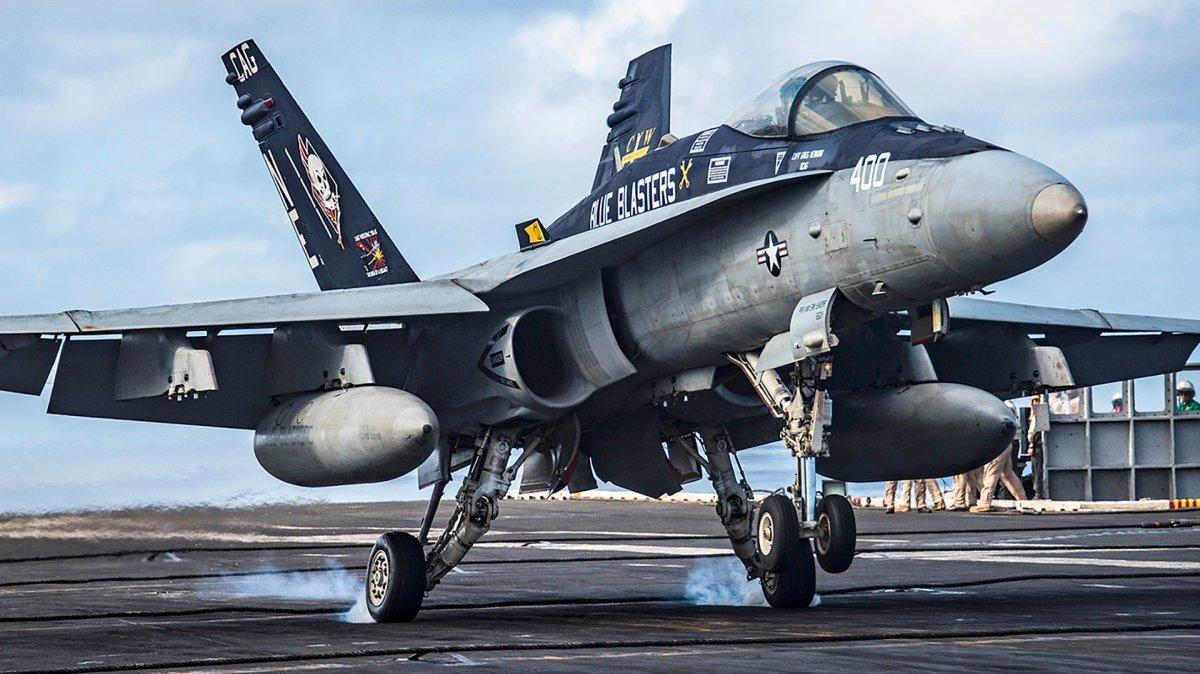
The Navy’s F/A-18 ‘Legacy’ Hornets have made their final cruise aboard an aircraft carrier. VFA-34 “Blue Blasters” had the honor of putting the F/A-18C through its final operational deployment aboard the USS Carl Vinson, which just returned from a three-month cruise. During that deployment, the Carl Vinson made history by being the first American aircraft carrier to make a port visit in Vietnam.
The news that this cruise will be the last for the Navy’s Legacy Hornets came as a surprise to many. Our friends over at Scramble Magazine were the first to report it on their Facebook page , stating:
“On 11 April 2018, Strike Fighter Squadron (VFA) 34 Blue Blasters (‘NE-4xx’) arrived back home at NAS Oceana (VA) after a three-month deployment with CVW-2 on board the USS Carl Vinson (CVN-70). The F/A-18C squadron embarked on 5 January 2018 the Vinson. The deployment marked the sundown cruise of the US Navy F/A-18C Hornet. CVW-3’s VFA-131 Wildcats (‘AC-3xx’) and CVW-8’s VFA-37 Bulls (‘AJ-4xx’) still operate the legacy F/A-18C Hornet but these squadrons will not deploy anymore with these types. VFA-34 will transition to F/A-18E Super Hornet in the upcoming months, likewise followed by VFA-131 and VFA-37.”
“On 11 April 2018, Strike Fighter Squadron (VFA) 34 Blue Blasters (‘NE-4xx’) arrived back home at NAS Oceana (VA) after a three-month deployment with CVW-2 on board the USS Carl Vinson (CVN-70).
The F/A-18C squadron embarked on 5 January 2018 the Vinson. The deployment marked the sundown cruise of the US Navy F/A-18C Hornet.
CVW-3’s VFA-131 Wildcats (‘AC-3xx’) and CVW-8’s VFA-37 Bulls (‘AJ-4xx’) still operate the legacy F/A-18C Hornet but these squadrons will not deploy anymore with these types.
VFA-34 will transition to F/A-18E Super Hornet in the upcoming months, likewise followed by VFA-131 and VFA-37.”
We quickly contacted the Navy’s Pacific Fleet headquarters to verify the report and initially, they seemed as surprised and interested as we were. They quickly put us in contact with Commander Ronald Flanders, spokesman for Commander Naval Air Forces, who confirmed that this was indeed the last cruise for the Navy’s Legacy Hornets.
VFA-34, as part of the Carl Vinson’s Carrier Air Wing Two, is still scheduled to take part in the Navy’s Rim of the Pacific multi-national war games this summer, but that will only be a short training deployment aboard the carrier. The squadron will transition to the Super Hornet early next year. The Blue Blasters originally from A-6 Intruders to F/A-18 Hornets back in 1996.
Legacy Hornets will still remain in the Navy’s inventory for a variety of roles going forward, including serving in reserve and aggressor squadrons , at the Naval Aviation Warfighting Development Center at NAS Fallon, and with a handful of other squadrons that will also be transitioning to the Super Hornet fairly soon. Commander Flanders also noted that the Legacy Hornet is ending its carrier deployment carrier while VFA-147 “Argonauts” are transitioning to the F-35C, the first front-line strike-fighter squadron to do so thus far.
With its recently expanded budget, the Navy is ordering dozens of extra Super Hornets in the advanced Block III configuration over the coming years, as well as beginning to field the F-35C to operational units. The seagoing service is also starting to put its oldest Super Hornets through a service life extension upgrade. All combined, this new plan will allow many Navy F/A-18A+s and F/A-18Cs to be transferred to the USMC to help bolster their very tired Hornet fleet both in terms of providing fresher aircraft and a ton of dearly needed spare parts.
So even though it’s always a bitter-sweet moment when any aircraft type ends a major portion of its operational run, Legacy Hornets will be around for at least another decade, and likely even after that with the help of some targeted upgrades . The sweetest part is that the Navy is getting a bunch of new aircraft to replace their fleet Legacy Hornets with and those jets have exciting new capabilities some of which the service has waited decades to acquire.
In retrospect, the first operational cruise of the F/A-18 Hornet occurred when strike-fighter squadrons VFA-25 and VFA-113 deployed aboard USS Constellation in 1985—33 years ago.
That’s one hell of a run.
VFA-113 F/A-18A intercepting a TU-142 on the Hornet’s very first cruise in 1985. , USN
Contact the author: Tyler@thedrive.com
Comments couldn’t be loaded. Please refresh the page.
更新于美国东部时间2018年4月14日下午5:46
美国海军的F/A-18“老大黄蜂”战斗机已完成其在航母上的最后一次巡航。VFA-34“蓝色爆破者”中队荣幸地驾驶F/A-18C战斗机在“卡尔·文森”号航空母舰上完成了其最后一次作战部署。“卡尔·文森”号刚刚结束了为期三个月的巡航返回。在这次部署期间,“卡尔·文森”号创造了历史,成为第一艘访问越南港口的美国航空母舰。
海军“老兵”大黄蜂战机此次巡航将是其最后一次执行任务的消息令许多人感到意外。我们的朋友《Scramble》杂志率先在其Facebook页面上报道了此事,并写道:
2018年4月11日,第34攻击战斗机中队(VFA-34)“蓝爆破者”(NE-4xx)结束了在“卡尔·文森”号航空母舰(CVN-70)上随第2舰载航空联队(CVW-2)执行的为期三个月的部署任务,返回位于弗吉尼亚州奥希阿纳海军航空站的基地。该F/A-18C中队于2018年1月5日登上“卡尔·文森”号。此次部署标志着美国海军F/A-18C“大黄蜂”战斗机退役。第3舰载航空联队(CVW-3)的VFA-131“野猫”(AC-3xx)中队和第8舰载航空联队(CVW-8)的VFA-37“公牛”(AJ-4xx)中队目前仍在使用老式F/A-18C“大黄蜂”战斗机,但这些中队将不再使用该机型进行部署。VFA-34中队将在未来几个月内换装F/A-18E“超级大黄蜂”战斗机,VFA-131和VFA-37中队也将随后进行换装。
“2018 年 4 月 11 日,第 34 攻击战斗机中队(VFA)蓝色爆破者('NE-4xx')在卡尔·文森号航空母舰(CVN-70)上与 CVW-2 一起部署三个月后,返回位于弗吉尼亚州奥希阿纳海军航空站的基地。
2018年1月5日,F/A-18C中队登上“文森”号航母。此次部署标志着美国海军F/A-18C“大黄蜂”战斗机退役巡航的结束。
CVW-3 的 VFA-131 野猫中队(“AC-3xx”)和 CVW-8 的 VFA-37 公牛中队(“AJ-4xx”)仍然装备着老式的 F/A-18C 大黄蜂战斗机,但这些中队将不再使用这些机型进行部署。
VFA-34 将在未来几个月内换装 F/A-18E 超级大黄蜂战斗机,VFA-131 和 VFA-37 也将随后换装。
我们迅速联系了海军太平洋舰队司令部核实报道,起初他们似乎和我们一样感到惊讶和感兴趣。他们很快安排我们与海军航空兵司令部发言人罗纳德·弗兰德斯指挥官取得联系,弗兰德斯指挥官证实这确实是海军“老黄蜂”战斗机的最后一次巡航。
作为“卡尔·文森”号航母第二舰载航空联队的一部分,VFA-34中队仍计划参加今年夏季海军的环太平洋多国联合军事演习,但这只是在航母上进行的一次短期训练部署。该中队将于明年初换装F/A-18“超级大黄蜂”战斗机。这支绰号“蓝色爆破者”的中队最初于1996年从A-6“入侵者”攻击机换装为F/A-18“大黄蜂”战斗机。
传统型“大黄蜂”战斗机仍将保留在海军的装备序列中,用于执行各种任务,包括在预备役和假想敌中队服役,在法伦海军航空站的海军航空作战发展中心服役,以及与其他一些即将换装“超级大黄蜂”的中队一起服役。弗兰德斯指挥官还指出,“大黄蜂”战斗机即将结束其航母部署任务,而VFA-147“阿尔戈英雄”中队正在换装F-35C,成为迄今为止首个完成换装的一线攻击战斗机中队。
由于近期预算增加,海军将在未来几年内订购数十架先进的Block III型F/A-18“超级大黄蜂”战斗机,并开始向作战部队部署F-35C。此外,海军也开始对其服役时间最长的F/A-18“超级大黄蜂”进行延寿升级。所有这些新计划将使许多海军的F/A-18A+和F/A-18C战斗机能够移交给美国海军陆战队,从而帮助其补充老旧的F/A-18“大黄蜂”机队,不仅能提供更新的飞机,还能提供大量急需的备件。
因此,尽管任何机型结束其大部分服役期总是令人百感交集,但老款“大黄蜂”战斗机至少还能服役十年,而且在一些针对性升级的帮助下,很可能还会服役更久。最令人欣喜的是,海军将获得一批新飞机来替换其老款“大黄蜂”战斗机,这些新战机拥有令人兴奋的新能力,其中一些能力是海军等待了几十年才获得的。
回想起来,F/A-18“大黄蜂”战斗机的首次作战巡航发生在1985年,当时VFA-25和VFA-113攻击战斗机中队部署在“星座”号航空母舰上——距今已有33年了。
那真是一次精彩绝伦的奔跑。
1985年,VFA-113中队的F/A-18A战斗机在“大黄蜂”的首次巡航中拦截了一架图-142轰炸机。(美国海军)
联系作者:Tyler@thedrive.com
评论加载失败,请刷新页面。