Lamborghini Tried To Break Into The Military Market With Its G.I. Joe Toy Looking “Cheetah”兰博基尼曾试图凭借其外形酷似特种部队玩具的“猎豹”跑车打入军用市场。
The vehicle had a low-slung tactical profile and some interesting features, but it was incredibly underpowered considering it was a Lambo.
新闻视频
By Joseph Trevithick
Updated Dec 1, 2019 6:37 AM EST
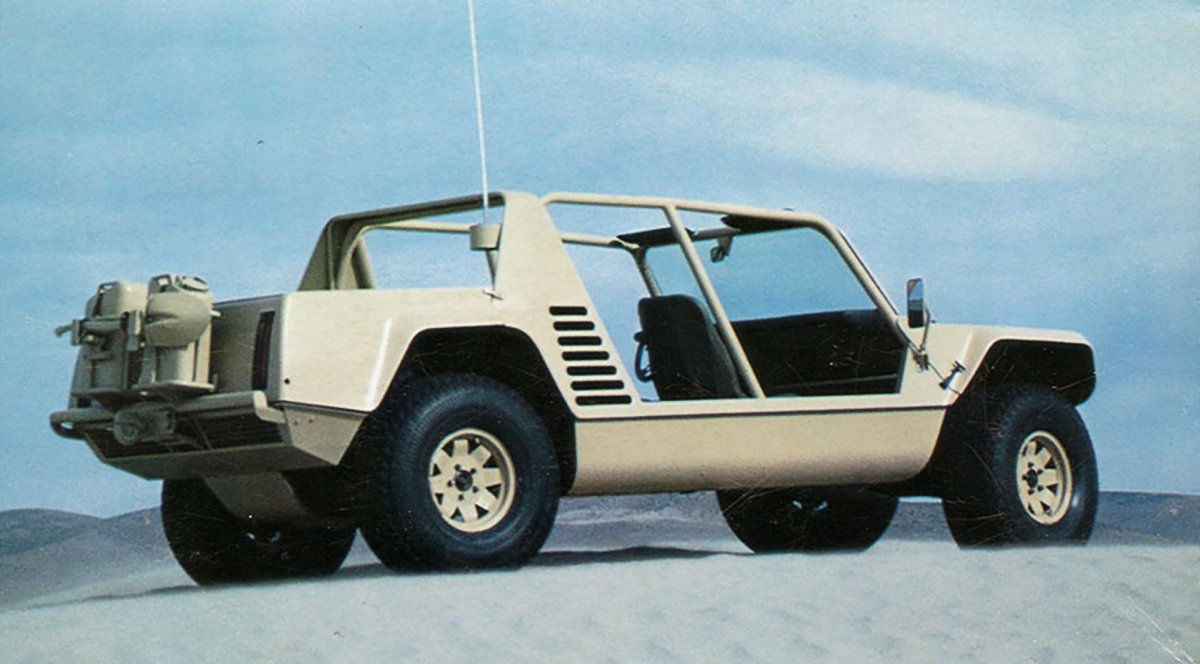
When you hear Lamborghini and the 1970s in the same sentence, you probably think about the origins of the iconic Countach luxury sports car. What you might not know is that, just three years after introducing the Countach, the Italian car maker went in a completely different direction, developing an off-road vehicle called the Cheetah that looks like it could have had a starring role in the cult-classic Death Race 2000 . Able to carry machine guns or TOW anti-tank missiles , the company even tried to pitch it to the U.S. military.
Lamborghini publicly unveiled the futuristic-looking Cheetah at the 1977 Geneva Motor Show in Switzerland. Mobility Technology International (MTI), situated in San Jose, California, had developed the vehicle under contract to the Italian firm. The 4×4 vehicle featured a dune buggy-like design with an open center area with a simple roll cage to protect the occupants.
It had a rear-mounted Chrysler V8 engine producing 180 brake horsepower attached to a three-speed automatic transmission. The 4,500-pound vehicle could reportedly hit speeds up over 100 miles per hour on paved roads and had seating for the driver and three passengers, one in the front and two in the back.
Lamborghini promoted the design’s low profile and independent suspension as being ideal for military use. The vehicle came with low-pressure tires to better navigate sand and other loose terrain. These also had a higher-pressure inner tube that the Cheetah could run on if the outer tire wall burst, offering sort of run-flat capability.
The Cheetah., Teledyne Continental Motors via Warwheels.net
Though the initial design featured a lightweight fiberglass body, the decision was made to switch to a sheet steel construction for the final prototype. This gave it the ability to drive over various obstacles without risking breaking the fiberglass body. The engine compartment was waterproofed, too, allowing it to ford water up to three feet deep.
Cheetah’s “performance uniquely qualifies it for duty in the combat zone where it can serve in many capacities,” the narrator in a marketing video, seen below, which opens with a musical score reminiscent of many later 1980s action television shows , explains. “As a TOW missile system carrier, a reconnaissance vehicle, a command and control vehicle, a prime mover for light artillery, or on convoy escort duty and security patrols.”
If these mission sets seem particularly specific, this is because these were the roles the U.S. Army was looking to fill with a new family of light tactical vehicles at the time. The service was looking to replace the mix of Ford M151 Jeeps and LTV M561 Gama Goats it was then using to perform these tasks.
But Army troops were not destined to take Lamborghini trucks into battle. The rear-mounted engine reportedly threw off the vehicle’s balance, giving it poor turning and other handling characteristics, even on improved surfaces.
Despite it’s name, the Cheetah was underpowered, as well, without any specialized military equipment added on top of the basic curb weight. Fully loaded with weapons and gear, with four fully-equipped soldiers inside, the performance would have been far worse.
To make matter’s worse, MTI’s Cheetah design was at best influenced by, and at worst outright copied, an earlier vehicle known as the XR311 that FMC had developed as a private venture in 1969. Over the next few years, the Army eventually obtained around 10 XR311s in a number of slightly different configurations and evaluated them in a variety of roles, including as scout and patrol vehicles armed with machine guns, automatic grenade launchers, recoilless rifles, TOW missiles, and even the 30mm cannon from the then still-in-development AH-64 Apache gunship helicopter.
An experimental XR311 armed with the same 30mm cannon found in the Apache gunship helicopter., US Army
As with the Cheetah, the XR311s were low-profile, high-speed vehicles. With their 187-horsepower V8s, they could do 0-60 in 12 seconds and hit top speeds between 80 to 90 miles on the road, according to Fourwheeler Network .
By 1978, the Army was still experimenting with the vehicles, but had declined to purchase large numbers, primarily due to concerns about whether the vehicles would be suitably survivable in the scout and anti-tank roles. That year, the service’s Ballistic Research Laboratory produced a study with a number of different concepts for using lightweight and flexible nylon or Kevlar “armor” to shield its crew.
A line drawing of a notional XR311 TOW missile carrier with flexible nylon or Kevlar side panels, windscreen, and bonnet over the gunner’s position., US Army
The Cheetah was so similar to the XR311, that FMC sued MTI and Lamborghini for infringing on their design. It is unclear what the result of that legal action was, but MTI’s lead designer Rodney Pharis did manage to demonstrate his vehicle for the Army.
The Army passed on Cheetah, just as it had with the XR311. Lambroghini, already reeling from a string of financial difficulties beginning in the early 1970s, and unable to find any other military buyers, abandoned the entire project. The company subsequently sold the rights and lone prototype to Teledyne Continental Motors.
Teledyne Continental Motors had no better luck with the Cheetah. In 1979, the Army put out its final requirements for new light tactical vehicles as part of the High Mobility Multipurpose Wheeled Vehicle (HMMWV) program.
Two years later, it awarded AM General the contract to build hundreds of what would become widely known as “Humvees” or “Hummers.” The most recent iterations of this iconic design remain in service with the U.S. military and in dozens of countries around the world.
Lamborghini’s 4×4 ambitions didn’t die with the Cheetah project, though. At the 1981 Geneva Auto Show, the company, reinvigorated by a burst of outside investment, revealed the LM001 , which it had derived from the earlier design. The LM stood for Lamborghini Militaria and reflected the company’s continuing desire to produce a light tactical military vehicle.
The Lambroghini LM001., Lamborghini
Swapping the Chrsyler engine for an AMC V8, the LM001 reportedly had many of the same performance and handling problems as the Cheetah. Lamborghini had planned to use its own proprietary V12 , found on the Countach, in subsequent models to provide extra power, but discontinued the entire project after building the first prototype.
In 1982, Lamborghini abandoned the rear-mounted engine configuration and various other features from the Cheetah completely, further evolving the LM001 into a much more conventional 4×4 truck with a front-mounted engine. This vehicle, the LMA001, eventually transformed into the LM002, which did enter limited production.
An LM002., Detectandpreserve via Wikimedia
The LM002 featured the company’s iconic V12 engine, which provided more than ample power for the truck, but retailed for around $120,000. The vehicle eventually gained the nickname “ Rambo Lambo ,” but still failed to find any military buyers. Lamborghini offered civilian versions with luxurious interiors, including full leather trim and then-state-of-the-art stereo systems. Italian race car and rally car driver Sandro Munari also drove modified versions in a number of off-road races.
In a bizarre twist of fate, in 2004, American troops in Iraq blew up an LM002 that had once belonged to Uday Hussein , son of former Iraqi dictator Saddam Hussein , as part of an experiment to determine the effects of a car bomb on concrete blast walls. This seems to be the extent of the U.S. military’s use of any of Lamborghini’s LM-series vehicles.
Uday’s LM002 before getting blown up in 2004., via Motorpasión
Sticks of explosives in the back of the LM002., via Motorpasión
The remnants of the Rambo Lambo after the detonation., via Motorpasión
Between 1987 and 1993, Lamborghini made two more truck prototypes based on the LM002, the LM003 and LM004 , but neither entered production. With less than 330 LM002s ever made, they’re highly sought after by collectors and command prices to match their rarity, often around $400,000 at least . Guzzling gas at between 8 and 12 miles per gallon on the highway, and only having tanks able to hold between 45 to 70 gallons in total, its an expensive vehicle to drive at all. A single one of the original run-flat tires will set you back around $5,000 .
The company has made a number of attempts to get into the SUV market since then. These projects finally bore fruit in February 2018, when the Urus entered production. This vehicle, which has a sticker price starting at around $200,000, has proven to be a relatively big seller for Lamborghini already.
But the Urus, with a design more reminiscent of an oversized luxury sedan, has, at best, a spiritual connection to the Cheetah and subsequent LM-series vehicles. Of course, that hasn’t stopped the Urus from going on display next to an LM002 in the Lamborghini museum in Italy. But the company seems to have put the idea of the Lamborghini Militaria, which began with the obscure, but futuristic looking Cheetah, to rest for good.
A Lamborghini Urus next to an LM002 at the Lamborghini in Italy., Y.Leclercq via Wikimedia
Contact the author: jtrevithickpr@gmail.com
Comments couldn’t be loaded. Please refresh the page.
作者:约瑟夫·特雷维西克
更新于美国东部时间2019年12月1日上午6:37
提到兰博基尼和20世纪70年代,你很可能会想到标志性豪华跑车Countach的诞生。但你或许不知道,就在Countach问世三年后,这家意大利汽车制造商却另辟蹊径,开发了一款名为Cheetah的越野车,其造型酷似经典恐怖片《死亡飞车2000》中的主角。Cheetah能够携带机枪或TOW反坦克导弹,兰博基尼甚至还曾试图将其推销给美国军方。
兰博基尼在1977年瑞士日内瓦车展上正式发布了造型极具未来感的猎豹(Cheetah)车型。这款车由位于加利福尼亚州圣何塞的移动技术国际公司(MTI)根据与这家意大利公司的合同开发。这款四驱越野车采用了类似沙滩车的设计,中央区域敞开,仅配备一个简单的防滚笼来保护车内乘员。
它搭载了一台后置的克莱斯勒V8发动机,可输出180制动马力,并匹配三速自动变速箱。据报道,这辆重达4500磅的汽车在铺装路面上最高时速可超过100英里/小时,车内设有驾驶员和三名乘客的座位,前排一名,后排两名。
兰博基尼宣称,该车的低矮车身和独立悬架设计使其成为军事用途的理想之选。为了更好地应对沙地和其他松软地形,该车配备了低压轮胎。这些轮胎还带有高压内胎,即使外胎爆裂,猎豹也能依靠内胎继续行驶,具备一定的防爆胎能力。
猎豹,Teledyne Continental Motors,图片来自 Warwheels.net
虽然最初的设计采用轻质玻璃纤维车身,但最终原型车决定改用钢板结构。这使得车辆能够越过各种障碍物,而不会损坏玻璃纤维车身。发动机舱也做了防水处理,使其能够涉水深度达三英尺。
一段宣传视频(如下所示)的旁白解释道:“猎豹装甲车的卓越性能使其完全胜任战区多种任务,例如作为陶式导弹系统的运载车、侦察车、指挥控制车、轻型火炮的牵引车,或执行护航和安全巡逻任务。”这段视频的开头配乐让人想起上世纪80年代后期的许多动作电视剧。
如果这些任务描述显得格外具体,那是因为当时美军正计划用一系列新型轻型战术车辆来承担这些角色。美军当时正寻求替换其用于执行这些任务的福特M151吉普车和LTV M561“伽玛山羊”轻型战术车辆。
但陆军部队注定不会驾驶兰博基尼卡车上战场。据报道,后置发动机破坏了车辆的平衡,导致其转弯和其他操控性能很差,即使在路况良好的路面上也是如此。
尽管名为“猎豹”,但这款车动力不足,更何况是在没有加装任何专用军用装备的情况下。如果满载武器装备,并搭载四名全副武装的士兵,其性能会更差。
更糟糕的是,MTI 的猎豹装甲车设计充其量是受到了 FMC 公司于 1969 年作为私人项目开发的 XR311 装甲车的影响,最坏的情况是直接抄袭了该车。在接下来的几年里,陆军最终获得了大约 10 辆配置略有不同的 XR311 装甲车,并对其在各种角色中的应用进行了评估,包括作为侦察和巡逻车辆,装备有机枪、自动榴弹发射器、无后坐力炮、TOW 导弹,甚至还有当时仍在研发中的 AH-64 阿帕奇武装直升机的 30 毫米机炮。
一架实验型XR311,装备有与阿帕奇武装直升机相同的30毫米机炮。(美国陆军)
与 Cheetah 一样,XR311 也是低调而高速的车辆。据 Fourwheeler Network 报道,凭借其 187 马力的 V8 发动机,它们可以在 12 秒内完成 0-60 英里/小时的加速,公路最高时速可达 80 至 90 英里/小时。
到1978年,陆军仍在试验这些车辆,但并未大量采购,主要原因是担心这些车辆在侦察和反坦克任务中是否具备足够的生存能力。同年,陆军弹道研究实验室发表了一项研究,提出了多种使用轻便灵活的尼龙或凯夫拉“装甲”来保护乘员的方案。
一张示意图,展示了XR311 TOW导弹发射车,其侧板、挡风玻璃和炮手位置上方的罩盖均采用柔性尼龙或凯夫拉材质。(美国陆军)
Cheetah 与 XR311 非常相似,以至于 FMC 公司起诉 MTI 和兰博基尼侵犯其设计权。目前尚不清楚该诉讼的结果,但 MTI 的首席设计师 Rodney Pharis 确实成功地向美国陆军展示了他的车辆。
就像之前对XR311一样,陆军最终放弃了猎豹(Cheetah)项目。兰博基尼公司自20世纪70年代初以来就一直饱受财务困境的困扰,又找不到其他军方买家,最终放弃了整个项目。随后,该公司将该项目的所有权利和唯一的原型车出售给了泰莱达因大陆汽车公司(Teledyne Continental Motors)。
泰莱达因大陆汽车公司在猎豹装甲车项目上也未能取得成功。1979年,作为高机动性多用途轮式车辆(HMMWV)计划的一部分,陆军发布了新型轻型战术车辆的最终需求。
两年后,该公司将建造数百辆后来广为人知的“悍马”或“悍马车”的合同授予了AM General公司。这款标志性设计的最新版本至今仍在美军以及世界数十个国家服役。
兰博基尼的四驱车雄心并未随着猎豹项目的终止而消亡。在1981年的日内瓦车展上,凭借外部投资的注入,兰博基尼推出了LM001,这款车型正是基于早期的设计打造而成。LM代表兰博基尼军用车辆(Lamborghini Militaria),体现了该公司持续致力于生产轻型战术军用车辆的愿景。
兰博基尼 LM001., 兰博基尼
据报道,LM001车型将克莱斯勒发动机更换为AMC V8发动机后,出现了与Cheetah车型类似的诸多性能和操控问题。兰博基尼原本计划在后续车型中使用其自主研发的V12发动机(该发动机也应用于Countach车型),以提供更强劲的动力,但在制造出第一辆原型车后便终止了整个项目。
1982年,兰博基尼彻底放弃了猎豹(Cheetah)的后置发动机布局和其他一些设计,将LM001进一步演变为一款更为传统的前置发动机四驱皮卡。这款车,即LMA001,最终演变为LM002,并投入限量生产。
LM002.,Detectandpreserve via Wikimedia
LM002搭载了兰博基尼标志性的V12发动机,动力强劲,但售价高达12万美元左右。这款车最终获得了“兰博基尼兰博”(Rambo Lambo)的绰号,但始终未能找到任何军方买家。兰博基尼也推出了民用版本,内饰豪华,包括全真皮装饰和当时最先进的音响系统。意大利赛车手兼拉力赛车手桑德罗·穆纳里(Sandro Munari)也曾驾驶改装版LM002参加过多项越野赛事。
令人匪夷所思的是,2004年,驻伊拉克美军炸毁了一辆曾属于伊拉克前独裁者萨达姆·侯赛因之子乌代·侯赛因的LM002跑车,作为一项旨在测试汽车炸弹对混凝土防爆墙影响的实验的一部分。这似乎是美军使用兰博基尼LM系列车型的唯一一次。
这是乌代的LM002赛车在2004年爆炸前的照片,图片来自Motorpasión。
LM002 后部装有炸药棒。(图片来自 Motorpasión)
爆炸后兰博基尼的残骸。(图片来自 Motorpasión)
1987年至1993年间,兰博基尼基于LM002打造了两款卡车原型车——LM003和LM004,但均未投入量产。LM002的总产量不足330辆,因此备受收藏家追捧,价格也与其稀有程度相符,通常至少在40万美元左右。这款车高速公路油耗仅为每加仑8至12英里,油箱容量也只有45至70加仑,因此驾驶成本相当高昂。一条原装防爆轮胎的价格就高达5000美元左右。
此后,该公司多次尝试进军SUV市场。这些努力终于在2018年2月结出硕果,Urus正式投产。这款起售价约为20万美元的车型,已经成为兰博基尼销量相当不错的车型之一。
但Urus的设计更像是超大型豪华轿车,充其量只能说与Cheetah及后续LM系列车型有着某种精神上的联系。当然,这并没有阻止Urus与LM002一同在意大利兰博基尼博物馆展出。不过,兰博基尼似乎已经彻底放弃了“兰博基尼军用系列”(Lamborghini Militaria)的构想——该系列最初源于那款鲜为人知却极具未来感的Cheetah。
意大利兰博基尼的一辆兰博基尼 Urus 旁边是一辆 LM002。, Y.Leclercq 来自 Wikimedia
联系作者:jtrevithickpr@gmail.com
评论加载失败,请刷新页面。