Getting more out of US-Australian defense cooperation如何从美澳防务合作中获得更多益处
Opinion: Canberra and Washington tend to view challenges in the Indo-Pacific through different ends of a strategic telescope.
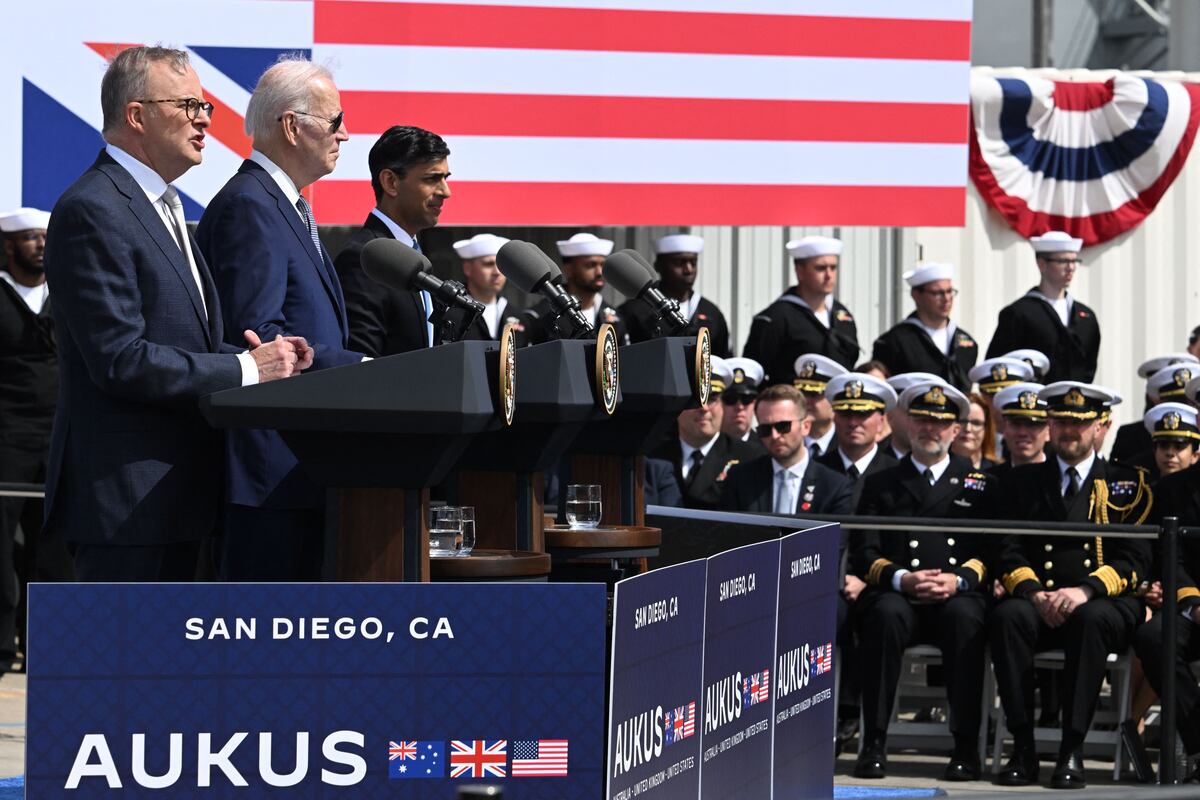
When surveying America’s attempts to upscale its defense ties with Indo-Pacific partners, it’s commonly assumed that the Australia-US relationship is amongst the lowest-hanging fruit. There are good reasons for that view. One is the alliance’s long and deep history, which Australians regularly refer to as the ‘bedrock’ of Canberra’s security policy. Another is the importance Australia has placed on an enhanced U.S. military presence in an era of heightened great power competition. And a third is the AUKUS agreement, which promises to deliver U.S. Virginia-class nuclear submarines to the Royal Australian Navy , as well as deepen collaboration in the development of next-generation defense technologies.
But it would be a grave mistake to think that there are no challenges in deepening U.S.-Australia defense integration . For instance, Canberra and Washington tend to view challenges in the Indo-Pacific through different ends of a strategic telescope. Granted, both see China as the main threat (or ‘pacing challenge’, to use the U.S. term), and both see the main domain to be secured as the maritime one. Yet they differ over where the most likely locus of future conflict might be: the U.S. is focused on Taiwan and potential war on the open oceans; whereas Australia sees the main challenge in terms of thwarting efforts to deny it access to sea lanes of communication and trade.
In other words, the U.S. sees the risk of war in high-end terms, ranging across vast maritime distances; whilst for Australia the primary tasks for its much smaller armed forces are more local, and littoral.
There are also other points of potential disjuncture. Australia does not outsource sovereign decisions about whether or not to go to war, and it has different interests that shape its threat perceptions. Indeed, while there is broad bipartisan agreement about the value of the alliance, this does not automatically translate into an Australian willingness to follow Washington unquestioningly into every conflict. A case in point is Taiwan, where Australian domestic debates offer no consensus on whether defending Taipei is a vital national interest.
Fortunately, there are clear steps both Washington and Canberra can take to better align their mutual defense postures. This is helped by the fact that both nations remain closely aligned in strategic outlook. And, importantly, we see this task as being much easier to accomplish if it is targeted in terms of the specific effects the U.S. and Australia are seeking to generate, rather than through adapting often amorphous terms like ‘integrated deterrence’.
When looking at the desired effects of U.S.-Australian security and defense alignment, three arenas stand out. The first of these is resources, or the capabilities both nations can bring to bear in future crises. Here, while Australia has been rapidly developing the ability to acquire long range strike weapons in order to hold adversaries at risk, it should be acknowledged that Australia will be able to contribute very little extra in terms of the capacity to deter China in the short term.
Even when Australia’s capabilities are enhanced via AUKUS, still at least a decade away, its forces will be far better suited to green-water deterrence. Hence enhancing the ability of U.S. and Australian militaries to conduct joint operations at the land-sea nexus would be an important step towards closer alignment. So too would stronger U.S. support for Australia’s proximity advantage relative to South Pacific island nations, which will continue to be aggressively courted by China via proposed investment and security partnerships. And finally, developing the ability to better respond to Chinese sub-threshold hybrid operations in a maritime context – including by articulating a more convincing regional narrative about the need to uphold international law and strategic stability – would better anchor joint Australian and U.S. maritime operations, especially in the South China Sea.
A second arena Australia and the U.S. should devote attention to concerns relationships with other regional players. Of course, there are obstacles to region-wide balancing: India, for instance, is less interested in countering Chinese power in East Asia than in continental South Asia and in the Indian Ocean; and many ASEAN states see China as crucial to their future prosperity.
Yet there are opportunities in promoting ‘spoke-to-spoke’ cooperation between U.S. bilateral security partners. Most notably these are with Japan and the ROK, both of which have been gradually coming around to the idea that investing in the maintenance of regional security order makes sense. Here, deepening Japan-Australia strategic alignment through scenario planning, intensifying ROK participation in Australian-hosted military exercises, and enhancing cooperation via loose minilateral arrangements like the AP4 would be steps in the right direction. But so too would be more effort to bolster Australia-Indonesia ties in a way that is mindful of Jakarta’s preferences for non-alignment, but nonetheless seeks to establish agreements over future contingencies in which Indonesia (and possibly Brunei too) might permit the transit, overflight and resupply of Australian and U.S. military assets.
Finally, the U.S. and Australia should seek to build resilience in regional order. This might incorporate a number of initiatives: a more catholic approach to intelligence sharing with selected partners; cooperation on high-end technology (especially on AI) with advanced nations like Singapore; crafting norms of behavior in maritime, space, and cyber domains; and more coherently pushing back on disinformation efforts around AUKUS and U.S. alliances more generally, which are currently going largely unchallenged.
Taken together, these three suites of cooperation will help Australia and the U.S. better align their defense policies to produce important effects. They will make better use of each partner’s specific capabilities; leverage regional relationships more effectively; and help underpin a security order that is more resilient to external pressure. More importantly, they represent a logical evolution in a close defense and security relationship that is intertwined, but driven by considerations that are naturally not identical.
Matthew Sussex is an associate professor (adjunct) at the Griffith Asia Institute, Griffith University; a fellow at the Institute for Regional Security (IFRS); visiting fellow at the Strategic and Defence Studies Centre, Australian National University (ANU); and a visiting fellow at the Centre for European Studies, ANU. He has previously been a senior fellow at the Australian Defence College; and an associate professor and academic director at the National Security College, ANU.
Peter Tesch was deputy secretary for strategy, policy, and industry in Australia’s Department of Defence from 2019 to 2022. During his thirty-two-year career in the Department of Foreign Affairs and Trade, he was ambassador to the Russian Federation (2016–19), ambassador to Germany (2009–13), and head of the International Security Division (2014–15). He also served as deputy permanent representative to the United Nations, New York (2002–05).
在审视美国为加强与印太伙伴的防务关系所做的努力时,人们普遍认为澳美关系是最容易实现的。这种观点不无道理。首先,澳美联盟历史悠久且根基深厚,澳大利亚人经常将其视为堪培拉安全政策的“基石”。其次,在大国竞争日益激烈的时代,澳大利亚高度重视美国加强军事存在。第三,澳美合作协议(AUKUS)承诺向澳大利亚皇家海军交付美国弗吉尼亚级核潜艇,并深化双方在下一代国防技术研发方面的合作。
但认为深化美澳防务一体化不存在挑战,那就大错特错了。例如,堪培拉和华盛顿看待印太地区的挑战,往往从不同的战略视角出发。诚然,两国都将中国视为主要威胁(或者用美国的话来说,是“速度挑战”),也都将海上安全视为首要保障领域。然而,双方对未来冲突最可能发生的地点却存在分歧:美国关注的是台湾以及可能发生的公海战争;而澳大利亚则认为,主要挑战在于如何阻止任何企图切断其海上交通和贸易通道的行动。
换句话说,美国从宏观角度看待战争风险,其范围涵盖广阔的海域;而澳大利亚规模小得多的武装部队的主要任务则更偏向于局部和沿海地区。
此外,还存在其他潜在的分歧点。澳大利亚不会将是否参战的主权决定外包,而且其自身利益也影响着对威胁的认知。事实上,尽管两党普遍认同联盟的价值,但这并不意味着澳大利亚会毫无保留地追随华盛顿卷入每一场冲突。台湾问题就是一个典型的例子,澳大利亚国内对于保卫台北是否属于至关重要的国家利益,并未达成共识。
幸运的是,华盛顿和堪培拉都可以采取明确的措施,更好地协调彼此的防御态势。两国在战略视野上保持高度一致,这为此提供了帮助。而且,重要的是,我们认为,如果着眼于美澳两国希望产生的具体效果,而不是套用诸如“一体化威慑”这类往往含义模糊的术语,这项任务将更容易完成。
在探讨美澳安全与防务合作的预期效果时,有三个方面尤为突出。首先是资源,即两国在未来危机中能够调动的能力。虽然澳大利亚一直在迅速发展远程打击武器的能力以威慑对手,但必须承认,在短期内,澳大利亚在威慑中国方面所能做出的额外贡献非常有限。
即使澳大利亚的能力通过“奥库斯”联合军事演习得到提升(这至少还需要十年时间),其部队也更适合远海威慑。因此,提升美澳两军在陆海交界地带开展联合行动的能力,将是加强合作的重要一步。同样重要的是,美国应加大对澳大利亚相对于南太平洋岛国的近岸优势的支持力度,因为中国将继续通过拟议的投资和安全伙伴关系积极拉拢这些国家。最后,提升应对中国在海上低风险混合行动的能力——包括构建更具说服力的区域叙事,强调维护国际法和战略稳定的重要性——将更好地巩固澳美联合海上行动,尤其是在南海地区的行动。
澳大利亚和美国应关注的第二个领域是与其他地区国家的关系。当然,实现区域平衡并非易事:例如,印度对在东亚遏制中国实力的兴趣远不如在南亚大陆和印度洋遏制中国实力;而且许多东盟国家将中国视为其未来繁荣的关键。
然而,促进美国双边安全伙伴之间的“直接合作”仍存在机遇。尤其值得关注的是与日本和韩国的合作,两国都已逐渐认识到,投资维护地区安全秩序是明智之举。在此方面,通过情景规划深化日澳战略协同,加强韩国参与澳大利亚主办的联合军事演习,以及通过AP4等非正式的小多边安排加强合作,都是朝着正确方向迈出的步伐。同时,也应更加努力地加强澳印关系,既要考虑到雅加达奉行的不结盟政策,又要寻求就未来可能发生的突发事件达成协议,届时印尼(或许还有文莱)可能会允许澳大利亚和美国的军事资产过境、飞越和补给。
最后,美国和澳大利亚应努力增强区域秩序的韧性。这可能包括多项举措:与特定伙伴采取更全面的情报共享方式;与新加坡等先进国家在高端技术(尤其是人工智能)领域开展合作;制定海事、太空和网络领域的行为规范;以及更有力地反击目前基本未受挑战的围绕“奥库斯行动”和美国联盟的虚假信息宣传活动。
总而言之,这三项合作将有助于澳大利亚和美国更好地协调其国防政策,从而产生重要影响。它们将更有效地利用各自伙伴的特定能力;更有效地发挥区域关系的作用;并有助于巩固一个更能抵御外部压力的安全秩序。更重要的是,它们代表着紧密的防务与安全关系的自然演进,这种关系相互交织,但其驱动因素自然并不完全相同。
马修·苏塞克斯是格里菲斯大学格里菲斯亚洲研究所的兼职副教授;区域安全研究所(IFRS)的研究员;澳大利亚国立大学(ANU)战略与国防研究中心的访问研究员;以及澳大利亚国立大学欧洲研究中心的访问研究员。他曾任澳大利亚国防学院的高级研究员;以及澳大利亚国立大学国家安全学院的副教授和学术主任。
彼得·特施于2019年至2022年担任澳大利亚国防部战略、政策和产业副部长。在他长达32年的外交贸易部职业生涯中,他曾任澳大利亚驻俄罗斯联邦大使(2016-2019年)、驻德国大使(2009-2013年)和国际安全司司长(2014-2015年)。他还曾担任澳大利亚常驻联合国副代表(2002-2005年)。