China shows snazzy clip of DF-17 missile on state TV in show of force中国在国家电视台播放DF-17导弹的炫酷视频,展示武力。
Experts say the broadcast answers Asia-Pacific military exercises by other countries, warning the U.S. that the weapons could cause pain in any war.
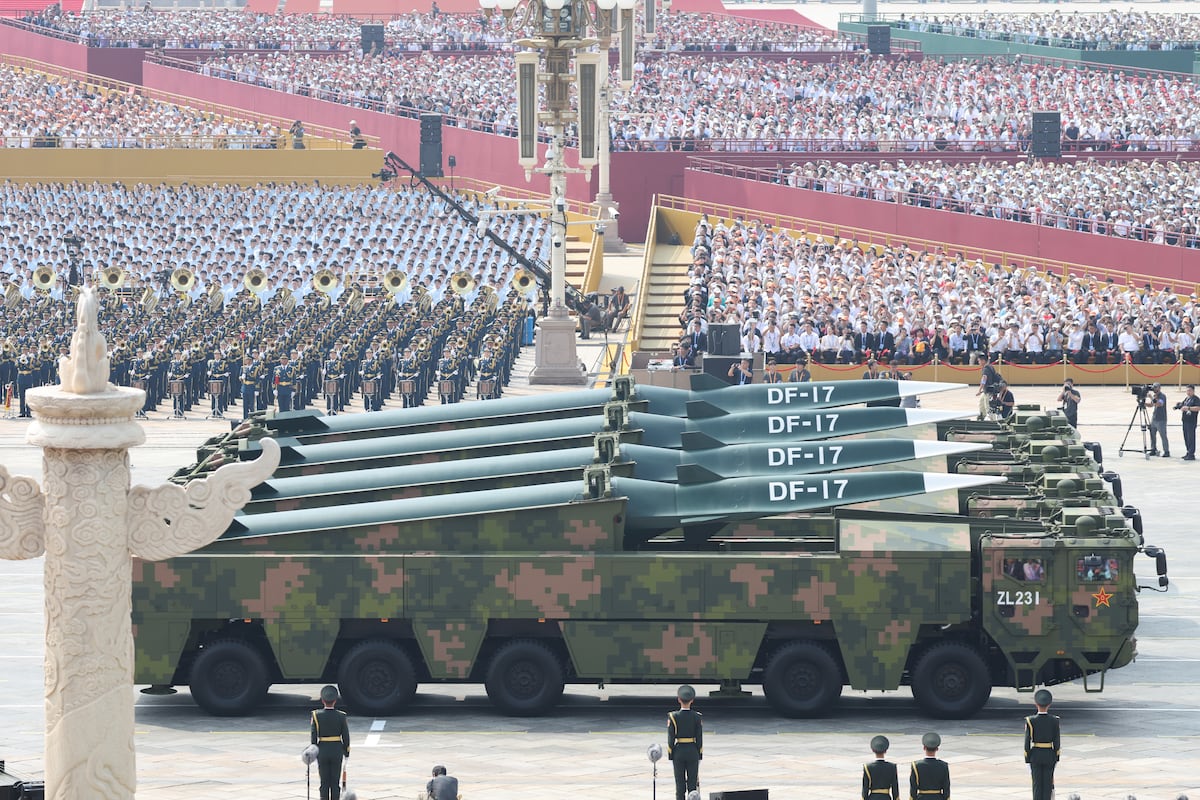
NEW TAIPEI CITY, Taiwan — China’s Dong Feng-17 ballistic missile has probably existed for more than a decade, quietly adding to the People’s Liberation Army arsenal of ever more modern weaponry .
Suddenly in June it was showcased for the first time in official Chinese media, as analysts tell it, and described as one of China’s top military assets as English-language subtitles extolled its battlefield capacities.
Experts say the broadcast answers Asia-Pacific military exercises by other countries and aims to warn the U.S. military that the missiles better known as DF-17s, for short, have what it takes to cause particular pain in any war with China.
“Video footage might be political signaling or mild deterrence, because the DF-17 is very hard to defend against, especially for large surface targets,” said Alexander Huang, chairman of the Council of Strategic and Wargaming Studies in Taipei. “It’s a big threat to carriers and other assault ships.”
The medium-range missiles are equipped with a hypersonic glide vehicle, which means they can fly at lower altitudes in unpredictable directions.
DF-17s have existed for at least 12 years and been available to the People’s Liberation Army since 2019, according to a paper by the Center for Strategic and International Studies think tank in Washington.
The release of DF-17 into the Chinese media syncs up time-wise with the ongoing U.S.-led 2026 Rim of the Pacific (RIMPAC) maritime military exercises near Hawaii and the U.S.-Japan drills in late June.
“The other exercises were pretty tough and harsh, clearly targeting Chinese possible actions,” Huang said.
By showing the DF-17s after RIMPAC, China wants to suggest that the missiles can evade interception and make “saturation strikes” at the same time, said Chen Yi-fan, assistant professor in the Diplomacy and International Relations Department at Taiwan’s Tamkang University.
“This signaling is intended to underscore the PLA’s growing confidence in its capacity to overwhelm regional missile‑defense systems and complicate operational planning” by any military opponents, Chen said.
The missiles, as shown during a drill in an English-language YouTube video by the Chinese state-run media outlet CGTN, can make “ultra-precise” strikes and “penetrate advanced defense systems”, per the video .
CGTN said the missiles may be used without fixed launch sites and in any kind of weather.
“The coordinated salvo launches greatly improve strike efficiency and battlefield safety, demonstrating China’s advances in military technology,” CGTN said.
The U.S. think tank describes the DF-17 missiles as 11 meters (36 feet) long with a range of 1,800 to 2,500 kilometers (1,118 to 1,553 miles). It says they can carry conventional or nuclear payloads. China has 1,300 missiles and 300 launchers.
“As one of the PLA’s premier strategic assets, the DF‑17 is likely reserved for the most consequential scenarios, such as foreign military intervention perceived as supporting Taiwan independence,” Chen said.
American military bases in Hawaii, Guam and Japan are monitoring the uptick in People’s Liberation Army naval drills around Taiwan and Beijing’s tiffs with the Philippines in the South China Sea.
China claims sovereignty over self-ruled Taiwan, a de-facto U.S. ally. China and the Philippines – a U.S. treaty ally – contest sovereignty over small islets in the sea between them.
The DF-17’s hypersonic glide vehicle would give the missiles an edge in battle, said M. Taylor Fravel, Security Studies Program Director at Massachusetts Institute of Technology.
“This maneuverability means that it is much harder to defeat than a ballistic missile without a hypersonic glide vehicle,” Fravel said. “It can more easily penetrate missile defenses.”
Earlier DF-series missiles flew the traditional path of a surface-to-surface missile, meaning they were easier to predict than the flight course of a DF-17, Huang said.
U.S. forces may need to expand their long-range radar technology to spot any DF-17s launchers and respond preemptively in the case of any conflict, analysts said.
The U.S. is already developing systems “similar” to the DF-17, Fravel said. He said those include the U.S. army’s Long-Range Hypersonic Weapon missile system as well as hardware that may defeat hypersonic glide vehicles.
A long-range hypersonic system is designed to strike well defended targets from thousands of miles away.
“Washington must accelerate the development and deployment of its own hypersonic weapons to establish credible mutual deterrence,” Chen said.
台湾新台北市——中国的东风-17弹道导弹可能已经存在了十多年,悄然地丰富了中国人民解放军日益现代化的武器库。
据分析人士称,今年6月,它突然首次出现在中国官方媒体上,并被描述为中国最重要的军事资产之一,英文字幕还盛赞了它的战场能力。
专家表示,此次广播是对其他国家在亚太地区举行的军事演习的回应,旨在警告美国军方,这些更广为人知的DF-17导弹,有能力在与中国的任何战争中造成特别严重的打击。
“这段视频可能是政治信号或轻微的威慑,因为DF-17导弹很难防御,尤其对大型水面目标而言,”台北战略与兵棋推演研究委员会主席黄国强表示。“它对航母和其他两栖攻击舰艇构成巨大威胁。”
这种中程导弹配备了高超音速滑翔飞行器,这意味着它们可以以较低的高度向不可预测的方向飞行。
根据华盛顿战略与国际研究中心的一份报告,DF-17导弹已经存在至少12年,并且自2019年以来一直供中国人民解放军使用。
DF-17导弹在中国媒体上的曝光,在时间上与美国主导的2026年环太平洋军事演习(RIMPAC)在夏威夷附近举行,以及美日6月下旬的联合军演相吻合。
黄说:“其他演习都相当艰苦严苛,显然是针对中国可能采取的行动。”
台湾淡江大学外交与国际关系系助理教授陈义凡表示,中国在环太平洋军演后展示东风-17导弹,意在表明该导弹能够躲避拦截并同时进行“饱和打击”。
陈表示,“这一信号旨在强调解放军越来越有信心能够压制区域导弹防御系统,并使任何军事对手的作战计划变得复杂化”。
根据中国官方媒体CGTN在YouTube上发布的一段英文视频中的演习显示,这些导弹可以进行“超精确”打击并“穿透先进的防御系统”。
中国环球电视网(CGTN)称,这些导弹无需固定发射场,且可在任何天气条件下使用。
“协同齐射大大提高了打击效率和战场安全,展现了中国在军事技术领域的进步,”中国环球电视网(CGTN)表示。
美国智库称,东风-17导弹长11米(36英尺),射程1800至2500公里(1118至1553英里),可携带常规弹头或核弹头。中国拥有1300枚东风-17导弹和300套发射装置。
陈表示:“作为解放军最重要的战略资产之一,东风-17很可能被保留用于最具重大影响的场景,例如被认为支持台湾独立的外国军事干预。”
美国在夏威夷、关岛和日本的军事基地正在密切关注中国人民解放军在台湾附近海域日益频繁的海军演习,以及北京与菲律宾在南海的争端。
中国声称对自治的台湾拥有主权,而台湾实际上是美国的盟友。中国和菲律宾(美国的条约盟友)对两国之间海域的一些小岛存在主权争议。
麻省理工学院安全研究项目主任 M·泰勒·弗拉维尔表示,DF-17 的高超音速滑翔飞行器将使导弹在战斗中占据优势。
弗拉维尔说:“这种机动性意味着它比没有高超音速滑翔飞行器的弹道导弹更难被击落。它更容易突破导弹防御系统。”
黄说,早期的DF系列导弹飞行轨迹与地对地导弹的传统轨迹相同,这意味着它们的飞行路线比DF-17的飞行路线更容易预测。
分析人士表示,美军可能需要扩展其远程雷达技术,以便发现任何DF-17导弹发射器,并在发生冲突时采取先发制人的应对措施。
弗拉维尔表示,美国已经在研发与DF-17“类似”的系统。他说,这些系统包括美国陆军的远程高超音速武器导弹系统,以及可能拦截高超音速滑翔飞行器的硬件。
远程高超音速系统旨在从数千英里之外打击防御严密的目标。
陈说:“华盛顿必须加快研发和部署自己的高超音速武器,以建立可信的相互威慑。”