Britain’s Cold War-Era Monster Destroyer Has Finally Been Retired英国冷战时期的巨型驱逐舰终于退役了
After 47 years of Royal Navy service, the flag has finally been lowered aboard the destroyer HMS Bristol.
新闻视频
Updated Nov 27, 2020 6:14 PM EST
Cold War military history is full of “might-have-beens,” with canceled projects ranging from nuclear-reactor-juggling tracked mecha-robots , to electron guns that would generate invisible radar-absorbing fields around spyplanes , to name just two. When it comes to the U.K. Royal Navy, this includes its lone Type 82 destroyer, HMS Bristol , which it just retired today.
In the United Kingdom, the fate of the planned CVA-01 class of aircraft carrier remains another tantalizing “what if?” While the catapult assisted take-off, but arrested recovery ( CATOBAR ) flattop was canceled as a cost-saving measure in 1966, work did still progress on its planned escorts. The mighty Type 82 class guided-missile destroyers would have provided a defensive umbrella around the carrier.
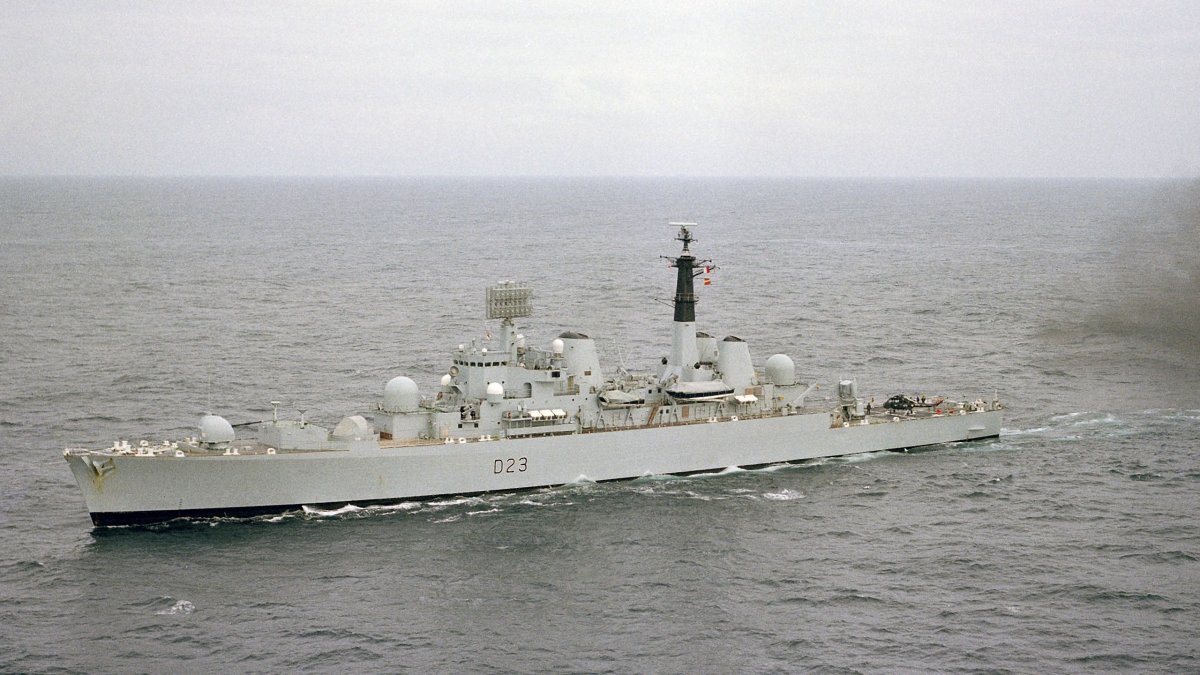
So big that it was sometimes described as a cruiser, only one example of the Type 82 was ever built, after which the Royal Navy concentrated its efforts on more modest-sized destroyers — at least until the arrival of today’s Type 45 class . The one-off Type 82 destroyer HMS Bristol was, at 507 feet long, marginally longer than the current Type 45, which measures 500 feet.
For much of its career, the pioneering HMS Bristol was considered a “white elephant,” but it remained in Royal Navy service until today, October 28, 2020. It had spent its last days as a training vessel confined to the dockside at Her Majesty’s Naval Base, Portsmouth, on the south coast of England.
HMS Bristol , the solitary Type 82 destroyer, was originally expected to be the lead example of a class of eight ships. These were to have provided both anti-submarine warfare (ASW) and anti-aircraft warfare (AAW) support for the CVA-01 class of carriers, four of which were also envisaged for the Royal Navy.
When the axe fell on the CVA-01 as a result of the 1966 Defence White Paper, the Type 82 building program was trimmed back to a single hull, which it was decided would serve primarily as a trials platform for new weapons and equipment.
Construction work on HMS Bristol began at Swan Hunter in Tyne and Wear, northeast England, in November 1967 and the destroyer was launched in June 1969. Entering Royal Navy service in March 1973, the new destroyer was characterized by its unusual three-funnel arrangement that served a combined steam and gas turbine propulsion system. This was the last Royal Navy warship design to be powered by steam, bringing to an end a period of British maritime history that had begun in the early 1820s, with the first experiments using steam-powered warships .
The destroyer’s primary armament included a twin GWS Mk 30 zero-length launcher for a total of 40 Sea Dart surface-to-air missiles (SAMs). HMS Bristol was the first warship to carry this ramjet-powered area-defense weapon that had a maximum range of 40 miles and could engage targets flying at altitudes up to 60,000 feet. Weighing 1,210 pounds, the Sea Dart missile utilized semi-active radar homing guidance.
The twin Sea Dart launcher on HMS Bristol after its return from the Falklands in 1982., HUGH LLEWELYN/WIKIMEDIA COMMONS
Twenty Ikara missiles were provided for the ASW system, based around the GWS Mk 40 launcher. Ikara was an Australian-designed rocket-powered missile that could deliver a homing torpedo, or a nuclear depth charge, out to around 10 miles from the ship. Once in the drop zone, the Ikara’s payload was released under a parachute, then either detonating, in the case of the depth charge, or, if a torpedo, beginning its search pattern to hunt for a submarine.
The Ikara was supplemented by a Limbo anti-submarine mortar, the basic design of which dates back to World War II. This weapon, optimized for shallow water engagements, consisted of a three-barrel launcher that fired three mortar bombs fused to create a three-dimensional explosive burst around the target. The bombs could be fitted with a pre-programmed pressure fuse or a delayed-action time fuse. The effective range was a little over half a mile.
As well as being the first Royal Navy warship to be armed with the Sea Dart and Ikara, HMS Bristol introduced other innovations in its 4.5-inch-caliber Mk 8 main gun — a weapon that remains in service today — and its computerized Action Data Automated Weapons System Mk 2 (ADAWS-2), which coordinated the various weapons and sensors.
Although the warship had a flight deck at the stern, a helicopter was not usually embarked as the vessel lacked a hangar or aviation facilities, a reflection of its original role as a carrier escort, where it was expected to work in cooperation with rotorcraft embarked in the carrier. Another deficit was long-range anti-ship weaponry, again expected to be handled by other elements of the carrier group, including embarked aircraft.
After entering service, HMS Bristol spent much of the 1970s undertaking trials of its various weapons and control systems, which then found themselves arming a new generation of (smaller) destroyers, as well as guided-missile frigates.
After a fire in the boiler that burnt for four hours off the coast of Wales in February 1974, HMS Bristol lost the use of its steam propulsion system for two years, until repairs could be made. In the interim, it was still able to operate using its two Rolls-Royce Olympus gas turbines.
By 1979, new electronic countermeasures, Corvus chaff launchers, and a pair of 20mm Oerlikon cannon had been added and the veteran Limbo ASW weapon was deleted. The former Limbo housing was thereafter used for a while as a makeshift swimming pool.
Despite being mainly engaged on trials work, the HMS Bristol was more than capable of combat duty and its command and control facilities made it an ideal flagship. It also carried more extensive communications and data links than other Royal Navy warships, allowing it to serve as a “node” for other Royal Navy vessels to communicate with other NATO ships — frequently from the U.S. Navy or French Navy — that may have had incompatible communications suites.
The destroyer’s value as a flagship was proven during the Falklands War of 1982 when the Royal Navy Task Force sailed to the South Atlantic to retake the Falkland Islands after the Argentine invasion. The big destroyer’s extra capacity allowed additional staff to be embarked for the flagship role and it sailed to the South Atlantic as the lead ship in a group of reinforcements, before joining the carrier battle group.
HMS Bristol also fired its Sea Dart missiles in anger in the South Atlantic — among the 18 Sea Darts launched from this warship and the smaller Type 42 destroyers during the campaign — but did not register any Argentine aircraft destroyed.
When the previous flagship in the campaign, the aircraft carrier HMS Hermes , departed for the United Kingdom after the British victory, HMS Bristol took on this role.
A Royal Air Force Chinook helicopter loads stores on HMS Bristol at Ascension Island during the Falklands campaign., KEN GRIFFITHS/WIKIMEDIA COMMONS
Prior to the Falklands War, it had been expected that HMS Bristol would be retired prematurely under the 1982 Defence White Paper, but the destroyer’s usefulness had been adequately demonstrated and it was given a reprieve, including a refit based on lessons from the then-recent conflict. The light anti-aircraft weapons were boosted with the addition of another pair of twin 30mm Oerlikon cannon and a pair of single 20mm Oerlikons, and more modern SRBOC countermeasures launchers were also fitted. The SRBOC — or Super Rapid Bloom Offboard Countermeasures is a short-range mortar that punches out chaff or infrared decoys to spoof anti-ship missiles like the Exocets encountered in the Falklands.
Losses during the Falklands War also provided an opportunity for HMS Bristol to remain in the frontline fleet until 1984 when it suffered a boiler explosion that required extensive repairs. While these were being conducted, the obsolete Ikara was removed and a new Type 1022 long-range air search radar was added.
In 1987, HMS Bristol was adapted for a training role, receiving additional accommodation and classrooms to serve the Britannia Royal Naval College, Royal Navy’s initial officer training establishment.
Officially decommissioned in 1991, HMS Bristol continued its training duties in Portsmouth, but no longer ventured out to sea. So began almost three decades in which the destroyer provided the first taste of Royal Navy life for successive generations of Sea Scouts, Sea Cadets, and members of the Combined Cadet Force, alongside other training duties. According to Royal Navy figures, the destroyer hosted up to 17,000 visitors every year, while providing “the closest thing to a sea-going experience without leaving port.”
HMS Bristol as a training vessel dockside in Portsmouth in 2009., CROCHET.DAVID/WIKIMEDIA COMMONS
By early 2020, however, there were reports that HMS Bristol was to be scrapped since it was too expensive to maintain and no longer fit for purpose as a training ship.
Despite calls to save the unique destroyer from scrapping and instead turn it into a museum, the destroyer’s fate now seems to be set. According to the U.K. Ministry of Defence, HMS Bristol will be “released for disposal by March 31, 2021,” with “no plans” to review the decision.
Although it was destined to see out its service in the relative obscurity of a dockside role, HMS Bristol nonetheless played a vital role in training officers and other recruits to serve aboard Royal Navy warships. While the successors to the stillborn CVA-01 are now entering service as the new Queen Elizabeth class of carriers, they are in turn protected by the six-strong class of Type 45 destroyers — the logical descendants of the Type 82 carrier escorts.
Contact the author: thomas@thedrive.com
Comments couldn’t be loaded. Please refresh the page.
更新于美国东部时间2020年11月27日下午6:14
冷战时期的军事史充满了“如果当初……”的遗憾,被取消的项目不胜枚举,例如用于操控核反应堆的履带式机甲机器人,以及能够为间谍飞机制造隐形雷达吸收场的电子炮等等。就英国皇家海军而言,这其中就包括其唯一的82型驱逐舰“布里斯托尔”号,该舰于今日刚刚退役。
在英国,计划中的CVA-01级航空母舰的命运至今仍是一个引人遐想的“如果当初……”。尽管1966年出于节省成本的考虑,采用弹射起飞阻拦降落(CATOBAR)的航母项目被取消,但其护航舰艇的建造工作仍在继续。强大的82型导弹驱逐舰本可以为航母提供一道坚固的防御屏障。
82型驱逐舰体型庞大,有时甚至被称作巡洋舰,但实际上只建造了一艘。此后,英国皇家海军便将精力集中在建造尺寸较小的驱逐舰上——至少在如今的45型驱逐舰服役之前是如此。这艘独一无二的82型驱逐舰“布里斯托尔”号全长507英尺,比现役的45型驱逐舰(500英尺)略长一些。
在其服役生涯的大部分时间里,开创性的“布里斯托尔”号军舰都被视为“累赘”,但它一直服役于英国皇家海军,直到2020年10月28日。它的最后时光是在英格兰南部海岸朴茨茅斯皇家海军基地的码头边作为训练舰度过的。
“布里斯托尔”号驱逐舰是82型驱逐舰中唯一的一艘,最初预计它将是该型八艘舰艇的首舰。这些舰艇原本计划为CVA-01型航空母舰提供反潜作战(ASW)和防空作战(AAW)支援,其中四艘CVA-01型航空母舰也计划交付皇家海军。
由于 1966 年国防白皮书的颁布,CVA-01 被取消,82 型巡洋舰的建造计划缩减为单一船体,并决定主要用作新武器和装备的试验平台。
“布里斯托尔”号驱逐舰于1967年11月在英格兰东北部泰恩-威尔郡的斯旺亨特造船厂开工建造,并于1969年6月下水。该舰于1973年3月正式加入英国皇家海军服役,其独特之处在于采用了三烟囱布局,为蒸汽和燃气轮机联合推进系统提供服务。这是英国皇家海军最后一艘采用蒸汽动力的军舰,标志着英国自19世纪20年代初开始的蒸汽动力军舰试验时代的终结。
这艘驱逐舰的主要武器包括两座GWS Mk 30零长度发射器,共可携带40枚“海标枪”舰空导弹。布里斯托尔号是第一艘装备这种冲压式喷气发动机区域防御武器的军舰,其最大射程为40英里,可攻击飞行高度达60000英尺的目标。“海标枪”导弹重1210磅,采用半主动雷达制导。
1982年,布里斯托尔号巡洋舰从福克兰群岛返回后,舰上的双联装“海标枪”导弹发射器。(图片来源:HUGH LLEWELYN/WIKIMEDIA COMMONS)
反潜作战系统配备了20枚伊卡拉导弹,均基于GWS Mk 40发射架。伊卡拉是一种澳大利亚设计的火箭动力导弹,可将自导鱼雷或核深水炸弹投放至距离舰艇约10英里(约16公里)的射程。进入投放区域后,伊卡拉的有效载荷会通过降落伞释放,如果是深水炸弹则会引爆,如果是鱼雷则会开始搜索潜艇。
伊卡拉反潜导弹系统还配备了林博反潜迫击炮,其基本设计可追溯至二战时期。这种武器针对浅水作战进行了优化,由一个三管发射器组成,可发射三枚迫击炮弹,这些炮弹通过引信在目标周围形成三维爆炸。炮弹可配备预编程压力引信或延时引信。有效射程略超过半英里。
除了是第一艘装备了海标枪导弹和伊卡拉导弹的皇家海军军舰外,布里斯托尔号还引入了其他创新,例如其 4.5 英寸口径 Mk 8 主炮(该武器至今仍在服役)以及其计算机化的行动数据自动化武器系统 Mk 2 (ADAWS-2),该系统协调了各种武器和传感器。
尽管这艘军舰的舰尾设有飞行甲板,但通常不会搭载直升机,因为舰上缺乏机库或航空设施,这反映了它最初作为航母护航舰艇的角色,需要与航母上搭载的旋翼机协同作战。另一个不足之处是缺乏远程反舰武器,这同样需要由航母战斗群的其他组成部分,包括舰载机来承担。
布里斯托尔号军舰服役后,在 20 世纪 70 年代的大部分时间里,它都在进行各种武器和控制系统的试验,这些武器和控制系统随后被用于装备新一代(较小的)驱逐舰以及导弹护卫舰。
1974年2月,英国皇家海军“布里斯托尔”号巡洋舰在威尔士海岸附近发生锅炉火灾,燃烧了四个小时后,其蒸汽推进系统瘫痪了两年,直到修复完成。在此期间,该舰仍能依靠两台罗尔斯·罗伊斯奥林巴斯燃气轮机维持运行。
到1979年,该导弹系统新增了电子对抗设备、Corvus箔条干扰弹发射器和两门20毫米厄利孔机炮,而老旧的Limbo反潜导弹系统则被拆除。原Limbo导弹系统的机库随后被临时用作游泳池。
尽管“布里斯托尔”号巡洋舰主要从事试航工作,但它完全具备作战能力,其指挥控制设施使其成为理想的旗舰。与其他皇家海军军舰相比,它还配备了更完善的通信和数据链路,使其能够作为“节点”,与其他皇家海军舰艇(通常是美国海军或法国海军的舰艇)进行通信,因为这些舰艇的通信系统可能不兼容。
在1982年的福克兰群岛战争中,驱逐舰作为旗舰的价值得到了充分体现。当时,英国皇家海军特遣舰队驶往南大西洋,在阿根廷入侵后收复了福克兰群岛。这艘大型驱逐舰的额外容量使其能够搭载更多人员担任旗舰角色,并作为增援舰队的先头舰驶往南大西洋,之后加入航母战斗群。
在南大西洋,布里斯托尔号驱逐舰也曾发射过海标枪导弹——在这次战役中,这艘军舰和较小的 42 型驱逐舰共发射了 18 枚海标枪导弹——但没有击落任何阿根廷飞机。
在英国取得胜利后,上一艘旗舰——航空母舰“赫尔墨斯”号启程返回英国,“布里斯托尔”号接过了这一角色。
在福克兰群岛战争期间,一架英国皇家空军的奇努克直升机正在阿森松岛为“布里斯托尔”号巡洋舰装载物资。(图片来源:KEN GRIFFITHS/WIKIMEDIA COMMONS)
在福克兰群岛战争爆发前,根据1982年的国防白皮书,人们曾预期“布里斯托尔”号驱逐舰会提前退役。但由于该舰的实用性得到了充分证明,因此得以保留,并根据当时刚刚结束的冲突中的经验教训进行了改装。轻型防空武器得到了加强,增加了两门双联装30毫米厄利孔舰炮和两门单装20毫米厄利孔舰炮,并安装了更先进的SRBOC(超快速外挂反制导弹)发射器。SRBOC是一种短程迫击炮,可以发射箔条或红外诱饵来干扰反舰导弹,例如在福克兰群岛战争中遇到的“飞鱼”导弹。
福克兰群岛战争中的损失也使“布里斯托尔”号巡洋舰得以继续留在前线舰队服役,直到1984年发生锅炉爆炸,需要进行大规模维修。维修期间,老旧的伊卡拉雷达被拆除,并加装了新型1022型远程空中搜索雷达。
1987 年,布里斯托尔号军舰被改造为训练舰,增设了住宿和教室,为皇家海军初级军官培训机构——不列颠皇家海军学院服务。
“布里斯托尔”号驱逐舰于1991年正式退役,之后继续在朴茨茅斯执行训练任务,但不再出海。此后近三十年间,这艘驱逐舰为一代又一代的海事童子军、海事学员和联合学员部队成员提供了体验皇家海军生活的契机,同时还承担着其他训练任务。据皇家海军统计,该驱逐舰每年接待多达17000名访客,为他们提供了“无需离港即可体验海上生活的最佳方式”。
2009年,英国皇家海军“布里斯托尔”号训练舰停靠在朴茨茅斯码头。(图片来源:CROCHET.DAVID/WIKIMEDIA COMMONS)
然而,到 2020 年初,有报道称,由于维护成本过高且不再适合作为训练舰,HMS Bristol 将被拆解。
尽管有人呼吁保留这艘独特的驱逐舰,避免其被拆解,而是将其改造成博物馆,但其命运似乎已成定局。英国国防部表示,“布里斯托尔”号驱逐舰将于2021年3月31日之前“移交处置”,并且“没有计划”重新考虑这一决定。
尽管布里斯托尔号注定只能在码头边默默无闻地度过余生,但它在训练军官和其他新兵为皇家海军军舰服务方面仍然发挥了至关重要的作用。如今,作为夭折的CVA-01的继任者,新一代伊丽莎白女王级航母正在服役,而它们又由六艘45型驱逐舰——82型航母护卫舰的自然继承者——负责护航。
联系作者:thomas@thedrive.com
评论加载失败,请刷新页面。