Germany won’t build nukes but could flash French, UK weapons to deter foes, Merz says梅尔茨表示,德国不会制造核武器,但可能会展示法国和英国的武器以威慑敌人。
Chancellor Friedrich Merz suggested examining whether France and the U.K. could be elevated to the same level as the U.S. nuclear umbrella.
BERLIN — Germany does not want to pursue nuclear weapons of its own, but is interested in incorporating French and British atomic bombs in a deterrence arrangement reminiscent of NATO’s U.S.-based nuclear umbrella, according to Chancellor Friedrich Merz.
“I don’t want Germany to consider developing its own nuclear weapons,” Merz said in the Machtwechsel podcast, published online on Wednesday. It was the first major interview the chancellor gave this year.
Instead, Merz suggested seeing whether France and the U.K. could be elevated to the same level as the U.S. nuclear umbrella to shield Europe and ensure NATO’s territorial integrity.
“As with the Americans, the final decision in this case rests with the French and the British,” Merz said, describing employment scenarios for such weapons.
France and the U.K. both field submarine‑launched ballistic missiles as the core of their nuclear deterrents. Paris additionally maintains upwards of 50 air-launched cruise missiles that can be loaded onto its Rafale fighters, which are both land- and carrier-based.
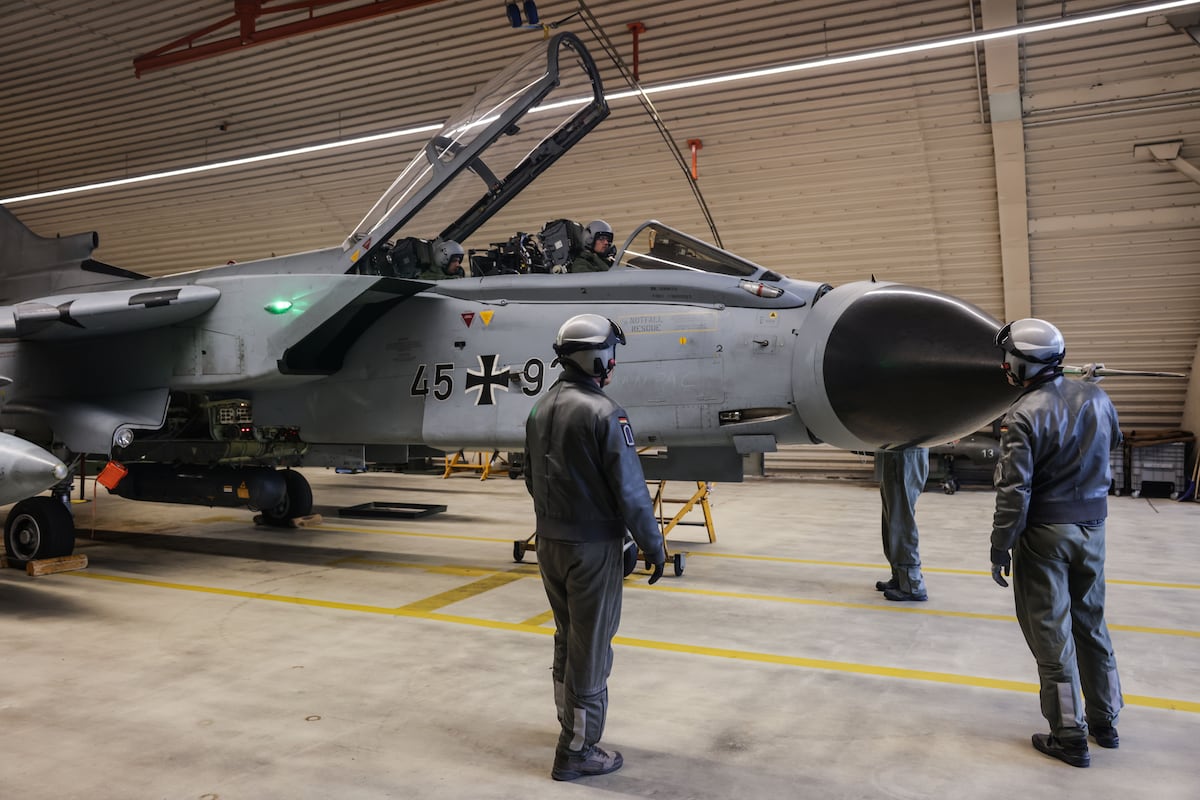
NATO’s current nuclear-sharing doctrine prescribes that German Tornado and forthcoming F-35A aircraft are kitted with the gear needed to deliver U.S. nuclear bombs that are stored in Germany, though Berlin cannot make the call to drop them on its own.
French President Emmanuel Macron has previously offered Germany the option of extending Paris’s own nuclear deterrence to the eastern neighbor.
France has kept its nuclear forces separate from NATO’s command-and-control and decision-making process to retain what the country calls strategic autonomy.
“Times have changed now, and I would like us to at least discuss the offer from the French,” Merz said. “In times like these, an offer like this from the French government cannot simply be left unexamined.”
Macron said in Munich on Feb. 13 he will deliver a speech clarifying France’s nuclear doctrine “in a few weeks’ time,” with local media reporting the talk is expected by the end of February. He repeated a reference to comments by former President Charles de Gaulle that the “vital interests of France” have a European component.
The French president said his country has engaged in a strategic dialogue with Merz and several other European leaders to see “how we can articulate our national doctrine,” including through “special cooperation, common exercises and common security interests with key countries.”
“I think this dialogue is important by itself, but it’s important because this is the way to articulate nuclear deterrence in a holistic approach of defense and security. And this is a way to create convergence in our strategic approach and strategic culture between Germany and France,” said Macron.
France is also in discussion with Sweden, though that is a “very specific discussion, with a very specific approach,” according to the French head of state, who didn’t provide further details.
In light of Russia’s ongoing invasion of Ukraine and the breakdown of relations between European capitals and Moscow, the nuclear debate has gained steam across the continent. Germany is managing a balancing act as it reimagines its military role on the continent and sheds a longstanding pacifist defense and foreign policy.
Berlin is constrained by its own laws and international commitments in what types of nuclear deterrence it can consider, Merz pointed out, citing the 2+4 contract between West and East Germany and the Allies of World War II, and the nuclear nonproliferation treaty, which bans the spread of nuclear weapons to those who did not yet possess them prior to 1967.
Merz described a French-German nuclear weapons partnership as a longstanding option going back to former French President de Gaulle in the 1960s, with discussions springing up now in earnest.
“We are at the very beginning,” the German chancellor said. “The only thing that has happened so far is that the German chancellor has said to the French president, ‘Let’s talk about it,’ nothing more.”
France and the U.K. agreed in July to increase the coordination of their nuclear deterrents, with both governments repeating a position that they could see no situations arising in which the vital interests of one could be threatened, without the same being true for the other. They agreed that there was “no extreme threat to Europe” that would not prompt a response by both nations.
Ruitenberg reported from Paris.
Editor’s note: This story was updated to correct the description of France’s air-based deterrent, which consists of air-launched nuclear cruise missiles.
Linus Höller is Defense News' Europe correspondent and OSINT investigator. He reports on the arms deals, sanctions, and geopolitics shaping Europe and the world. He holds master’s degrees in WMD nonproliferation, terrorism studies, and international relations, and works in four languages: English, German, Russian, and Spanish.
Rudy Ruitenberg is a Europe correspondent for Defense News. He started his career at Bloomberg News and has experience reporting on technology, commodity markets and politics.
柏林——德国总理弗里德里希·默茨表示,德国不想发展自己的核武器,但有兴趣将法国和英国的原子弹纳入类似北约以美国为基地的核保护伞的威慑安排中。
“我不希望德国考虑发展自己的核武器,”默茨在周三发布的Machtwechsel播客节目中说道。这是这位总理今年接受的首次重要采访。
梅尔茨建议,不妨看看能否将法国和英国提升到与美国核保护伞相同的级别,以保护欧洲并确保北约的领土完整。
“与美国人一样,最终的决定权在于法国和英国,”梅尔茨在描述此类武器的使用场景时说道。
法国和英国都部署了潜射弹道导弹作为其核威慑力量的核心。此外,巴黎还拥有超过50枚空射巡航导弹,可装载于其陆基和舰载“阵风”战斗机上。
北约目前的核共享原则规定,德国的“旋风”战斗机和即将服役的F-35A战斗机必须配备投放储存在德国的美国核弹所需的设备,但柏林不能自行决定是否投放这些核弹。
法国总统马克龙此前曾向德国提出,巴黎可以将自身的核威慑力量扩展到这个东部邻国。
法国一直将其核力量与北约的指挥控制和决策过程分开,以保持该国所谓的战略自主权。
“时代已经改变,我希望我们至少能讨论一下法国方面的提议,”梅尔茨说。“在这样的时期,我们不能对法国政府提出的这样的提议置之不理。”
马克龙2月13日在慕尼黑表示,他将在“几周后”发表讲话,阐明法国的核战略。当地媒体报道称,讲话预计将在2月底前举行。他重申了前总统戴高乐的观点,即“法国的根本利益”包含欧洲层面。
法国总统表示,法国已与梅尔茨和其他几位欧洲领导人展开战略对话,探讨“如何阐明我们的国家战略”,包括通过“与关键国家开展特殊合作、共同演习和维护共同安全利益”。
马克龙表示:“我认为这次对话本身就很重要,但它之所以重要,是因为这是在国防和安全的整体框架下阐述核威慑的途径。这也是在德法两国战略方针和战略文化上达成共识的途径。”
法国也在与瑞典进行磋商,但据法国国家元首称,这是一次“非常具体的磋商,采取了非常具体的方法”,他没有提供更多细节。
鉴于俄罗斯持续入侵乌克兰以及欧洲各国首都与莫斯科关系破裂,核问题辩论在欧洲大陆愈演愈烈。德国正努力寻求平衡,重新构想其在欧洲大陆的军事角色,并摒弃长期以来奉行的和平主义国防和外交政策。
梅尔茨指出,柏林在考虑何种类型的核威慑方面受到自身法律和国际承诺的约束,他援引了西德和东德与二战盟国之间的“2+4”条约,以及禁止向1967年以前尚未拥有核武器的国家扩散核武器的《不扩散核武器条约》。
梅尔茨表示,法德核武器伙伴关系是一个由来已久的选择,可以追溯到上世纪 60 年代法国前总统戴高乐时期,而现在双方正在认真讨论此事。
德国总理说:“我们还处于起步阶段。目前为止,唯一发生的事情就是德国总理对法国总统说,‘我们来谈谈吧’,仅此而已。”
法国和英国在7月同意加强核威慑力量的协调。两国政府重申,他们看不到任何一方的重大利益受到威胁而另一方却不受同样威胁的情况。他们一致认为,不存在任何“对欧洲的极端威胁”,不会促使两国做出回应。
鲁伊滕贝格从巴黎报道。
编者按:本文已更新,以更正对法国空中威慑力量的描述,该力量由空射核巡航导弹组成。
林努斯·霍勒是《防务新闻》的欧洲记者和开源情报调查员。他报道影响欧洲乃至全球的军火交易、制裁和地缘政治。他拥有大规模杀伤性武器不扩散、恐怖主义研究和国际关系三个硕士学位,并精通英语、德语、俄语和西班牙语四种语言。
鲁迪·鲁伊滕贝格是《防务新闻》的欧洲记者。他的职业生涯始于彭博新闻社,拥有报道科技、大宗商品市场和政治方面的经验。