Airbus open to two-fighter option for FCAS to keep program alive空客对未来空中作战系统(FCAS)的双战斗机方案持开放态度,以维持该项目的可行性。
“The deadlock of a single pillar should not jeopardize the entire future of this high-tech European capability, which will bolster our collective defense."
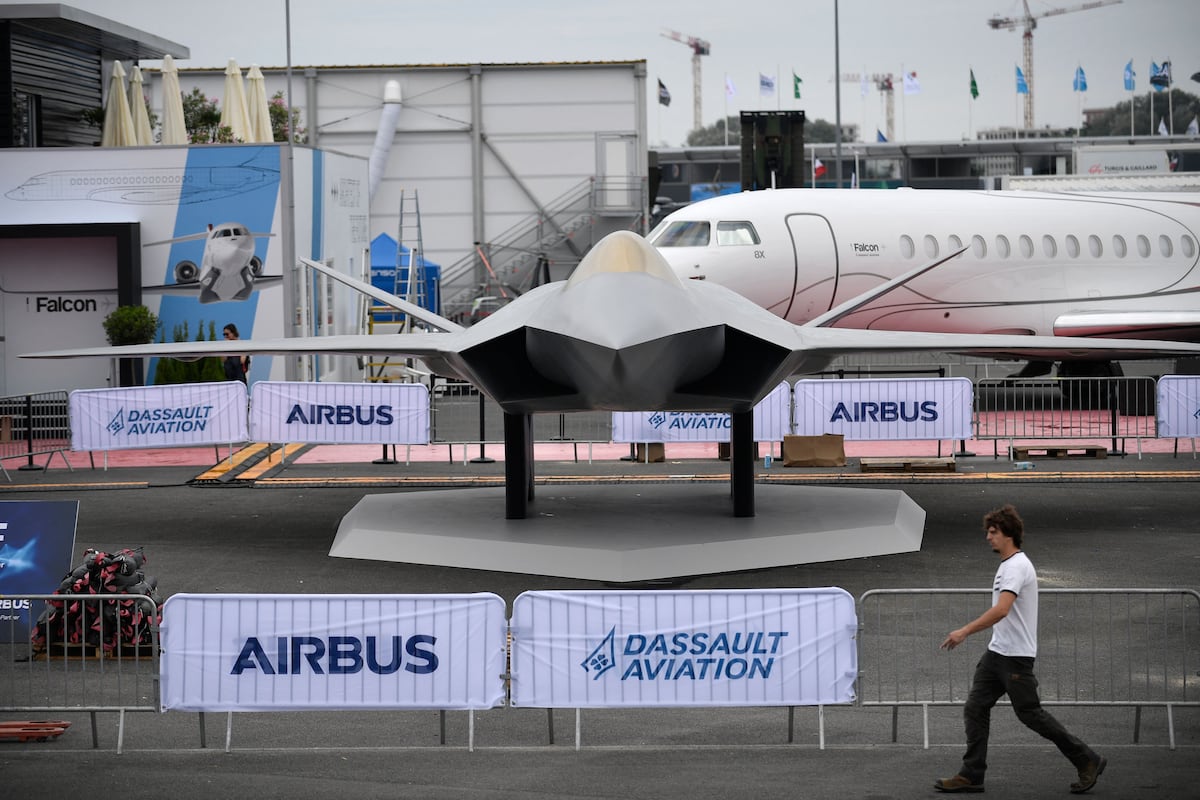
PARIS — Airbus is open to a “two-fighter solution” to break the deadlock on the future air-combat system that France, Germany and Spain are developing, Chief Executive Officer Guillaume Faury said, as work on the next-generation fighter (NGF) that’s part of the program has stalled amid infighting between Airbus and Dassault Aviation.
The Future Combat Air System program, or FCAS, is at “a difficult junction,” Faury said at the Airbus full-year earnings press conference in Toulouse, France, on Thursday. Work is divided into multiple areas, and Faury said other than the future fighter segment, other pillars such as the combat cloud, remote drone carriers and engine are “working well and making good progress.”
“The deadlock of a single pillar should not jeopardize the entire future of this high-tech European capability, which will bolster our collective defense,” Faury said. “If mandated by our customers, we would support a two-fighter solution, and are committed to playing a leading role in such a reorganized FCAS delivered through European cooperation.”
The program for a sixth-generation air combat system, first announced in 2017, has been dragging for years amid disputes over work share, leadership and issues around technology transfer.
Frustrations have mounted recently as a deadline by France and Germany to clarify the program’s future by the end of 2025 slipped by without an announcement.
There are also questions “under a certain governance, on the ability to reach the objective of the program for the different customers,” according to Faury, who said it’s up to the program clients to comment on the that issue.
German Chancellor Friedrich Merz said in an interview this week his country doesn’t currently need the same aircraft as France.
Officials in Paris have stated from early on in the project that the nation requires a fighter able to operate from an aircraft carrier and fire nuclear weapons to ensure sovereign capabilities.
Airbus Chief executive officer (CEO) Guillaume Faury speaks during an Airbus annual results press conference in Toulouse, France, on Feb. 19, 2026. Ed Jones / AFP via Getty Images)
Merz said if the requirement profile can’t be solved, the project can’t be maintained.
Belgian Minister of Defence Theo Francken summarized the Merz interview as meaning “FCAS is dead according to the German Chancellor,” in a social media post , saying there will be no French-German fighter aircraft, and Belgium would reassess its observer status in the program.
“We continue to believe that the program as a whole makes sense and that we should not jeopardize the progress and the relevance of the other pillars,” Faury said. “And we need to find a way forward on the NGF pillar, expecting decisions from customers. And then we’ll see. We are not at the point of deciding next before this step is passed.”
Asked whether Airbus would prefer to develop a new fighter alone, do so together with Sweden, or join the British-Italian-Japanese Global Combat Air Programme, Faury said “we would be wrong to be right too early.” He said Airbus has invested “a lot of time, energy” into the FCAS program.
“We believe if there’s a way forward with two fighters, it could be an opportunity to have other partners with us,” the Airbus executive said. “But it belongs to our customers to decide with whom they want to join forces, would it be the case. Again, we are not yet at that point.”
The European need for an “ambitious” future combat air system is unchanged, according to Faury, who said a project of the scale of FCAS can only be delivered through cooperation.
A number of air forces face the question of whether to move directly to a future of unmanned aircraft, with the risk of becoming irrelevant for a period of time due to a lack of modern manned fighters, or invest “a lot of money” in crewed fighters before moving to the next capability, Faury said.
While autonomous technology is moving fast, “the belief at this stage is that there is still a need for a manned fighter, besides growing capabilities in unmanned flight,” Faury said. He said there is an expectation that at some point “quite far in the future” manned capabilities will be largely replaced by unmanned capabilities.
Regarding the troubled Eurodrone program to develop a long-range drone led by Airbus, Faury said discussions are ongoing between customers “about the way forward,” though he expects the program to continue as the majority of partners still back the project.
France is in negotiations with Germany, Italy and Spain to exit the program, Challenges reported earlier this month.
Rudy Ruitenberg is a Europe correspondent for Defense News. He started his career at Bloomberg News and has experience reporting on technology, commodity markets and politics.
巴黎——空客首席执行官纪尧姆·福里表示,空客对“双战斗机方案”持开放态度,以打破法国、德国和西班牙正在开发的未来空战系统僵局。此前,作为该项目一部分的下一代战斗机(NGF)的研发工作因空客和达索航空之间的内讧而停滞不前。
空客首席执行官马克·福里周四在法国图卢兹举行的空客全年业绩新闻发布会上表示,未来作战空中系统(FCAS)项目正处于“一个艰难的转折点”。他指出,该项目分为多个领域,除了未来战斗机部分外,其他支柱,例如作战云、远程无人机载体和发动机,“进展顺利,取得了良好成效”。
“单一支柱的僵局不应危及这项高科技欧洲能力的整个未来,它将加强我们的集体防御,”福里说。“如果客户要求,我们将支持双战斗机方案,并致力于在通过欧洲合作交付的重组后的前沿空中作战系统(FCAS)中发挥领导作用。”
第六代空中作战系统项目于 2017 年首次宣布,但由于在工作分配、领导权和技术转让问题上的争议,该项目已经拖延多年。
最近,法国和德国要求在 2025 年底前明确该计划未来的最后期限已过,但至今仍未发布任何公告,这加剧了人们的沮丧情绪。
Faury表示,在“某种治理模式下,能否为不同的客户实现项目目标”也存在疑问,他表示,这个问题应由项目客户来评论。
德国总理弗里德里希·默茨本周在接受采访时表示,德国目前不需要与法国相同的飞机。
巴黎官员从项目初期就表示,法国需要一种能够从航空母舰上起飞并发射核武器的战斗机,以确保其主权能力。
2026年2月19日,空客首席执行官纪尧姆·福里在法国图卢兹举行的空客年度业绩新闻发布会上发表讲话。(图片来源:Ed Jones / AFP via Getty Images)
梅尔茨表示,如果需求概况无法得到满足,项目就无法维护。
比利时国防部长西奥·弗兰肯在社交媒体上发帖,将梅尔茨的采访总结为“根据德国总理的说法,FCAS项目已经死了”,并表示不会再有法德联合研制的战斗机,比利时将重新评估其在该项目中的观察员地位。
“我们仍然认为整个项目是合理的,我们不应该为了推进项目而损害其他支柱的进展和意义,”福里说。“我们需要在NGF支柱上找到前进的方向,等待客户的决定。之后我们再看情况。在这一步通过之前,我们不会决定下一步的计划。”
当被问及空客更倾向于单独研发新型战斗机、与瑞典合作研发,还是加入英意日联合的全球空中作战系统(FCAS)项目时,福里表示“我们过早下结论是错误的”。他指出,空客已在FCAS项目上投入了“大量的时间和精力”。
“我们认为,如果两款战斗机的合作方案可行,这或许能为我们带来与其他合作伙伴携手的机会,”空客高管表示。“但最终决定权在于我们的客户,由他们决定与哪些合作伙伴携手。再次强调,我们目前还没有到那一步。”
福里表示,欧洲对“雄心勃勃”的未来作战空中系统的需求没有改变,像FCAS这样规模的项目只有通过合作才能实现。
福里表示,许多国家的空军面临着这样的问题:是直接迈向无人机的未来,但这样可能会因为缺乏现代化的有人驾驶战斗机而在一段时间内变得无关紧要;还是先在有人驾驶战斗机上投入“大量资金”,然后再迈向下一个发展阶段。
福里表示,虽然自主技术发展迅速,但“现阶段人们普遍认为,除了不断提升的无人飞行能力外,仍然需要有人驾驶战斗机”。他还表示,预计在“相当遥远的未来”,有人驾驶能力将被无人驾驶能力基本取代。
关于由空客牵头的远程无人机研发项目 Eurodrone 遇到的困难,福里表示,客户之间仍在就“未来的发展方向”进行讨论,但他预计该项目将继续进行,因为大多数合作伙伴仍然支持该项目。
据《挑战》杂志本月早些时候报道,法国正在与德国、意大利和西班牙进行谈判,以退出该计划。
鲁迪·鲁伊滕贝格是《防务新闻》的欧洲记者。他的职业生涯始于彭博新闻社,拥有报道科技、大宗商品市场和政治方面的经验。