This One Navy F-16N Aggressor Had An Electronic Warfare Suite Only Found On Israeli Jets这架海军F-16N假想敌战斗机配备了只有以色列战机才有的电子战系统。
The unique countermeasures system found itself onto one of Topgun's F-16s during the 1990s and it happens to have a convoluted and colorful past.
Updated Jan 16, 2020 8:16 PM EST
The Navy’s purpose-built F-16N aggressors remain arguably the most fascinating variant of the highly diverse F-16 Viper family. The type’s remarkably short, but hard flown career, lasting just a decade, didn’t allow it to see much change in configuration. But at least one F-16N, Bureau Number 163268, received a very curious and noticeable electronic warfare system upgrade around 1993. So, what was this mysterious system and how did it end up on a random Topgun F-16N? Here’s the story.
Make sure to read the definitive account on the Navy’s F-16N and what it was like to fly in this past War Zone special feature .
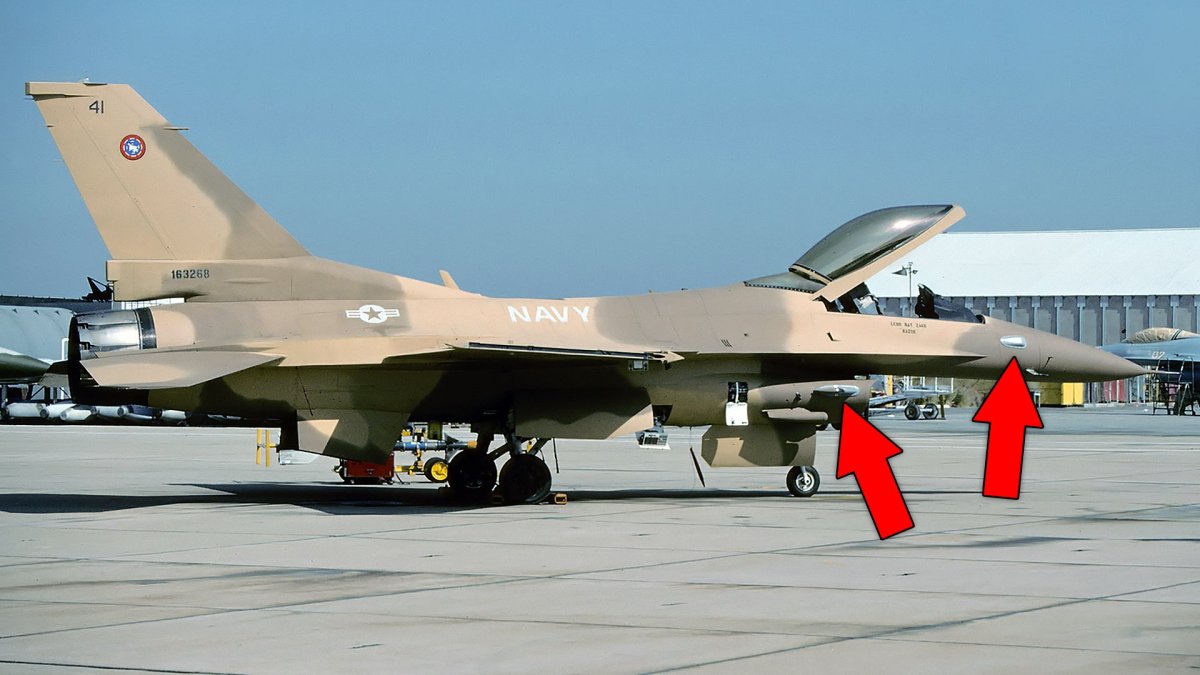
The unique electronic warfare system’s most prominent feature is a pair of blade-like antenna appendages on each side of the F-16N’s inlet structure. Because the aircraft’s running lights are also placed in that position, they are integrated into the edge of the streamlined antenna fairings. A pair of larger than normal antennas are also situated on both sides of the F-16s nose.
F-16N RAPPORT III intake fairing installation. , Reader submission
Beyond its visual appearance, the electronic warfare system on this lone F-16N—the only one we are certain received it—has a very colorful past. The system, which is known as the AN/ALQ-178 Rapid Alert Programmed Power management of Radar Targets III, or RAPPORT III, was originally developed by Loral, which eventually ended up in Lockheed hands. The all internally-mounted suite provided both passive radar warning receiver and active jamming functions into a single integrated system. It is capable of automatically detecting, classifying, locating, and countering hostile emitters.
RAPPORT III’s first customer was supposed to be the Belgium Air Force. That ended up not happening, but Israel embraced the at the time cutting-edge system and saw great success with it on their F-16Cs during operations over Lebanon. A version of it later went on to equip the Turkish Air Force and it was evaluated in the 1990s for use in a number of American fighters. The last U.S. version of the system was dubbed the AN/ALQ-202 and it could have equipped most tactical jets in the Pentagon’s stable at the time.
The best history we found on the system was from a Forecast International document on electronic warfare systems from the early 2000s. It gives a good overall synopsis of the system and its peculiar past:
The Rapid Alert Programmed Power management of Radar Targets (RAPPORT) electronic countermeasures system was the only internal integrated system of its type developed and produced by one manufacturer. Development began in the early 1970s for a competition sponsored by the Belgian AirForce. The installation targeted 85 Mirage 5BA and BR aircraft. In June 1975, (then) Loral was selected as the contractor and production began in 1978. In 1979, the Belgian Air Force tentatively decided to install a more advanced model, RAPPORT III, in all Belgian F-16s from the 53rd production aircraft, with the previous aircraft to be retrofitted. Because of budget problems, the program was postponed, and funding of RAPPORT III stopped by the Belgian Air Force. ALQ-178(V) RAPPORT II production was completed in 1985 at 100 systems, with most installed on Belgian F-5BA/R aircraft. Experience with RAPPORT II was instrumental in deciding to adapt RAPPORT III in lieu of the standard US Air Force countermeasures suite for the Belgian F-16s, which would have used the ALR-69(V) and ALQ-119(V). The ALE-40(V) chaff/flare dispenser was retained. The first production contract for RAPPORT III was awarded in December 1983. The $88 million contract was awarded by Israel. The Israeli Air Force installed the system in its F-16s and used it with remarkable success against the Syrian Air Force during the Lebanon campaign. Under a special agreement, the Belgian Air Force was kept informed of the RAPPORT III’s performance and subsequently decided to install the system on its own F-16s.
The Rapid Alert Programmed Power management of Radar Targets (RAPPORT) electronic countermeasures system was the only internal integrated system of its type developed and produced by one manufacturer. Development began in the early 1970s for a competition sponsored by the Belgian AirForce. The installation targeted 85 Mirage 5BA and BR aircraft. In June 1975, (then) Loral was selected as the contractor and production began in 1978. In 1979, the Belgian Air Force tentatively decided to install a more advanced model, RAPPORT III, in all Belgian F-16s from the 53rd production aircraft, with the previous aircraft to be retrofitted. Because of budget problems, the program was postponed, and funding of RAPPORT III stopped by the Belgian Air Force.
ALQ-178(V) RAPPORT II production was completed in 1985 at 100 systems, with most installed on Belgian F-5BA/R aircraft. Experience with RAPPORT II was instrumental in deciding to adapt RAPPORT III in lieu of the standard US Air Force countermeasures suite for the Belgian F-16s, which would have used the ALR-69(V) and ALQ-119(V). The ALE-40(V) chaff/flare dispenser was retained.
The first production contract for RAPPORT III was awarded in December 1983. The $88 million contract was awarded by Israel. The Israeli Air Force installed the system in its F-16s and used it with remarkable success against the Syrian Air Force during the Lebanon campaign. Under a special agreement, the Belgian Air Force was kept informed of the RAPPORT III’s performance and subsequently decided to install the system on its own F-16s.
F-16C Barak seen equipped with a version of Rapport III still in 2017. , MathKnight and Zachi Evenor
In mid-1985, the Belgian Air Force announced plans to restart the RAPPORT III program. The production plan granted the Teamco Co exclusive production rights, and the company set up manufacturing facilities in Belgium. From 1988 on, the Belgian Air Force provided the bulk of RAPPORT III funding. The total Belgian program for the RAPPORT III was valued at $180 million for 108 systems. In late 1988, after expending $33 million in development funds, Belgium dropped the RAPPORT III program because of escalating program costs, selecting Carapace, a combination RWR/jammer from France as a follow-on to RAPPORT II. In 1989, Loral announced that the government of Turkey had placed a $325 million order for the self protection electronic countermeasures system for its new F-16s. The name RAPPORT III was replaced by the nomenclature ALQ-178(V). Turkey selected it to equip a major production run of F-16s. First deliveries were made in 1992. Loral and Kavala (a Turkish holding company) formed a joint venture to produce ALQ-178(V) Self-ProtectionEW Suites (SPEWS) in Turkey. The joint venture was known as Mikrodalga Elektronik Sistemler (MiKES), and a production facility was operational by 1993. In 1998, MiKES announced that it would manufacture the ALQ-178(V)5 EW protection system for the Turkish Air Force’s Block 50 F-16s, rather than simply assemble the systems from components provided by Lockheed Martin (as it did with the ALQ-178(V)3). In 1993, Loral offered a significantly enhanced ALQ-178(V) (the ALQ-202(V), Loral Autonomous Jammer – LAJ) as an alternative to the terminated ALQ-165(V) ASPJ [Airborne Self Protection Jammer]. The enhanced and repackaged system was offered to both the US Navy and international F-16 and F/A-18 customers. The company offered to pay the cost of a competitive fly-off between the LAJ and ASPJ. Test flights of the ALQ-178(V)3 began at Eglin AFB, Florida, in February 1993. The tests were completed in August. The ALQ-178/202(V) was offered to South Korea and Egypt for their F-16s, and to Finland and Switzerland for their F/A-18s. In 1994, Finland and Switzerland decided to procure the ALQ-165(V) ASPJ instead in a combined FMS/commercial program. South Korea followed suit in early 1997. The US Navy awarded a contract for the Integrated Defensive ElectronicCountermeasure (IDECM) electronic warfare system for the F/A-18E/F in November 1995, eliminating any chance that the ALQ-202(V) would be procured for US F/A-18s.
In mid-1985, the Belgian Air Force announced plans to restart the RAPPORT III program. The production plan granted the Teamco Co exclusive production rights, and the company set up manufacturing facilities in Belgium. From 1988 on, the Belgian Air Force provided the bulk of RAPPORT III funding. The total Belgian program for the RAPPORT III was valued at $180 million for 108 systems. In late 1988, after expending $33 million in development funds, Belgium dropped the RAPPORT III program because of escalating program costs, selecting Carapace, a combination RWR/jammer from France as a follow-on to RAPPORT II.
In 1989, Loral announced that the government of Turkey had placed a $325 million order for the self protection electronic countermeasures system for its new F-16s. The name RAPPORT III was replaced by the nomenclature ALQ-178(V). Turkey selected it to equip a major production run of F-16s. First deliveries were made in 1992.
Loral and Kavala (a Turkish holding company) formed a joint venture to produce ALQ-178(V) Self-ProtectionEW Suites (SPEWS) in Turkey. The joint venture was known as Mikrodalga Elektronik Sistemler (MiKES), and a production facility was operational by 1993. In 1998, MiKES announced that it would manufacture the ALQ-178(V)5 EW protection system for the Turkish Air Force’s Block 50 F-16s, rather than simply assemble the systems from components provided by Lockheed Martin (as it did with the ALQ-178(V)3).
In 1993, Loral offered a significantly enhanced ALQ-178(V) (the ALQ-202(V), Loral Autonomous Jammer – LAJ) as an alternative to the terminated ALQ-165(V) ASPJ [Airborne Self Protection Jammer]. The enhanced and repackaged system was offered to both the US Navy and international F-16 and F/A-18 customers. The company offered to pay the cost of a competitive fly-off between the LAJ and ASPJ. Test flights of the ALQ-178(V)3 began at Eglin AFB, Florida, in February 1993. The tests were completed in August. The ALQ-178/202(V) was offered to South Korea and Egypt for their F-16s, and to Finland and Switzerland for their F/A-18s. In 1994, Finland and Switzerland decided to procure the ALQ-165(V) ASPJ instead in a combined FMS/commercial program. South Korea followed suit in early 1997.
The US Navy awarded a contract for the Integrated Defensive ElectronicCountermeasure (IDECM) electronic warfare system for the F/A-18E/F in November 1995, eliminating any chance that the ALQ-202(V) would be procured for US F/A-18s.
Considering what we know about the system’s complicated history and the timing of the F-16N photograph, shot in October of 1993 on Topgun’s ramp at NAS Miramar, the jet is most likely equipped with a variant of the RAPPORT III that was tested just a couple of months prior. Using a Navy F-16 for some of the testing would have been very efficient as the system wouldn’t have to be integrated onto a new Navy platform, such as the Hornet or Tomcat. Still, it isn’t clear how long the Topgun Viper retained the system or what the conclusions its evaluators were. Considering the combat record of the system and its success with at least a handful of air arms, it likely gave Navy fleet fighters opposing it a run for their money.
F-16N equipped with AN/ALQ-178 on the Topgun ramp at NAS Miramar in October of 1993., Peter Boschert
There has been a decades-long debate over equipping fighters with internal electronic warfare suites or relying on podded systems. It can be far more expensive and harder to upgrade internal systems, but they can be tailored to the airframe and the aircraft’s mission more tightly and don’t cause the drag penalty that an external podded system does. In addition, they don’t occupy valuable stores hardpoints. On the other hand, internal systems, which take up space and add weight to the aircraft, are always installed, even when they are not needed.
F-16CJs with ALQ-131 electronic warfare pods on their centerline stations., USAF
Up until the last decade or so, podded systems were remarkably popular even for relatively modern 4th generation fighters. In fact, they were so effective that they could turn even older fighter jets into highly formidable foes when their use was combined with creative cooperative tactics . But the increasing importance of electronic warfare and the incredible situational awareness a fully integrated digital electronic warfare and surveillance suite provides has meant that internal systems are becoming very hot items. In fact, they have been a key component of keeping new and upgraded 4th generation fighter designs relevant, with aircraft like the F-15 , F-16 , Super Hornet , and foreign offerings featuring various forms of these systems. They also often feature advanced towed decoys and other emerging expendable countermeasures capabilities . Taken as a whole, they are known to be absolute game-changers in terms of survivability. 5th generation fighters, with their high degree of sensor fusion, have these systems as a necessity.
So, in some ways, RAPPORT III was ahead of its time and helped blaze a trail for the advanced internal electronic warfare suites that are so prevalent in today’s fighter market.
That being said, at least one F-16N, even if for just a period of time in the early to mid-1990s, was the most formidable aggressor Viper on the block. And considering the stripped-down hotrod-like F-16N’s already notorious reputation, that’s really saying something.
F-16N 163268 equipped with RAPPORT III alongside an A-4M aggressor. , Unknown
A huge thanks to aviation journalist and photographer Peter Boschert for sharing his rare F-16N shot with us. Make sure to check out more of his awesome work here .
Contact the author: Tyler@thedrive.com
Comments couldn’t be loaded. Please refresh the page.
更新于美国东部时间2020年1月16日晚上8:16。
海军专门研制的F-16N假想敌战机,可以说是F-16“蝰蛇”系列中最引人入胜的型号之一。该机服役生涯虽短,却也异常艰苦,仅有十年,因此配置上鲜有变化。然而,至少有一架F-16N,编号163268,在1993年左右接受了一次非常奇特且引人注目的电子战系统升级。那么,这套神秘的系统究竟是什么?它又是如何出现在一架名不见经传的F-16N上的呢?让我们一起来了解一下。
务必阅读上一期《战区》特刊中关于海军 F-16N 的权威报道,了解驾驶这架战机的感受。
这套独特的电子战系统最显著的特征是F-16N进气道两侧各有一对刀片状天线。由于飞机的航行灯也位于该位置,因此它们被巧妙地集成到流线型天线罩的边缘。此外,F-16机头两侧还各装有一对尺寸大于普通天线的装置。
F-16N RAPPORT III 进气整流罩安装。(读者投稿)
除了外观之外,这架孤零零的F-16N(我们确定它是唯一一架安装了该系统的F-16N)上的电子战系统还有着一段颇为传奇的经历。这套名为AN/ALQ-178快速雷达目标程序化电源管理III型(RAPPORT III)的系统最初由洛拉尔公司(Loral)研发,最终落入洛克希德·马丁公司(Lockheed Martin)手中。这套完全内置的系统将被动雷达告警接收和主动干扰功能集成于一体,能够自动探测、识别、定位并对抗敌方辐射源。
RAPPORT III 的首个客户原本应该是比利时空军。虽然最终未能实现,但以色列采用了这套当时最先进的系统,并在黎巴嫩作战行动中,凭借其 F-16C 战机取得了巨大成功。该系统的一个改进版本后来装备了土耳其空军,并在 20 世纪 90 年代接受了评估,以用于多种美国战斗机。该系统的最后一个美国版本被命名为 AN/ALQ-202,它原本可以装备当时五角大楼的大多数战术喷气式飞机。
我们找到的关于该系统的最佳历史资料来自Forecast International在2000年代初发布的一份关于电子战系统的文档。该文档对该系统及其特殊的历史进行了很好的概述:
快速预警雷达目标程序化电源管理(RAPPORT)电子对抗系统是当时唯一由单一制造商开发和生产的同类内部集成系统。该系统的研发始于20世纪70年代初,当时比利时空军发起了一项竞标。该系统最初计划安装在85架幻影5BA和5BR战斗机上。1975年6月,当时的洛拉尔公司(Loral)被选为承包商,并于1978年开始生产。1979年,比利时空军初步决定为所有比利时F-16战斗机(从第53架生产型开始)安装更先进的RAPPORT III型系统,之前的飞机则进行改装。但由于预算问题,该项目被推迟,比利时空军停止了RAPPORT III的资金投入。ALQ-178(V) RAPPORT II型系统于1985年完成生产,共生产了100套,其中大部分安装在比利时F-5BA/R战斗机上。 RAPPORT II 的经验对决定采用 RAPPORT III 取代美国空军为比利时 F-16 战机配备的标准对抗系统起到了至关重要的作用,该系统原本将使用 ALR-69(V) 和 ALQ-119(V) 对抗系统。ALE-40(V) 箔条/曳光弹投放器则得以保留。RAPPORT III 的首份生产合同于 1983 年 12 月授予以色列,合同金额为 8800 万美元。以色列空军将该系统安装在其 F-16 战机上,并在黎巴嫩战役中对叙利亚空军取得了显著战果。根据一项特殊协议,比利时空军一直被告知 RAPPORT III 的性能,并随后决定在其 F-16 战机上安装该系统。
快速预警雷达目标程序化电源管理(RAPPORT)电子对抗系统是当时唯一由单一制造商开发和生产的同类内部集成系统。该系统的研发始于20世纪70年代初,当时比利时空军发起了一项竞标。该系统最初计划安装在85架幻影5BA和5BR战斗机上。1975年6月,当时的洛拉尔公司(Loral)被选为承包商,并于1978年开始生产。1979年,比利时空军初步决定为所有比利时F-16战斗机(从第53架生产型开始)安装更先进的RAPPORT III系统,之前的飞机则进行改装。但由于预算问题,该项目被推迟,比利时空军也停止了RAPPORT III的资金投入。
ALQ-178(V) RAPPORT II 的生产于 1985 年完成,共生产了 100 套系统,其中大部分安装在比利时的 F-5BA/R 战斗机上。RAPPORT II 的经验对于决定采用 RAPPORT III 取代美国空军为比利时 F-16 战斗机配备的标准对抗系统(原计划使用 ALR-69(V) 和 ALQ-119(V))至关重要。ALE-40(V) 箔条/曳光弹投放器得以保留。
RAPPORT III 的首份生产合同于 1983 年 12 月授予,价值 8800 万美元,合同授予以色列。以色列空军将该系统安装在其 F-16 战斗机上,并在黎巴嫩战役中对叙利亚空军取得了显著战果。根据一项特殊协议,比利时空军获悉了 RAPPORT III 的性能,随后决定在其 F-16 战斗机上安装该系统。
2017年,一架配备Rapport III雷达的F-16C“巴拉克”战斗机被拍到。(图片来源:MathKnight和Zachi Evenor)
1985年中期,比利时空军宣布重启RAPPORT III项目。该生产计划授予Teamco公司独家生产权,该公司随后在比利时设立了生产设施。从1988年起,比利时空军承担了RAPPORT III项目的大部分资金。比利时RAPPORT III项目的总投资为1.8亿美元,计划生产108套系统。1988年末,在投入3300万美元的研发资金后,由于项目成本不断攀升,比利时放弃了RAPPORT III项目,转而选择法国的Carapace——一款集雷达告警接收机和干扰机于一体的系统——作为RAPPORT II的后续产品。1989年,Loral公司宣布土耳其政府已订购价值3.25亿美元的自卫电子对抗系统,用于其新型F-16战斗机。RAPPORT III的名称被ALQ-178(V)取代。土耳其选择该系统装备其大规模生产的F-16战斗机。首批产品于1992年交付。洛拉尔公司与土耳其控股公司卡瓦拉公司成立了一家合资企业,在土耳其生产ALQ-178(V)自卫电子战系统(SPEWS)。该合资企业名为Mikrodalga Elektronik Sistemler(MiKES),生产设施于1993年投入运营。1998年,MiKES宣布将为土耳其空军的Block 50 F-16战斗机生产ALQ-178(V)5电子战防护系统,而不是像ALQ-178(V)3那样,仅由洛克希德·马丁公司提供组件进行组装。 1993年,洛拉尔公司推出了一款性能大幅提升的ALQ-178(V)(即ALQ-202(V),洛拉尔自主干扰机——LAJ),作为已终止的ALQ-165(V) ASPJ(机载自卫干扰机)的替代方案。这款经过改进和重新包装的系统同时面向美国海军以及国际F-16和F/A-18用户。该公司还提出承担LAJ和ASPJ竞标飞行测试的费用。ALQ-178(V)3的试飞于1993年2月在佛罗里达州埃格林空军基地开始,并于同年8月完成。ALQ-178/202(V)被推荐给韩国和埃及的F-16战机,以及芬兰和瑞士的F/A-18战机。 1994年,芬兰和瑞士决定通过一项对外军售/商业联合项目采购ALQ-165(V) ASPJ电子战系统。韩国于1997年初效仿。1995年11月,美国海军授予F/A-18E/F战斗机综合防御电子对抗(IDECM)电子战系统合同,彻底断绝了美国F/A-18战斗机采购ALQ-202(V)电子战系统的可能性。
1985年中期,比利时空军宣布重启RAPPORT III项目。该生产计划授予Teamco公司独家生产权,该公司随后在比利时设立了生产设施。从1988年起,比利时空军承担了RAPPORT III项目的大部分资金。比利时RAPPORT III项目的总投资为1.8亿美元,计划生产108套系统。1988年末,在投入3300万美元研发资金后,由于项目成本不断攀升,比利时放弃了RAPPORT III项目,转而选择法国的Carapace雷达告警接收机/干扰机组合系统作为RAPPORT II的后续产品。
1989年,洛拉尔公司宣布土耳其政府已订购价值3.25亿美元的F-16自卫电子对抗系统。该系统原名为RAPPORT III,后更名为ALQ-178(V)。土耳其选择该系统装备其生产的F-16战斗机。首批交付于1992年完成。
洛拉尔公司和卡瓦拉公司(一家土耳其控股公司)成立了一家合资企业,在土耳其生产ALQ-178(V)自卫电子战系统(SPEWS)。该合资企业名为Mikrodalga Elektronik Sistemler(MiKES),生产设施于1993年投入运营。1998年,MiKES宣布将为土耳其空军的Block 50 F-16战斗机生产ALQ-178(V)5电子战防护系统,而不是像ALQ-178(V)3那样,简单地从洛克希德·马丁公司提供的组件中组装系统。
1993年,洛拉尔公司推出了一款性能大幅提升的ALQ-178(V)(即ALQ-202(V),洛拉尔自主干扰机——LAJ),作为已终止的ALQ-165(V) ASPJ(机载自卫干扰机)的替代方案。这款经过改进和重新包装的系统同时面向美国海军以及国际F-16和F/A-18用户。该公司还提出承担LAJ和ASPJ竞标飞行测试的费用。ALQ-178(V)3的试飞于1993年2月在佛罗里达州埃格林空军基地开始,并于同年8月完成。ALQ-178/202(V)被推荐给韩国和埃及的F-16战机,以及芬兰和瑞士的F/A-18战机。 1994年,芬兰和瑞士决定通过对外军售/商业联合项目采购ALQ-165(V) ASPJ型发动机。韩国于1997年初效仿。
1995 年 11 月,美国海军授予了 F/A-18E/F 战斗机综合防御电子对抗 (IDECM) 电子战系统的合同,从而彻底断绝了美国 F/A-18 战斗机采购 ALQ-202(V) 的可能性。
考虑到我们对该系统复杂历史的了解,以及这张1993年10月在米拉马尔海军航空站“壮志凌云”训练场停机坪拍摄的F-16N照片的时间,这架战机很可能配备的是几个月前刚刚测试过的RAPPORT III系统的改进型。使用海军F-16进行部分测试非常高效,因为这样就无需将该系统集成到新的海军平台上,例如“大黄蜂”或“雄猫”。然而,目前尚不清楚“壮志凌云”训练场的“蝰蛇”战机使用了该系统多久,也不清楚评估人员的结论是什么。考虑到该系统的实战记录以及它在至少几个空军部队的成功应用,它很可能给与之对抗的海军舰队战斗机带来了不小的麻烦。
1993年10月,一架配备AN/ALQ-178的F-16N战斗机停放在米拉马海军航空站的“壮志凌云”停机坪上。(彼得·博舍特摄)
关于战斗机应该配备内置电子战系统还是依赖外挂式系统,一直存在着长达数十年的争论。升级内置系统虽然成本更高、难度更大,但可以根据机身和任务进行更精准的定制,而且不会像外挂式系统那样增加阻力。此外,内置系统也不会占用宝贵的挂架位置。另一方面,内置系统虽然占用空间并增加飞机重量,但即使不需要,也总是会被安装。
美国空军的F-16CJ战斗机,其机身中心挂架上挂载了ALQ-131电子战吊舱。
直到近十年来,吊舱式电子战系统即便在相对先进的第四代战斗机中也极为流行。事实上,它们的效用如此之高,以至于当与创造性的协同战术结合使用时,甚至可以将老旧的战斗机变成极其强大的对手。然而,电子战日益重要,以及完全集成的数字化电子战和监视系统所提供的强大态势感知能力,使得内置式电子战系统变得炙手可热。事实上,内置式电子战系统一直是保持新型和升级版第四代战斗机竞争力的关键组成部分,例如F-15、F-16、超级大黄蜂以及国外同类机型都配备了各种形式的内置式电子战系统。它们通常还配备先进的拖曳式诱饵和其他新兴的消耗性对抗措施。总而言之,内置式电子战系统在提升战斗机的生存能力方面具有颠覆性的意义。而对于高度融合传感器的第五代战斗机来说,内置式电子战系统更是必不可少。
因此,从某种意义上说,RAPPORT III 超前于时代,并为当今战斗机市场中普遍存在的先进内部电子战套件开辟了道路。
话虽如此,至少有一架F-16N,即便只是在20世纪90年代初中期的一段时间内,也是当时最强大的假想敌战机。考虑到这款精简改装、性能强劲的F-16N早已臭名昭著,这番话的分量着实不轻。
一架装备 RAPPORT III 系统的 F-16N 163268 与一架 A-4M 假想敌机并肩作战。,未知
非常感谢航空记者兼摄影师彼得·博舍特与我们分享他拍摄的珍贵F-16N照片。请务必点击此处查看他的更多精彩作品。
联系作者:Tyler@thedrive.com
评论加载失败,请刷新页面。