The Futuristic Cold War Era SAGE Air Defense Bunkers Looked Right Out Of A Kubrick Film冷战时期未来主义的SAGE防空掩体看起来就像是从库布里克电影里走出来的一样。
The sci-fi-esque bunkers were scattered across North America, and sat ready to fend off nuclear-armed Russian bombers.
新闻视频
Updated Dec 1, 2019 6:40 AM EST
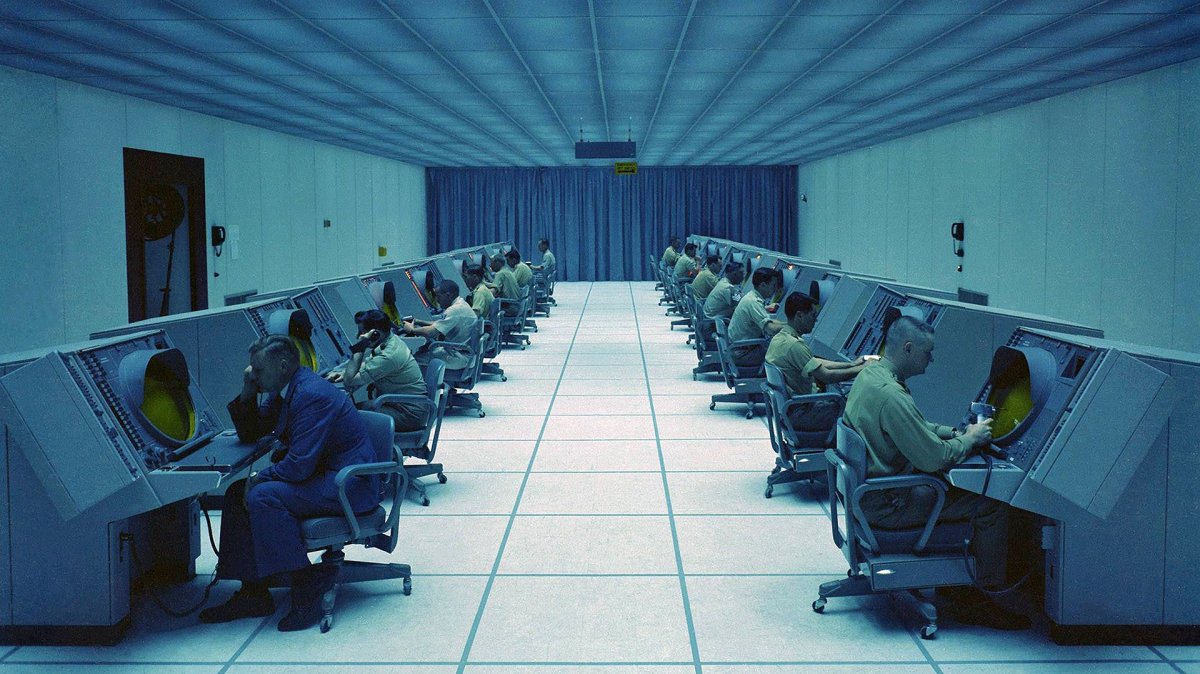
The photo above was taken at the height of the Cold War inside one of nearly two dozen Semi Automatic Ground Environment (SAGE) Direction Centers that dotted the United States and Canada. The room seen here, nicknamed the Blue Room for obvious reasons, was one of many built inside the nuclear-fortified block houses that were really an elaborate and, at the time absolutely cutting-edge, weapon system in their own right. The oversized computer hardware, blinking lights and moody lighting, large projection systems, and austere bunker atmosphere influenced pop culture and science fiction heavily during SAGE’s heyday, which ran from 1959 through 1984.
SAGE was the eyes and brains of North American Air Defense Command’s (NORAD) strategic mission having the job of detecting and directing the response to an incoming armada of nuclear bomb laden Soviet bombers. By default, it also kept tabs on air traffic around North America.
The system was amazing advanced for its time, running on huge mainframe computers that were interlinked to radar stations, radar picket ships, and airborne early warning aircraft, as well as surface-to-air missile and aircraft interceptor sites. Not long after its founding, SAGE gained the ability to remotely take control of surface-to-air missiles and interceptor aircraft, some of them nuclear armed, to prosecute incoming targets largely on its own. But it still was 1950s computer technology that ran on constant streams of punch cards and outputted teletype instructions. As such, even though it was highly automated for its age, it was also extremely labor intensive.
The system was also tied into a handful of master Combat Centers that could unilaterally direct North America’s entire air defense system during a conflict, as well as the Pentagon’s own nerve center , and NORAD headquarters. So, we are really talking about one of the first fully integrated data networks that spanned thousands of miles, as well as the dawn of what we know now as sensor fusion and an integrated air defense system (IADS).
At the heart of each SAGE Direction Center was an enormous IBM AN/FSQ-7 duplex computer, taking up a whole level of the bunker structure—roughly 22,000 square feet—and made up of a whopping 49,000 vacuum tubes. It is also still the largest single computer system ever built.
This computer fused all the radar and other telemetry data from disparate remote sensors together to create common, relatively accurate radar tracks of targets and would even recommend the best response to them if they were deemed hostile based on the nearest air defense assets, those assets’ real-time status, and their varying capabilities. The duplex arrangement meant that one of the computers was always double checking the primary one and would instantly take over full functionality if the lead computer had any sort of technical difficulties.
SAGE Direction Center in Duluth, MN and the AN/FSQ-7 mainframe modules. , DoD
The Direction Center bunker installations were built to withstand the pressure from nearby thermonuclear warheads detonating and were hardened from the effects of electromagnetic pulses (EMPs) as they had to continue operating even though what could have potentially been the beginning of the end of human civilization. This was all part of a deterrent strategy that was one abstract aspect of the complex and hugely expensive SAGE system.
The foreboding-looking Direction Centers were high security, windowless, concrete and steel facilities made up of four floors. The first housing the mechanical and electrical systems and the heavy cooling systems needed to keep all that archaic computer technology running and the bunker’s inhabitants alive and communicating to the outside world. The second floor was where the massive AN/FSQ-7 was installed and maintained.
The third floor contained offices and store rooms, as well as the Sector Command Post. This was also a very sci-fi looking feature that inspired sets used in films and television shows for decades. It included a pit-like theater area where a large projection screen displayed a ‘big board’ that showed the air defense ‘picture’ over an entire geographical region. A cutting-edge Kelvin-Hughes projector was used for the big situational display.
Around the pit was seating for a command staff to oversee the status of the region at any given time and to make decisions based on the info fed into the projector, which itself was made up of ever-changing data being produced by the computer and a small army of radar operators housed on the level above, as well as a support staff that worked tirelessly to translate critical info into visual form.
The corded gun you see the officer holding is either a form of long-distance light pen device or a very early version of a laser pointer. I have been told by two people that it was a laser pointer, but I haven’t been able to confirm it with a primary source. , USAF
The fourth floor is where the Blue Room photo was taken. Here is where all the information the computer fused was shown to radar and weapons control operators. Everything from threat discrimination and identification, to actually ordering or even controlling the employment of surface-to-air missiles and interceptor aircraft occurred on this level. It was from this information, much of which was filtered by the human operators, that those down in the Sector Command Post could make decisions.
The Blue Room at Canada’s North Bay bunker installation., Canadian Department of National Defense Photo
Left: Experimental SAGE Subsector Direction Center at Lincoln Laboratory in 1957 (Via Engineering and Technology History Wiki). Center: Airmen training on SAGE terminals with light pens (timetoast.com) Right: Sage Blue Room (via palosverdes.com). , See description
Light pen technology, which was totally new at the time, and CRT monitors, were the technological backbone of the consoles used by SAGE operators. The light pens could designate/select targets to allow them to be classified and tracked.
Check out these awesome atomic age videos explaining SAGE and its incredibly complex functionality.
SAGE, which did get critical upgrades throughout its lifetime, has been gone for 35 years, and it is far cry from the office-like settings we see Air Force air defense operators working at today. The abilities that NORAD has presently seem lightyears ahead of SAGE, especially when it comes to automation and the streamlining of user interfaces, let alone the amount of data available at what amounts to a desktop computer workstation. But knowing that makes SAGE all that more jaw dropping technologically speaking.
Despite all the computers, the system was run by people. Lots and lots of people, including civilian contractors, some of which were women. It was not glamorous or particularly engaging work by any means. Basically, you were trapped in a fortified prison all day with no natural light and surrounded by buzzing and blinking computer gear. Considering the very nature of its utility—to repel a Soviet nuclear strike—not a whole lot happened outside of exercises, issues with airliners, and enemy training sorties skimming the SAGE network’s sensor perimeter. But that was the point. SAGE’s existence was all about not having to realize its fullest combat potential.
In that way it worked marvelously.
So, here’s to all the Americans and Canadians who spent large parts of their lives keeping an eye on the skies over North America from their futuristic, computer-stuffed, concrete cubes.
Just another group of unsung heroes of the Cold War.
Contact the author: Tyler@thedrive.com
Comments couldn’t be loaded. Please refresh the page.
更新于美国东部时间2019年12月1日上午6:40
上图拍摄于冷战高峰时期,地点是美国和加拿大境内近二十个半自动地面环境(SAGE)指挥中心之一。图中所示的房间,因其颜色而得名“蓝房间”,是众多建在核防御工事内的房间之一。这些工事本身就是一套精密复杂、在当时堪称尖端的武器系统。SAGE系统鼎盛时期(1959年至1984年),其庞大的计算机硬件、闪烁的指示灯、昏暗的照明、大型投影系统以及肃穆的掩体氛围,对流行文化和科幻小说产生了深远的影响。
SAGE系统是北美防空司令部(NORAD)战略任务的“眼睛”和“大脑”,其职责是探测并指挥对来袭的苏联核弹轰炸机群的应对。此外,它还负责监视北美周边的空中交通。
这套系统在当时堪称先进,它运行在与雷达站、雷达警戒舰、空中预警机以及地对空导弹和飞机拦截阵地互联的大型主机上。SAGE系统成立不久,便具备了远程控制地对空导弹和拦截机(其中一些携带核武器)的能力,能够自主打击来袭目标。然而,它仍然沿用20世纪50年代的计算机技术,依靠穿孔卡片持续传输数据,并通过电传打字机输出指令。因此,尽管在当时来说自动化程度很高,但同时也极其耗费人力。
该系统还与少数几个主作战中心相连,这些中心可以在冲突期间单方面指挥北美整个防空系统,此外还与五角大楼的指挥中心和北美防空司令部总部相连。因此,我们实际上是在谈论最早的、覆盖数千英里的完全集成数据网络之一,以及我们现在所知的传感器融合和综合防空系统(IADS)的雏形。
每个SAGE指挥中心的核心都是一台巨大的IBM AN/FSQ-7双面计算机,占据了掩体结构的一整层——大约22000平方英尺——由多达49000个真空管组成。它至今仍是建造过的最大的单体计算机系统。
这台计算机将来自不同遥感器的雷达和其他遥测数据融合在一起,生成相对精确的目标雷达轨迹,甚至还能根据最近的防空设施、这些设施的实时状态及其不同的性能,推荐最佳应对方案,以识别敌对目标。双工配置意味着其中一台计算机始终对主计算机进行复核,一旦主计算机出现任何技术故障,另一台计算机将立即接管全部功能。
位于明尼苏达州德卢斯的SAGE指挥中心和AN/FSQ-7主机模块。,美国国防部
指挥中心掩体设施的建造旨在承受附近热核弹头爆炸带来的巨大压力,并针对电磁脉冲(EMP)的影响进行了加固,因为即使在可能预示着人类文明终结的时刻,它们也必须继续运行。这一切都是威慑战略的一部分,而威慑战略只是复杂且造价极其高昂的SAGE系统的一个抽象方面。
这些外观阴森的指挥中心是高度戒备、没有窗户的钢筋混凝土建筑,共有四层。一层容纳了机械和电气系统以及维持所有古老计算机技术运转、保障地堡居民生命安全并与外界保持联系所需的大型冷却系统。二层则安装并维护着庞大的AN/FSQ-7系统。
三楼设有办公室、储藏室以及区域指挥所。这个指挥所极具科幻感,几十年来启发了众多电影和电视剧的布景设计。它包括一个类似地坑的剧场区域,巨大的投影屏幕上显示着一幅“大图”,展现着整个地理区域的防空“态势图”。这幅大型态势图使用了当时最先进的凯尔文-休斯投影机。
坑周围设有指挥人员的座位,以便随时监督该地区的状况,并根据输入投影仪的信息做出决策。投影仪本身由计算机和楼上一小队雷达操作员不断生成的数据组成,此外还有不知疲倦地将关键信息转化为视觉形式的支持人员。
你看到的军官手里拿着的有线枪,要么是一种远程光笔装置,要么是激光指示器的早期版本。有两个人告诉我那是激光指示器,但我还没能从一手资料中证实这一点。——美国空军
四楼是拍摄“蓝室”照片的地方。计算机融合的所有信息都会在这里显示给雷达和武器控制操作员。从威胁识别和辨别,到实际下达甚至控制地对空导弹和拦截机的使用,所有操作都在这一层进行。正是基于这些信息(其中大部分经过操作员的筛选),位于下方的战区指挥所的人员才能做出决策。
加拿大北湾掩体设施的蓝室。(加拿大国防部照片)
左图:1957 年林肯实验室的实验性 SAGE 子扇区指挥中心(图片来自工程与技术历史维基)。中图:空军人员使用光笔在 SAGE 终端上进行训练(图片来自 timetoast.com)。右图:SAGE 蓝室(图片来自 palosverdes.com)。,参见描述
当时全新的光笔技术和CRT显示器是SAGE操作员使用控制台的技术核心。光笔可以指定/选择目标,以便对其进行分类和跟踪。
来看看这些精彩的原子时代视频,它们解释了SAGE及其极其复杂的功能。
SAGE系统在其服役期间虽经过多次关键升级,但至今已退役35年,与我们今天看到的空军防空人员在类似办公室的环境中工作的情况截然不同。北美防空司令部(NORAD)目前的能力似乎远远领先于SAGE,尤其是在自动化和用户界面简化方面,更不用说相当于一台台式电脑工作站所能处理的数据量了。但正因如此,SAGE在技术层面才显得更加令人叹为观止。
尽管配备了大量计算机,但整个系统仍然由人运行。很多人,包括一些文职承包商,其中一些是女性。这绝不是什么光鲜亮丽或引人入胜的工作。基本上,你整天被困在一个戒备森严的监狱里,没有自然光,周围全是嗡嗡作响、闪烁不停的计算机设备。考虑到它的用途——抵御苏联的核打击——除了演习、客机故障以及敌方训练飞行掠过SAGE网络传感器边界之外,几乎什么事都没发生。但这正是关键所在。SAGE存在的意义就在于不必发挥其全部作战潜力。
那样做效果非常好。
所以,谨以此献给所有那些在充满未来感、装满电脑的混凝土立方体建筑里,花费大半生关注北美天空的美国人和加拿大人。
冷战时期又一群默默无闻的英雄。
联系作者:Tyler@thedrive.com
评论加载失败,请刷新页面。