Blasting The Air In Front Of Hypersonic Vehicles With Lasers Could Unlock Unprecedented Speeds用激光照射高超音速飞行器前方的空气,可以解锁前所未有的速度。
For decades, the DoD has been researching a radical drag reduction technique that involves sheathing a vehicle in directed energy-induced plasma.
Updated Nov 27, 2020 6:25 PM EST
Over the last decade, two of the most significant topics in defense research and development have been directed energy systems and hypersonic weapons . The Department of Defense and its major contractors have been pushing the boundaries of what is possible with these technologies and those efforts could someday soon literally change the face of warfare forever.
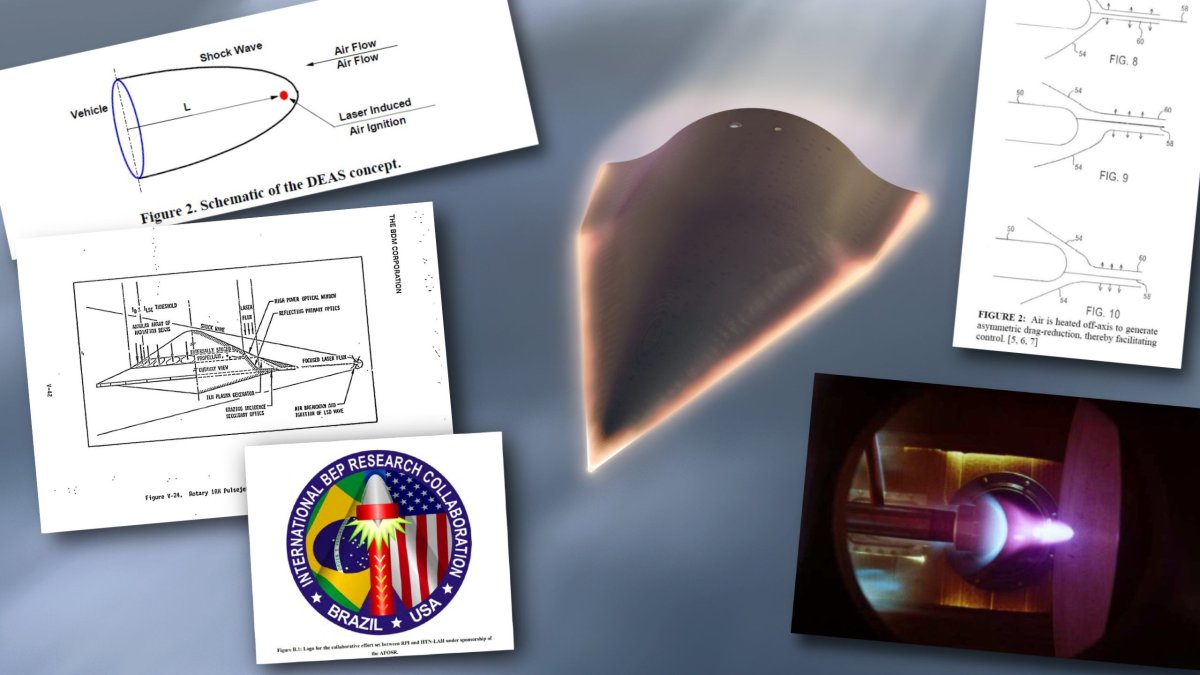
As it turns out, these two cutting edge areas of defense research are beginning to converge in laboratories with the goal of enabling unprecedented levels of speed for aerial weapons. By combining advanced directed energy technology with the latest in hypersonic vehicle design, researchers in private and Department of Defense (DoD) funded laboratories have laid the groundwork for systems designed to literally sheathe an entire vehicle in laser and/or microwave-induced plasma in order to drastically reduce drag. If successfully developed, this concept may someday lead to new frontiers in speed and radical new forms of aerodynamic control and aircraft design.
The Rapidly Evolving Hypersonic Landscape
As the world’s military superpowers jockey for position in a new arms race , hypersonic technologies have been pushed to the forefront of defense and aerospace research. These vehicles and weapons represent a true leap-ahead capability, enabling flight speeds that can outpace even the most advanced and robust air defense systems. It’s one thing to intercept and destroy a ballistic missile falling on an arcing path, but it’s another thing entirely to attempt to intercept a projectile moving at speeds greater than five times the speed of sound while executing abrupt changes in trajectory. It’s no surprise that hypersonic systems are becoming integral to the United States’ military’s future strategy in key theaters such as the Indo-Pacific region.
The need for hypersonic weapons has evolved alongside the parallel evolution of missile defense systems. As integrated sensor networks and missile defenses continue to become more sophisticated and adept, developing weapon delivery systems capable of evading or bypassing defenses with extreme speed has become paramount to ensuring global battlefield dominance and conventional deterrence. To that end, and to keep up with foreign advances , the USAF and other branches of the DoD have been investing vast sums of money into hypersonic research and development in recent years.
That R&D has already led to several systems approaching operational status. The USAF and Lockheed Martin are working on the AGM-183A Air-launched Rapid Response Weapon (ARRW), a boost-glide hypersonic system that is claimed to be able to achieve speeds up to Mach 20 . The wedge-shaped ARRW has been tested in captive flights on a B-52 Stratofortress and is expected to be operational by 2022. Meanwhile, the Army and Navy, in conjunction with the Missile Defense Agency (MDA), have tested their own hypersonic delivery system , the Common Hypersonic Glide Body vehicle, or C-HGB. There are a number of other initiatives underway as well, including air-breathing hypersonic cruise missile designs, such as HAWC , and a multitude of classified efforts.
A Lockheed Martin-built AGM-183 ARRW (Air-Launched Rapid Response Weapon) hypersonic missile during a captive flight test aboard a USAF B-52. , USAF
As with all hypersonic systems, drag and the resulting thermal stresses of extremely high-speed flight are two of the biggest hurdles faced by these vehicles. Even with advanced geometry, extreme levels of heat are generated by friction on the skin of high-speed craft, which can potentially degrade the structural integrity of the airframe and damage internal components, potentially even in a catastrophic fashion.
One of the ways of mitigating that heat buildup is to add shielding to the external surfaces of an airframe. That can increase a craft’s weight and may, therefore, decrease its range, maneuverability, and top speed. Thermal shielding requirements can also be very restrictive for aerospace designers that are looking to push the limits of inter-atmospheric speed.
Tweaking a vehicle’s geometry can mitigate drag, which can also help to reduce heat buildup. However, due to the limitations of materials science and the need to include various subsystems and payloads inside of hypersonic craft, there are restrictions on just how much the geometry can be altered. Thus, there is a pressing need for other drag reduction methods to be used in conjunction with airframe geometry. Like in many other areas of cutting-edge defense and aerospace research today, that’s where breakthroughs in directed energy may be able to lend a hand.
Drag Reduction Through Directed Energy Deposition
Alongside the ongoing hypersonic revolution, the Department of Defense has been investing vast sums in directed energy systems. Many huge leaps in power and miniaturization have occurred in the last decade as solid-state systems have rapidly matured, enabling them to be used for new applications.
Laser weapons have been developed and tested for use aboard Naval vessels and even aircraft , while other forms of directed energy systems, such as high-powered microwaves, have been designed for power-beaming concepts , close-in defense systems , and anti-satellite technologies . While most discussions of directed energy focus on the potential to revolutionize anti-aircraft systems, missile defenses, or anti-satellite systems, it turns out directed energy could revolutionize high-speed aerospace propulsion and airframe design just as significantly.
Since at least the 1980s, many leading aerospace laboratories have explored the concept of “energy deposition” in order to reduce drag. This concept involves beaming energy in the form of laser filaments, electric arcs, or microwave radiation along the leading edges or just in front of an aircraft in order to condition the air to be more conducive to high-speed flight. Similar concepts have been tested in the past for different purposes, including an electron gun aboard the Lockheed A-12 designed to reduce the aircraft’s radar signature.
In a 1983 NASA-funded study conducted by the BDM Corporation and authored by Leik Myrabo, pioneer of the laser lightcraft propulsion concept , Myrabo proposed using lasers to literally explode the air in front of a high-speed craft. Myrabo’s initial concept centered on small lightcraft propelled by ground-based lasers focused on their aft section. These proposed craft would also employ internal mirrored optics to then redirect those beams forward to create a “laser-supported detonation” or “LSD wave” in front of the craft.
This LSD wave would create a detached shockwave “at some distance in advance of the leading edge,” which would theoretically “do the work of pushing the atmosphere out of the way and thereby suppress the formation of a strong bow shock and the associated wave drag.” The hot, pressurized gases created by the LSD wave would also theoretically then be used by the craft’s air-breathing engine, thus reducing the amount of energy required for combustion.
Myrabo updated the concept throughout the 1990s in response to the limitations of high-powered lasers at the time. In a 1995 Popular Mechanics article by Gregory Pope, Myrabo claimed that pulsed microwave energy beamed from an overhead satellite could be focused in front of a craft to “blast air into plasma,” which could then be focused downward by powerful superconducting magnets circling the craft in order to create propulsion. As Pope’s article points out, “NASA officials see promise in some of the component technologies, but envision no short-term payoff.” Myrabo’s radical concept appears to have never left the ground.
Other researchers continued exploring similar concepts, however. In 1999, Australia-based aerospace researcher H. David Froning conducted a study published by AIAA titled “Influence of EM Discharges on Hypersonic Vehicle Lift, Drag, and Airbreathing Thrust” that investigated creating “plasma formations by electric arcs or by laser or microwave radiation.” Using computational fluid dynamics, Froning found that “electric or electromagnetic discharges from hypersonic vehicles’ nose sections propagate downstream over the entire extent of the vehicles and through their engines – affecting not only nose drag, but temperatures, pressures, and total vehicle thrust, drag, and lift.” These were only computational studies, but they established a theoretical framework for developing these systems in the future.
A figure from H.D. Froning’s “Influence of EM Discharges on Hypersonic Vehicle Lift, Drag, and Airbreathing Thrust”., AIAA
Throughout the last two decades, researchers in Brazil and the Rensselaer Polytechnic Institute in Rochester, New York have built upon this theoretical research and designed experiments to test energy deposition in hypersonic wind tunnels. This concept became known as the Laser-Supported Directed Energy Air Spike , or DEAS. Leik Myrabo was once again involved with the research, this time alongside a team of Brazilian researchers.
Brazilian Society of Mechanical Sciences and Engineering
In 2005, Myrabo and Brazilian researchers testing the DEAS concept in hypersonic wind tunnels concluded that “the laser-supported DEAS was able to generate a decrease in the surface pressure over the new model tested and, therefore, a considerable decrease in the aerodynamic drag” experienced by a hemispherical test model.
Myrabo’s concept seemed to have attracted the attention of several top laboratories. In 2010, the Journal of Propulsion and Power published the article “ Review: Laser-Ablation Propulsion ” which features input from personnel at the USAF Office of Scientific Research (AFOSR), Los Alamos National Laboratory, and academic institutions worldwide. The review notes that at that time, Brazilian researchers had shown that “hypersonic drag can be cut by as much as 40%” and cites cooperation between American, Brazilian, and Australian researchers on the subject of laser-aided propulsion.
By 2011, Myrabo’s team was researching the DEAS concept in cooperation with the Brazilian Air Force and the U.S. Air Force Research Laboratory. Curiously, one of the team’s publications from that year mentions a “Brazil-USA BEP cooperation” (Beamed Energy Propulsion) program, a claim that appears to be supported by additional reporting by Wired and MIT Technology Review published around the same time.
The War Zone has been unable to identify such a program. However, an AFOSR report from 2010 also mentions such a program overseen by Rensselaer Polytechnic Institute (RPI) and the Henry T. Nagamatsu Laboratory of Aerothermodynamics and Hypersonics (HTN-LAH) located at the Instituto de Estudos Avançados (IEAv-CTA) in Sao Jose dos Campos, Brazil.
According to the AFOSR report, this collaboration “was forged by the shared research goals envisioned by both parties (RPI and IEAv-CTA), and the unique facilities and equipment made available for this AFOSR research: i.e., a) the operational T3 hypersonic shock tunnel at the HTN-LAH; and, b) RPI’s two Lumonics TEA 620 lasers that were transported to Brazil with the approval of AFOSR.”
Similar energy deposition concepts have been explored by researchers at Johns Hopkins University Applied Physics Laboratory ( Van Wie 2004 ), Rutgers University ( Knight 2008 ; Anderson & Knight 2012 ), the Laboratory of Optics Applications in France ( Elias 2018 ), and the Russian Academy of Sciences ( Fomin 2004 ), among many other laboratories.
A search on the AIAA Aerospace Research Central database turns up over 11,000 results for various aerospace applications of energy deposition. Many major aircraft manufacturers are assigned patents for similar systems , including Boeing and Lockheed Martin .
Department Of Defense Research On Energy Deposition
The DOD has conducted its own research into energy deposition as a concept for reducing the drag experienced by high-speed vehicles. The USAF is also the assignee of numerous patents related to plasma aerodynamics .
A 2004 report commissioned by the Air Force Research Laboratory (AFRL) studied “plasmas generated by electron beams and high-voltage nanosecond pulses” and explored “aerodynamic steering using plasma energy addition” using a “microwave-driven supersonic plasma wind tunnel.” As in many exotic aerospace studies, the authors note that “Of course, fundamental issues have to be resolved prior to any practical applications.”
That doesn’t mean the DOD stopped trying to resolve those issues. In 2009, the AFRL published another study titled “Lines of Energy Deposition for Supersonic/Hypersonic Temperature/ Drag-Reduction and Vehicle Control.” The report was authored by Kevin Kremeyer, Vice President of Research at Physics, Materials, and Applied Mathematics Research (PM&AM) in Tucson, AZ. Kremeyer holds numerous patents for systems designed to reduce drag through the use of directed energy.
In the 2009 AFRL study, Kremeyer describes using laser pulses to create ionized paths in the air surrounding an aircraft and then passing an electrical current through that path, essentially forming a miniaturized lightning bolt ahead of a vehicle. By creating these ionized paths at different angles relative to an aircraft’s motion, it is claimed that novel forms of vehicle control could be accomplished that do away with external control surfaces entirely:
Reducing drag at an angle or “off-axis” steers and controls the vehicle, since it will travel along the center of the low-density tube ahead of it. This presents the alluring ability to use the vehicle’s body as the only required control and lifting surface, as it balances the moments/forces to keep the vehicle confined within the low-density path.
Kremeyer claims this could allow for more effective maneuvering at extreme speeds and notes that “each of the technical elements required to implement this technology has been demonstrated individually in the laboratory, with no apparent physical limitation barring execution as a full system.”
The USAF isn’t the only U.S. military branch investigating energy deposition. A 2015 study by the Naval Research Laboratory titled “Guiding Supersonic Projectiles Using Optically Generated Air Density Channels” states that a “channel of reduced air density can be generated by the energy deposited from filamentation of an intense femtosecond laser pulse” and that this channel could be used to control the trajectory of flying projectiles. While the report focuses on small projectiles instead of aircraft and describes using lasers external to the projectiles as opposed to carried aboard them, the concept remains relatively identical to other research cited here: using directed energy to reduce air pressure ahead of a vehicle or projectile’s path.
NASA even conducted a study in 2017 at the Langley Research Center into the “experimental determination of the drag reduction and energetic efficiency” of laser discharges ahead of simulated aircraft traveling at high speeds, and the Department of Energy (DOE) has looked into the same concept for increasing the performance of wind turbines.
Physics, Materials, And Applied Mathematics Research
Since 2002, Kremeyer and his firm Physics, Materials, and Applied Mathematics Research have been awarded at least 48 SBIR contracts offered by DHS, DOD, DOE, and NASA, largely focused on advanced materials, short-pulse lasers, and other directed energy applications. According to their website , PM&AM’s research largely focuses on drag reduction and hypersonic flight dynamics, and the firm claims its drag reduction technology “presents the possibility to eliminate more than 90% of the drag when flying at supersonic/hypersonic speeds.” It’s unclear how credible that claim of 90% drag reduction is, but if it turns out to be true or even remotely true, such a technology would represent a total game-changer in terms of aerodynamic performance.
In a 2019 patent , PM&AM’s Kremeyer claims that his system can reduce drag, aid propulsion, and reduce the thermal effects an aircraft experiences by ionizing and heating the air immediately around the vehicle with short laser pulses. Microwave energy is then pulsed into that laser-induced plasma to further heat the air in front of the vehicle:
Our proposed technology depends critically on coupling electromagnetic energy into air in a precisely defined, extended geometry ahead of a vehicle’s shockwave. Laser “discharges” or “sparks” have been researched since the 1960s with great success. Scaling relations have been obtained for various wavelengths, and contributing mechanisms such as dust and carrier-diffusion have also been identified. For our application, however, we require more than simply a spark in the air. We require a well-controlled extended swath of air to be heated as efficiently as possible. These methods can still be optimized, and one of our primary interests is the ionization and energy-deposition resulting from laser pulses propagating through the atmosphere. Similar to using electric discharges along a closed path, guided and initiated by ionizing laser pulses (such as laser filaments), energy can also be deposited further ahead of the vehicle, using more remote deposition techniques, such as depositing microwave energy, whose deposition is seeded/facilitated by creating an ionized region in front of the vehicle, again, potentially using a laser plasma.
Our proposed technology depends critically on coupling electromagnetic energy into air in a precisely defined, extended geometry ahead of a vehicle’s shockwave. Laser “discharges” or “sparks” have been researched since the 1960s with great success. Scaling relations have been obtained for various wavelengths, and contributing mechanisms such as dust and carrier-diffusion have also been identified. For our application, however, we require more than simply a spark in the air. We require a well-controlled extended swath of air to be heated as efficiently as possible. These methods can still be optimized, and one of our primary interests is the ionization and energy-deposition resulting from laser pulses propagating through the atmosphere.
Similar to using electric discharges along a closed path, guided and initiated by ionizing laser pulses (such as laser filaments), energy can also be deposited further ahead of the vehicle, using more remote deposition techniques, such as depositing microwave energy, whose deposition is seeded/facilitated by creating an ionized region in front of the vehicle, again, potentially using a laser plasma.
Kremeyer also claims this energy deposition system could mitigate sonic booms and other noises or resonances, as well as aid in a variety of non-aerospace industrial and manufacturing processes.
In 2011, PM&AM was awarded an Air Force Phase I SBIR contract worth $99,999 titled “Laser/Microwave Energy Deposition to Improve Control/Performance of High Speed Vehicles.” The War Zone was unable to find an original listing for this SBIR offering, but one is archived on a Russian website .
According to this archived version, the objective of AF103-009 is to “develop and demonstrate laser-microwave pulsed discharges to generate surface and volumetric plasma regions in high-speed aerodynamic flows to improve vehicle performance and flight control.” The description section goes on to state that using lasers, “it is conceivable with patterned slewing, that surface and volumetric discharge clouds may be sculpted and customized to have two- or three- dimensional shapes placed strategically on or over a vehicle that could have benefits for drag reduction, vehicle steering, and, possibly, heat transfer reduction.”
The abstract and project benefits for the program as listed on SBIR.gov are as follows:
ABSTRACT: In this effort, we will couple the energy of focused microwave bursts into the air and onto surfaces by first forming a laser plasma. The presence of the laser plasma allows much lower microwave intensities to couple their energy to the laser-pre-ionized surface or air-volume, allowing more efficient energy-transfer and the use of lower-power microwave systems to achieve the desired effect. We will use a variety of laser pulses, including ultrashort laser pulses, which can achieve the intensities required to seed surfaces and air, even with very little energy per pulse. This is a direct result of their short pulse width, and will allow very low average laser-power as the seed, relying on the more cost-effective microwave source for the bulk of the energy deposition. In this effort, our team will define energetically favorable high speed conditions, under which to implement laser-microwave discharges. We will also determine the test parameters required to test a slewing laser-microwave system that produces sculpted surface-volumetric discharges in quiescent and flowing air. Lastly, we will identify the plans for Phase II, to develop and demonstrate a laser-microwave system. BENEFIT: The benefits of this technology will increase control and performance on high speed air platforms, including military and civilian aircraft, as well as unmanned systems (including missiles and re-entry vehicles), and space access and re-entry craft. The potential absence of moving parts in the resulting control effectors stand to dramatically improve cost, risk, performance, and longevity.
ABSTRACT: In this effort, we will couple the energy of focused microwave bursts into the air and onto surfaces by first forming a laser plasma. The presence of the laser plasma allows much lower microwave intensities to couple their energy to the laser-pre-ionized surface or air-volume, allowing more efficient energy-transfer and the use of lower-power microwave systems to achieve the desired effect. We will use a variety of laser pulses, including ultrashort laser pulses, which can achieve the intensities required to seed surfaces and air, even with very little energy per pulse. This is a direct result of their short pulse width, and will allow very low average laser-power as the seed, relying on the more cost-effective microwave source for the bulk of the energy deposition. In this effort, our team will define energetically favorable high speed conditions, under which to implement laser-microwave discharges. We will also determine the test parameters required to test a slewing laser-microwave system that produces sculpted surface-volumetric discharges in quiescent and flowing air. Lastly, we will identify the plans for Phase II, to develop and demonstrate a laser-microwave system.
BENEFIT: The benefits of this technology will increase control and performance on high speed air platforms, including military and civilian aircraft, as well as unmanned systems (including missiles and re-entry vehicles), and space access and re-entry craft. The potential absence of moving parts in the resulting control effectors stand to dramatically improve cost, risk, performance, and longevity.
In 2013, PM&AM won a NASA SBIR contract worth $124,991 to “demonstrate the feasibility of depositing energy using basic, well-demonstrated techniques along the surface in supersonic flow to control/compress/forcibly-move the boundary layer fluid by creating a low-density ‘bubble-like’ region, thereby reducing the viscous skin friction.” A NASA.gov listing for the same contract states that the technology can be used “to improve the aerodynamic efficiency of a wide range of supersonic Government and industry platforms including supersonic business jets, commercial and military access to space vehicles, supersonic cruise vehicles, and high-speed delivery platforms.”
In 2015, PM&AM’s Air Force SBIR moved to Phase II with a new contract worth $1,199,999. In Phase II, PM&AM planned “to develop and demonstrate a laser-microwave system capable of coupling the energy of focused microwave bursts into quiescent air without the need for a microwave cavity, resulting in configuration much more applicable for improving performance of high speed vehicles.” The contract also claimed that PM&AM’s laser-microwave system would be tested at various pressure ranges experienced by hypersonic and other high-speed vehicles.
A FY 2016 DARPA funding spreadsheet found on the Executive Services Directorate website lists an identical contract number under the “Solider Protection Systems” program worth $150,000. In Kremeyer’s 2020 patent “Energy-Deposition Systems, Equipment and Methods for Modifying and Controlling Shock Waves and Supersonic Flow”, it’s claimed that the same type of laser-microwave energy deposition system could be used to protect ground vehicles from shockwaves or blastwaves produced by IEDs or other explosives. According to its website, DARPA’s Solider Protection Systems is focused on “materials and material systems that can control the energy absorption and propagation of ballistics or blasts”.
The War Zone reached out to Kremeyer and PM&AM for more information on their research, but has yet to receive a response.
To help us contextualize this research in terms of actual systems in development, The War Zone spoke with Dr. David Van Wie , head of the Johns Hopkins Applied Physics Laboratory’s Air and Missile Defense Sector. Among other aerospace and defense topics, Van Wie has published extensively on energy deposition drag reduction systems and other plasma-based aerodynamic concepts , and led AFRL’s “ Advanced Physics System Study for Future Aerospace Vehicles.”
Van Wie told The War Zone that while the levels of power required for the energy deposition systems cited above are indeed possible given today’s aircraft power systems, the accompanying weight that must be accommodated into any aircraft drag reduction system would offset some of the gains that system could produce. “A one-megawatt generator riding on a turbine engine is a fairly heavy system to get integrated into any practical aircraft,” he said. “It’s not that you couldn’t do it, but it ends up being a weight challenge to generate any appropriate level of power to have a reasonable drag reduction.”
He pointed out that efficiency is key to energy depositions for drag reduction, as the levels of drag reduction must be weighed against the added weight and power requirements. “The drag reduction system has to be more efficient than what you could get out of an engine or it doesn’t make sense to use drag reduction; you’d just build a bigger engine.”
Van Wie is not aware of any actual flight testing of these types of energy deposition systems, as it still remains quite complex and expensive to integrate such a system into an aircraft. In addition, he noted there are “still relatively significant uncertainties about the efficiency that a system like this could operate with, even given all of the academic and wind tunnel papers that have been generated. There’s still quite a bit of uncertainty about the performance that can be realized.”
Still, Van Wie said that the quite significant levels of drag reduction cited by Kremeyer and others are “not just theoretical” and have been realized in wind tunnel testing, although those tests often involve blunt test bodies and other non-aircraft shapes. “The real question is what kind of efficiency can I get on a system that’s more optimized for a flight vehicle, an aerodynamic shape, which is fundamentally designed to not have a lot of drag,” he told The War Zone. “The question of efficiency is tied ultimately to questions of shapes and such, and so you have to answer those questions together. Can I get high efficiency both in a configuration that would be typical of those that we use for flying vehicles which are highly aerodynamically efficient already?”
A Possible Glimpse At What’s To Come
Interest in hypersonic weapons and vehicles have exploded across the aerospace defense-industrial complex, with massive contracting opportunities popping up across the board. The Pentagon’s appetite for hypersonic weapons has grown so immense and pressing that it has issued contracting opportunities for what appears to be literally any hypersonic technology .
Alongside the burgeoning hypersonic revolution, directed energy systems continue to become smaller and more powerful , and applications like the energy deposition concepts cited above seem far more possible than they were in decades past. DoD research into solid-state laser technology has made directed energy weapons much more portable, enabling them to be installed aboard surface vessels or in pods aboard aircraft . It’s no stretch of the imagination to say that directed energy systems could eventually be miniaturized and efficient enough to be used in drag reduction or flow control systems.
Artist’s rendering of a future aircraft neutralizing a threat with a directed energy weapon., LOCKHEED MARTIN
The energy deposition research cited above is a rare case in which two of the Department of Defense’s most cutting edge areas of research could potentially combine to form an entirely new and utterly formidable capability: hypersonic vehicles that can fly extremely efficiently at incredible speeds, a feat made possible by revolutionary new applications of lasers and microwaves that are coupled to tailored aerodynamic shapes and hypersonic propulsion.
Of course, all of the research cited above is only a glimpse into what has been published publicly. There is no doubt energy deposition research at various stages in the classified world, as well. Especially now. Given that the DoD is poised to spend over $71 billion on classified programs in 2021, one can only imagine what types of undisclosed hypersonic platforms and directed energy systems are being developed given that these are two of the most strategically competitive areas of weapons development today.
As these two areas of cutting edge technological research continue to merge in the form of energy deposition for aerodynamic control, entirely new forms of aircraft design, propulsion, and control may arise and unlock new frontiers in terms of velocities that are attainable within Earth’s atmosphere.
Contact the author: Brett@thedrive.com
Comments couldn’t be loaded. Please refresh the page.
更新于美国东部时间2020年11月27日下午6:25。
过去十年,定向能系统和高超音速武器一直是国防研发领域最重要的两个课题。美国国防部及其主要承包商一直在不断拓展这些技术的边界,而这些努力或许在不久的将来会彻底改变战争的面貌。
事实证明,这两个前沿国防研究领域正在实验室中融合,旨在使空中武器达到前所未有的速度水平。通过将先进的定向能技术与最新的高超音速飞行器设计相结合,私人实验室和国防部资助的实验室的研究人员已经为一种系统奠定了基础,该系统旨在将整个飞行器包裹在激光和/或微波诱导等离子体中,从而大幅降低阻力。如果成功开发,这一概念未来可能会在速度方面开辟新的天地,并带来全新的空气动力学控制和飞行器设计方式。
快速演变的高超音速领域
随着世界军事超级大国在新一轮军备竞赛中争夺优势,高超音速技术已成为国防和航空航天研究的前沿领域。这些飞行器和武器代表着真正的飞跃式能力,其飞行速度甚至能够超越最先进、最强大的防空系统。拦截并摧毁一枚沿弧线飞行的弹道导弹是一回事,但拦截一枚速度超过音速五倍且飞行轨迹发生突变的弹丸则完全是另一回事。毫不奇怪,高超音速系统正成为美国在印太地区等关键战区未来军事战略不可或缺的一部分。
随着导弹防御系统的发展,对高超音速武器的需求也随之演变。随着集成传感器网络和导弹防御系统日益复杂和先进,研发能够以极高速度规避或绕过防御系统的武器投放系统,对于确保全球战场优势和常规威慑至关重要。为此,为了跟上国外的发展步伐,美国空军和国防部其他部门近年来在高超音速武器的研发方面投入了巨资。
这项研发工作已经促成了多个系统接近投入使用。美国空军和洛克希德·马丁公司正在联合研发AGM-183A空射快速反应武器(ARRW),这是一种助推滑翔式高超音速武器系统,据称速度可达20马赫。楔形ARRW已在B-52同温层堡垒轰炸机上进行了系留飞行测试,预计将于2022年投入使用。与此同时,陆军和海军与导弹防御局(MDA)合作,测试了他们自主研发的高超音速运载系统——通用高超音速滑翔体飞行器(C-HGB)。此外,还有许多其他项目正在进行中,包括吸气式高超音速巡航导弹的设计,例如HAWC,以及众多保密项目。
一枚由洛克希德·马丁公司制造的AGM-183 ARRW(空射快速反应武器)高超音速导弹正在美国空军B-52轰炸机上进行系留飞行测试。
与所有高超音速系统一样,阻力以及由此产生的极高速飞行热应力是这些飞行器面临的两大挑战。即使采用先进的几何设计,高速飞行器蒙皮摩擦仍会产生极高的热量,这可能会降低机身结构完整性并损坏内部部件,甚至造成灾难性后果。
缓解热量积聚的方法之一是在机身外部表面加装隔热层。但这会增加飞行器的重量,从而可能降低其航程、机动性和最高速度。对于那些力求突破大气层内飞行速度极限的航空航天设计师来说,隔热层的要求也可能非常苛刻。
调整飞行器的几何形状可以降低阻力,从而有助于减少热量积聚。然而,由于材料科学的局限性以及高超音速飞行器内部需要容纳各种子系统和有效载荷,几何形状的改变幅度受到限制。因此,迫切需要将其他减阻方法与机身几何形状相结合。正如当今许多其他尖端国防和航空航天研究领域一样,定向能技术的突破或许能够为此提供帮助。
通过定向能量沉积减少阻力
随着高超音速技术的飞速发展,美国国防部也对定向能系统投入了巨资。过去十年间,固态定向能系统迅速成熟,功率和小型化方面都取得了巨大飞跃,使其能够应用于新的领域。
激光武器已被研发并测试用于海军舰艇甚至飞机上,而其他形式的定向能系统,例如高功率微波,则被设计用于能量束发射、近程防御系统和反卫星技术。虽然大多数关于定向能的讨论都集中在其革新防空系统、导弹防御系统或反卫星系统的潜力上,但事实证明,定向能同样可以显著革新高速航空航天推进和机身设计。
至少从20世纪80年代起,许多领先的航空航天实验室就开始探索“能量沉积”的概念,以降低阻力。这一概念涉及将能量以激光丝、电弧或微波辐射的形式,沿着飞机的前缘或正前方注入空气,从而改善空气状况,使其更有利于高速飞行。过去也曾出于不同的目的测试过类似的概念,例如洛克希德A-12飞机上用于降低雷达反射截面积的电子枪。
在1983年由NASA资助、BDM公司开展的一项研究中,激光推进器概念的先驱莱克·迈拉博(Leik Myrabo)提出利用激光在高速飞行器前方引爆空气。迈拉博最初的概念是利用地面激光器聚焦于小型飞行器尾部,从而实现推进。这些飞行器还将采用内部反射镜光学系统,将激光束向前引导,在飞行器前方产生“激光辅助爆破”或“LSD波”。
这种LSD波会在“前缘前方一定距离处”产生一个分离激波,理论上,该激波可以“将大气层推开,从而抑制强弓形激波的形成及其相关的波阻”。LSD波产生的高温高压气体理论上还可以被飞行器的吸气式发动机利用,从而减少燃烧所需的能量。
在整个 20 世纪 90 年代,迈拉博不断更新这一概念,以应对当时高功率激光器的局限性。在 1995 年格雷戈里·波普发表于《大众机械》杂志的一篇文章中,迈拉博声称,从高空卫星发射的脉冲微波能量可以聚焦在飞行器前方,将空气“喷射成等离子体”,然后利用环绕飞行器的强大超导磁体将等离子体向下聚焦,从而产生推进力。正如波普的文章所指出的,“NASA 官员认为其中一些组件技术很有前景,但预计短期内不会有任何回报。” 迈拉博的这一激进概念似乎从未真正实现。
然而,其他研究人员继续探索类似的概念。1999年,澳大利亚航空航天研究员H·大卫·弗罗宁(H. David Froning)在AIAA发表了一篇题为《电磁放电对高超声速飞行器升力、阻力和吸气式推力的影响》的研究论文,探讨了“通过电弧、激光或微波辐射产生等离子体结构”的方法。弗罗宁运用计算流体动力学发现,“高超声速飞行器鼻锥产生的电或电磁放电会向下游传播,覆盖整个飞行器并穿过其发动机——不仅影响鼻锥阻力,还会影响温度、压力以及飞行器的总推力、阻力和升力。” 这些研究虽然只是计算研究,但它们为未来开发此类系统奠定了理论基础。
图表来自HD Froning的论文“电磁放电对高超音速飞行器升力、阻力和吸气式推力的影响”,AIAA
过去二十年间,巴西和纽约州罗切斯特市伦斯勒理工学院的研究人员在此理论研究的基础上,设计了实验来测试高超声速风洞中的能量沉积。这一概念被称为激光辅助定向能量空气尖峰(DEAS)。莱克·米拉博再次参与了这项研究,这次是与一支巴西研究团队合作。
巴西机械科学与工程学会
2005 年,Myrabo 和巴西研究人员在超音速风洞中测试了 DEAS 概念,得出结论:“激光辅助的 DEAS 能够降低所测试的新模型的表面压力,从而显著降低半球形测试模型所受到的空气动力阻力”。
米拉博的构想似乎引起了多家顶尖实验室的关注。2010年,《推进与动力杂志》(Journal of Propulsion and Power)发表了题为“综述:激光烧蚀推进”的文章,其中汇集了美国空军科学研究办公室(AFOSR)、洛斯阿拉莫斯国家实验室以及世界各地学术机构人员的意见。该综述指出,当时巴西研究人员已经证明“超音速阻力可以降低多达40%”,并提及了美国、巴西和澳大利亚研究人员在激光辅助推进领域的合作。
到2011年,迈拉博的团队正与巴西空军和美国空军研究实验室合作研究DEAS概念。有趣的是,该团队当年发表的一篇论文提到了“巴西-美国BEP合作”(定向能推进)项目,这一说法似乎也得到了同期《连线》杂志和《麻省理工科技评论》的报道佐证。
战区未能找到此类计划。然而,美国空军科学研究办公室 (AFOSR) 2010 年的一份报告也提到了这样一个计划,该计划由伦斯勒理工学院 (RPI) 和位于巴西圣若泽杜斯坎普斯高级研究学院 (IEAv-CTA) 的亨利·T·纳加马苏气动热力学和高超音速实验室 (HTN-LAH) 负责监督。
根据 AFOSR 的报告,此次合作“是由双方(伦斯勒理工学院和 IEAv-CTA)共同设想的研究目标,以及为 AFOSR 研究提供的独特设施和设备促成的:即 a) HTN-LAH 的运行中的 T3 高超音速激波风洞;以及 b) 经 AFOSR 批准运往巴西的伦斯勒理工学院的两台 Lumonics TEA 620 激光器。”
约翰·霍普金斯大学应用物理实验室(Van Wie 2004)、罗格斯大学(Knight 2008;Anderson & Knight 2012)、法国光学应用实验室(Elias 2018)和俄罗斯科学院(Fomin 2004)等众多实验室的研究人员都探索过类似的能量沉积概念。
在AIAA航空航天研究中心数据库中检索,可找到超过11000条关于能量沉积在航空航天领域各种应用的结果。许多大型飞机制造商都拥有类似系统的专利,包括波音公司和洛克希德·马丁公司。
美国国防部关于能量沉积的研究
美国国防部已开展关于能量沉积作为降低高速飞行器阻力概念的研究。美国空军也是多项与等离子体空气动力学相关的专利的受让人。
2004年,美国空军研究实验室(AFRL)委托撰写的一份报告研究了“由电子束和高压纳秒脉冲产生的等离子体”,并利用“微波驱动的超音速等离子体风洞”探索了“利用等离子体能量叠加进行气动控制”。正如许多前沿航空航天研究一样,作者指出:“当然,在任何实际应用之前,必须先解决一些基本问题。”
但这并不意味着美国国防部停止了解决这些问题的努力。2009年,空军研究实验室(AFRL)发表了另一项研究报告,题为《用于超音速/高超音速温度/阻力降低和飞行器控制的能量沉积线》。该报告由位于亚利桑那州图森市的物理、材料和应用数学研究中心(PM&AM)研究副总裁凯文·克雷梅耶撰写。克雷梅耶拥有多项利用定向能量降低阻力系统的专利。
在2009年美国空军研究实验室(AFRL)的一项研究中,克雷迈耶描述了如何利用激光脉冲在飞机周围的空气中创建电离路径,然后让电流通过该路径,从而在飞机前方形成一个微型闪电。通过以相对于飞机运动的不同角度创建这些电离路径,据称可以实现一种全新的飞行器控制方式,完全无需外部控制面:
通过以一定角度或“偏轴”方式减少阻力,可以控制车辆的转向,因为车辆会沿着前方低密度管道的中心行驶。这使得车辆能够利用车身作为唯一所需的控制和升力面,因为它可以平衡力矩/力,从而使车辆保持在低密度路径内。
克雷梅耶声称,这可以实现以极高速度进行更有效的机动,并指出“实施这项技术所需的每个技术要素都已在实验室中单独进行了验证,没有明显的物理限制阻止其作为一个完整系统执行”。
美国空军并非唯一研究能量沉积技术的美国军种。海军研究实验室2015年发布的一份题为《利用光学生成空气密度通道制导超音速弹丸》的研究报告指出,“利用强飞秒激光脉冲丝状化沉积的能量可以生成一个空气密度降低的通道”,而该通道可用于控制飞行弹丸的轨迹。虽然该报告侧重于小型弹丸而非飞机,并且描述的是使用弹丸外部的激光器而非将其搭载在弹丸上,但其概念与此处引用的其他研究基本相同:利用定向能量降低飞行器或弹丸飞行路径前方的气压。
美国国家航空航天局 (NASA) 甚至在 2017 年于兰利研究中心进行了一项研究,旨在“通过实验确定激光放电对高速飞行的模拟飞机的减阻和能量效率”,而美国能源部 (DOE) 也研究了同样的概念,以提高风力涡轮机的性能。
物理学、材料学和应用数学研究
自2002年以来,克雷梅耶及其公司“物理、材料与应用数学研究公司”(PM&AM)已获得至少48份由美国国土安全部、国防部、能源部和美国国家航空航天局提供的“小型企业创新研究”(SBIR)合同,主要集中在先进材料、短脉冲激光器和其他定向能应用领域。据其官网介绍,PM&AM的研究主要集中在减阻和高超音速飞行动力学方面,该公司声称其减阻技术“有可能在超音速/高超音速飞行时消除90%以上的阻力”。目前尚不清楚90%减阻的说法是否属实,但如果属实,哪怕只是接近属实,这项技术都将彻底改变空气动力性能。
PM&AM公司的克雷梅耶在2019年的一项专利中声称,他的系统可以通过短激光脉冲电离和加热飞行器周围的空气,从而减少阻力、辅助推进并降低飞行器所受到的热效应。然后,微波能量被脉冲式地注入到激光诱导的等离子体中,以进一步加热飞行器前方的空气:
我们提出的技术关键在于将电磁能耦合到车辆冲击波前方特定几何形状的空气中。自20世纪60年代以来,激光“放电”或“火花”的研究取得了巨大成功。人们已经获得了不同波长的标度关系,并确定了诸如尘埃和载流子扩散等相关机制。然而,对于我们的应用而言,我们需要的不仅仅是空气中的火花。我们需要尽可能高效地加热一片可控的、大范围的空气。这些方法仍有优化空间,我们主要关注的是激光脉冲在大气中传播时产生的电离和能量沉积。类似于利用电离激光脉冲(例如激光丝)引导和引发的沿闭合路径的放电,也可以使用更远距离的沉积技术,例如微波能量沉积,将能量沉积在车辆前方更远的位置。微波能量的沉积可以通过在车辆前方创建电离区域来诱导/促进,而这同样可以利用激光等离子体来实现。
我们提出的技术关键在于将电磁能量耦合到车辆冲击波前方特定扩展几何形状的空气中。自20世纪60年代以来,激光“放电”或“火花”的研究取得了巨大成功。人们已经获得了不同波长的标度关系,并确定了诸如尘埃和载流子扩散等相关机制。然而,对于我们的应用而言,我们需要的不仅仅是空气中的火花。我们需要尽可能高效地加热一片可控的扩展空气带。这些方法仍有优化空间,我们主要关注的是激光脉冲在大气中传播时产生的电离和能量沉积。
与利用电离激光脉冲(例如激光丝)引导和引发的沿闭合路径的放电类似,也可以使用更远程的沉积技术(例如沉积微波能量)将能量沉积在车辆更前方,其沉积是通过在车辆前方创建电离区来播种/促进的,同样,也可以使用激光等离子体。
克雷梅耶还声称,这种能量沉积系统可以减轻音爆和其他噪音或共振,并有助于各种非航空航天工业和制造过程。
2011年,PM&AM公司获得了一份价值99,999美元的空军第一阶段小型企业创新研究(SBIR)合同,项目名称为“激光/微波能量沉积以提高高速车辆的控制/性能”。“战区”网站未能找到该SBIR项目的原始清单,但俄罗斯网站上存档了一份。
根据这份存档版本,AF103-009 的目标是“开发并演示激光微波脉冲放电技术,以在高速气动流中生成表面和体等离子体区域,从而提高飞行器的性能和飞行控制能力。” 描述部分进一步指出,利用激光,“通过图案化的旋转,可以对表面和体放电云进行塑形和定制,使其具有二维或三维形状,并策略性地放置在飞行器上或上方,这可能有利于降低阻力、改善飞行器转向,并可能降低热传递。”
根据 SBIR.gov 网站上的列表,该计划的摘要和项目效益如下:
摘要:本研究将首先形成激光等离子体,然后将聚焦微波脉冲的能量耦合到空气和物体表面。激光等离子体的存在使得强度更低的微波能够将其能量耦合到激光预电离的表面或空气体积中,从而实现更高效的能量传递,并允许使用功率更低的微波系统来实现所需效果。我们将使用多种激光脉冲,包括超短激光脉冲,即使单脉冲能量很低,也能达到在表面和空气中注入离子所需的强度。这直接得益于其极短的脉冲宽度,使得我们能够使用极低的平均激光功率作为注入源,而将大部分能量沉积依赖于更经济高效的微波源。本研究团队将确定能量有利的高速条件,以实现激光-微波放电。我们还将确定测试参数,以测试一种能够在静止和流动空气中产生雕刻状表面-体积放电的激光-微波旋转系统。最后,我们将阐明第二阶段的计划,即开发和演示激光微波系统。优势:这项技术的优势在于能够提升高速空中平台(包括军用和民用飞机)、无人系统(包括导弹和再入飞行器)以及太空进出和再入飞行器的控制性能。由此产生的控制执行器中可能不存在运动部件,这将显著降低成本、风险,并提升性能和使用寿命。
摘要:本研究将首先形成激光等离子体,然后将聚焦微波脉冲的能量耦合到空气和物体表面。激光等离子体的存在使得强度更低的微波能够将其能量耦合到激光预电离的表面或空气体积中,从而实现更高效的能量传递,并允许使用功率更低的微波系统来实现所需效果。我们将使用多种激光脉冲,包括超短激光脉冲,即使单脉冲能量很低,也能达到在表面和空气中注入离子所需的强度。这直接得益于其极短的脉冲宽度,使得我们能够使用极低的平均激光功率作为注入源,而将大部分能量沉积依赖于更经济高效的微波源。本研究团队将确定能量有利的高速条件,以实现激光-微波放电。我们还将确定测试参数,以测试一种能够在静止和流动空气中产生雕刻状表面-体积放电的激光-微波旋转系统。最后,我们将确定第二阶段的计划,即开发和演示激光微波系统。
优势:这项技术将提升高速空中平台(包括军用和民用飞机)、无人系统(包括导弹和再入飞行器)以及太空进出和再入飞行器的操控性和性能。由此产生的控制执行器中可能无需移动部件,这将显著降低成本、风险,提升性能并延长使用寿命。
2013年,PM&AM公司赢得了一份价值124,991美元的NASA小型企业创新研究(SBIR)合同,用于“验证在超音速流动中,利用成熟的技术沿表面沉积能量,通过创建低密度‘气泡状’区域来控制/压缩/强制移动边界层流体,从而降低粘性摩擦力的可行性”。NASA官网对该合同的描述指出,这项技术可用于“提高各种超音速政府和工业平台的空气动力效率,包括超音速公务机、商用和军用航天器、超音速巡航飞行器以及高速运输平台”。
2015年,PM&AM公司的空军小型企业创新研究计划(SBIR)进入第二阶段,并获得了一份价值1,199,999美元的新合同。在第二阶段,PM&AM计划“开发并演示一种激光微波系统,该系统无需微波腔即可将聚焦微波脉冲的能量耦合到静止空气中,从而形成一种更适用于提升高速飞行器性能的配置。” 合同还规定,PM&AM的激光微波系统将在高超音速飞行器和其他高速飞行器所经历的各种压力范围内进行测试。
一份在DARPA执行服务局网站上找到的2016财年拨款电子表格显示,在“士兵防护系统”项目下有一个相同的合同编号,价值15万美元。克雷迈耶在2020年获得的专利“用于修改和控制冲击波和超音速流的能量沉积系统、设备和方法”中声称,同类型的激光微波能量沉积系统可用于保护地面车辆免受简易爆炸装置或其他爆炸物产生的冲击波或爆炸冲击波的伤害。根据DARPA网站的说法,其“士兵防护系统”项目专注于“能够控制弹道或爆炸能量吸收和传播的材料和材料系统”。
《战区》已联系克雷梅耶和PM&AM,以获取有关其研究的更多信息,但尚未收到回复。
为了帮助我们从实际研发系统的角度来理解这项研究,《战区》栏目采访了约翰·霍普金斯大学应用物理实验室空天与导弹防御部门负责人大卫·范·维博士。范·维博士的研究领域涵盖航空航天和国防等多个方面,他在能量沉积减阻系统和其他基于等离子体的空气动力学概念方面发表了大量文章,并领导了美国空军研究实验室的“未来航空航天飞行器先进物理系统研究”。
范·维告诉《战区》杂志,虽然以目前的飞机动力系统而言,上述能量沉积系统所需的功率水平确实可行,但任何飞机减阻系统都必须容纳相应的重量,这将抵消该系统所能带来的部分收益。“一台安装在涡轮发动机上的兆瓦发电机对于任何实际应用的飞机来说都是一个相当重的系统,”他说道。“这并非不可能,但要产生足够功率以实现合理的减阻效果,最终会面临重量方面的挑战。”
他指出,效率是实现减阻能量沉积的关键,因为减阻程度必须与增加的重量和功率需求进行权衡。“减阻系统的效率必须高于发动机的效率,否则使用减阻技术就毫无意义;你还不如直接制造一台更大的发动机。”
范维表示,他并不了解这类能量沉积系统的任何实际飞行测试,因为将此类系统集成到飞机上仍然相当复杂且成本高昂。此外,他还指出,“即便已经发表了大量学术论文和风洞试验报告,这类系统的运行效率仍然存在相当大的不确定性。其性能究竟能达到什么水平,仍然存在相当大的不确定性。”
不过,范·维表示,克雷迈耶等人提到的显著减阻效果“并非只是理论上的”,而是在风洞试验中已经实现的,尽管这些试验通常使用钝体或其他非飞行器形状的物体。“真正的问题是,对于一个更适合飞行器、空气动力学外形(其设计初衷就是为了减少阻力)的系统,我能获得怎样的效率?”他告诉《战区》杂志。“效率问题最终与形状等因素息息相关,因此你必须同时回答这些问题。我能否在一种类似于我们用于飞行器(其空气动力学效率已经很高)的典型配置中,同时获得高效率?”
未来展望
整个航空航天国防工业界对高超音速武器和飞行器的兴趣呈爆炸式增长,各种大规模的合同机会层出不穷。五角大楼对高超音速武器的需求如此巨大且迫切,以至于它几乎对所有高超音速技术都发布了合同机会。
随着高超音速革命的蓬勃发展,定向能系统不断小型化、威力增强,而上述能量沉积等应用场景的实现可能性也远超几十年前。美国国防部对固态激光技术的研究显著提升了定向能武器的便携性,使其能够安装在水面舰艇或飞机吊舱中。不难想象,定向能系统最终有望实现小型化和高效化,从而应用于减阻或流动控制系统。
艺术家绘制的未来战机使用定向能武器消除威胁的场景。洛克希德·马丁公司
上述能量沉积研究是一个罕见的例子,国防部的两个最前沿的研究领域有可能结合起来,形成一种全新的、极其强大的能力:高超音速飞行器,它可以以惊人的速度高效飞行,这一壮举得益于激光和微波的革命性新应用,这些应用与定制的空气动力学形状和高超音速推进相结合。
当然,以上引用的所有研究仅仅是已公开成果的冰山一角。毫无疑问,在保密领域,能量沉积研究也处于各个阶段,尤其是在当下。鉴于美国国防部计划在2021年为保密项目投入超过710亿美元,考虑到高超音速平台和定向能系统是当今武器研发领域最具战略竞争力的两个方面,人们不禁会想象,究竟有哪些类型的未公开高超音速平台和定向能系统正在研发中。
随着这两个尖端技术研究领域以空气动力控制的能量沉积形式不断融合,可能会出现全新的飞机设计、推进和控制形式,并在地球大气层内可达到的速度方面开辟新的疆界。
联系作者:Brett@thedrive.com
评论加载失败,请刷新页面。