India fears its ballistic missiles are outmatched by China’s印度担心其弹道导弹性能不如中国的导弹。
The mismatch poses a dilemma in case of war: either endure Chinese missile strikes deep inside India without the ability to retaliate, or go nuclear.
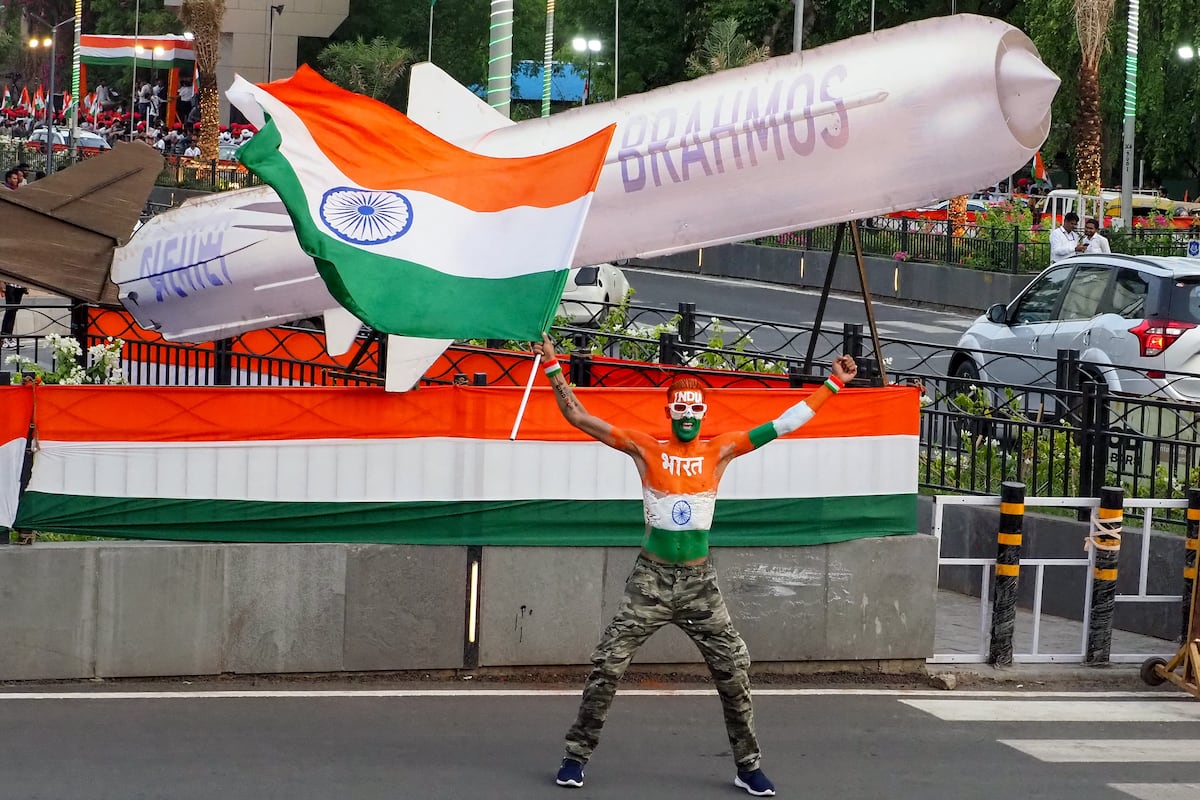
Worried by China’s growing arsenal of ballistic missiles, India is responding with a plan to create a joint rocket force that would control and expand the country’s non-nuclear missiles.
But the proposed Integrated Rocket Force, or IRF, has been beset by delays and may be outgunned by Chinese missiles.
The mismatch could place India in a dilemma: either endure Chinese missile strikes deep inside India without the ability to retaliate, or escalate to nuclear weapons.
“The IRF is aimed at addressing a conventional war-fighting asymmetry that India has against China,” Debak Das, a professor of peace and security at the Univ. of Denver, told Defense News. “Using a rocket force dedicated to conventional military action will likely allow India space to militarily engage the PLA along the LAC [Line of Actual Control, or the Sino-Indian border] without escalation to the nuclear level.”
However, the IRF – first proposed in 2021 – has yet to materialize.
“The IRF, envisioned primarily as a conventional missile force geared mostly for tactical strike missions, is still theoretical,” wrote Kartik Bommakanti, a researcher for the Observer Research Foundation, an Indian think tank.
The IRF would be a joint army-navy-air force organization that in some ways mirrors the People’s Liberation Army Rocket Force, which is a branch of the Chinese military. But unlike the PLARF, the IRF would be responsible for conventional rockets, with India’s ICBMs and IRBMs remaining under the Strategic Forces Command.
The IRF would be armed with an array of missiles, including the Brahmos cruise missile, the ship-based Long-Range Land Attack Cruise Missile, the Pinaka multiple rocket launch system, and the Pralay tactical ballistic missile. But these weapon can’t reach more than 500 kilometers, or only enough to reach the Tibet plateau and other areas close to the border.
However, China’s ballistic missiles, such as the DF-26 and DF-100, have ranges up to 2,000 kilometers.
Chinese missiles “can strike across the great depth of the Indian land mass even when launched from deep within the Chinese mainland,” Bommakanti wrote. In contrast, “most of China’s economic and industrial hubs are located in central and eastern parts of the country, which need to be rendered vulnerable with Indian missiles that have an extended range.”
Indeed, China’s arsenal of 3,500 missiles – which has surged 50% over the past four years – has emerged as one of the potent factors in Asian security. Taiwan fears a deluge of rockets if China invades, while the U.S. worries that key bases such as Guam would be devastated by missile salvoes.
For India, the question is the impact of Chinese missiles if another conflict erupts along the 2,100-mile Sino-Indian border. Conflicting territorial claims led China and India to fight a brief war in 1962 – which China won – followed most recently by border clashes in 2020 and 2022.
Amid Himalayan mountains as high as 28,000 feet, large-scale ground combat operations would be a nightmare. But as in the Ukraine war, long-range munitions can hit supply depots, headquarters, bridges, and critical infrastructure such as the electrical grid.
Bommakanti suggests that India could use the Agni-5 – a 5,000-kilometer IRBM currently assigned to India’s nuclear forces – for conventional missions, as well as developing a long-range Indian hypersonic weapon. But he argues that there needs to be an organization to coordinate Indian non-strategic missiles.
“Without an IRF, clear priorities cannot be established, and all missile capabilities related to ballistic, cruise, and hypersonic projectiles with longer ranges cannot be integrated, deployed, or launched effectively in the event of military hostilities against the PRC [People’s Republic of China].”
Still, the IRF may face problems such as rivalry between services reluctant to give up control of their missiles.
“Many of IRF’s initial assets will come from the army and air force, and there appears to be concerns among Indian defense analysts about whether IRF will only control the missiles and rockets or the launching, communication, and intelligence systems that come with them as well,” noted an essay by the Center for Strategic and International Studies, a U.S. think tank.
Either way, the prospect of two nuclear-armed powers launching missiles – even without nuclear warheads – is almost apocalyptic.
“So far, there has been no public discussion about the conventional deep strike capability against Chinese strategic infrastructure,” Das said. “The problem with adopting such a doctrine is that China could do the same against India.”
There is also the question of India’s other strategic worry: a nuclear-armed Pakistan. Though the IRF is aimed at China, it has also rattled the Pakistanis, who recently announced the creation of the Army Rocket Force. “This is a response to India’s IRF announcement,” said Das. “Islamabad will likely try to minimize any asymmetry it has with India as its conventional rocket forces mature.”
In the end, a China-India missile competition may come to an existential question: Can two nuclear powers fire conventional missiles at each other’s homeland without escalation to thermonuclear war?
“While New Delhi might hope that this [the IRF] will decrease Beijing’s appetite for low level skirmishes along the Line of Actual Control, it is not clear if this will ultimately be the case,” said Das.
“India is still a ways away from being at parity with China along some of these vectors of conventional strength. So until we see ideas like the IRF mature, it is difficult to say if they will be effective in keeping peace.”
印度对中国日益增长的弹道导弹库感到担忧,因此制定了一项计划,旨在建立一支联合火箭部队,以控制和扩大该国的非核导弹。
但拟议中的一体化火箭军(IRF)一直受到延误的困扰,并且可能在火力上逊于中国导弹。
这种实力差距可能会使印度陷入两难境地:要么忍受中国导弹袭击印度境内纵深地区而无力反击,要么升级到核武器。
“印度火箭军旨在解决印度在常规战争中对华作战能力上的不对称问题,”丹佛大学和平与安全学教授德巴克·达斯告诉《防务新闻》。“使用一支专门用于常规军事行动的火箭军,很可能使印度能够在不升级到核战争的情况下,沿实际控制线(即中印边界)与解放军进行军事交战。”
然而,IRF(最早于 2021 年提出)至今尚未实现。
“印度核力量(IRF)主要被设想为一支以战术打击任务为主的常规导弹部队,目前仍处于理论阶段,”印度智库观察家研究基金会的研究员卡尔蒂克·博马坎蒂写道。
印度火箭军(IRF)将是一个由陆军、海军和空军组成的联合部队,在某些方面类似于中国人民解放军火箭军(中国军队的一个分支)。但与解放军火箭军不同的是,印度火箭军将负责常规火箭,而印度的洲际弹道导弹和中程弹道导弹仍由战略部队司令部负责。
伊斯兰革命卫队将配备一系列导弹,包括布拉莫斯巡航导弹、舰载远程陆攻巡航导弹、皮纳卡多管火箭炮系统和普拉莱战术弹道导弹。但这些武器的射程不超过500公里,仅足以覆盖青藏高原和边境附近的其他地区。
然而,中国的弹道导弹,如东风-26和东风-100,射程可达2000公里。
博马坎蒂写道,中国导弹“即使从中国大陆纵深发射,也能打击印度广袤的陆地”。相比之下,“中国的大部分经济和工业中心都位于中部和东部地区,这些地区需要用射程更远的印度导弹才能使其变得脆弱。”
事实上,中国拥有3500枚导弹,过去四年数量激增50%,已成为亚洲安全的重要因素之一。台湾担心中国入侵后会遭到导弹袭击,而美国则担心关岛等重要基地会遭到导弹齐射的毁灭性打击。
对印度而言,问题在于如果中印2100英里长的边境再次爆发冲突,中国导弹的影响会如何。领土争端曾导致中印两国在1962年爆发短暂战争(中国获胜),此后两国又分别在2020年和2022年发生边境冲突。
在海拔高达28000英尺的喜马拉雅山脉中,大规模地面作战行动将是一场噩梦。但正如在乌克兰战争中一样,远程弹药可以击中补给站、指挥部、桥梁以及电网等关键基础设施。
博马坎蒂认为,印度可以将目前隶属于印度核力量的射程5000公里的中程弹道导弹“烈火-5”用于常规作战任务,并研发远程高超音速武器。但他认为,印度需要设立一个机构来协调其非战略导弹的研发和部署。
“如果没有综合作战框架,就无法确定明确的优先事项,而且在对中华人民共和国发生军事冲突时,所有与弹道导弹、巡航导弹和射程更远的高超音速导弹相关的导弹能力都无法得到有效整合、部署或发射。”
不过,IRF 也可能面临一些问题,例如各军种之间不愿放弃对导弹的控制权而产生的竞争。
美国智库战略与国际研究中心在一篇文章中指出:“IRF 的许多初始资产将来自陆军和空军,印度国防分析人士似乎担心 IRF 是否只会控制导弹和火箭,还是也会控制与之配套的发射、通信和情报系统。”
无论如何,两个拥有核武器的国家发射导弹——即使没有核弹头——的前景几乎是世界末日般的景象。
达斯说:“到目前为止,还没有公开讨论过针对中国战略基础设施的常规纵深打击能力。采用这种战略的问题在于,中国也可以对印度使用同样的手段。”
此外,印度还面临着另一个战略担忧:拥有核武器的巴基斯坦。尽管印度的“印度火箭军”(IRF)计划旨在应对中国,但也令巴基斯坦感到不安,巴基斯坦最近宣布组建陆军火箭军。“这是对印度宣布组建‘印度火箭军’的回应,”达斯说。“随着巴基斯坦常规火箭军的日趋成熟,伊斯兰堡可能会试图尽可能减少与印度之间的任何不对称优势。”
最终,中印导弹竞赛可能会演变成一个关乎存亡的问题:两个核大国能否在不升级为热核战争的情况下,向对方国土发射常规导弹?
达斯表示:“虽然新德里可能希望这(印巴实际控制线)能够降低北京沿实际控制线发生低级别冲突的意愿,但最终是否能达到这一目的尚不明确。”
“在某些常规实力方面,印度距离与中国并驾齐驱还有一段距离。因此,在看到像印度-俄罗斯联邦军事合作机制这样的理念成熟之前,很难说它们能否有效维护和平。”