EU rail push to eastern flank still snarled by rules: French general法国将军:欧盟铁路向东翼推进仍受规则阻碍
Military officials in Europe have struggled to cut through the red tape that hinders fast transportation of troops and equipment across the continent.
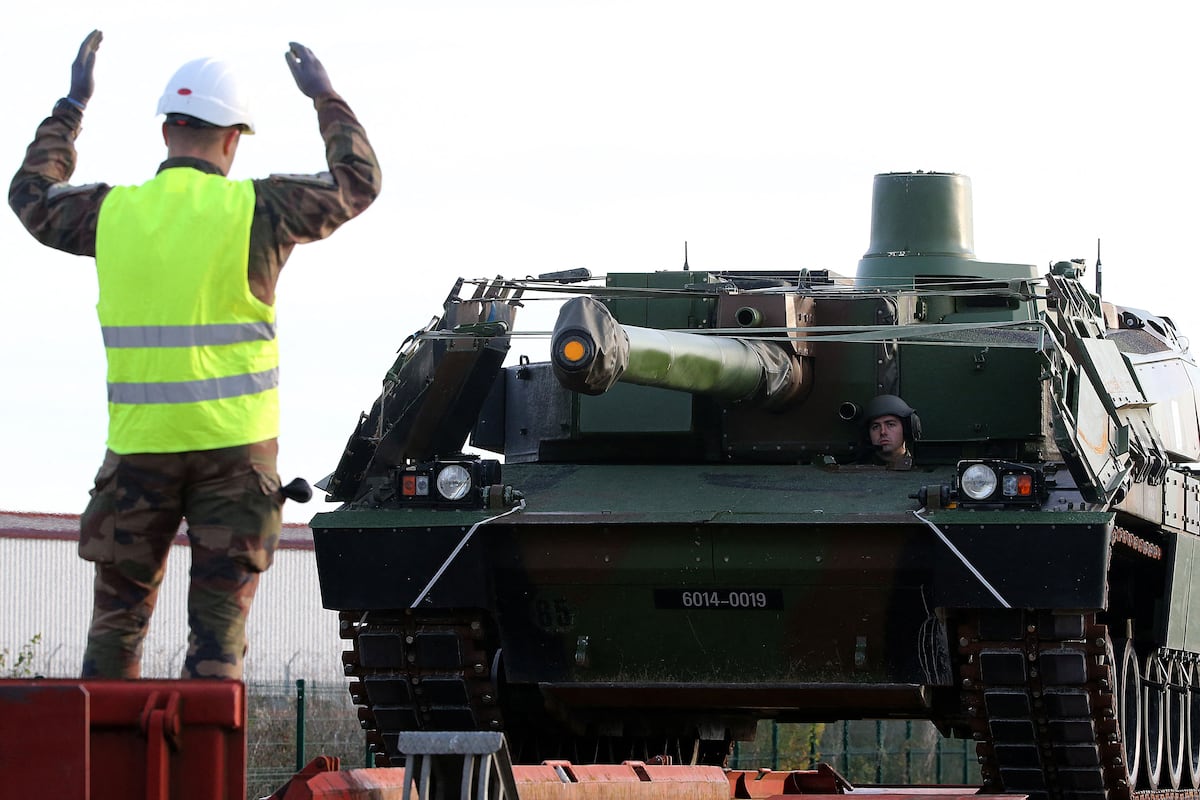
PARIS — As Russia’s war in Ukraine raises the possibility of a major deployment on NATO’s eastern flank, France continues to face bureaucratic hurdles that could slow down the rush of troops and tanks to the region, according to the French general in charge of coordinating military transport.
Obtaining approval to cross neighboring countries by military convoy today takes much longer than a European Union target of five days – “more like tens of days,” said Brig. Gen. Fabrice Feola, who commands France’s Centre for Operations and Transport Support, in a briefing here on Thursday.
The EU has vowed to address the bloc’s remaining barriers to military mobility in a regulatory proposal this year. The objective for military border-crossing procedures to take no more than five working days by the end of 2023 had “progress issues,” the European Court of Auditors wrote in a February report , with not all member countries meeting the target, and progress variable.
A conflict on NATO’s eastern front could “mobilize resources on a scale not seen in years,” Feola said. “Efforts have to be optimized to ensure continuity in projection, should we face a major engagement in the east, and in reception, particularly in our role as a host nation for allies on the Atlantic coast.”
Europe’s overground transportation network needs to mapped out better “on order to return to what we had during the Cold War,” with no doubts or ambiguity about the capability of roads and railways to handle large flows, according to the general.
A major mobilization would create competition on the ground transport network, including from the United States, “who in the event of NATO plans being activated, would land on a massive scale on the Atlantic coast and would need to cross our country to reach positions further east,” Feola said.
“This notion of competition inevitably leads us to coordinate at the international level in order to make the best possible use of the resources,” he added.
The amount of military equipment freighted across Europe jumped after Russia invaded Ukraine in 2022, with NATO countries moving troops east, stepping up exercises and sending billions of euros worth of military equipment to Ukraine. That has put new emphasis on rail as the most cost-effective and speedy means of land transport to move kit such as tanks and ammunition over long distances.
France organized around 150 international military trains in 2024, according to Feola, compared with fewer than five such trains a year before Russia invaded Ukraine. The rail transports support a French battalion deployed in Romania, and include trains heading to Poland with equipment for Ukraine at an “extremely regular interval.”
The lessons learned from France’s deployment to Romania have been “extremely valuable” for the Center for Operations and Transport Support, with force projection “on a scale rarely achieved in recent years,” Feola said.
France is one of the few European countries to own a fleet of military rail wagons, together with Germany and the Netherlands.
“Railways are an absolutely essential mode of transport, especially in a context where our center of gravity for operations has shifted from Africa to Europe, and particularly Eastern Europe,” Feola said.
One issue taking a lot of time today is checking route feasibility, for example whether a tunnel can accommodate a train carrying military equipment, Feola said. For a new set of EU military mobility rules to be unveiled this year, France is pushing to identify corridors capable of handling military vehicles and convoys, with sufficiently large and sturdy tunnels, bridges and roads.
“The solution, and this is what we are currently working on, is to set up these corridors, these train paths, to avoid excessive processing times,” Feola said.
Germany, the Netherlands and Poland signed a declaration of intent in 2024 to set up just such a corridor, with plans to tackle infrastructure choke points such as low bridges and reduce bureaucracy for cross-border transport of ammunition and other dangerous goods.
The EU is looking at simplifying procedures across the bloc, Feola said.
“Speeding up the time it takes to obtain authorization to cross territories, digitizing a number of customs documents, all of these are achievable, within reach, and the current situation further highlights the importance and necessity of resolving them in the short term,” Feola said.
While France has permanent border-crossing agreements with other European countries for a certain number of standard military convoys, those come with constraints such as the number of vehicles and whether there are weapons on board.
French logistics officials are also calling for a coordinating authority for military mobility governance in Europe that can “ensure that everything fits together from one country to another, from one corridor to another, and that there is no discontinuity between corridors and routes,” Feola said.
Rudy Ruitenberg is a Europe correspondent for Defense News. He started his career at Bloomberg News and has experience reporting on technology, commodity markets and politics.
巴黎——据负责协调军事运输的法国将军称,随着俄罗斯在乌克兰的战争增加了向北约东翼大规模部署兵力的可能性,法国继续面临官僚主义障碍,这可能会减缓部队和坦克向该地区的快速部署。
法国作战和运输支援中心指挥官法布里斯·费奥拉准将在周四的新闻发布会上表示,如今获得军事车队穿越邻国的批准所需的时间远远超过欧盟设定的五天目标——“更像是几十天”。
欧盟承诺将在今年的监管提案中解决欧盟内部军事人员流动方面仍然存在的障碍。欧洲审计院在2月份的一份报告中指出,到2023年底,军事人员过境程序不超过五个工作日的目标存在“进展问题”,并非所有成员国都达到了目标,而且进展情况也各不相同。
费奥拉表示,北约东线冲突可能会“调动多年来未见的资源”。“我们必须优化各项工作,以确保在东线遭遇重大冲突时,以及在接收方面,尤其是在我们作为大西洋沿岸盟国的东道国时,能够持续提供支援。”
这位将军表示,欧洲的地面交通网络需要更好地规划,“以便恢复到冷战时期的状态”,确保公路和铁路能够处理大量客流,这一点毋庸置疑。
费奥拉说:“大规模动员将导致地面运输网络出现竞争,包括来自美国的竞争。如果北约计划启动,美国将在大西洋沿岸大规模登陆,并且需要穿越我国才能到达更东部的阵地。”
他补充说:“这种竞争观念必然会促使我们在国际层面进行协调,以便最大限度地利用资源。”
自2022年俄罗斯入侵乌克兰以来,途经欧洲的军事装备运输量激增。北约国家向东调兵,加强军事演习,并向乌克兰输送价值数十亿欧元的军事装备。这使得铁路运输的重要性日益凸显,它成为长途运输坦克、弹药等装备最经济快捷的陆路方式。
据费奥拉称,法国在2024年组织了约150列国际军用列车,而俄罗斯入侵乌克兰之前,每年此类列车不足5列。这些铁路运输为部署在罗马尼亚的法国营提供支持,其中包括“极其频繁地”向波兰运送乌克兰所需装备的列车。
费奥拉表示,法国向罗马尼亚部署部队所吸取的经验教训对作战和运输支援中心来说“极其宝贵”,兵力投送的规模“在近年来很少能达到”。
法国是少数几个拥有军用铁路货车车队的欧洲国家之一,其他三个国家是德国和荷兰。
“铁路是一种绝对必要的运输方式,尤其是在我们的运营重心已经从非洲转移到欧洲,特别是东欧的情况下,”费奥拉说。
费奥拉表示,目前耗时最长的一项工作是核查路线可行性,例如隧道是否能够容纳运载军事装备的列车。为了配合今年即将公布的一套新的欧盟军事机动规则,法国正积极推动确定能够通行军用车辆和车队的走廊,这些走廊需要具备足够大且坚固的隧道、桥梁和道路。
费奥拉说:“解决方案,也是我们目前正在努力的方向,是建立这些走廊、这些列车线路,以避免过长的处理时间。”
德国、荷兰和波兰于 2024 年签署了一项意向声明,旨在建立这样一条走廊,计划解决低矮桥梁等基础设施瓶颈问题,并减少跨境运输弹药和其他危险品的官僚程序。
费奥拉表示,欧盟正在考虑简化整个欧盟的程序。
费奥拉表示:“加快跨境授权审批速度,将许多海关文件数字化,所有这些都是可以实现的,触手可及的,而当前形势进一步凸显了在短期内解决这些问题的重要性和必要性。”
虽然法国与其他欧洲国家就一定数量的标准军事车队签订了永久性的边境通行协议,但这些协议也存在一些限制,例如车辆数量以及车上是否载有武器。
费奥拉表示,法国后勤官员也呼吁在欧洲设立一个军事机动管理协调机构,以“确保从一个国家到另一个国家,从一个走廊到另一个走廊,一切都衔接起来,走廊和路线之间没有中断”。
鲁迪·鲁伊滕贝格是《防务新闻》的欧洲记者。他的职业生涯始于彭博新闻社,拥有报道科技、大宗商品市场和政治方面的经验。