Eyes on the Target: Seizing the Strategic Initiative Against Russia目光锁定目标:掌握对俄战略主动权
The United States and Europe risk squandering the best opportunity since 2022 to alter Russia’s trajectory toward a longer and larger war.
The United States and Europe risk squandering the best opportunity since 2022 to alter Russia’s trajectory toward a longer and larger war. Ukraine currently has the best chance of seizing the strategic initiative against Russia since December 2022, while simultaneously facing the greatest risk to its momentum. Russia’s ballistic missile and jet-powered drone campaign against Ukraine, alongside its growing kinetic attacks against NATO states, aims to drive Ukraine and its allies into a reactive stance and distract them from seizing a hard-won opportunity to hold the strategic initiative against Russia. The Kremlin’s offer to supply diesel to global markets is a cognitive warfare effort that similarly aims to disrupt the momentum of the effective pressure campaign against Russia’s energy sector. The Kremlin, unlike the United States and Ukraine’s other partners, recognizes that Russia is critically vulnerable to initiative, momentum, and sustained pressure.[1] The Kremlin is vigilant about Ukraine and its partners holding the initiative and seeks to deter and disrupt it at all costs.[2] The United States and Europe can either deny the Kremlin’s strategy or risk a greater war with greater escalation risks.
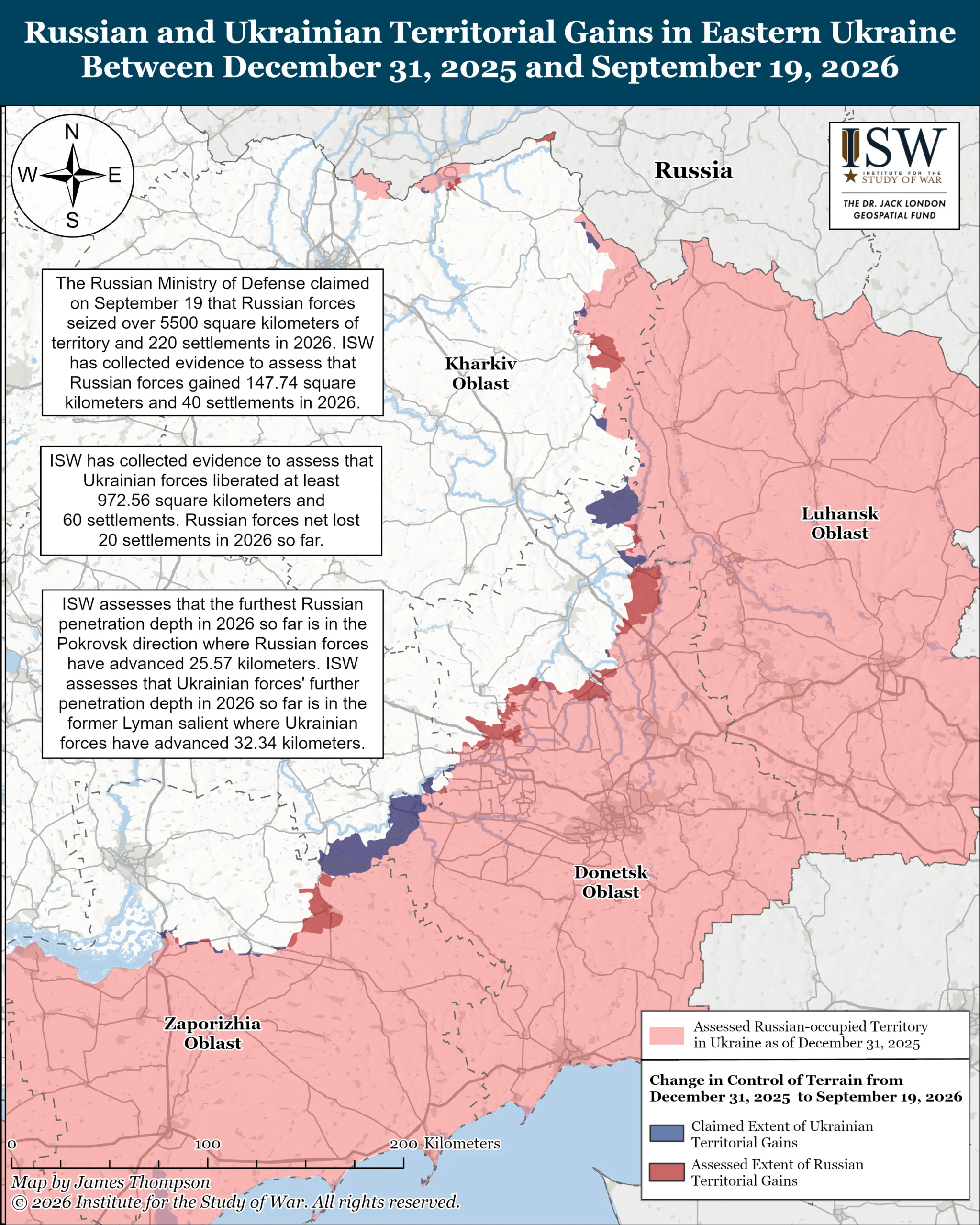
Ukraine has regained the operational initiative on most key battlefield directions and has been contesting Russia’s strategic initiative since late 2025 . Ukraine has slowed Russian battlefield advances to a footpace in 2026 and has grown the already staggering human cost of the Russian advance.[3] Ukraine has retaken significant territory from Russia in 2026, and at the theater level has nearly zeroed out Russian gains for the year. ISW has observed evidence to assess that Russian forces have only made a net gain of about 100 square kilometers thus far in 2026 thanks to Ukrainian counteroffensives, which have liberated at least 1,046 square kilometers, for example. The daily Russian net rate of advance in 2026 is so far less than a square kilometer per day — literal footpace. Russia’s summer offensive has failed.[4] Russia’s fall offensive is likely to fail as well. Russian President Vladimir Putin has failed to accomplish any of his stated war aims in Ukraine to date. Putin did not force the Ukrainian government to capitulate, nor did he destroy the Ukrainian military. Russia is nowhere close to taking the rest of the Donetsk region, including the Fortress Belt – one of Putin’s stated war aims.[5] Ukraine has forced the Kremlin to confront dilemmas inside of Russia that would have been unthinkable not long ago. Ukraine’s deep strike campaign has triggered fuel shortages in Russia, degrading at least 30 percent of its refining capacity, and forced Moscow to choose which infrastructure to protect with air defense assets.[6] Ukrainian advances and strikes are challenging Putin’s promises of Russia’s economic stability, security, and greatness.[7]
Ukraine’s 2026 battlefield progress is not transient or accidental — it is a result of Ukraine’s maturing warfighting capabilities and military transformation that occurred over 2025 and 2026.[8] Ukraine has significantly grown its intermediate-range and deep-strike campaigns, expanded military production, matured operational art concepts, and is increasingly focused on the long-term warfighting strategy.[9] Ukraine is working on its ballistic missile program, which, if successful, will put key Russian defense industrial and military infrastructure at even greater risk.[10]
The design of Russia’s 2026 strategic bombing campaign against Ukraine, coupled with its intensifying attacks against other European states, seeks to in part overshadow Ukraine’s hard-won gains and force Ukraine and its partners into a reactive posture. Russia has surged its strategic bombing of Ukraine each fall and winter since 2022 — efforts that have failed to break Ukraine’s will or capability to fight . [11] The design of Russia’s 2026 strategic bombing campaign seeks to inflict maximum terror and civilian harm by exploiting the gap in Ukraine’s ability to counter jet-powered drones and ballistic missiles. First, the Kremlin aims to make major Ukrainian cities unlivable through sustained daytime and nighttime strikes on civilian infrastructure, such as post distribution centers or bridges.[12] Second, the Kremlin is targeting major cities to drive distrust in Ukraine’s authorities and drive a wedge between the frontline and the rear.[13] Third, Russia likely seeks to impose resourcing dilemmas on Ukraine, forcing Ukrainian forces to balance the use of mid- and long-range systems to suppress targets enabling Russia’s strategic bombing campaign and using those systems in support of Ukraine’s frontline requirements. Fourth, Russia is attempting to isolate Ukraine from European support by increasingly targeting logistics and transportation in and out of Ukraine. Russia’s growing attacks against NATO states, which include drone and missile incursions, sabotage, arson, and assassinations, seek to force the alliance into a reactive stance and drive false dilemmas for the resurging European defense industry between supporting Ukraine and preparing for a potential Russian escalation.[14] These attacks also support Putin’s long-standing aim of neutralizing NATO as an effective alliance.
Russia’s cognitive warfare effort aims to disrupt the success of Ukraine and its partners’ sustained pressure against Russia’s critical war capability — its energy sector. Russia’s energy sector is vital to the Kremlin’s ability to fund the war.[15] Ukraine’s sustained strikes and Western economic pressure on Russia’s energy sector have been driving severe fuel shortages in Russia, in turn forcing Putin to make hard choices. The Kremlin, for example, started to buy refined fuel from India, thereby sustaining additional costs.[16] The Russian Ministry of Finance announced its intent to increase its purchase of foreign currency and gold between October 7 and November 6, 2026 amid declining energy export revenues . [17] It is precisely because the pressure strategy is working that the Kremlin seeks to disrupt it — including by offering to export insignificant quantities of diesel to the global markets in exchange for sanctions relief.[18]
Ukraine’s partners must learn what is arguably the most important lesson from this war – recognizing (and denying) the Kremlin’s strategy of disrupting Ukraine’s and its partners’ initiative . Russia has undermined Ukraine’s and Western initiative in the past by manipulating Western decision-making. The Kremlin invoked nuclear blackmail during Ukraine’s counteroffensive in Kharkiv Oblast and in Kherson in Fall 2022.[19] The Kremlin’s cognitive warfare effort at the time negatively shaped Ukraine’s allies’ decision about supplying Ukraine with military equipment and prevented Ukrainian forces from imposing additional defeats on Russian forces, disrupting Ukraine’s momentum and prolonging the war.[20]
Russia seeks to keep Ukraine and its allies in a reactive stance, focused on discussing tactics rather than developing a strategy. Russia is trying to create new dilemmas to force Ukraine and its allies to respond to exigent threats and crises, for example jet-powered drones or offers of cooperation — like the Kremlin’s energy deal — to undermine Ukraine and the West’s proactive and sustained campaigns.
Ukraine’s allies must prevent Russia from once again disrupting Ukraine’s battlefield momentum and help Ukraine seize and hold the strategic initiative against Russia — as Russia’s strategic bombing campaign against Ukraine becomes more brutal alongside Russia’s kinetic attacks against Europe. Most immediately, Ukraine’s partners must help accelerate the scaling of countermeasures to Russian jet-powered drones, recognizing that this capability makes Russia’s 2026 strategic bombing campaign particularly dangerous due to the systems’ effectiveness against dynamic targets, including those deep in Ukraine’s rear.[21]
Ukraine’s partners must proactively resource Ukraine’s battlefield momentum. Momentum requires resourcing and planning. The European Union’s release of its loan to Ukraine should avoid repeating the incrementalism patterns in delivery of Western military aid that allowed Russia to prolong the war in the first place.[22] European funding needs to support Ukraine’s military leadership’s ability to plan simultaneous and successive operations well into the next year in order to sustain and grow the effects of Ukraine’s 2026 progress in its ground war .
The United States and Europe must proactively resource Ukraine’s deep strike campaign against Russia’s defense industrial and energy sectors by increasing sanctions on Russia’s energy sector and helping accelerate the growth of Ukraine’s deep strike capability.
Europe must finally develop measures to deter Russia from conducting attacks against its territory. For example, Europe must prioritize denying Russia the ability to conduct sabotage operations or drone incursions. Russia feels comfortable accepting higher risks associated with such attacks, largely because it does not perceive European or NATO response as a meaningful deterrent.[23] NATO and Europe must therefore consider deterrents for emergent risks that are short of a traditional ground attack to regain the initiative against Russia.
[1] https://understandingwar.org/research/russia-ukraine/seizing-the-initiative-against-russia-putting-the-united-states-in-control-2/ [2] https://understandingwar.org/research/russia-ukraine/seizing-the-initiative-against-russia-putting-the-united-states-in-control-2/ [3] https://understandingwar.org/research/russia-ukraine/russian-offensive-campaign-assessment-september-2-2026/ [4] https://understandingwar.org/research/russia-ukraine/ukraine-disrupts-russias-donetsk-offensive/ [5] https://understandingwar.org/research/russia-ukraine/ukraine-disrupts-russias-donetsk-offensive/ [6] https://apnews.com/article/russia-ukraine-war-oil-strikes-48793b176934f0516b7402c8706a421a ; https://understandingwar.org/research/russia-ukraine/gasoline-shortages-in-occupied-ukraine-show-the-synergy-of-ukraines-long-range-and-mid-range-strike-campaigns/ ; https://understandingwar.org/research/russia-ukraine/russian-offensive-campaign-assessment-june-22-2026/ [7] https://understandingwar.org/wp-content/uploads/2025/04/Putin27s20Offset20The20Kremlin27s20Geopolitical20Adaptations20Since202014.pdf [8] https://understandingwar.org/research/russia-ukraine/ukraines-intermediate-range-strike-campaign-and-new-mechanized-attacks-herald-the-start-of-a-new-phase-of-the-war/ [9] https://understandingwar.org/research/russia-ukraine/ukraines-intermediate-range-strike-campaign-and-new-mechanized-attacks-herald-the-start-of-a-new-phase-of-the-war/; https://understandingwar.org/research/russia-ukraine/gasoline-shortages-in-occupied-ukraine-show-the-synergy-of-ukraines-long-range-and-mid-range-strike-campaigns/; http://mod.gov.ua/en/news/war-plan-our-steps-to-force-russia-into-peace [10] https://www.nytimes.com/2026/10/02/world/europe/ukraine-ballistic-missile-fp-7.html [11] https://understandingwar.org/research/russia-ukraine/russian-offensive-campaign-assessment_2-21/ ; https://understandingwar.org/research/russia-ukraine/russian-offensive-campaign-assessment_29-21/ ; https://understandingwar.org/research/russia-ukraine/russian-offensive-campaign-assessment-september-20-2025/ ; https://understandingwar.org/research/russia-ukraine/russian-offensive-campaign-assessment-october-4-2025/ ; https://understandingwar.org/research/russia-ukraine/russian-offensive-campaign-assessment-august-30-2026/ ; [12] https://understandingwar.org/research/russia-ukraine/russian-offensive-campaign-assessment-october-6-2026/ ; https://understandingwar.org/research/russia-ukraine/russian-offensive-campaign-assessment-september-24-2026/ ; https://understandingwar.org/research/russia-ukraine/russian-offensive-campaign-assessment-august-5-2026/ ; https://understandingwar.org/research/russia-ukraine/russian-offensive-campaign-assessment-june-21-2026/ ; https://understandingwar.org/research/russia-ukraine/russian-offensive-campaign-assessment-june-20-2026/ [13] https://understandingwar.org/research/russia-ukraine/russian-offensive-campaign-assessment-october-2-2026/ [14] https://understandingwar.org/research/russia-ukraine/russian-offensive-campaign-assessment-september-1-2026/ ; https://understandingwar.org/research/russia-ukraine/russian-offensive-campaign-assessment-october-2-2025/ ; https://understandingwar.org/research/russia-ukraine/russian-offensive-campaign-assessment_23-7/ [15] https://www.cbsnews.com/news/sanctions-choked-russia-oil-industry-a-key-source-of-kremlin-funds/ [16] https://www.reuters.com/business/energy/russia-buys-gasoline-india-tackle-shortages-sources-say-2026-07-01/ [17] https://understandingwar.org/research/russia-ukraine/russian-offensive-campaign-assessment-october-6-2026/ [18] https://www.reuters.com/business/energy/russia-says-it-may-export-up-35-million-tons-diesel-month-by-year-end-2026-10-12/ [19] https://understandingwar.org/research/cognitive-warfare/a-primer-on-russian-cognitive-warfare/; https://understandingwar.org/research/russia-ukraine/russian-offensive-campaign-assessment_6-25/ [20] https://understandingwar.org/research/cognitive-warfare/a-primer-on-russian-cognitive-warfare/ [21] https://understandingwar.org/research/russia-ukraine/russian-offensive-campaign-assessment-october-7-2026/ ; https://understandingwar.org/research/russia-ukraine/russian-offensive-campaign-assessment-october-2-2026/ ; https://understandingwar.org/research/russia-ukraine/russian-offensive-campaign-assessment-september-27-2026/ [22] https://www.criticalthreats.org/analysis/russian-offensive-campaign-assessment-january-29-2023 [23] https://understandingwar.org/research/defense-of-europe/the-russian-military-forecasting-the-threat/
美国和欧洲有可能错失自2022年以来改变俄罗斯走向旷日持久且规模更大的战争的最佳契机。乌克兰目前拥有自2022年12月以来夺取对俄战略主动权的最佳机会,但同时也面临着最大风险。俄罗斯针对乌克兰的弹道导弹和喷气式无人机行动,以及其日益频繁地对北约国家发动军事打击,旨在迫使乌克兰及其盟友采取被动应对的姿态,并分散他们的注意力,使其无法抓住来之不易的、对俄战略主动权的良机。克里姆林宫向全球市场供应柴油的提议,同样是一种认知战策略,其目的在于扰乱针对俄罗斯能源部门的有效施压行动的势头。与美国和乌克兰的其他伙伴不同,克里姆林宫认识到,俄罗斯极易受到主动权、势头和持续压力的影响。[1] 克里姆林宫对乌克兰及其伙伴掌握主动权保持警惕,并竭尽全力阻止和破坏这种局面。[2]美国和欧洲要么拒绝克里姆林宫的战略,要么冒着爆发更大规模战争、局势升级风险更大的风险。
乌克兰已在大多数关键战场方向上重新掌握了作战主动权,并自2025年末以来一直在与俄罗斯的战略主动权抗衡。乌克兰已将俄罗斯在2026年的战场推进速度减缓至步行速度,并加剧了俄罗斯推进行动中本已惊人的人员伤亡。[3] 乌克兰在2026年从俄罗斯手中夺回了大片领土,并在战区层面几乎完全抵消了俄罗斯当年的战果。据ISW观察,有证据表明,由于乌克兰的反攻(例如,乌克兰已解放至少1046平方公里),俄罗斯军队在2026年迄今为止仅净增约100平方公里。俄罗斯在2026年的日均净推进速度迄今为止不足1平方公里——真的是步行速度。俄罗斯的夏季攻势已经失败。[4] 俄罗斯的秋季攻势也可能失败。迄今为止,俄罗斯总统弗拉基米尔·普京在乌克兰的既定战争目标均未实现。普京既没有迫使乌克兰政府投降,也没有摧毁乌克兰军队。俄罗斯距离占领顿涅茨克地区的其余部分,包括普京公开宣称的战争目标之一——“堡垒带”——还相去甚远。[5] 乌克兰迫使克里姆林宫面对俄罗斯国内一些不久前还难以想象的困境。乌克兰的纵深打击行动导致俄罗斯燃料短缺,炼油能力至少下降了30%,迫使莫斯科在防空力量的保护范围上做出选择。[6] 乌克兰的推进和打击行动正在挑战普京关于俄罗斯经济稳定、安全和强大的承诺。[7]
乌克兰在2026年战场上取得的进展并非短暂或偶然,而是乌克兰在2025年和2026年期间作战能力日趋成熟和军事转型的结果。[8] 乌克兰显著增强了其中程和纵深打击能力,扩大了军事生产,完善了作战艺术概念,并日益注重长期作战战略。[9] 乌克兰正在推进其弹道导弹计划,如果成功,将使俄罗斯关键的国防工业和军事基础设施面临更大的风险。[10]
俄罗斯针对乌克兰的2026年战略轰炸行动,以及其对其他欧洲国家日益频繁的袭击,其目的在于部分掩盖乌克兰来之不易的成果,并迫使乌克兰及其盟友陷入被动防御。自2022年以来,俄罗斯每年秋冬季都会加大对乌克兰的战略轰炸力度,但这些努力未能动摇乌克兰的意志和战斗能力。[11] 俄罗斯2026年战略轰炸行动旨在利用乌克兰在应对喷气式无人机和弹道导弹方面的能力不足,最大限度地制造恐怖袭击并造成平民伤亡。首先,克里姆林宫的目标是通过持续的昼夜轰炸,破坏乌克兰主要城市的民用基础设施,例如邮政配送中心或桥梁,使这些城市变得不适宜居住。[12] 其次,克里姆林宫以主要城市为目标,旨在加剧民众对乌克兰当局的不信任,并在前线和后方之间制造隔阂。[13]第三,俄罗斯可能试图在资源方面给乌克兰制造困境,迫使乌克兰军队在利用中远程武器系统压制目标(以支持俄罗斯的战略轰炸行动)和利用这些系统支援乌克兰前线作战之间取得平衡。第四,俄罗斯正试图通过日益频繁地攻击进出乌克兰的后勤和运输,来孤立乌克兰,使其无法获得欧洲的支持。俄罗斯对北约国家的袭击日益增多,包括无人机和导弹入侵、破坏、纵火和暗杀,其目的是迫使北约采取被动应对的姿态,并给正在复兴的欧洲国防工业制造一种虚假的两难困境:一方面支持乌克兰,另一方面为应对俄罗斯可能采取的升级行动做好准备。[14] 这些袭击也符合普京长期以来削弱北约作为有效联盟的目标。
俄罗斯的认知战旨在破坏乌克兰及其盟友对俄罗斯关键战争能力——能源部门——持续施压的成效。俄罗斯的能源部门对克里姆林宫的战争资金来源至关重要。[15] 乌克兰持续的打击以及西方对俄罗斯能源部门的经济压力导致俄罗斯燃料严重短缺,迫使普京做出艰难抉择。例如,克里姆林宫开始从印度购买成品油,从而增加了成本。[16] 俄罗斯财政部宣布,鉴于能源出口收入下降,计划在2026年10月7日至11月6日期间增加外汇和黄金的购买量。[17] 正因为施压策略奏效,克里姆林宫才试图破坏它——包括提出向全球市场出口少量柴油以换取制裁的解除。[18]
乌克兰的伙伴必须吸取这场战争中最重要的一课——认清(并否认)克里姆林宫破坏乌克兰及其伙伴主动性的战略。俄罗斯过去曾通过操纵西方决策来削弱乌克兰和西方的主动性。2022年秋季,在乌克兰于哈尔科夫州和赫尔松发起的反攻中,克里姆林宫动用了核讹诈。[19] 当时,克里姆林宫的认知战策略对乌克兰盟友向乌克兰提供军事装备的决定产生了负面影响,并阻止了乌克兰军队对俄军造成更多打击,从而削弱了乌克兰的攻势,延长了战争。[20]
俄罗斯试图让乌克兰及其盟友保持被动姿态,专注于讨论战术而非制定战略。俄罗斯正试图制造新的困境,迫使乌克兰及其盟友应对紧急威胁和危机,例如使用喷气式无人机或提供合作机会(如克里姆林宫的能源协议),以削弱乌克兰和西方积极主动且持续的行动。
乌克兰的盟友必须阻止俄罗斯再次破坏乌克兰的战场势头,并帮助乌克兰夺取并保持对俄战略主动权——因为俄罗斯对乌克兰的战略轰炸行动以及其对欧洲的军事打击都变得更加残酷。当务之急是,乌克兰的伙伴必须帮助加快应对俄罗斯喷气式无人机的反制措施的规模,因为他们认识到,由于这些系统对动态目标(包括深入乌克兰后方的目标)的有效性,俄罗斯2026年的战略轰炸行动将尤其危险。[21]
乌克兰的合作伙伴必须积极主动地为乌克兰的战场优势提供资源。优势需要资源和规划。欧盟向乌克兰发放贷款时,应避免重蹈覆辙,不再像以往那样在提供西方军事援助方面采取渐进式的模式,正是这种模式使得俄罗斯得以延长战争。[22] 欧洲的资金需要支持乌克兰军方领导层规划未来一年内同时开展的连续作战行动的能力,以维持并扩大乌克兰在2026年地面战争中取得的进展。
美国和欧洲必须积极为乌克兰针对俄罗斯国防工业和能源部门的纵深打击行动提供资源,具体措施包括加大对俄罗斯能源部门的制裁力度,并帮助加快乌克兰纵深打击能力的提升。
欧洲最终必须制定措施,阻止俄罗斯对其领土发动袭击。例如,欧洲必须优先阻止俄罗斯进行破坏行动或无人机入侵。俄罗斯乐于承担此类袭击带来的更高风险,主要是因为它认为欧洲或北约的应对措施不足以构成有效的威慑。[23] 因此,北约和欧洲必须考虑针对新兴风险的威慑手段,这些手段无需采取传统的地面攻击,即可重新掌握对俄行动的主动权。
[1] https://understandingwar.org/research/russia-ukraine/seizing-the-initiative-against-russia-putting-the-united-states-in-control-2/ [2] https://understandingwar.org/research/russia-ukraine/seizing-the-initiative-against-russia-putting-the-united-states-in-control-2/ [3] https://understandingwar.org/research/russia-ukraine/russian-offensive-campaign-assessment-september-2-2026/ [4] https://understandingwar.org/research/russia-ukraine/ukraine-disrupts-russias-donetsk-offensive/ [5] https://understandingwar.org/research/russia-ukraine/ukraine-disrupts-russias-donetsk-offensive/ [6] https://apnews.com/article/russia-ukraine-war-oil-strikes-48793b176934f0516b7402c8706a421a ; https://understandingwar.org/research/russia-ukraine/gasoline-shortages-in-occupied-ukraine-show-the-synergy-of-ukraines-long-range-and-mid-range-strike-campaigns/ ; https://understandingwar.org/research/russia-ukraine/russian-offensive-campaign-assessment-june-22-2026/ [7] https://understandingwar.org/wp-content/uploads/2025/04/Putin27s20Offset20The20Kremlin27s20Geopolitical20Adaptations20Since202014.pdf [8] https://understandingwar.org/research/russia-ukraine/ukraines-intermediate-range-strike-campaign-and-new-mechanized-attacks-herald-the-start-of-a-new-phase-of-the-war/ [9] https://understandingwar.org/research/russia-ukraine/ukraines-intermediate-range-strike-campaign-and-new-mechanized-attacks-herald-the-start-of-a-new-phase-of-the-war/; https://understandingwar.org/research/russia-ukraine/gasoline-shortages-in-occupied-ukraine-show-the-synergy-of-ukraines-long-range-and-mid-range-strike-campaigns/; http://mod.gov.ua/en/news/war-plan-our-steps-to-force-russia-into-peace [10] https://www.nytimes.com/2026/10/02/world/europe/ukraine-ballistic-missile-fp-7.html [11] https://understandingwar.org/research/russia-ukraine/russian-offensive-campaign-assessment_2-21/ ; https://understandingwar.org/research/russia-ukraine/russian-offensive-campaign-assessment_29-21/ ; https://understandingwar.org/research/russia-ukraine/russian-offensive-campaign-assessment-september-20-2025/ ; https://understandingwar.org/research/russia-ukraine/russian-offensive-campaign-assessment-october-4-2025/;https://understandingwar.org/research/russia-ukraine/russian-offensive-campaign-assessment-august-30-2026/;[12] https://understandingwar.org/research/russia-ukraine/russian-offensive-campaign-assessment-october-6-2026/;https://understandingwar.org/research/russia-ukraine/russian-offensive-campaign-assessment-september-24-2026/; https://understandingwar.org/research/russia-ukraine/russian-offensive-campaign-assessment-august-5-2026/;https://understandingwar.org/research/russia-ukraine/russian-offensive-campaign-assessment-june-21-2026/;https://understandingwar.org/research/russia-ukraine/russian-offensive-campaign-assessment-june-20-2026/ [13] https://understandingwar.org/research/russia-ukraine/russian-offensive-campaign-assessment-october-2-2026/ [14] https://understandingwar.org/research/russia-ukraine/russian-offensive-campaign-assessment-september-1-2026/; https://understandingwar.org/research/russia-ukraine/russian-offensive-campaign-assessment-october-2-2025/ ; https://understandingwar.org/research/russia-ukraine/russian-offensive-campaign-assessment_23-7/ [15] https://www.cbsnews.com/news/sanctions-choked-russia-oil-industry-a-key-source-of-kremlin-funds/ [16] https://www.reuters.com/business/energy/russia-buys-gasoline-india-tackle-shortages-sources-say-2026-07-01/ [17] https://understandingwar.org/research/russia-ukraine/russian-offensive-campaign-assessment-october-6-2026/ [18] https://www.reuters.com/business/energy/russia-says-it-may-export-up-35-million-tons-diesel-month-by-year-end-2026-10-12/ [19] https://understandingwar.org/research/cognitive-warfare/a-primer-on-russian-cognitive-warfare/; https://understandingwar.org/research/russia-ukraine/russian-offensive-campaign-assessment_6-25/ [20] https://understandingwar.org/research/cognitive-warfare/a-primer-on-russian-cognitive-warfare/ [21] https://understandingwar.org/research/russia-ukraine/russian-offensive-campaign-assessment-october-7-2026/ ; https://understandingwar.org/research/russia-ukraine/russian-offensive-campaign-assessment-october-2-2026/;https://understandingwar.org/research/russia-ukraine/russian-offensive-campaign-assessment-september-27-2026/ [22] https://www.criticalthreats.org/analysis/russian-offensive-campaign-assessment-january-29-2023 [23] https://understandingwar.org/research/defense-of-europe/the-russian-military-forecasting-the-threat/