Ukrainian leaders find lessons in Trump’s daring Venezuela raid乌克兰领导人从特朗普大胆入侵委内瑞拉的行动中汲取教训
Ukrainian President Volodymyr Zelenskyy dared the West to act against the Kremlin in his speech on Thursday at the World Economic Forum in Davos.
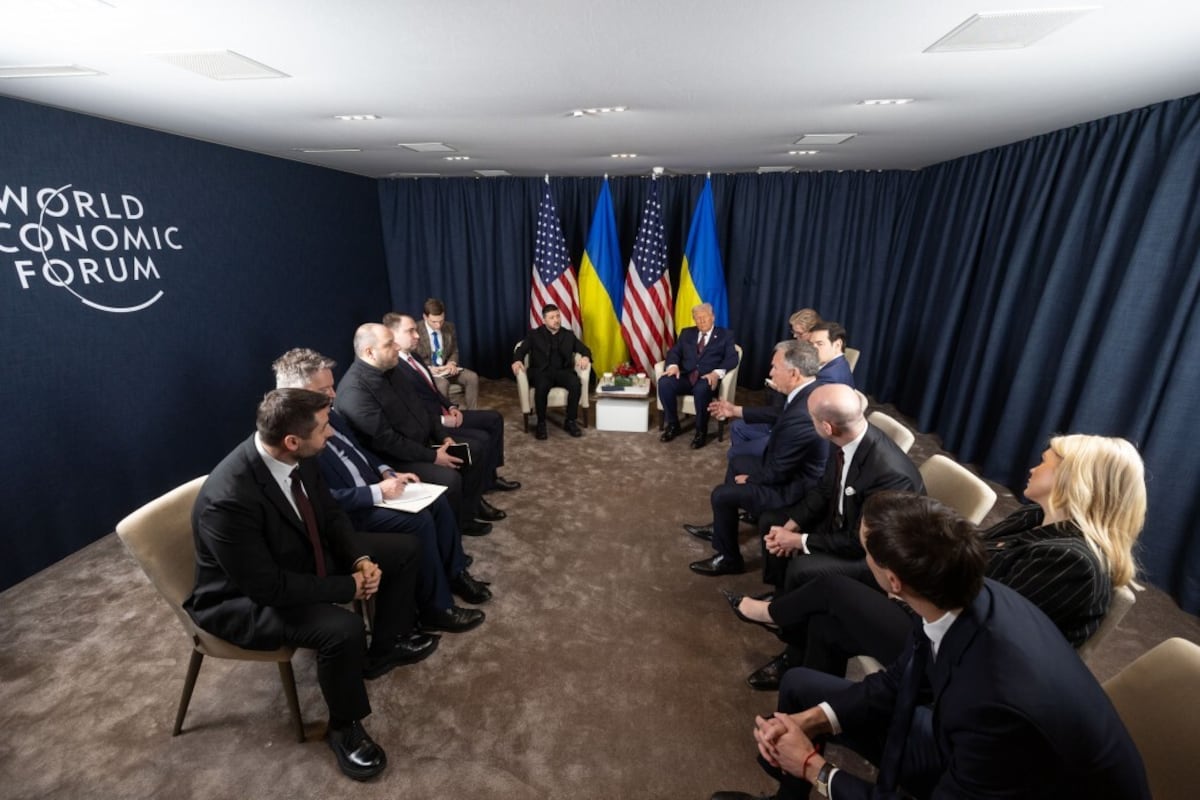
KYIV, Ukraine — As U.S. President Donald Trump started the new year by flaunting American military power in Venezuela, the episode has left Ukrainian officials wondering whether Washington would exhibit a similar brand of decisiveness in 2026 to end Russian attacks on Ukraine.
The Jan.3 U.S. raid to capture Venezuelan strongman president Nicolás Maduro was over before dawn, drawing praise from military leaders in Washington for its flawless execution.
Ukrainian President Volodymyr Zelenskyy watched from Kyiv and didn’t bother to hide the message Ukrainians heard.
“If you can do that with dictators,” Zelenskyy told reporters later, “then the United States knows what to do next.”
He again dared the West to act against the Kremlin in his speech on Thursday at the World Economic Forum in Davos, where he said: “Maduro is on trial in New York. Sorry, but Putin is not.”
Trump’s decision to snatch Maduro and intercept Venezuelan tankers is the decisive power Ukrainians once hoped he’d use against Russia — and the sphere-of-influence move that makes them wonder how fast any U.S.-drafted peace deal could shift under their feet.
Retired U.S. Army Lt. Gen. Ben Hodges has been arguing for months that Washington has been underselling its sway with Russia.
Hodges commanded U.S. Army Europe from 2014 to 2017 — through Russia’s first invasion of Ukraine and the start of the war in Donbas — and has since become one of NATO’s sharpest critics of Western hesitation.
“President Trump has enormous leverage over Russia,” Hodges told Military Times. “He just has never used it.”
“American dominance in the Western Hemisphere will never be questioned again,” Trump declared in a White House statement on Jan. 3. “We’re going to run the country,” he said, referring to Venezuela, according to NPR .
Moscow seemed to know what was coming. Kremlin officials began evacuating the families of Russian diplomats in Venezuela days before the U.S. launched its attack, the AP reported on Dec. 23. The Russian Ministry of Foreign Affairs later denied in an X post that it was sending its representatives home, but did not address whether diplomats’ families had been asked to leave.
The Kremlin had advance warning — and didn’t seem to warn Maduro or take any serious defensive action. Putin’s foreign ministry protested after the fact; Putin himself stayed silent.
At the same time, the domestic pushback to Trump’s attack on the oil-rich South American nation has been fierce, even among some in his own party.
“Bombing another nation’s capital and ousting their leader constitutes an act of war, plain and simple,” said Sen. Rand Paul, per CNBC . “The Constitution does not grant such authority to the presidency.”
But Trump has kept going.
Vice President JD Vance announced on Fox News that the U.S. now “controls the energy resources” of Venezuela and tells the regime what oil it can sell so long as it serves “America’s national interest.”
White House Press Secretary Karoline Leavitt declared that Venezuelan authorities’ decisions would “continue to be dictated by the United States of America,” Euronews reported.
Venezuela proved Trump could move fast, confront Moscow, and bulldoze Congress when he wants to. For officials across Europe and Ukraine, it confirmed what Hodges had warned: Trump has the leverage. He just hasn’t decided Kyiv is worth using it.
What this means for Kyiv
Analysts at Chatham House warned that allies “will be far from reassured,” noting Trump’s “willingness – indeed, as displayed during his press conference, exhilaration – to use US military power is clear.” Experts at the Brookings Institution put it more bluntly: “Ukrainians are likely watching in grim recognition” of how little leverage they have when Washington decides to move.
Meanwhile, earlier this month French President Emmanuel Macron gave voice to the fear that global norms are beginning to crumble. In his annual address to French ambassadors, he warned that the United States was “breaking free from international rules” and “gradually turning away” from its allies.
“We are living in a world of great powers,” Macron said, “with a real temptation to divide up the world,” according to France 24 .
Days earlier, Macron had convened 35 participants in Paris to address the messy peace negotiations — including ceasefire monitoring, armed forces support, and long-term defense cooperation.
Instead of Secretary of State Marc Rubio, Trump sent Steve Witkoff, his special envoy and longtime real estate friend with no diplomatic experience, and son-in-law Jared Kushner.
For Kyiv, it was a signal: Venezuela has the secretary of state’s attention. Ukraine gets the B-team.
Ukrainians are watching the new dynamics closely. In December polling by the Kyiv International Institute of Sociology , only 21% of Ukrainians said they trusted the United States — down from 41% in December 2024. Distrust rose from 24% to 48%. The phrase that kept surfacing in interviews: “bargaining chip.”
A senior European diplomat with knowledge of the peace negotiations, who spoke on condition of anonymity, said there is a bigger picture at play for American leaders.
“Trump doesn’t see Ukraine in isolation,” the diplomat told Military Times. “He sees it as one lever among many — from sanctions to oil to troop deployments — and that is terrifying if you live inside the theater he is trading over.”
Where this is heading
“It’s a shame that the erstwhile leader of the free world has decided to withdraw to the Western Hemisphere when our European allies are facing the greatest security threat since World War II,” Ian Kelly, who served as U.S. ambassador to Georgia and the Organization for Security and Cooperation in Europe, told Military Times.
“But that’s the world Europe has now. It’s not the world they want, but it’s the world they’re dealing with.”
Zelenskyy seems to agree. Days after Caracas, he offered a dare to the newly war-ready American president: If Trump could topple a dictator in 90 minutes, when would that firepower point east?
“Let them carry out some operation against Kadyrov, this murderer,” Zelenskyy said, Ukrainska Pravda reported. Ramzan Kadyrov, the Chechen strongman who has ruled the republic since 2007 with Putin’s blessing, commands forces accused of war crimes in Ukraine and runs what human rights groups call a personal fiefdom built on torture and disappearances.
“Maybe Putin will see that and stop to think.”
乌克兰基辅——美国总统唐纳德·特朗普在新的一年伊始便在委内瑞拉炫耀美国军事力量,这一事件让乌克兰官员不禁质疑,华盛顿是否会在2026年展现出类似的果断,以结束俄罗斯对乌克兰的袭击。
1月3日,美国突袭委内瑞拉强人总统尼古拉斯·马杜罗的行动在黎明前结束,华盛顿的军方领导人称赞此次行动执行得完美无瑕。
乌克兰总统泽连斯基在基辅关注着事态发展,并没有费心掩饰乌克兰民众听到的信息。
“如果对付独裁者都能做到这一点,”泽连斯基后来告诉记者,“那么美国就知道下一步该怎么做了。”
周四在达沃斯世界经济论坛上,他再次向西方发出挑战,要求其对克里姆林宫采取行动。他在演讲中说:“马杜罗正在纽约受审。抱歉,但普京没有。”
特朗普决定逮捕马杜罗并拦截委内瑞拉油轮,这是乌克兰人曾经希望他用来对抗俄罗斯的决定性力量——也是美国势力范围扩张的举动,这让他们不禁怀疑,任何由美国起草的和平协议都可能在他们脚下迅速瓦解。
美国陆军退役中将本·霍奇斯几个月来一直认为,华盛顿低估了其对俄罗斯的影响力。
霍奇斯在 2014 年至 2017 年期间担任美国陆军欧洲司令部司令,经历了俄罗斯首次入侵乌克兰和顿巴斯战争的开始,此后成为北约对西方犹豫不决最尖锐的批评者之一。
霍奇斯告诉《军事时报》:“特朗普总统对俄罗斯拥有巨大的影响力,但他从未动用过。”
1月3日,特朗普在白宫发表声明称:“美国在西半球的主导地位将永远不会再受到质疑。”据美国国家公共电台报道,他指的是委内瑞拉,并表示“我们将统治这个国家”。
莫斯科似乎早有预感。据美联社12月23日报道,就在美国发动袭击前几天,克里姆林宫官员就开始撤离驻委内瑞拉俄罗斯外交官的家属。俄罗斯外交部随后在一份声明中否认了遣返外交官的计划,但并未说明是否要求外交官家属撤离。
克里姆林宫事先得到了预警——但似乎并未警告马杜罗,也没有采取任何实质性的防御措施。普京的外交部事后提出了抗议;普京本人则保持沉默。
与此同时,特朗普对这个石油资源丰富的南美国家的攻击在国内引发了强烈的反弹,甚至在他自己的党内也出现了反弹。
据CNBC报道,参议员兰德·保罗表示:“轰炸他国首都并推翻其领导人,这无疑是战争行为。宪法并未赋予总统这种权力。”
但特朗普仍在继续。
美国副总统 JD Vance 在福克斯新闻上宣布,美国现在“控制着”委内瑞拉的“能源资源”,并告诉委内瑞拉政权可以出售哪些石油,只要这符合“美国的国家利益”。
据欧洲新闻台报道,白宫新闻秘书卡罗琳·莱维特宣称,委内瑞拉当局的决定将“继续由美利坚合众国决定”。
委内瑞拉事件证明,特朗普可以迅速行动,对抗莫斯科,并在必要时强行通过国会。对于欧洲和乌克兰的官员来说,这证实了霍奇斯此前的警告:特朗普拥有筹码,只是他还没决定是否要动用这种筹码。
这对基辅意味着什么
查塔姆研究所的分析人士警告说,盟友们“远不会感到安心”,并指出特朗普“动用美国军事力量的意愿——事实上,正如他在新闻发布会上所表现出的兴奋——是显而易见的”。布鲁金斯学会的专家则更加直言不讳地表示:“乌克兰人很可能正痛苦地意识到”,一旦华盛顿采取行动,他们几乎没有任何筹码。
与此同时,本月初,法国总统马克龙表达了对全球准则开始瓦解的担忧。在他向法国驻外大使发表的年度讲话中,他警告说,美国正在“摆脱国际规则”,并且“逐渐疏远”其盟友。
据法国24电视台报道,马克龙表示:“我们生活在一个大国林立的世界,面临着瓜分世界的真正诱惑。”
几天前,马克龙在巴黎召集了 35 名与会者,讨论棘手的和平谈判——包括停火监督、武装部队支持和长期防务合作。
特朗普没有派国务卿马克·卢比奥,而是派出了他的特使兼长期房地产界好友史蒂夫·威特科夫(他没有任何外交经验)和女婿贾里德·库什纳。
对基辅而言,这是一个信号:委内瑞拉引起了国务卿的注意,而乌克兰得到的只是二线团队。
乌克兰人正密切关注着新的局势动态。基辅国际社会学研究所12月的民调显示,仅有21%的乌克兰人表示信任美国,低于2024年12月的41%。不信任的比例则从24%上升至48%。在采访中反复出现的一个词是:“谈判筹码”。
一位了解和平谈判情况的欧洲高级外交官匿名表示,美国领导人考虑的是更大的格局。
这位外交官告诉《军事时报》:“特朗普并不孤立地看待乌克兰问题。他把乌克兰视为众多筹码之一——从制裁到石油再到军队部署——如果你身处他所利用的这个领域,你会感到非常恐惧。”
这事将如何发展?
“令人遗憾的是,自由世界的昔日领袖决定撤退到西半球,而我们的欧洲盟友正面临着二战以来最大的安全威胁,”曾任美国驻格鲁吉亚和欧洲安全与合作组织大使的伊恩·凯利告诉《军事时报》。
“但这就是欧洲现在所处的世界。这不是他们想要的世界,但却是他们不得不面对的世界。”
泽连斯基似乎同意这种说法。在加拉加斯会晤几天后,他向这位新近做好战争准备的美国总统发出挑战:如果特朗普能在90分钟内推翻一个独裁者,那么这种火力何时会指向东方?
据《乌克兰真理报》报道,泽连斯基说:“让他们对卡德罗夫这个杀人犯采取行动。” 拉姆赞·卡德罗夫是车臣强人,自2007年以来在普京的支持下统治着该共和国。他指挥的部队被指控在乌克兰犯有战争罪,人权组织称他建立的个人领地建立在酷刑和强迫失踪之上。
“或许普京会看到这一点,然后停下来好好想想。”